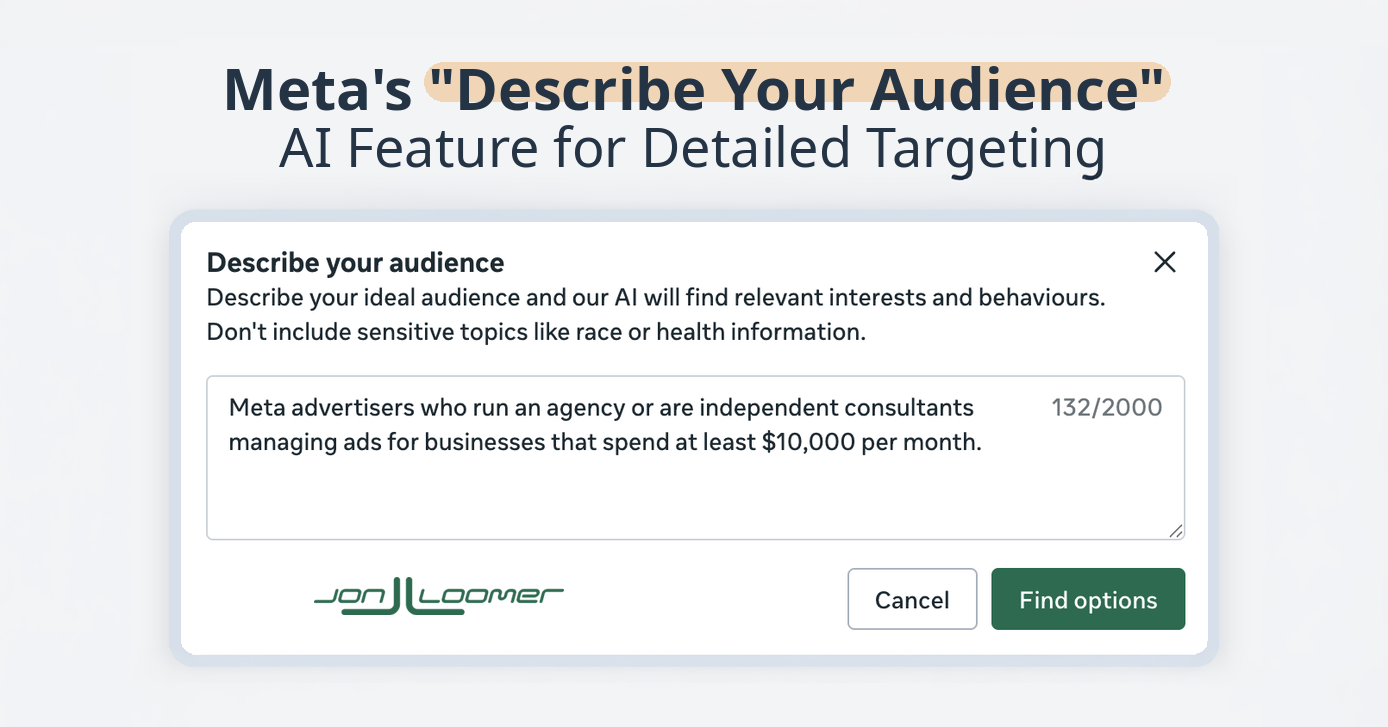
Some Meta advertisers have spotted a new “Describe Your Audience” AI feature for detailed targeting. I finally have it in one ad account, so let’s walk through what it is and isn’t.
It’s not clear if what advertisers are seeing is a test or the early stages of an official rollout. I’m not seeing any updates to Meta’s official documentation related to detailed targeting that would indicate this is a new fixture going forward.
I have some thoughts. The vast majority of reactions I’ve seen exaggerate or misunderstand what this feature actually does. My hope is to clarify things here.
Let’s get to it…
How It Works
If you have this feature, you’ll see “Describe Your Audience” as a new, default tab for detailed targeting.

The other option is to “Use Original Options.” If you don’t have this feature, it will look like this…

With “Describe Your Audience” selected, click “Get Started.” You’ll see a window that looks like this…

The instructions say to “describe your ideal audience and our AI will find relevant interests and behaviors.” Once you enter a prompt in under 2,000 characters that describes your ideal audience, click “Find Options.”
After a few seconds, Meta will generate a list of interests and behaviors that match your prompt.

If you hover over an interest, you’ll see an explanation of why Meta believes it’s relevant to your ideal audience.

You can individually remove interests, remove them all, or revise your prompt and have Meta find more options. Once you’re ready, click “add all” to add the selected interests and behaviors to your audience.
Your detailed targeting will then be updated with those items.

Here’s a quick video that walks through the process…

Is This Anything?
I’ve seen a lot of excitement about this new feature from advertisers, particularly on LinkedIn. To sort out whether this is a big deal, we need to answer a few questions…
1. Does it offer anything new?
Not really.
Yes, it’s a cool way to find interests and behaviors that you would otherwise search out manually. But these aren’t new options. This might surface interests and behaviors you wouldn’t have considered before, but they were always there.
2. Does it add more control?
No.
Within the default audience creation view, all detailed targeting inputs are suggestions.

If you click the option to “further limit the reach of your ads,” detailed targeting remains a suggestion for 11 of the most commonly used performance goals.

The advertiser’s level of control remains the same, which is minimal.
3. Does it make detailed targeting more accurate or effective?
The natural response to technology like this is awe because it automates stuff and makes it easier. But does it make it better?
The quality of the outputs will rely heavily on the quality of your inputs. You are still responsible for writing out a prompt that will generate relevant interests and behaviors.
That doesn’t mean we should automatically accept all of Meta’s recommendations either. This feature still needs to accurately surface the right detailed targeting options, including those you may not have considered, to be useful.
To be truly valuable, it needs to provably impact performance. And that takes us here…
4. Does it even matter?
The main thing to remember here is that this does not substantively change anything about our inputs or control. This feature only surfaces options that were previously available. It’s a novelty.
Whether the inputs are selected manually or found using the “Describe Your Audience” tool, they’re treated the same way. They’re only audience suggestions in most cases. And we have no reliable way to prove whether Meta uses them or whether they make a positive impact on performance.
If you’re using one of the few performance goals that allow advertisers to restrict by detailed targeting, this could become more valuable. That assumes, of course, that the output generated by the AI leads to better results. And we won’t know that without testing.
Verdict: Meh
I hate to say it, but this feature is mostly pointless.
It would have been useful five to 10 years ago when control over detailed targeting was possible and useful. But, of course, such technology to automate this would not have existed then.
If you believe that the detailed targeting suggestions you provide make a significant impact on performance, you probably think this is a big deal. I just don’t think that’s the case. I doubt suggestions can hurt you, but there’s little evidence that they do much of anything.
Meta has even de-emphasized the use of audience suggestions. They’ve removed the button to provide suggestions in the default view. Language indicating audience suggestions are “prioritized” before going broader has seemingly disappeared.
I just don’t understand why time was spent developing this feature. If Meta actually wants advertisers to provide detailed targeting suggestions because those suggestions have proven to improve performance, why are all of the platform’s trends moving in the opposite direction?
Your Turn
Have you experimented with this feature yet? What do you think?
Let me know in the comments below!