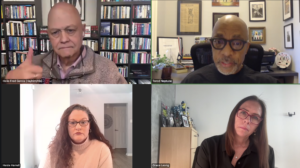
Over the last decade, “Trust in everything that we have as a society, as a nation, has dropped dramatically,” said Grace T. Leong, APR, Fellow PRSA. “Trust has never been lower. But trust is one of the core principles that binds a society together.”
Leong, CEO of the HUNTER communications agency in New York, was one of three panelists for the Jan. 26 installment of PRSA’s Member Mondays livestream discussion focused on trust and transparency, moderated by PRSA’s 2026 Chair Heide Harrell, M.A., APR.
“When trust erodes, we find ourselves in crisis,” Leong said. “We need trust to make progress. When it’s not there, everything stalls.”
Panelist Helio Fred Garcia, president of Logos Consulting Group, has taught public relations ethics at New York University for 38 years. He also teaches science ethics in the graduate school of engineering at Columbia University.
“Trust is the consequence of promises that have been fulfilled,” he said. “These could be explicit promises, or the implicit promises found in a brand identity. But when we’re seen to fulfill a promise, the result is that they trust us. But if we’re seen to break a promise, then trust falls.”
Society also sets expectations for organizations, Garcia said. “And it is when societal expectations are in conflict that we see stakeholder trust begin to plummet. And that’s usually because a leader tries to have it all ways and to not tick off anybody — and in the process manages to tick off everybody.”
Trust arises “when our stated values are the lived experience of those who matter to us,” Garcia said. “If we declare a value, that is a promise that sets an expectation.”
Trust and transparency as business assets
Transparency, Garcia said, “is the attempt not to obscure behavior or communication [and] show that we are worthy of trust, that we live our stated values, that we fulfill our promises, that we meet societal expectations. When we fail to be transparent, alarm bells ought to go off, because that suggests there’s something we don’t want people to know.”
Panelist Torod Neptune has spent most of his career as a chief communications officer for large brands, including Verizon, Lenovo and Medtronic. He is now an assistant professor at the University of North Carolina’s Hussman School of Journalism and Media in Chapel Hill.
“Strong trust is a business asset that is increasingly important in the C-suite and the boardroom,” Neptune said. Low trust, on the other hand, “is a clear business risk.”
Transparency, Neptune said, “is ongoing, every day — a process that has to consistently bring our stakeholders along.”
Leong said she’s still optimistic, despite the precipitous drop in trust over the past 10 years. “As communicators, we have the power to build trust back up,” she said. “We just have to do it better than we’ve done before.”
PR professionals should understand that “transparency and trust are not the domain exclusively of the communications function,” Neptune said. “They are leadership imperatives.”
As Garcia put it, “Communication typically is one of the things that sets expectations, but it’s not necessarily the thing that delivers on expectations. Many failed crisis [responses] result from communicators saying all the right things, but the enterprise not being able to deliver on those things.”
Member Mondays is an initiative designed to foster direct engagement and provide valuable information sharing within the PR community. Member Mondays will be offered on the fourth Monday of each month from 1–1:45 p.m. ET. All programs are free for PRSA members. Sign up for future sessions here.
Art credit: sulit.photos