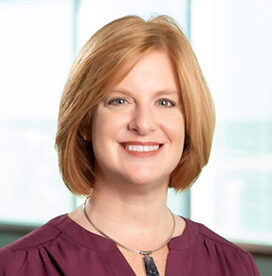
From crisis response to health policy messaging, Rebecca Fuller Beeler of the American Academy of Family Physicians shares how curiosity and pattern-spotting help communicators turn chaos into clarity.
Rebecca Fuller Beeler, vice president of integrated marketing communications at the American Academy of Family Physicians, has built a career on connecting dots others might miss. From tracking the pressures facing family physicians to aligning messages across patients, media and partners, Beeler is known for spotting patterns quickly and mobilizing the right voices when it matters most. With experience spanning crisis communication, higher education and health care leadership, she now leads the team responsible for the AAFP’s member, media and public communications.
You’re known as a “dot connecter.” When did you first realize that was your superpower?
I think I first realized dot connecting was something not everyone did when I was teaching at a university. My brain has always bounced between things and mapped connections, but I noticed that finding ways to help my students intentionally seek connections and see the bigger picture was an important skill they would need to be successful in PR. Then, as I moved into an administrative role at the university, I kept seeing opportunities for collaboration, efficiencies and synergy, and I had precious few colleagues who could look beyond their own discipline or their own focus area. That’s when I understood that dot connecting wasn’t just something that came easier to me—it was a unique strength I brought to my work.
What does connecting the dots look like on a typical day at AAFP?
I start the day reading a lot of news from mainstream to political to healthcare, so I know what the environment looks like before the workday takes off. That helps ground me in what might come up during the day. Then, once I’m at the office, my day is filled with developing messaging, working on large-scale immunization initiatives, working with our executive team, shaping our editorial calendar, developing our mainstage strategy for key events, collaborating with external partners on key initiatives, leading one of the pillars of our strategic plan and working with members of my team to help them connect with colleagues or other business units to help make connections in their work. Sometimes it means seeing something after it’s published and reverse engineering the connections.
I often say we should never be the toughest part of any family physician’s day. Finding our resources, understanding how topics are connected, digesting a new development in the environment, accessing a tool to help with patient conversations — we should make all of that as easy as possible for our members. Connecting dots all day helps us do that.
How has your experience in crisis and risk communication shaped your leadership style?
I was part of the local response for Sept. 11, 2001, and part of the national response for Hurricane Katrina. Those early experiences shaped how I respond to whatever the organization I was working for at the time was facing, but over the last 25 years, those cumulative experiences have shaped my leadership style in general.
The first way it’s shaped my leadership style is in the people I choose for key roles. I’ve developed a reliable meter for selecting and coaching high-performing employees. I’ve also become more committed to identifying the key high-pressure positions and making sure I have the right people in them. If I don’t, I work to coach them or move them into a position that’s a better fit. It took me too many years to become bold and unapologetic about building strong teams.
The second way my experience in crisis and risk communication has shaped my leadership style is probably more valuable to my team because so many of them aren’t involved in crisis/risk communication: it’s how I view the work we do. We do important work, but we aren’t (and won’t be) perfect — and that’s okay. We hold ourselves and each other accountable for performance, but I’ve also learned a lot about asking questions, seeking trusted counsel and giving grace. Mistakes and even failure aren’t the end of the world. We fix what we can, learn from it and move on.
What’s the biggest challenge in communicating for physicians right now?
The complexity of today’s environment creates our biggest challenge: striking a balance between communicating for the routine needs of physicians and communicating for the constant churn happening in the environment.
Family physicians are the heart of our health care system. They treat patients of every age in almost every county in the U.S. We represent 130,000 family physicians, residents and medical students — and they are each different. There are so many clinical, practice and advocacy needs.
The second part of the complexity is the external environment. Health care is governed by federal agencies and Congress, state agencies and legislatures, and local regulations. Physicians are navigating varying requirements by insurance companies, rapidly changing technology and emerging science. Patients are coming into their doctors’ offices with access to more information than ever before, including information that is untrue or misleading.
There is, quite literally, something new every day to respond to, and yet, the basics of family medicine — helping patients live lives that are as healthy as possible — remains stable.
Responding to the environment and ensuring family physicians still have what they need for their daily work is a tough balance to find.
How do you translate complex health policy issues into messages that resonate with patients and the public?
How would I explain this to my sister? A friend? A neighbor? That’s the test for me. It also helps that none of our writers are healthcare professionals. They are patients themselves who are trying to understand these issues. We also have policy experts who help us translate information into terms our communication team understands so we can, in turn, translate it for the final audience.
In the end, a complex health policy issue requires the same thing any other message requires. You have to know your audience, understand the language that resonates with that audience and choose the right channel. We are fortunate to have colleagues in other medical societies who can share the burden of message testing on common issues (e.g., immunizations) and share lessons learned from their efforts. Our messaging is iterative, and I’m committed to learning something from every new issue and new batch of messaging.
What’s one leadership habit that’s made you more effective over time?
Consistent curiosity. I’m an expert eavesdropper, question asker and situation observer. I read, listen to podcasts and watch random shows on TV. At work, this habit helps me understand situations and people better, which then helps me navigate relationships and projects more effectively. As a natural introvert, seeing how people interact and asking questions before weighing in helps me understand the dynamics in a room. As a leader, watching, listening and asking questions helps me understand how team members are responding to workload, team dynamics and my behavior. Out in the wild, I often hear a turn of phrase or overhear a conversation about someone else’s work situation that gives me a nugget I can file away for my own use.
What book, song or TV show has contributed to the way you think about communications?
It’s old now, but it has new relevance: “The West Wing.” It shaped how I thought about my future career when it was on the first time. Today, I often think of C.J.’s missteps and triumphs, the honest debates about tough issues, the times the team had to do the politically smart thing instead of the thing their hearts wanted to do. So many lessons, and so many times rewatching an episode is just good for my soul.
Isis Simpson-Mersha is a conference producer/ reporter for Ragan. Follow her on LinkedIn.
The post Making complexity feel simple: Using curiosity and pattern-spotting appeared first on PR Daily.