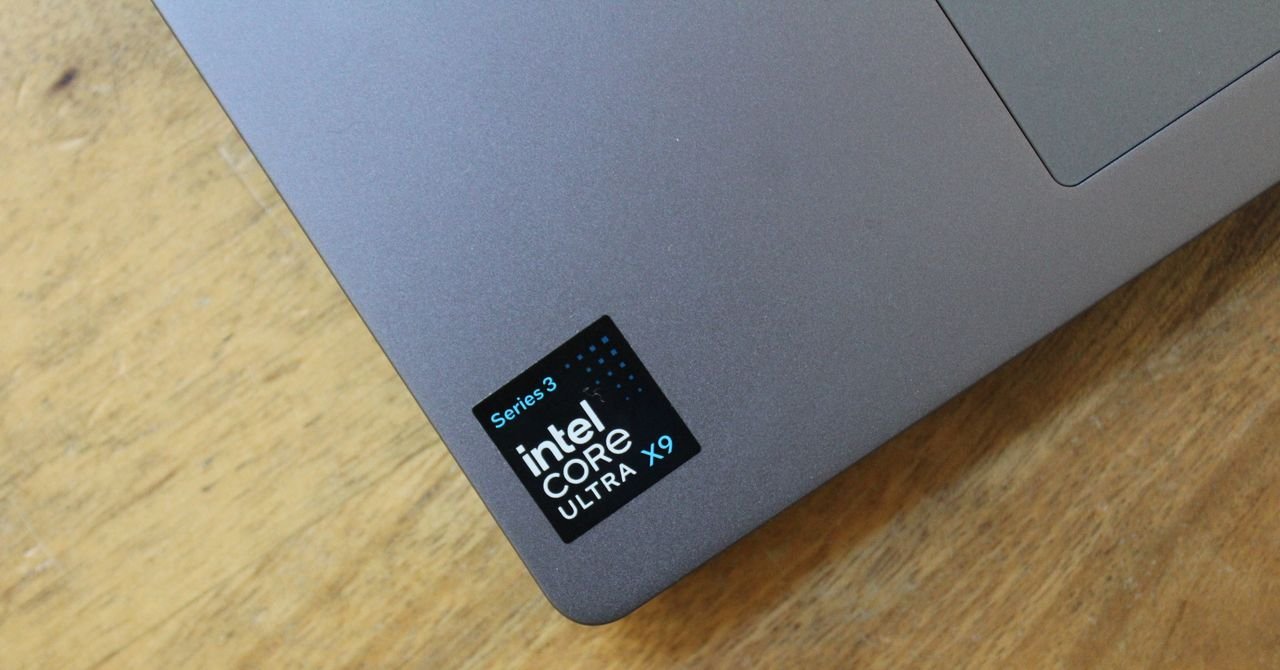
Note: This story has been updated with additional testing on the Intel Core Ultra X7 358H in the MSI Prestige 14 Flip.
This isn’t just another Intel chip launch. Far from it. For years, most updates to Intel’s laptop chips have been nothing more than modest performance increases over the previous year. That’s not the case with the long-awaited arrival of Panther Lake.
It’s a chip design announced almost five years ago as part of the company’s ambitious rescue plan to get back on track. Intel’s CEO at the time (and mastermind of the grand plan), Pat Gelsinger, called the technology the “cornerstone of the company’s turnaround strategy.” Now, I have laptops in front of me with these Panther Lake chips inside, officially known as Intel Core Ultra Series 3. Having tested it myself, I’m left extremely impressed. I’m not sure if the Series 3 will redeem Intel’s recent foibles, but these chips certainly feel like a big win for a company that really needs one.
Intel Takes On the M5
To succeed with the Core Ultra Series 3, Intel at least needed to fulfill the promises it made when the chips were announced last year. Namely, battery life and efficiency equivalent to its predecessor (Lunar Lake) with improved performance. That alone has been a major hurdle for the kind of x86 processors Intel has always made. The company has also boldly claimed that its higher-powered silicon for gaming laptops will do the opposite: maintain the performance of last year’s chips with added efficiency for better battery life. That is, yet again, another tall order.
I tested the Core Ultra X9 388H new Intel Core Ultra Series 3 line of chips, both on the higher end of the spectrum: the Intel Core Ultra X7 358H in the MSI Prestige 14 Flip and the Core Ultra X9 388H in a 16-inch Lenovo IdeaPad reference unit. These are both 16-core CPUs, broken down into four performance cores, eight efficiency cores, and four low-power efficiency cores.
Interestingly, this is actually two fewer performance cores than the Core Ultra 9 285H, though it gets confusing as to which chip from the Intel Core Ultra Series 2 this chip is the successor to. The 2025 MSI Prestige 14 Flip, for example, used the Core Ultra 7 258V Lunar Lake rather than an H-series Arrow Lake chip. In other words, there’s no exact one-to-one here in terms of comparing price and performance. Here’s a sampling of the scores it posted in my testing.
The Core Ultra 7 258V listed above was tested in the Dell 14 Plus, a laptop of similar size to the MSI Prestige 14 Flip. As you can see, there’s a significant 52 percent increase in multi-core CPU performance, as well as a 54 percent GPU upgrade, as tested in 3DMark Steel Nomad Light. Notably, that also surpasses the current-generation M4 MacBook Air.
Intel still can’t compete on single-core performance against Apple, and that’s where the improvement is the most modest. It’s also not as fast as the M4 Pro or M4 Max, which still have the edge in every category, though the difference in multi-core performance between the X9 and the M4 Pro is only 14 percent. Apple’s M5 Pro and M5 Max are just around the corner, too. I’d also love to test the Core Ultra X7358H against upcoming processors in next-gen laptops like the Snapdragon X2 Elite Enhanced, but I don’t have them on hand yet for comparisons.
The graphics really stand out, though, especially when you get to the X9 chip. For once, the inclusion of the “X” branding in the name actually feels worthwhile. Both the X7 and X9 chips use a B390 GPU, representing the top of the line in Intel’s architecture (outside of discrete desktop graphics cards). You get 12 Xe cores in the X7 and X9 configurations, the only difference between the two being clock speed. Intel claimed that Panther Lake graphics were 77 percent faster than in the previous-gen Lunar Lake laptops, and while I didn’t quite see that much of a jump, it’s hard to get a direct apples-to-apples comparison with laptops.






![What are the latest Hootsuite product features? [Dec 2025]](https://mgrowtech.com/wp-content/uploads/2026/01/What-are-the-latest-Hootsuite-product-features-Dec-2025-75x75.png)