Let’s get one thing out of the way.
Most AI content on the internet is bad. Like, painfully bad.
It’s stiff. It rambles. It sounds like it was written by someone who’s trying very hard to sound smart while saying absolutely nothing.
And yet… I still use AI to write content. All the time.
Not because it magically makes content good, but because when you use it right as an AI writing tool, it can make you faster, sharper, and more consistent without killing your voice.
This isn’t a “let AI write everything for you” article. It’s more like a walkthrough of how I personally use AI as a writing assistant that helps, but doesn’t hijack the wheel.

Link building cheat sheet
Gain access to the 3-step strategy we use to earn over 86 high-quality backlinks each month.
Can AI Content Even Be Good?
Yes. And more importantly, it can perform.
There’s this idea floating around that Google somehow “hates” AI content and will punish you for using it. But that’s not really backed up by data.
Ahrefs actually looked into this and found no correlation between whether content was AI-generated and how well it ranks. In other words, content didn’t rank worse just because AI was involved. Some AI-assisted pages did great. Some didn’t. Same as human-written content.
That tells us something important.
AI isn’t the problem. Bad content is.
If AI helps you create something genuinely useful, clear, and aligned with search intent, it can absolutely perform in search. If it spits out fluffy, generic nonsense, it won’t. But that’s true no matter who or what writes it.
The real question isn’t “Is this AI content?”
It’s “Is this actually good?”
Start with Keyword Research
Keyword research is a given, so I won’t rehash the basics.
Where AI comes in for me is right at the start of that process. Not to replace Ahrefs or any other tool, but to speed up ideation.
I’ll use ChatGPT to expand a core topic into long-tail keywords, variations, and question-based searches. It’s especially good at coming up with very specific queries people type when they’re trying to figure something out, not just broad head terms.
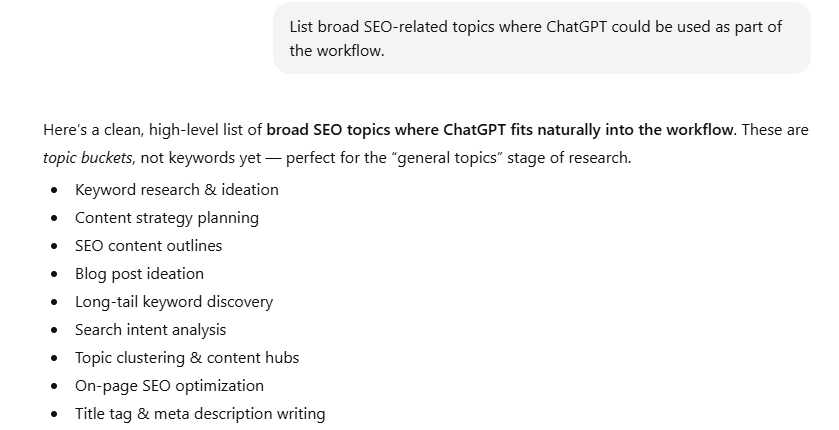
None of that gets used blindly. Everything still goes through Ahrefs for volume, difficulty, and prioritization. If you’re using the Ahrefs integration, that handoff is even smoother, but the principle doesn’t change.
Write Your Own Outline, then Let AI Expand it
This is where AI content usually goes wrong.
If you ask AI to write an article from scratch, you’ll get something technically fine and completely forgettable. The structure will be safe. The points will be obvious. And it won’t reflect how you actually think about the topic.
So I always write the outline myself writing process.
Not a polished one. Just the main points in the order I’d explain them to someone. What matters is that the logic and emphasis are mine, not the AI model’s.
Once that’s done, I let AI expand individual sections. At that point, it’s filling in ideas I already decided were worth covering, instead of inventing its own framing.
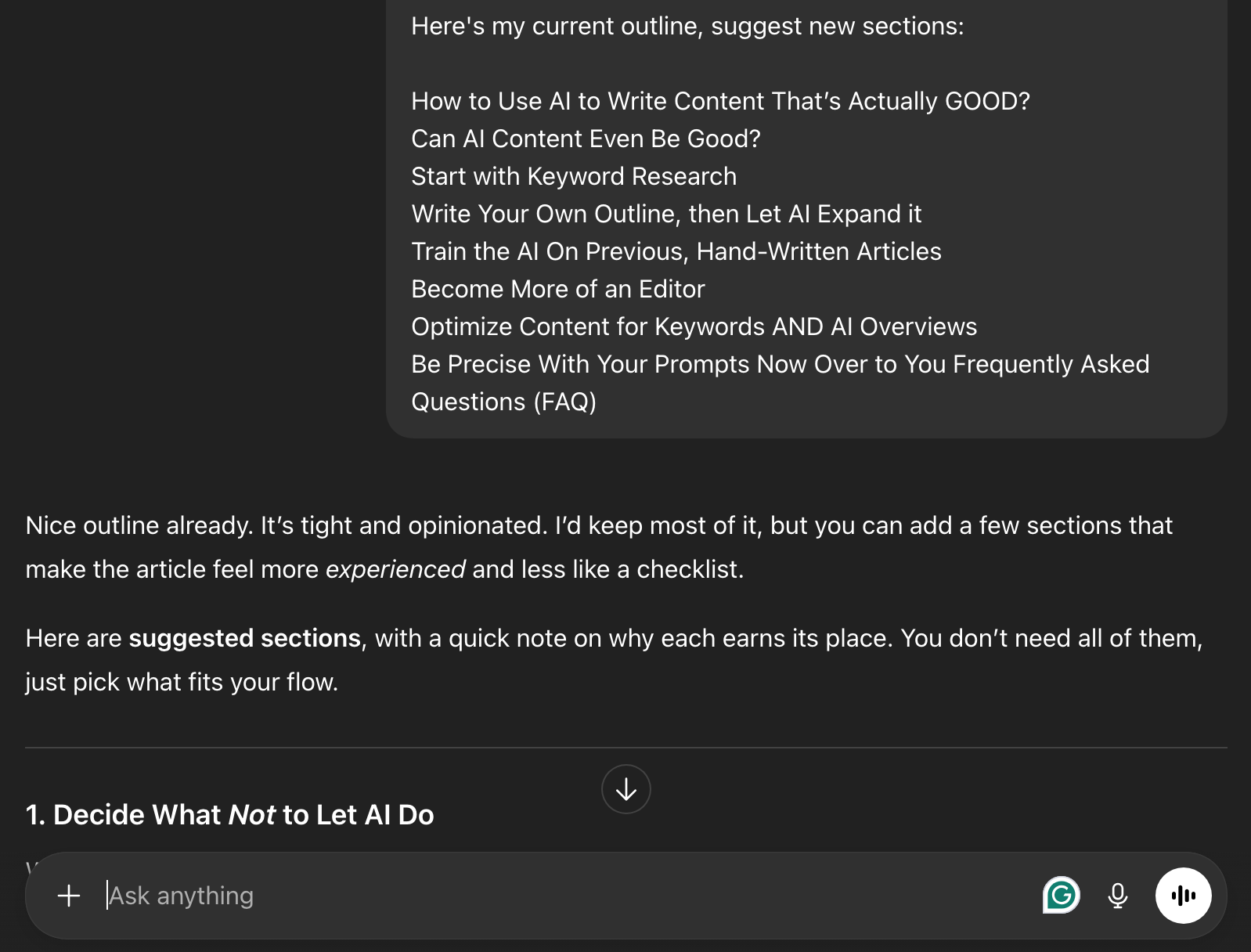
AI is good at execution. Direction still has to come from you.
Train the AI On Previous, Hand-Written Articles
If you want AI to sound anything like you, you have to give it examples.
Before I let it help with real content, I feed it a few articles I actually wrote by hand. Stuff that reflects my tone, pacing, and how I explain things when I’m not trying to impress anyone.
I’m not asking it to copy sentences. I’m giving it context. This is what “normal” sounds like for me.
Once it has that, the output changes fast. Less generic phrasing. Fewer buzzwords. More sentences I’d actually keep.
Without this step, AI defaults to a voice that doesn’t belong to anyone, whether you’re working on academic writing, essay writing, email content, or even a cover letter.
Become More of an Editor
Using AI changed how I think about writing.
I’m not trying to get a perfect draft out of it. I’m trying to get something workable. My role is to shape it.
That usually means cutting more than I add. Removing filler. Rewriting sentences that feel slightly off. Adding opinions or specifics AI would never risk including on its own.
This is also where the content stops sounding like it was generated. Editing is where your judgment shows up.
If you skip this step, it doesn’t matter how good the prompt was.
What separates human writers from AI-generated text is this editing layer is the ability to refine tone, inject personality, and ensure grammar and writing style match your audience.
Optimize Content for Keywords AND AI Overviews
Once the draft is there, this is where AI becomes purely mechanical in a good way.
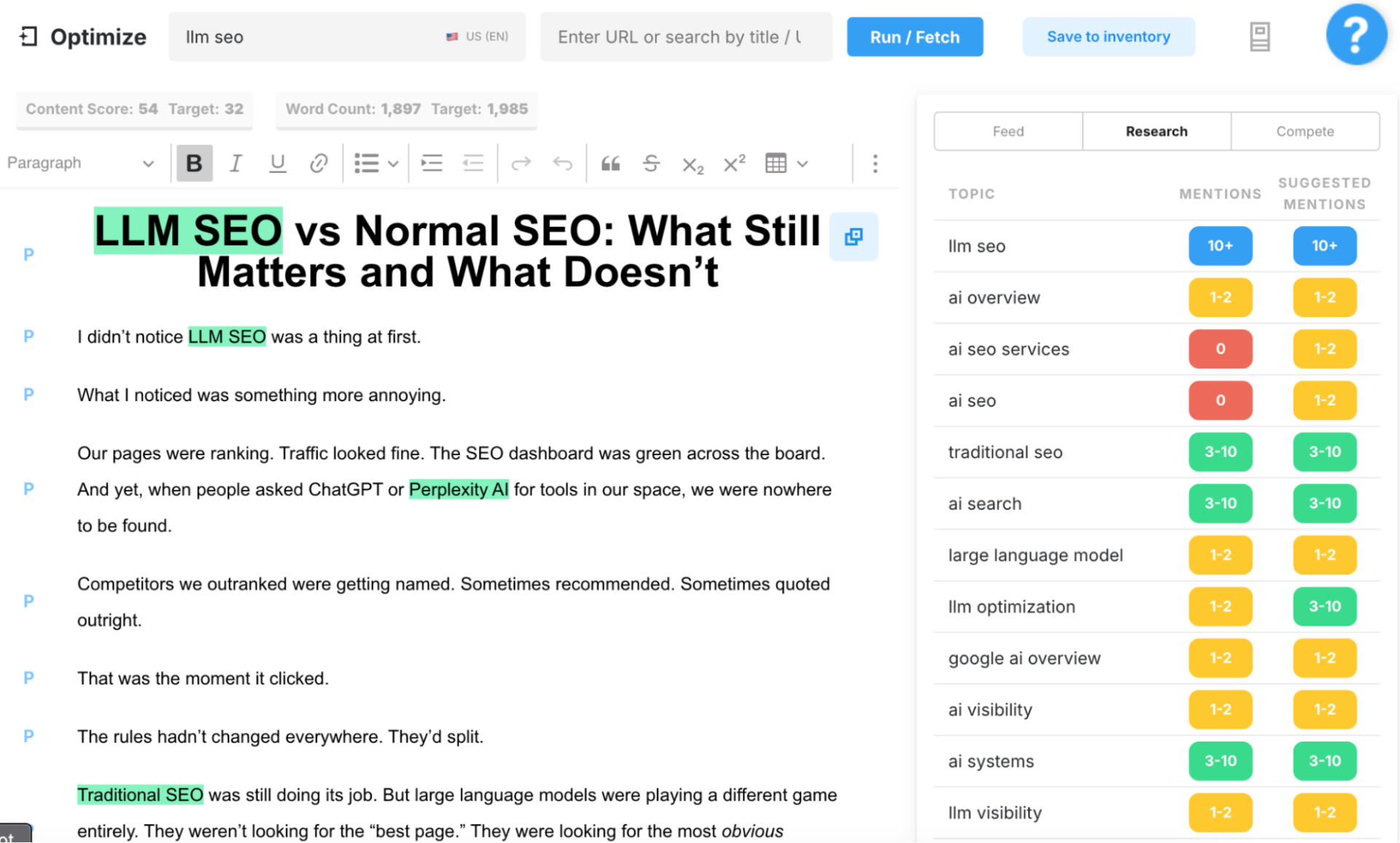
For keyword optimization, AI works really well alongside tools like MarketMuse or SurferSEO.
I’ll feed it the article plus the keyword report, and within seconds I have a version that hits all the important terms and gaps. It’s fast and it saves a lot of manual tweaking.
That said, it’s not fire-and-forget.
AI has a bad habit of pushing keywords too hard if you let it, so I always edit the result. I’ll cut repetitions, smooth out phrasing, and make sure nothing sounds forced. Optimization should be invisible, not obvious.
For AI overviews, the goal shifts slightly. Google’s overviews are built from the top-ranking pages and pull clear, well-structured answers from them.
So I pay extra attention to how information is presented. Direct answers right after headers. Clean lists. Simple definitions. No clever wording where clarity matters.
Featured snippets still matter here because they’ve basically become the raw material for AI overviews.
If your content is easy to extract and easy to understand, you’re giving Google’s AI exactly what it’s looking for.
Be Precise With Your Prompts
AI output is only as good as the instructions you give it.
If your prompt is vague, the writing will be vague. You’ll get safe phrasing, generic structure, and a lot of sentences that technically say something without really meaning anything.
I treat prompts like a brief, not a suggestion.
I’ll be explicit about tone, audience, and what to avoid. Especially what to avoid. That alone cuts out a lot of the fluff AI defaults to.
An effective prompt is specific, constrained, and clear about what you actually want the AI system to produce.
A few prompts I use a lot:
“Expand this section using my outline. Keep it practical, slightly opinionated, and avoid buzzwords.”
“Rewrite this paragraph to sound more conversational, like I’m explaining it to a peer.”
“Tighten this section. Remove filler and repetition without adding new ideas.”
“Explain this concept clearly in under 120 words. No metaphors, no marketing language.”
The more constraints you add, the more usable the output becomes.
Link building cheat sheet
Gain access to the 3-step strategy we use to earn over 86 high-quality backlinks each month.
Now Over to You
AI can help you write faster and structure content better. It can help you cover the right topics and clean up drafts.
But content doesn’t rank or get picked up on its own.
What actually moves the needle is links and placements. Being referenced on other sites. Getting included in listicles. Showing up on pages Google and AI systems already trust and reuse.
That’s exactly what our done-for-you link building service focuses on.
We secure contextual links and listicle placements on real, relevant sites. No templates. No spam. Just placements that help your content get noticed in Google and picked up by AI platforms.
Frequently Asked Questions (FAQ)
Can AI write content that ranks in Google?
Yes. Google doesn’t care whether content was written by a human or assisted by AI. What matters is relevance, structure, and whether the page gets discovered and referenced.
Should I disclose that I use AI to write content?
No disclosure is required. Search engines evaluate the output, not the process. Focus on clarity, usefulness, and accuracy.
What’s the biggest mistake people make with AI-written content?
Publishing it without editing. Raw AI text tends to be verbose, repetitive, and vague, which makes it less likely to rank or get reused by AI overviews.
Does AI-written content need backlinks?
Yes. Just like any other content, it needs links and placements to get visibility. Without them, even well-written pages can sit unnoticed.
Why do listicle placements matter for AI visibility?
Listicles are heavily crawled and reused by search engines and AI platforms. Getting included in them increases the chances of your brand and content being surfaced in both traditional search results and AI-generated answers.