Dealmaking has always been an information war. What’s changed is the balance of power.
For years, AI in mergers and acquisitions sat on the sidelines. Models were brittle. The data was fragmented. Most tools promised automation but delivered little beyond faster spreadsheets. That gap between promise and performance kept AI firmly in the interesting, but risky category for deal teams.
That gap has now closed.
Advances in large language models, cloud-scale data processing, and proprietary deal datasets have made AI operationally useful rather than experimental. Modern systems ingest millions of documents, normalize messy financials, flag hidden risks, and surface valuation insights in hours, not weeks. As a result, dealmaking has become asymmetric.
The firms winning competitive processes are training algorithms to think like their best ones. AI now surfaces insights before human teams even begin diligence, changing the underwriting speed and conviction.
There are risks, and this article does not ignore them. But the bigger risk is hesitation. In a market where targets are modeled, priced, and predicted by machines, slow decision-making is a disadvantage. This is why mergers and acquisitions (M&A) software has become foundational.
Here are some facts about AI in mergers and acquisitions to plan your growth two to three years down the line:
What is the state of AI in mergers and acquisitions?
Here’s an overview of the current state of AI in mergers and acquisitions:
- People have positive expectations: 64% of executives expect generative AI to transform M&A more than any other tech innovation.
- Mass adoption coming: Use of generative AI in M&A is projected to jump from 16% in 2024 to 80% within three years.
- Current usage high: 74.2% of M&A practitioners are already using AI in deal sourcing or marketing.
- Productivity gains: 78% report reduced manual effort, 54% faster timelines, and 42% cost savings.
- Competitive edge: 60% believe AI offers a moderate or significant advantage in dealmaking.
- Top risks: 59% cite data inaccuracy, 38% data privacy, and 36% cybersecurity as leading risks.
- Judgment concerns: 37.9% worry about overreliance or loss of human judgment in deal work.
What are the adoption trends of AI in mergers and acquisitions?
According to 64% of executives, generative AI is anticipated to transform M&A deal processes more significantly than any other recent technological innovations. This might suggest that dealmakers see AI not as an add-on but as the next competitive moat.
Let’s take a look at how these sentiments are driving adoption.
Use of generative AI in M&As is expected to reach 80% in the course of three years
In 2024 research, Bain found that the use of generative AI was at 16%, but expected to rise to 80% within the next three years. Their study included 300 M&A practitioners.
The study highlighted that early adopters are primarily found in the technology, healthcare, and finance sectors. They tend to be larger companies with a moderate M&A activity, involving three to five deals per year.
Source: Bain
In 2025, around 2/3rd of M&A practitioners were using AI in their processes
Based on a recent axial member survey, 74.2% of respondents were using AI tools in their deal sourcing or marketing efforts. 9.7% of respondents planned to adopt AI later in 2025.
The growing adoption is reshaping the M&A workflow itself.
Source: Axial
What are the use cases of generative AI in mergers and acquisitions?
AI is transforming the way deals are done. It doesn’t just support due diligence; it leads it. It helps teams find and screen the right targets faster than ever. Here’s an overview of how practitioners are using AI in their day-to-day.
How is AI streamlining M&A due diligence in 2026?
The due diligence step in M&As has the highest usage (58%) of generative AI. Here’s an overview of all M&A processes where practitioners use generative AI:
| Processes in M&A | Percentage of M&A practitioners using generative AI at each step |
| Developing M&A strategy | 38% |
| Sourcing targets | 50% |
| Screening targets | 50% |
| Conducting due diligence | 58% |
| Integration planning | 22% |
| Integration execution | 10% |
| Conducting postmortem | 10% |
Overall, 85% of early users reported that the generative AI met or exceeded their expectations in M&A processes.
Interestingly, 66% of people expect a high or very high value from generative AI in the due diligence process of mergers and acquisitions.
What is an example of using generative AI in M&A?
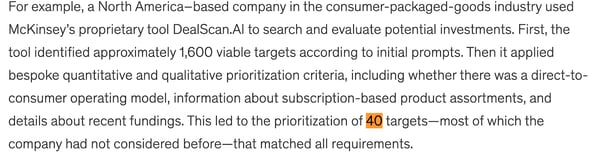
A North American consumer-packaged goods company uses McKinsey’s proprietary tool, DealScan.ai, to identify and evaluate potential investments. According to initial prompts, they identified 1600 viable targets.
The software applied a prioritization mechanism based on operating model, products, and information on recent funding rounds. The list was narrowed to 40 targets that met all requirements.
 Source: McKinsey
What are the different parts of M&A workflows that are currently using AI?
Around 80.6% of respondents use AI for market research, making it the most common use case. More than half also use it for email drafting, buyer targeting, and writing CIMs or teasers. These tasks are strategic and communication-heavy, showing how deeply AI supports day-to-day dealmaking.
Adoption rates are lower in areas such as financial modeling (25.8%) and deal workflow automation (12.9%). Still, these numbers signal steady progress. Only 6.5% of respondents said they don’t use AI at all. That means most firms are already testing and integrating AI across different stages of the M&A process.
Source: Axial
What are the benefits and risks of using generative AI in mergers and acquisitions processes?
Most practitioners report faster timelines, lower costs, and significant productivity gains. However, the enthusiasm is tempered by caution. Here’s why:
What are the benefits of using generative AI in M&A processes?
Among 300 M&A practitioners surveyed,78% achieved productivity gains from reduced manual effort. 54% of M&A practitioners observed accelerated timelines, and 42% saw reduced cost and improved focus.
This gives potential proof that AI’s real value isn’t just speed; it’s freeing teams to focus on strategic judgment instead of data wrangling.
Around 23.3% of M&A practitioners believe that AI offers a significant competitive edge. At the same time, 36.7% of M&A practitioners are rooting for the fact that AI gives them a moderate edge in M&A processes.
33.3% feel it just offers a minimal edge, while 6.7% of M&A professionals believe that AI offers no edge.
Overall, 60% of respondents believe AI offers a moderate or significant edge in M&A today.
Every leap forward brings new risks that teams must manage.
What are the most frequently identified risks of using AI in mergers and acquisitions?
Around 59% of M&A practitioners felt data inaccuracy was the most concerning risk of using generative AI in M&A. 38% and 36% of practitioners had concerns with data privacy and cybersecurity risks. It’s a reminder that AI may accelerate deals, but it can also amplify bad data if controls aren’t in place.
Another 16% of M&A practitioners found copyright infringement concerning. At the same time, 14% of people had concerns with reputational risk and risks associated with reduced organizational focus. 9% were worried about reduced regulatory compliance.
Source: Bain
What are the concerns of using generative AI in deal work?
When the Axial study asked about the most significant concern with using AI in deal work, 37.93% of respondents felt its overreliance or loss of judgment. 34.48% of respondents were concerned with accuracy, and nearly 20.69% were worried about confidentiality or data privacy.
Only 6.9% of respondents expressed no significant concerns.
Source: Axial
How do expectations and investments compare in utilizing AI in different parts of M&A processes?
Just one third of executives say they are investing heavily in generative AI specific to M&A activities, with 57% saying they are investing in pockets. Here’s an overview of how people’s expectations and investments compare:
| Specific M&A processes | Percentage of executives expecting high or very high value from genAI | The percentage of executives investing in specific M&A processes to leverage genAI |
| Industry and company research | 73% | 23% |
| Deal sourcing and screening | 34% | 24% |
| Due diligence | 66% | 43% |
| Valuation and deal structure | 69% | 28% |
| Synergy identification | 64% | 38% |
| Risk assessment and mitigation | 37% | 27% |
| Integration/separation planning | 30% | 24% |
| TSA design | 43% | 12% |
| Communications and change management | 39% | 21% |
| Operating model and organization design | 32% | 18% |
| Systems, security, and infrastructure integration, data migration, and testing | 29% | 11% |
| Post-deal performance assessment | 65% | 22% |
Source: Accenture
AI isn’t a future play, but a present performance lever
The gap between adopters and power users of AI in mergers and acquisitions is widening. It’s the gap between winning and watching. Generative AI won’t replace your investment committee. But it will expose every inefficiency, bias, and blind spot in your process.
The firms that build AI into their core deal engine, not as a tool, but as muscle, will own the next cycle. The question isn’t whether AI works. It’s how long you can afford to compete against those already using it.
If you’re new, here’s a primer on mergers and acquisitions to help you steer clear of the fundamentals.