
Two years ago, I was publishing one blog post a week and feeling pretty good about it.
Now I publish one a day. Sometimes more.
And no, I didn’t suddenly become a full-time content creator with unlimited free time. I just got way better at using AI the right way.
Because here’s the truth: AI blogging isn’t some magic shortcut where you press a button and get a perfect article. Most AI content is still sloppy, repetitive, and painfully obvious.
But when you use AI as an assistant instead of a replacement, it becomes one of the most powerful tools for blog writing and content creation I’ve ever used.
And it’s not just theory.
Ahrefs published a study showing no correlation between AI-generated content and rankings, meaning AI content can rank just fine if it’s actually good.
Google has also been clear about this in their guidelines: they don’t care how content is created. They care whether it’s helpful, accurate, and written with real experience.
So yes, AI blog writers can absolutely work. You just need a system.
In this article, I’ll walk you through the exact workflow I use to go from one blog post a week to one per day, without turning my blog into an AI-generated mess that nobody wants to read.
Key takeaways:
- AI blogging works best when you use AI to speed up writing, outlining, and keyword research, not to replace your brain.
- The biggest shift is becoming an editor, not a writer. You’ll spend more time cutting fluff than creating content.
- Publishing more content is great, but promotion matters more. In 2026, link building is what actually gets your blog post to rank.

Link building cheat sheet
Gain access to the 3-step strategy we use to earn over 86 high-quality backlinks each month.
Step 1: Keyword Research
If you want to scale AI blogging, keyword research is the part you can’t skip.
Not because it’s some sacred SEO ritual, but because writing a blog post without a real keyword is basically guessing. You might write something great, but if nobody is searching for it, it’ll just sit there collecting dust.
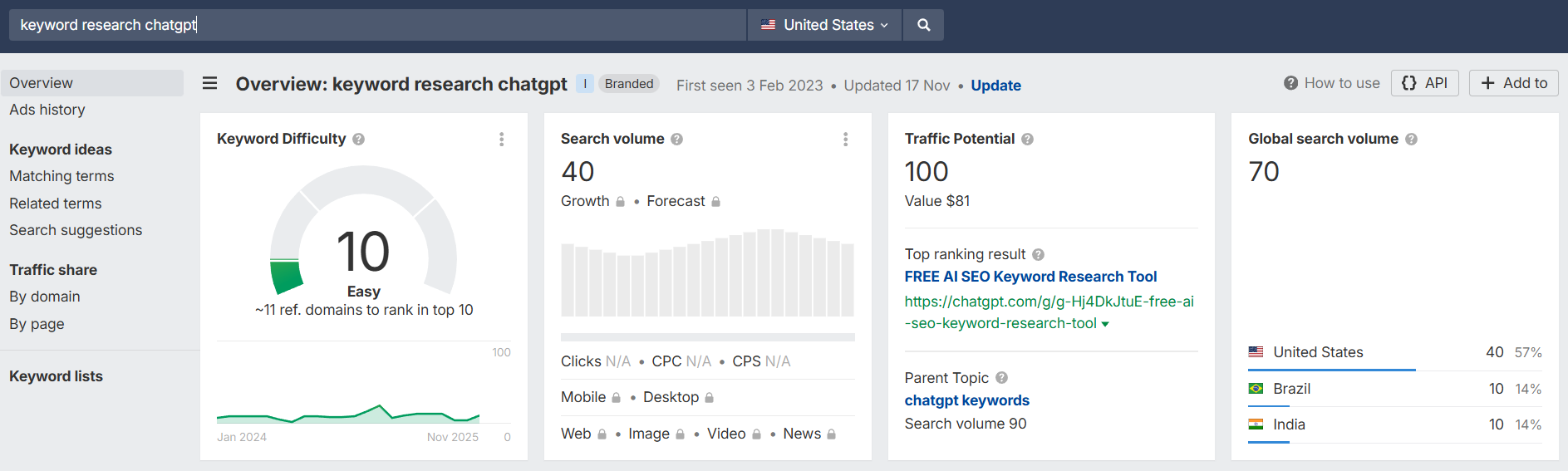
So I start in Ahrefs.
I use it to pull broad topics I already want to write about, then drill down into keywords that are actually realistic to rank for. Stuff that isn’t a KD 80 nightmare.
Then I bring in AI.
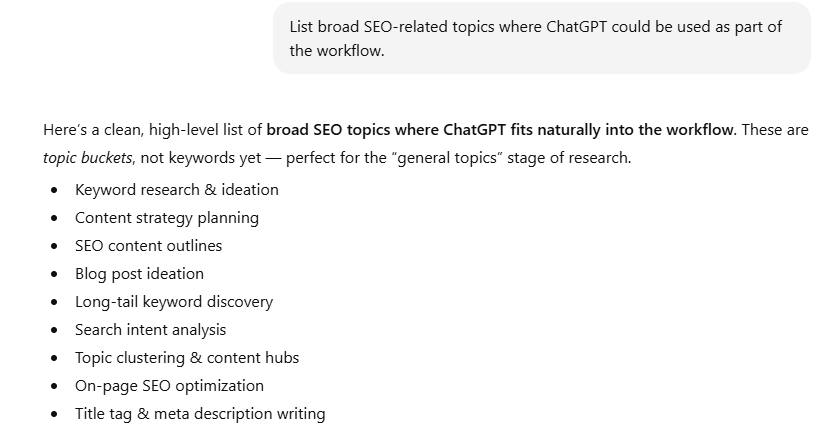
This is where ChatGPT is surprisingly useful, not as a keyword research tool, but as a fast brainstorming tool for long-tail keywords.
I’ll take a seed keyword and ask something like:
- “Give me 30 long-tail keyword variations for .”
- “List common questions people search related to [topic].”
- “Give me blog post ideas targeting low-competition searches around .”
This part is where AI saves me a ton of time. It comes up with angles and keyword variations I would not think of manually.
But then I always go back to Ahrefs and verify everything.
Because ChatGPT loves making up keywords that sound real, but aren’t.
So the workflow is basically:
Ahrefs → AI → Ahrefs again.
Once I find a keyword that has low difficulty, decent search volume, and clear intent, that becomes the blog post. That’s how I can publish daily without wasting time writing content that never had a chance to rank in the first place.
Step 2: Outlining
This is the part that sped everything up the most.
Because once you stop “writing articles” and start “filling in a structure,” blogging becomes way less intimidating.
Here’s what I do:
I write my own outline first. Always.
Not because I don’t trust AI (I don’t), but because if you let an AI blog writer create the outline from scratch, you usually get the same generic sections everyone else has. It’ll sound polished, but it’ll also feel empty.
So I start with a rough outline in a Google Doc, and I add quick notes under each heading like:
- what point I’m trying to make
- what example I want to include
- what I want the reader to do next
Nothing fancy. Just enough direction so the content doesn’t drift.
Then I paste that outline into ChatGPT or Claude and ask it to improve it.
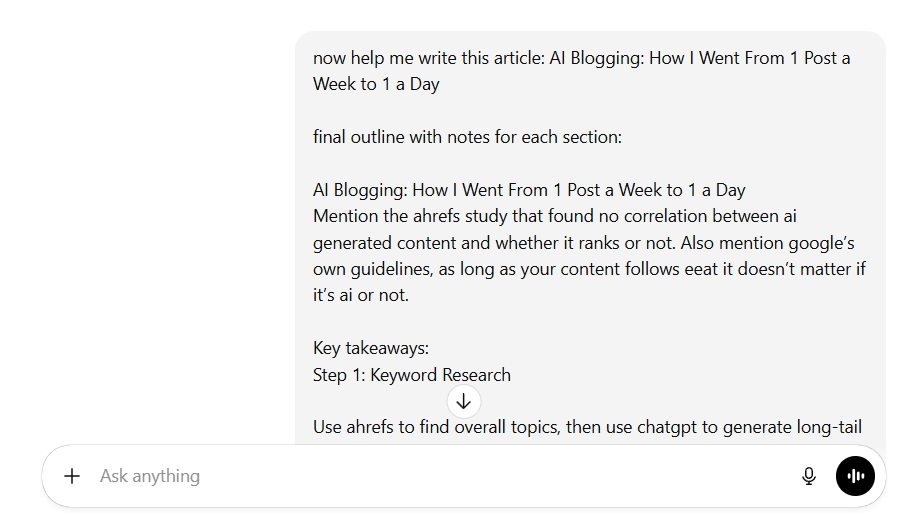
Not rewrite it. Improve it.
Usually I’ll prompt something like:
“Here’s my outline. Suggest missing sections, add better subheadings, and point out where the flow feels weak. Don’t write the article yet.”
That’s it.
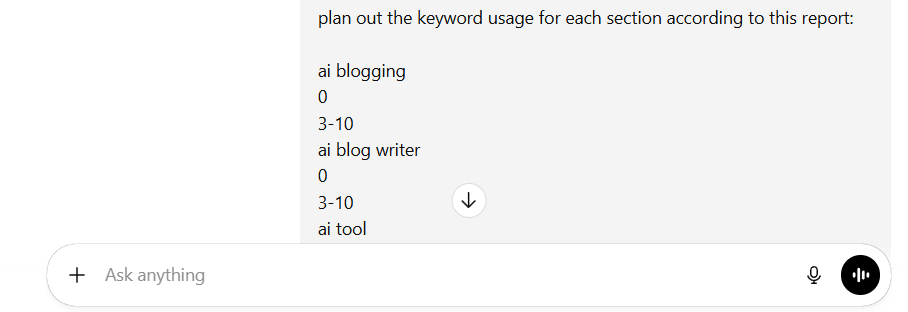
Then I pull up MarketMuse.
This is where content optimization becomes part of the outlining process, not something I do at the end.
MarketMuse gives me keyword suggestions and related terms that should naturally show up in the article. So instead of keyword stuffing later, I just bake them into the outline from the start.
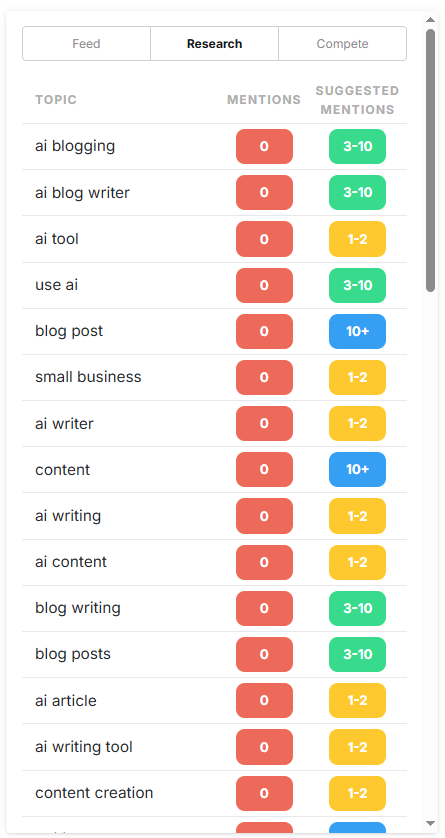
Sometimes I’ll even paste the MarketMuse report into ChatGPT and say:
“Here’s my outline and here are the keyword recommendations. Suggest where each keyword fits naturally without forcing it.”
At that point, I’m not guessing anymore.
I have the structure, the keyword plan, and the direction. The actual writing part becomes the easiest step.
Step 3: More Editing than Writing
This is where most people get AI blogging wrong.
They treat AI like an AI writer that’s supposed to produce a finished blog post. Then they copy-paste it, hit publish, and wonder why it reads like a college essay written by a robot.
The real trick is flipping your mindset.
I don’t use AI to write for me. I use it to write near me.
What I mean is: I feed it examples of my older, hand-written content, and I basically train it on how I naturally write. My tone, my sentence length, how I explain things, what I over-explain, what I skip.
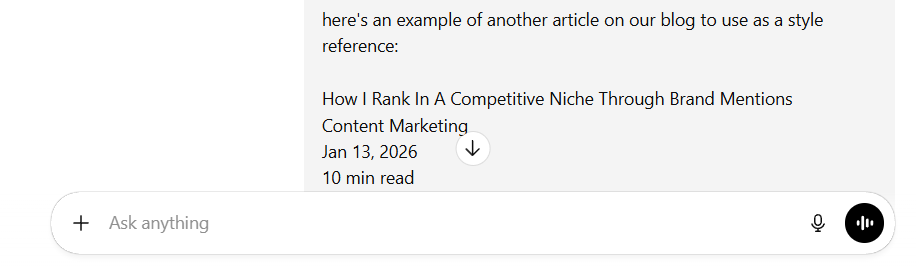
Then I give it my outline with notes and tell it to expand each section.
At that point, the first draft it generates is usually solid. Not publish-ready, but solid enough that I’m not starting from zero.
And then I do the part that actually matters: editing.
Aggressive editing.
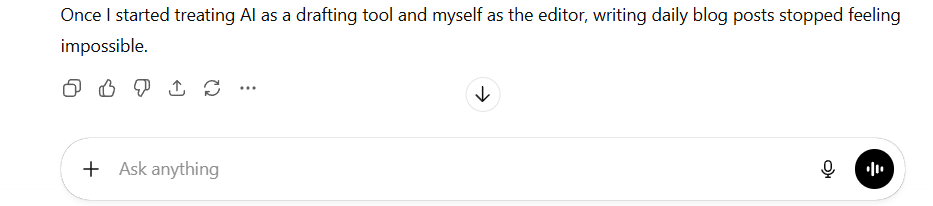
I cut paragraphs constantly. AI loves adding filler after it already answered your question. It’ll write three extra paragraphs that say nothing, just because it thinks longer content looks more “complete.”
Like this sentence (that it suggested for this very section!) that adds absolutely nothing to the content:
So my workflow is basically:
- generate draft section by section
- delete the fluff immediately
- rewrite the parts that sound too “AI”
- add real examples or opinions
- tighten everything until it feels like something I’d actually say
This is also where you protect your brand voice.
Because the goal isn’t just content creation. The goal is content that sounds like a real person wrote it and that actually keeps the reader on the page.
Step 4: Publishing & Promotion
This is the part nobody wants to hear.
Publishing more blog posts doesn’t automatically mean more traffic.
In fact, now that everyone is using AI, the barrier to producing content is the lowest it’s ever been.
You’re not competing against a few dedicated bloggers anymore. You’re competing against thousands of AI-assisted blogs pushing out content every day.
So if you’re spending 90 percent of your time writing and 10 percent promoting, you’ve got it backwards.
I hit publish, make sure the meta description is clean, double-check formatting, and move on. I don’t obsess over tiny tweaks.
Then I focus on promotion.
That means link building.
Because no matter how good your AI blogging workflow is, search engines still rely heavily on backlinks to decide which blog post deserves to rank. Good content alone is not enough anymore.
If you want your blog to grow fast, you need links pointing to your content. Especially if you’re publishing at scale.
That’s exactly why we built our done-for-you link building.
You focus on writing and scaling blog posts. We secure placements and backlinks that actually move rankings. Not spammy links, not random directories. Real placements that help your content compete.
AI helps you publish more.
Links make sure people actually see it.
Link building cheat sheet
Gain access to the 3-step strategy we use to earn over 86 high-quality backlinks each month.
Now Over to You
That’s basically the whole system.
AI blogging didn’t magically make me a better writer. It just removed the slow parts. Keyword research got faster, outlining got cleaner, and first drafts stopped being a time sink.
But the real reason I can publish one blog post a day is because I stopped treating writing like the finish line.
Publishing is step one. Promotion is what makes it work.
If you’re scaling content and want those posts to actually rank, link building is the piece that moves the needle. Especially now, when everyone is producing content at scale.
That’s exactly what our done-for-you link building is for.
You keep publishing. We get your content featured on real sites, earn you high-quality backlinks, and help your pages climb instead of getting stuck on page two forever.
Frequently Asked Questions (FAQ)
Is AI blogging bad for SEO?
No. An Ahrefs study found no clear correlation between AI generated content and rankings. Google has also said it does not penalize content just because it was created with artificial intelligence. What matters is whether your content is helpful, accurate, and aligned with E-E-A-T principles.
Can I use an AI blog writer for every blog post?
You can use AI for every blog post, but you should not publish raw output. AI blogging works best when you combine your own outline, real examples, and heavy editing. Think of an AI blog writer as a drafting assistant, not a replacement for strategy or judgment.
What’s the best AI tool for blogging?
There is no single best AI blogging tool. Some people use Jasper AI, others rely on ChatGPT or Claude as their main AI assistant. The best setup usually combines an AI writing tool with SEO tools like Ahrefs or Surfer SEO for keyword research and optimization.
How do I keep AI generated content from sounding generic?
Train the AI on your existing blog content, give detailed notes in your prompt, and cut aggressively. Most AI writing adds fluff after it answers the main question. Editing is where your brand voice and clarity come back in.
Can AI blogging work for a small business?
Yes. For a small business, AI blogging can dramatically speed up content creation and blog writing without hiring a full content team. As long as you focus on smart keyword research, strong editing, and proper promotion, it can be a powerful tool for consistent growth.