
Fractional executive pricing is the bridge between a million displaced corporate professionals and the small businesses desperate for their expertise. In 2025, U.S. employers announced 1.1 million job cuts—the highest level of professional displacement since the 2008 financial crisis. At the same time, 92% of small business owners describe their firms as stable or growing. One side has the talent. The other side needs it. And the only thing standing between them is pricing.
I saw this collision up close last month during a Fix-It Session with a former VP of Marketing from a mid-size SaaS company. She’d been laid off in October, had 18 years of experience running $2M campaigns, and was offering her services to local businesses for $50 an hour. Fifty bucks. She was underpricing herself into oblivion—and the small business owners she was pitching still thought she was too expensive. The problem wasn’t her value. The problem was how she packaged and priced it.
This is the Fractional Paradox: the experts who ran Fortune 500 departments yesterday are becoming the fractional leaders helping small firms survive today. But most of them are pricing themselves wrong—and most small businesses don’t know how to buy what they’re selling.
This article is for both sides of the equation. If you’re a new consultant figuring out fractional executive pricing, you’ll walk away with a framework you need. If you’re a small business owner wondering whether you afford expert help, you’ll see why the answer is yes.
Why 1.1 Million White-Collar Layoffs Created the Biggest Talent Opportunity in a Decade
The numbers tell a story the headlines missed. Challenger, Gray & Christmas—the firm tracking corporate layoffs since 1989—reported that 1.1 million layoffs were announced through November 2025. Only five other times since 1993 has the number crossed that threshold.
Tech got hammered the hardest, with more than 150,000 cuts. But this wasn’t a tech story. It was an everywhere story. Amazon cut 14,000 corporate jobs. UPS eliminated 14,000 managerial positions over 22 months. Target dropped 1,800 corporate roles. Molson Coors slashed 400 salaried positions—9% of its white-collar workforce.
Meanwhile, LinkedIn profiles mentioning “fractional” roles exploded from 2,000 in 2022 to 110,000 in 2024. The fractional executive market topped $5.7 billion and is growing at 14% annually.
Here’s what makes this different from past recessions: these aren’t junior employees getting trimmed. They’re senior strategists, operations leaders, and marketing directors with 10-20 years of experience. And instead of waiting 6-9 months for the job market to recover (the current average at the senior level), many are going fractional.
For small business owners, this means Fortune 500-caliber talent is available right now—if you know how to structure the engagement.
What Is Fractional Executive Pricing and Why Does It Matter for Small Business
Fractional executive pricing is the model where a senior professional sells strategic leadership to multiple businesses simultaneously, typically at 30-50% of what a full-time hire would cost. The client gets C-suite thinking without the C-suite salary.
According to the Frak Conference’s State of Fractional Industry Report, 25% of U.S. businesses have already adopted fractional hiring, with Gartner forecasting that more than 30% of midsize enterprises will have at least one fractional executive on retainer by 2027.
The average fractional sales leader earns $9,651 per month and maintains around 4.3 client engagements simultaneously. More than half of fractional professionals generate six-figure annual incomes. This isn’t a side hustle. It’s a legitimate business model.
But here’s where most new fractionals go wrong: they default to hourly billing.
The Hourly Trap and Why It Destroys Your Consulting Business
Selling hours is a race to the bottom. Period. When you bill by the hour, you’re penalized for being fast, experienced, and efficient. The better you get at your job, the less you earn. It’s backwards economics.
I watch this happen with every former corporate executive who launches a fractional practice. They take their old salary, divide by 2,080 working hours, add a “consultant premium,” and land on some number between $150 and $300 per hour. Then they pitch it to a small business owner who immediately does the math: “$250 an hour times 10 hours a week is $10,000 a month? I’ll pass.”
The conversation dies. Not because the value isn’t there—but because the pricing structure is wrong for the buyer.
🛑 DON’T COPY BLINDLY
If you’re a new fractional and your pricing page lists an hourly rate, take it down today. Hourly rates signal “vendor.” Value-based packages signal “partner.” Small business owners don’t buy hours. They buy outcomes—more leads, better systems, fewer headaches.
Small businesses—particularly the 81% with no employees—are making decisions with razor-thin margins. Their average gross receipts hover around $57,000. Every dollar has to show a return. An hourly rate gives them no confidence in what the return will be.
The “Good-Better-Best” Framework for Fractional Executive Pricing
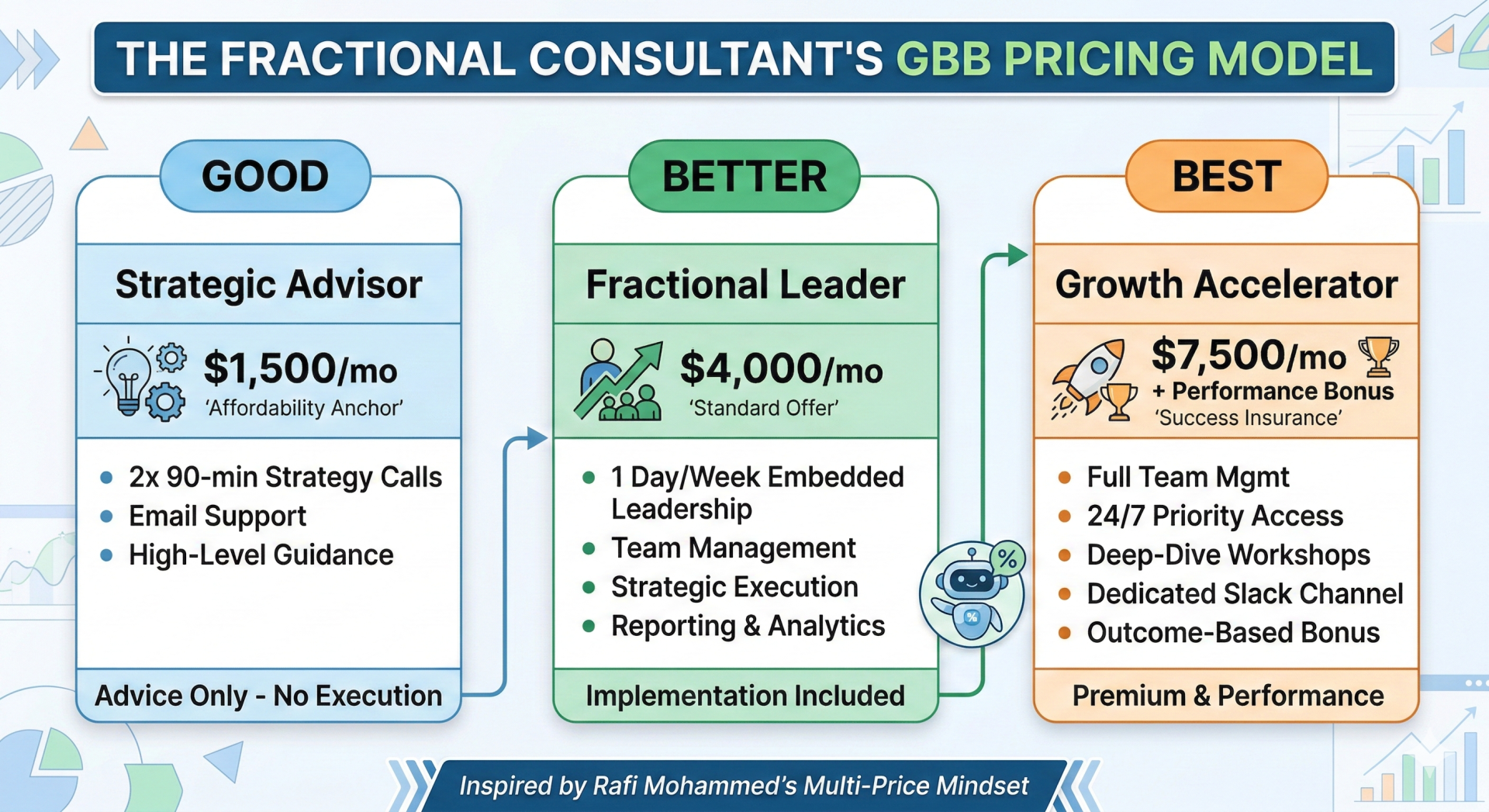
Pricing expert Rafi Mohammed, founder of Culture of Profit and author of The 1% Windfall, has written over 98 articles on pricing strategy for the Harvard Business Review. His most actionable framework for consultants is the Good-Better-Best (GBB) model.
Mohammed’s core argument: pricing is not a single number. It’s a series of options designed to capture different types of buyers. For fractional executives, this means building three tiers of service with different outcomes attached to each.
Tier 1: “The Good” – Your Affordability Anchor ($500-$1,500/month)
This is the stripped-down, advisory-only version of your service. Think of it as a “strategy subscription.” The client gets one monthly strategy call, a written action plan, and email access for quick questions.
Why it matters: This tier exists for the 66.3% of small businesses spending less than $1,000 per year on marketing (according to the UpFlip survey of 1,800 business owners). They won’t hire you at $5,000/month. But $750/month for structured strategic guidance? Now you’re in their budget.
Tier 2: “The Better” – Your Core Offering ($2,500-$5,000/month)
This is the fractional engagement most people picture: one day a week of active leadership. You attend team meetings, execute on deliverables, manage campaigns or projects, and own specific KPIs.
This is your “chef’s regular menu.” It serves the majority of your clients and delivers the strongest balance of value and profitability.
Tier 3: “The Best” – Your Accelerator ($7,500-$15,000/month)
High-touch engagement with team training, performance dashboards, 24/7 Slack or Voxer access, and quarterly strategic reviews. This tier includes everything in “Better” plus dedicated project management and measurable ROI tracking.
Mohammed notes in his Harvard Business Review research on the Good-Better-Best approach: roughly 30% of customers will opt for the premium tier simply because it exists. The presence of the “Best” option also makes the “Better” tier feel like a smart middle-ground choice—which is exactly what you want.
| Tier | What the Client Gets | Price Range | Best For |
|---|---|---|---|
| Good (Anchor) | Monthly strategy call + action plan + email access | $500–$1,500/mo | Solopreneurs on tight budgets who need direction |
| Better (Core) | 1 day/week leadership + deliverables + KPI ownership | $2,500–$5,000/mo | Growing businesses ready for strategic execution |
| Best (Accelerator) | Full engagement + team training + dashboards + 24/7 access | $7,500–$15,000/mo | Businesses scaling fast who need embedded leadership |
How to Use “Unbundling” to Protect Your Margins When Clients Ask for Discounts
When a client is squeezed by rising costs—and with 62% of small business owners concerned about tariff policy according to the SBE Council’s 2026 Check-Up Survey—they will ask for a lower price. It’s inevitable.
Mohammed’s advice: don’t panic discount. Unbundle instead.
Keep your rate for the strategic work. Remove the “busy work”—the admin tasks, reporting, data entry—and have the client’s internal team handle those pieces. You stay profitable. The client stays on budget. Nobody gets resentful.
💡 STRATEGY ALERT
When a client asks, “Is there a way to bring the cost down?” — don’t lower your price. Remove deliverables. Say: “Absolutely. I’ll handle the strategy and the decision framework. Your team handles the execution and reporting. That brings us to $X.” You maintain your hourly effective rate. The client feels heard. The scope matches their budget.
This is the same principle behind picking one marketing strategy instead of three. Doing fewer things at a higher level beats doing everything poorly. For consultants, selling fewer deliverables at a premium beats discounting your full package into commodity territory.
How AI Protects Your Profit Without Cutting Your Price
The SBE Council survey reports that 77% of small businesses are now using AI tools. For the fractional consultant, AI is a margin protector—not a replacement for your expertise.
If an AI tool lets you complete a 10-hour competitive analysis in 90 minutes, you don’t bill for 90 minutes. Under value-based pricing, you bill for the outcome—the strategic insight, the recommendations, the decision framework. The speed is your efficiency gain. The result is what the client pays for.
This is the key to staying affordable to small business clients without working 80-hour weeks. AI compresses your input time while the value of your output stays constant (or increases). Your effective hourly rate goes up. Your client’s cost stays the same. Everyone wins.
I talk about this concept in my work on building a personal brand for small business. Your brand is the “hidden economic variable” reducing the cost of every marketing activity. For fractionals, AI is the hidden efficiency variable increasing the profitability of every engagement.
⚠️ REALITY CHECK
AI doesn’t make you replaceable. It makes you faster. A former marketing VP who uses AI to deliver competitor research in 2 hours instead of 20 isn’t worth less—she’s worth more because the client gets the same strategic output in a fraction of the time. The mistake is passing those efficiency savings to the client as a discount. Don’t. The client is buying the result, not the clock.
The Affordability Gap: Why Small Businesses Need Fractional Help Now More Than Ever
The 2026 small business environment is a pressure cooker. According to the SBE Council survey, 81% of owners are confident about the year—but they’re deeply worried about affordability on both sides of the transaction.
Rising input costs: 62% are concerned about tariff policy. For construction and manufacturing, nearly 78% report rising material costs. Labor costs increased for 77.1% of service-based businesses, according to the EverCommerce 2025 survey.
Shrinking customer wallets: Inflation remains the top concern for 55% of small businesses, marking over eight consecutive quarters as the #1 issue (U.S. Chamber Small Business Index). Consumers are more price-sensitive than they’ve been in years.
The marketing confidence gap: According to the 2024 Keap survey, 33% of small business owners say marketing takes too much time, 30% don’t have a marketing plan, and 29% don’t know if what they’re doing works. These are the exact problems a fractional CMO solves.
For the new fractional, this is your ideal client profile: a profitable business owner drowning in operational demands who knows they need strategic help but is terrified of committing to a $150K salary. Your Good-Better-Best pricing model is the answer to their prayer.
How New Fractionals Should Get Their First Clients Using Direct Marketing
Most new consultants default to building a website, posting on LinkedIn, and waiting. That’s content marketing. It works—over 12-18 months. If you need revenue in 90 days, you need direct marketing.
Here’s the playbook:
Start with your warm network. Every corporate executive has 500+ LinkedIn connections. Fifteen to twenty of those people own or run small businesses. Send 10 direct messages this week—not pitching, but asking: “I’m building a fractional practice. Who do you know running a growing business who’s struggling with [your specialty]?” Referrals are the fastest path to revenue—50% of small businesses rely on them.
Join one networking group. BNI, your local Chamber, or an industry association. Show up every week for 90 days. Track every referral. The average BNI member generates $50,000 to $100,000 in annual referrals with close rates around 60%. Your cost per deal? Between $67 and $80.
Offer a “Fix-It” style diagnostic. A one-time, paid engagement at $150-$350 where you audit one specific area—their marketing funnel, their pricing, their customer experience. It’s low-risk for the buyer, positions you as the expert, and creates a natural on-ramp to your monthly fractional package.
Getting your first 100 customers without paid ads isn’t the easy path. It’s the smart one. The fractionals who build practices on relationships—not on social media impressions—are the ones still standing two years from now.
Beware the Optimism Bias: The Hidden Trap for New Consultants
Academic research on entrepreneurial psychology shows a consistent pattern: business owners believe negative economic shocks will affect others but not themselves. Researchers call it optimism bias.
This explains why 92% of small business owners feel positive despite tariff headwinds and inflation fatigue. And it’s the same bias new fractionals fall into. They assume clients will come, the pipeline will fill, and the pricing will work itself out.
It won’t. Not without structure.
The fractional professionals who succeed—the 62% reporting satisfaction with their business, according to the Frak Conference report—pair their natural entrepreneurial optimism with disciplined pricing strategy and consistent direct marketing activity.
Your first 90 days should follow this weekly rhythm:
- 5 direct outreach messages to warm contacts
- 1 networking event or group meeting
- 1 piece of thought leadership content (a LinkedIn post, a short article, a video)
- 1 follow-up sequence to every lead from the previous week
This isn’t a marketing plan. It’s a business development system. And systems beat optimism every time.
What Small Business Owners Should Ask Before Hiring a Fractional Executive
If you’re on the buying side of this equation, here’s how to evaluate fractional executive pricing without getting burned:
Ask for outcomes, not hours. “What will be different about my business after 90 days?” beats “How many hours will you work?” every time. If a fractional talks about deliverables and results, you’re on the right track. If they lead with their hourly rate, keep looking.
Request a diagnostic first. Any experienced fractional should be willing to do a paid assessment before you commit to an ongoing engagement. This gives both of you a “trial run” without the risk of a long-term contract.
Compare to the real cost of doing nothing. If your marketing budget is sitting idle or you’re spending $500/month on tactics with no measurable return, redirecting that spend toward a fractional strategist at the “Good” tier is a net positive. You’re not adding cost—you’re redirecting wasted spend toward someone who knows how to make it work.
Check for relevant small business experience. A fractional who ran $20M campaigns at a Fortune 500 company is impressive. But if they’ve never worked with a business generating under $500K in revenue, they’ll struggle with your constraints. Look for someone who understands that $57,000 in gross receipts means every dollar counts.
The New Normal: A Redistribution of Talent
The “white-collar recession” of 2025 wasn’t an ending. It was a redistribution. The 1.1 million professionals entering the fractional market are the exact fuel small businesses need to overcome the 2026 affordability squeeze.
For new fractionals: adopt the Good-Better-Best framework, use AI to protect your margins, lead with direct marketing to fill your pipeline, and stop selling hours. Sell results.
For small business owners: the expert you need is out there right now, probably within your LinkedIn network, offering strategic leadership at a fraction of what it would cost to hire full-time. The barrier isn’t budget—it’s knowing how to structure the engagement. Start with a diagnostic. Measure the ROI. Scale from there.
The businesses thriving in 2026 won’t be the ones with the biggest budgets. They’ll be the ones smart enough to tap the talent wave that landed in their backyard.
Frequently Asked Questions About Fractional Executive Pricing
How much does a fractional executive charge per month?
Fractional executive pricing varies by specialty and engagement level. Advisory-only engagements run $500-$1,500/month. Core fractional leadership (one day per week) ranges from $2,500-$5,000/month. Full-service accelerator packages run $7,500-$15,000/month. The average fractional sales leader earns $9,651/month across multiple clients, according to 2024 Vendux data.
Is hiring a fractional executive cheaper than a full-time hire?
Yes. Fractional engagements typically cost 30-60% less than a full-time executive salary when you factor in benefits, bonuses, and overhead. A full-time CMO costs $150,000-$250,000 annually. A fractional CMO delivering one day per week costs $30,000-$60,000 per year for comparable strategic output.
How do I know if my small business is ready for a fractional executive?
If you’re spending money on marketing without knowing the return, if your growth has plateaued, or if you’re doing everything yourself and burning out, you’re ready. Start with a one-time paid diagnostic ($150-$500) to identify your biggest bottleneck before committing to an ongoing engagement.
What’s the difference between a fractional executive and a freelancer?
A freelancer executes tasks you assign. A fractional executive owns strategic outcomes. A fractional CMO doesn’t write your social media posts—they build the marketing system, set the KPIs, and guide your team (or you) on execution. Think “department leader” vs. “task doer.”
How long does a typical fractional engagement last?
Most fractional engagements run 6-12 months. According to industry data, client relationships often reach a natural conclusion around the 12-month mark as the systems the fractional built become self-sustaining. Start with a 90-day commitment to prove ROI before extending.
Additional Reading
Whether You’re Pricing Your Fractional Services or Hiring One—Get It Right the First Time
Book a Fix-It Session for $150 and I’ll audit your pricing, your positioning, or your marketing system in 24 hours. No meetings. No fluff. A video walkthrough, an action plan, and the clarity to move forward TODAY.