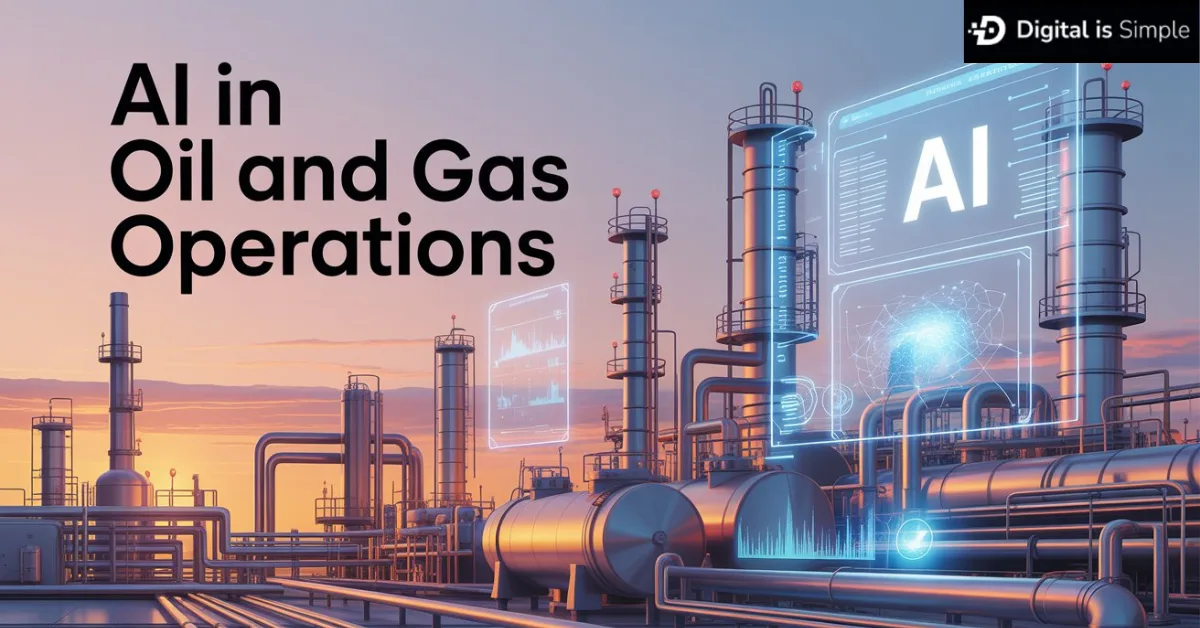
The energy industry is going through a massive shift. Companies are no longer relying only on manual processes and traditional tools to explore and extract oil and gas. Artificial intelligence is now sitting at the center of this change. AI in oil and gas operations is helping businesses cut costs, reduce risks, and make smarter decisions at every stage of production. According to Future Market Insights, the global AI in oil and gas market is expected to grow from USD 4.0 billion in 2025 to USD 14.9 billion by 2035, at a CAGR of 14.1%, with the upstream segment leading this growth.
This blog breaks down exactly how AI is reshaping upstream oil and gas, what technologies are involved, and why your business should pay attention.
What Is Upstream Oil and Gas?
Before diving into AI, it helps to understand what “upstream” means. Upstream refers to the earliest stages of oil and gas production. This includes exploration, drilling, and extraction. These are the most complex, expensive, and risky parts of the entire supply chain.
Companies working in this space deal with massive amounts of data every day. They also work in remote and dangerous environments. This is exactly where AI can make the biggest difference.
Key Areas Where AI in Oil and Gas Operations Is Making an Impact
1. Smarter Exploration and Reservoir Analysis
Finding oil is not simple. Geologists study seismic data, satellite images, and soil samples to identify drilling locations. This process used to take months and still carried a high risk of error.
AI changes that completely. Machine learning models can now analyze seismic data in hours instead of weeks. According to Mordor Intelligence, AI tools have lifted drilling location accuracy by 70% compared with manual methods. That is a remarkable improvement that directly reduces exploration risk and capital waste.
Companies providing AI solutions for oil and gas industry are building tools that process decades of geological data to pinpoint the best drilling spots with far greater precision.
2. Drilling Optimization
Drilling is one of the most expensive activities in upstream oil and gas. A single error can cost millions of dollars and delay projects by months. AI is now being used to monitor drilling conditions in real time and make adjustments automatically.
Autonomous drilling systems look at data like pressure, temperature, and drilling speed in real time. They can spot problems early before they become serious issues. For example, companies like ADNOC and Baker Hughes have started using AI to improve drilling speed by analyzing past data, showing that AI is quickly becoming an important part of drilling work.
3. Predictive Maintenance
Equipment failure is a major problem in oil and gas. Unplanned downtime costs companies billions every year. Traditional maintenance schedules are based on time intervals, not actual equipment health.
AI takes a different approach. Sensors collect real-time data from pumps, compressors, and drilling equipment. Machine learning models then predict when a component is likely to fail. This allows teams to schedule maintenance before something breaks. Predictive maintenance captured 37.60% of the AI in oil and gas market share in 2025 [Source: Mordor Intelligence], making it the single largest application of AI in this sector.
4. Safety and Risk Management
Working in upstream oil and gas is risky. Workers use heavy machines in remote areas, often in tough weather conditions. AI is helping companies improve safety in ways that were not possible before.
With computer vision development, systems can now detect unsafe actions on rigs in real time. AI can also spot gas leaks or pressure issues early, before they turn into serious accidents. Companies can use aerial photos, satellite images, and remote data to quickly find oil spills and pipeline leaks. This fast detection helps reduce environmental damage and keeps workers safe.
How AI Technologies Power Upstream Operations
Machine Learning and Deep Learning
Machine learning is the backbone of most AI applications in oil and gas. It allows systems to learn from large datasets and improve over time. Deep learning goes one step further, handling complex patterns in unstructured data like seismic images or acoustic signals.
Machine learning approaches led with 49.20% of 2025 AI in oil and gas market revenue [Source: Mordor Intelligence]. This shows how central these technologies are becoming across the sector.
Digital Twins
A digital twin is a virtual copy of a physical asset, such as a drilling rig or a wellbore. Engineers can simulate different scenarios on the digital twin before making changes in the real world. This reduces costly trial and error in actual field operations.
AI-Powered Communication and Support Tools
Upstream operations span multiple teams across remote locations. Coordinating these teams efficiently requires fast and accurate communication. Many companies are now integrating AI chatbot development into their internal systems to streamline field reporting, maintenance queries, and operational support without delays.
Real Business Benefits of AI in Upstream Operations
The benefits of AI in oil and gas operations go well beyond cutting costs. Here is what companies are actually gaining:
Faster decision making: AI processes data instantly and gives teams actionable insights in real time.
Reduced operational risk: Predictive tools flag problems before they cause accidents or equipment failures.
Lower exploration costs: Better data analysis means fewer dry wells and wasted drilling investments.
Environmental compliance: AI monitors emissions and detects leaks early, helping companies stay within regulatory limits.
Workforce efficiency: Automation handles repetitive tasks, freeing up skilled workers for more complex problem solving.
Challenges to Keep in Mind
AI is powerful, but it is not without challenges. Data quality is a major issue. AI models are only as good as the data they are trained on. Inconsistent or incomplete datasets can lead to poor predictions.
Integration is another hurdle. Many upstream companies still rely on legacy systems that do not easily connect with modern AI platforms. Building the right infrastructure takes time and investment.
There is also a skills gap. Using AI effectively requires people who understand both the technology and the oil and gas domain. This combination is still relatively rare in the market.
What This Means for Business
If you are involved in upstream oil and gas services, now is the time to evaluate where AI can add the most value in your operations. You do not need to overhaul everything at once. Start with one pain point, whether that is equipment maintenance, seismic analysis, or safety monitoring, and build from there.
The companies that invest in AI today will have a clear operational advantage over those that wait. The technology is maturing fast, and the cost of not adopting it is becoming higher every year.
Final Thoughts
AI in oil and gas operations is not a distant future concept. It is happening right now, across exploration teams, drilling rigs, and production facilities around the world. Upstream companies are using it to find oil faster, drill smarter, maintain equipment better, and protect their workers more effectively.
The shift is already underway. The question is not whether your company should adopt AI, but how quickly you can start doing it effectively.