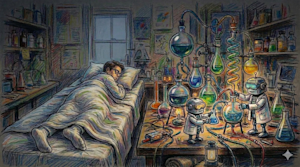
When it comes to artificial intelligence, few fears loom larger than the idea of robots coming to take our jobs. But if you talk to the AI evangelists among us, that could be a good thing.
Not in the Elon Musk robots-will-babysit-your-kids way, but in a way that helps us make better use of our resources and handles our busy-work. If the doom doesn’t come to fruition — and that is a big if — we could get the one thing there never seems to be enough of: time.
There’s actually a name for this best-case scenario: AI abundance.
Here’s how Anton Korinek — an economics professor at the University of Virginia and one of Vox’s 2024 Future Perfect 50 — recently explained the idea to the host of Explain It to Me, Vox’s weekly call-in podcast: “AI abundance essentially carries the notion that we could all be so much more wealthier than we can even imagine today…AI and robots will be able to produce a lot more goods and services than when we have in today’s economy, and would make us an order of magnitude wealthier and better off.”
But what would a world without work look like? And what would need to happen for AI to free us from work and provide everyone with a good, universal living standard? We discuss that on the latest episode of Explain It to Me. Below is an excerpt of our conversation with Korinek, edited for length and clarity.
You can listen to the full episode on Apple Podcasts, Spotify, or wherever you get podcasts. If you’d like to submit a question, send an email to askvox@vox.com or call 1-800-618-8545.
We keep hearing that a change of this scale is unprecedented. Is that true or is it hype?
I think it’s the first time of this particular nature, but if you want to go into history and look for any parallels, I think the closest parallel would be the Industrial Revolution. So you would have to go back some 250 years for anything that comes even close to what we are about to experience this time.
What can the Industrial Revolution teach us about this particular moment?
From a big-picture economic perspective, you can say work as we have it today didn’t even really exist before the Industrial Revolution. Because before then, the most important factor of production was the land that people worked in order to produce the food that they needed. Then all of the sudden you had these new technologies that didn’t rely so much on land as they relied on machines. It started with spinning and weaving in the textile sector, but then soon we had the steam engine and electricity.
The new thing that you needed to produce — in addition to the labor that people had to put in — were machines that you could easily copy and reproduce. That meant that there was nothing holding back production. And that meant that we could suddenly produce a lot more because that bottleneck of land was overcome. In some sense, you can say that’s the main reason why today people in advanced economies are something like 20 times richer, on average, than they were before the Industrial Revolution.
What did that mean for workers at the time? I imagine that transition wasn’t easy.
It was actually quite disruptive. If you were an artisan weaver or something like that, if you were a skilled professional doing your trade, then all of a sudden you had these machines coming along that could do what you were doing, but at an order of magnitude cheaper.
So those artisans lost their livelihood essentially overnight, and they were impoverished. But looking at the positive side, their descendants lived in a world where they had cheap textiles and soon all other kinds of cheap industrial goods, and they lived to be much wealthier than their artisan parents or grandparents who lost their job in the first wave of the Industrial Revolution.
This can be hugely disruptive and painful for the individual. But if we have a little bit of social protection, we can mitigate the disruption and we can make sure that in the end everybody actually benefits. Now, if there is a lot of disruption all at once, then it may become a lot harder.
There are people now who lived through another, more recent technology disruption: I’m thinking about the ‘80s and ‘90s with computers.
In some ways, the way that I see the Industrial Revolution is that it first consisted of building machines that could automate a lot of our physical strength. And then since roughly the middle of the 20th century, we created machines that could automate cognitive tasks: computers.
Those first computers could only perform highly routinized things like adding up numbers in a spreadsheet, and that was very useful for businesses. We are seeing that AI can perform more and more of the complex, really thoughtful cognitive tasks. So the big question is where will this stop? And will they leave anything for us?
You talked about land being the bottleneck during the time of the Industrial Revolution. Do we have a bottleneck now?
I would say the most valuable resource in our economy today is our human capital. It is you and me and everybody [reading] this. Because if we can have more workers, then we can increase the amount that the economy is producing. We may enter a world where they can just press a button and have one more AI worker perform work on their behalf and essentially expand our economic opportunities.
When it comes to the AI revolution, is this something that’s going to benefit our grandkids more than us?
I very much hope that we can all benefit. But whether or not that’s going to happen is a story that is yet to be written, and it’s going to be challenging.
At first, there will be small sectors where people are losing out, and then there’s going to be a debate, “Well, why should we help them? We didn’t help other workers in previous technological revolutions that much.” Then, eventually, most people will be affected by this. But it’s not going to happen overnight. It’s going be a somewhat slow process.
We work to get a paycheck. In a future where we don’t work anymore, how do we eat? How do we get health insurance? How do we pay for a place to live?
That’s going to be the most important and also the most fundamental challenge to our current system. In some sense, you can say the Industrial Revolution accidentally created a system where our labor became more and more and more valuable because we were so scarce. That has kind of underpinned all this material progress, all this increase in wellbeing that we have seen over the past 250 years.
But once the AI revolution really hits, there is no guarantee that we can earn a decent living based on the value of our labor anymore. I do believe that we are going to need a new system of income distribution at that point. For example, Universal Basic Income, compute allotments: everybody essentially gets a certain amount of computational power allocated that they can then either use or sell off. People are also talking about job guarantees. There’s a whole range of options out there from a big picture perspective.
The primary concern has to be that we’ll find some solution because if labor does get significantly devalued by this technological change and at the same time we have much more abundance in the economy, it would be such a failure if we don’t use that additional abundance to make sure that nobody’s left behind.
This series was supported by a grant from Arnold Ventures. Vox had full discretion over the content of this reporting.