Key takeaways:
- The healthcare kiosks streamline administrative processes, enhance patient flow, improve staff productivity, reduce costs, and enhance the patient experience.
- Healthcare kiosks enhance efficiency and personalized care through EMR/EHR-integrated kiosk software with AI, delivering real-time data updates.
- Scalable kiosk solutions lower operations expenses, enhance patient throughput and improve service delivery in healthcare organizations.
- Patient data is secure, reliable, and compliant, as data security and HIPAA compliance are foundational to healthcare kiosks.
- Patient satisfaction is also enhanced by self-service healthcare kiosk software, which reduces wait times, facilitates prompt payment, and simplifies the healthcare experience.
- There is strong demand for digital health kiosks in the global kiosk market, which is projected to reach $3.76 billion by 2030.
It is 8:30 AM in a multi-facility hospital network. Hundreds of patients arrive across departments. Front desks are already under load. You know what happens next. Delays, manual data entry, and growing frustration.
Now imagine patients walking straight to a screen, checking in, updating records, and completing payments, with every action instantly syncing with your EMR/EHR system. This is the operational shift delivered by healthcare kiosk software development.
Enterprise healthcare organizations are under pressure to scale patient intake, reduce administrative costs, and maintain data accuracy across locations. Healthcare kiosk systems answer that need through secure self-service touchpoints that automate check-ins, billing, and record updates. The outcome is faster patient throughput, fewer manual errors, and measurable efficiency gains across facilities.
Medical kiosk software development has also evolved beyond basic automation. AI-powered healthcare kiosk development now supports guided intake and symptom triage. EMR/EHR integrated kiosk software keeps clinical and administrative data consistent in real time. Digital health kiosk solutions connect patients, hospital platforms, and care teams into a continuous workflow.
The global healthcare kiosk market is projected to reach $3.76 billion by 2030 at a 15.1% CAGR. For enterprise healthcare leaders, this is now core operational infrastructure.
15.1% CAGR Means Your Competitors Are Already Scaling
Hospitals adopting kiosk automation are reducing intake delays, lowering operational costs, improving throughput, and driving measurable ROI at scale.
Benefits of Healthcare Kiosk Software for Hospitals
Walk into any busy hospital, and the pattern is familiar. Long reception lines. Staff jumping between systems. Patients are waiting to complete basic paperwork. Healthcare kiosk software development removes this friction by shifting routine interactions to secure self-service points.
- Healthcare kiosk systems automate check-ins, payments, and data capture through self-service software. Front-desk congestion drops. Patient throughput rises. Daily operations move faster with fewer manual touchpoints.
- EMR/EHR-integrated interfaces keep patient records updated in real time, reducing manual entry errors and preventing data inconsistencies across departments. This strengthens data integrity and compliance readiness, supported by a mature EHR software development architecture.
- For large hospital groups, standardized kiosk deployments create consistent patient experiences across outpatient, inpatient, and specialty departments. These platforms scale easily across multi-location networks, keeping service delivery uniform everywhere.
- AI-based capabilities add guided intake, symptom triage, and automated routing. Combined with digital health and pharmacy kiosk deployments, hospitals expand capacity without increasing staff overhead.
The outcome is clear. Shorter wait times. Lower operational costs. Higher patient satisfaction. And modernized workflows that integrate seamlessly with existing EMR/EHR infrastructure.
Types of Kiosks Used in Healthcare Facilities
Hospital operations rarely slow down. Morning outpatient rush, afternoon diagnostics, evening pharmacy pickups. In each of these moments, healthcare kiosk systems step in to keep workflows moving without adding staff pressure.
Medical kiosk software development now supports multiple kiosk formats, each mapped to a specific operational function inside enterprise healthcare environments.
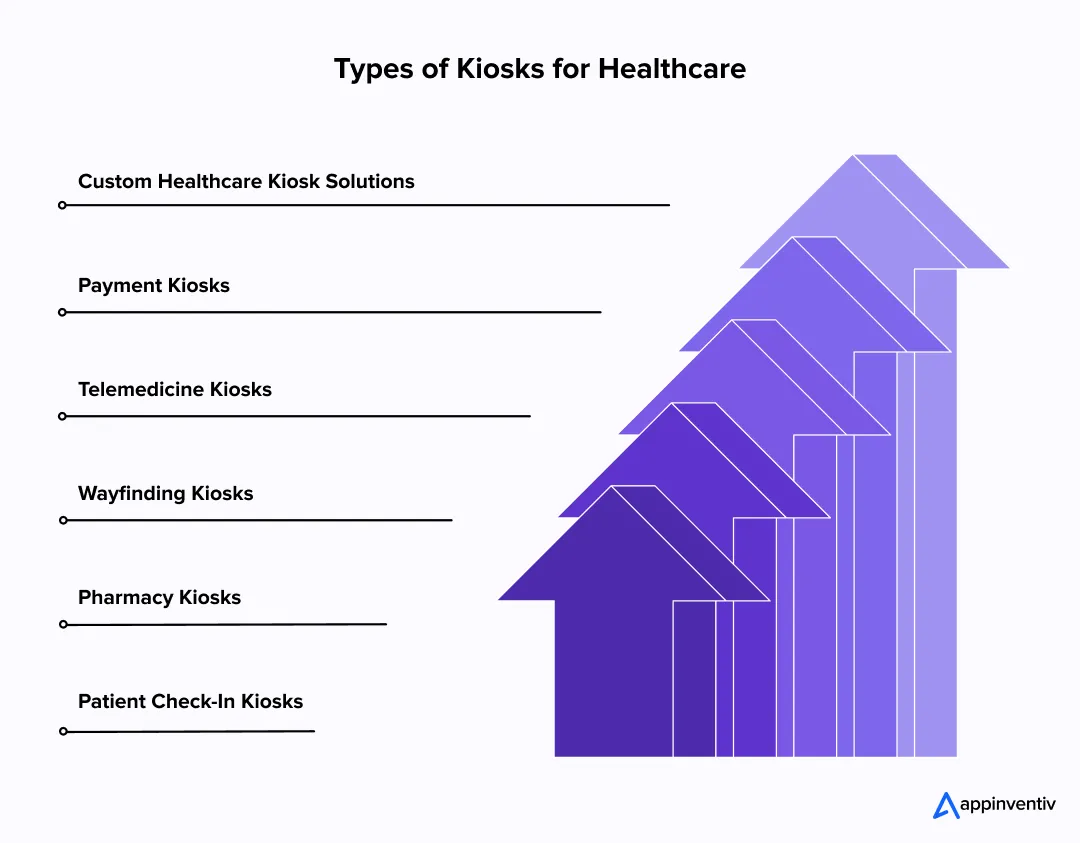
Patient Check-In Kiosks
Patient kiosk software solutions allow visitors to complete registration, confirm appointments, and update records independently. This reduces intake congestion at reception desks and stabilizes patient flow. For multi-location networks, clinic kiosk software development ensures consistent self-service experiences across facilities.
Also Read: How to Build Patient Management Software? Process, Features, Costs
Payment Kiosks
Payment kiosks enable self-service healthcare kiosk software for co-payments, billing clearance, and receipt generation. Transactions move faster. Administrative workload decreases. Revenue cycles tighten without expanding cashier staffing.
Also Read: How to Build a Payment App? All You Need to Know
Telemedicine Kiosks
Digital health kiosks create secure spaces for virtual consultations and remote vitals capture. Patients connect with clinicians without occupying physical exam rooms. Medical kiosk software development in this category expands care capacity while controlling infrastructure costs.
Also Read: Telemedicine App Development: Build a Secure & Scalable Telehealth Platform
Wayfinding Kiosks
Large hospitals introduce navigation challenges for patients and visitors. Kiosk software for hospitals with interactive maps guides users to departments, labs, and wards. Fewer missed appointments. Fewer staff interruptions. A smoother on-site experience.
Pharmacy Kiosks
Pharmacy kiosk software solutions automate prescription refills, inventory checks, and pickup alerts. Patients spend less time waiting. Pharmacists spend more time on clinical verification and counseling.
Also Read: How to Develop a Pharmacy Management Software – Features, Process, Costs
Custom Healthcare Kiosk Software Development
Custom healthcare kiosk software development supports specialized workflows such as chronic disease intake, diagnostic questionnaires, and insurance verification. When paired with EMR/EHR integrated kiosk software, these kiosks keep patient records synchronized in real time across hospital systems.
Common Healthcare Kiosk Formats and Use Cases
| Kiosk Type | Primary Operational Use |
|---|---|
| Patient Check-In Kiosks | Registration and appointment confirmation |
| Payment Kiosks | Co-payments and billing processing |
| Telemedicine Kiosks | Virtual consultations and vitals capture |
| Wayfinding Kiosks | Hospital navigation assistance |
| Pharmacy Kiosks | Prescription refill and pickup automation |
| Custom Healthcare Kiosk Solutions | Specialized clinical and administrative workflows |
Each kiosk type plays a defined role. Together, they create a connected service layer that improves efficiency, data accuracy, and patient experience across enterprise healthcare environments.
Key Features of Enterprise Healthcare Kiosk Software
Most enterprise healthcare teams reach a point where front-desk operations begin to slow patient flow. Intake lines grow. Staff re-enter the same information into multiple systems. That is usually when healthcare kiosk systems move from optional to essential digital infrastructure.
At enterprise scale, kiosk platforms must support interoperability, security, and long-term scalability. The goal is not just self-service access, but a direct connection between patients, hospital IT ecosystems, and clinical workflows.
Interoperability Comes First
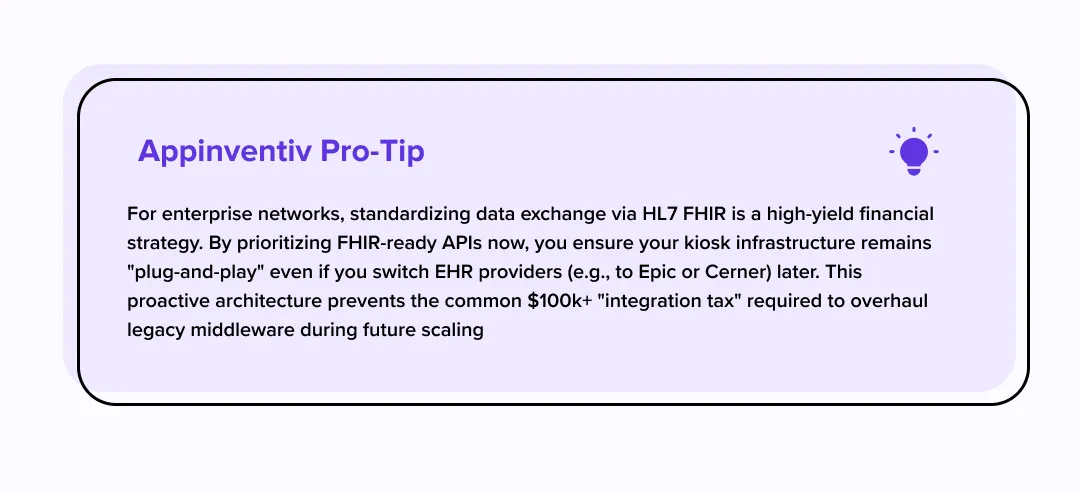
EMR/EHR-integrated kiosk software synchronizes patient data with hospital information systems in real time, using data analytics in healthcare. Medical kiosk software development for enterprises typically uses API-based integrations and HL7 FHIR-aligned data exchange, ensuring that clinicians always have access to current records and minimizing manual data entry errors.
Self-Service Automation Reduces Administrative Load
Self-service healthcare kiosk software manages patient intake, appointment scheduling, payments, and prescription requests. This shortens queues, standardizes data collection, and allows staff to focus on patient care instead of repetitive data entry.
AI Improves Intake Quality At Scale
AI-based healthcare kiosk development enables symptom triage, guided form completion, and personalized patient prompts. Hospitals benefit from consistent intake workflows across departments without increasing staffing requirements, as well as AI-based medical diagnostics.
Security And Compliance Stay Built In
Healthcare kiosk software features include encrypted sessions, secure patient authentication, audit trails, and HIPAA-compliant data handling. Cloud-based kiosk software for hospitals also allows centralized monitoring, controlled access, and remote updates across multiple facilities.
Accessibility And Hardware Integration Complete The Experience
Easy-to-use multilingual interfaces and ADA-compliant design ensure every patient can use the system confidently. Healthcare kiosk systems also integrate barcode scanners, biometric readers, printers, and payment terminals, enabling identity verification, data capture, and payments in a single workflow.
When combined, these capabilities make custom healthcare kiosk software development a practical foundation for enterprise efficiency, clinical accuracy, and scalable patient experience delivery.
How Does Healthcare Kiosk Software Integrate with Hospital IT Systems?
Enterprise healthcare kiosk software development enables EMR/EHR integration, connecting seamlessly with hospital information systems and EHR platforms such as Epic or Cerner via HL7 FHIR REST APIs.
This allows real-time patient data exchange, secure identity verification, and audit-ready transaction tracking across healthcare kiosk systems deployed in hospitals and clinics.
Integration architecture typically includes:
- HL7 FHIR JSON-based interoperability for medical kiosk software development
- RESTful APIs for EMR/EHR, billing, and scheduling systems
- OAuth2 / SSO patient authentication for self-service healthcare kiosk software access
- Encrypted cloud data synchronization supporting digital health kiosk solutions
- API gateways for clinic kiosk software development and legacy system connectivity
- SOC2-monitored system logging and access control
- Offline failover for uninterrupted kiosk software for hospital operations
This healthcare interoperability layer ensures custom healthcare kiosk software development eliminates fragmented software ecosystems, supports enterprise-scale deployment, and prevents long-term technical debt across hospital IT stacks.
What Is the Process for Custom Healthcare Kiosk Software Development?
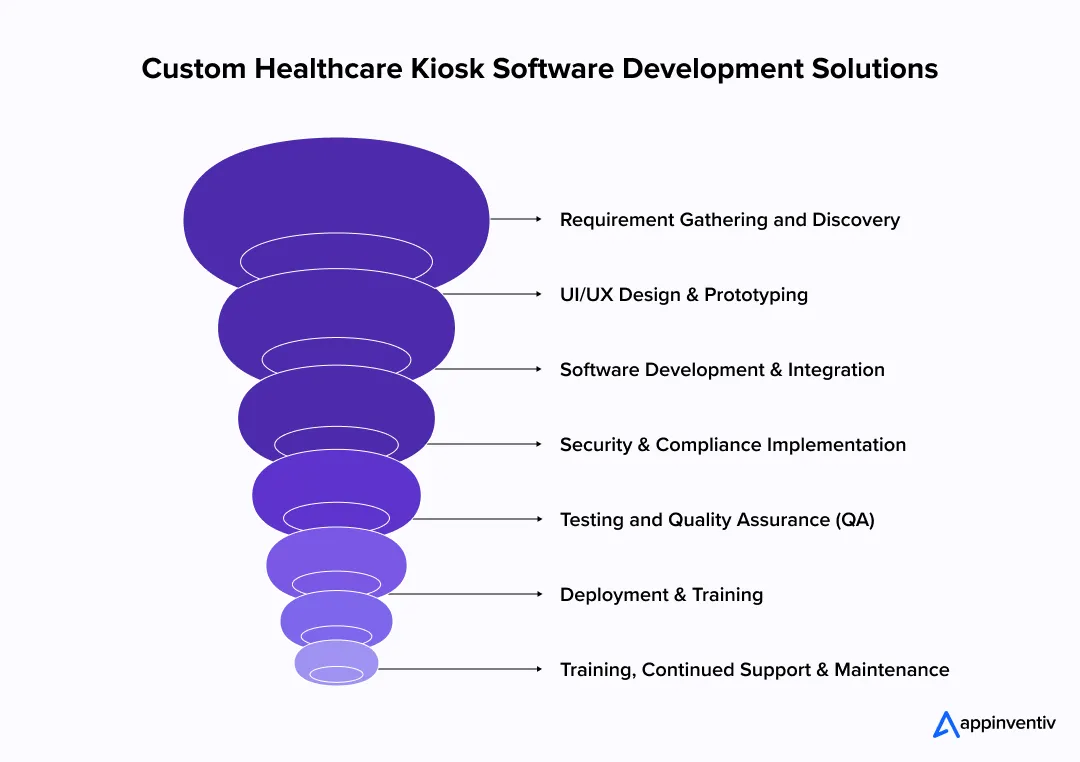
Medical kiosk software development involves way more than just writing code; rather, this is about creating a strategic solution that will seamlessly integrate into your existing healthcare ecosystem.
With the global market of medical kiosks anticipated to reach $3.76 billion by 2030, it simply goes to show that these systems are not an alternative anymore but a necessity for all healthcare organizations wishing to remain competitive, efficient, and innovative.
The steps in designing a healthcare kiosk solution to meet the demands of creating a path to efficiency, scalability, and compliance can be subdivided as follows:
Requirement Gathering and Discovery
The first thing to do is to define precisely what you want. Health care organizations differ significantly in respect to patient numbers, services provided, and technology. In this stage, we come up with concrete information about:
- Patient flow requirement: how patients will use kiosks across departments for check-in, making payments, pharmacy, etc.
- Integration requirements: How the kiosks will integrate with EMR/EHR systems, payment gateways, and other healthcare systems, such as telehealth and clinical diagnostics.
- Healthcare Compliance & Security: This ensures the kiosk meets compliance requirements under HIPAA, GDPR, and other regulations that safeguard patient information.
UI/UX Design & Prototyping
Healthcare kiosks need a UX design. An interface should be usable, easy to use, and user-friendly. At this stage:
- Interface Testing: develop an interface that is easily usable, clean, multi-lingual, intuitive, with a range of user options available, such as for older or computer-phobic patients.
- Feedback loops: Frequent feedback by real health professionals and patients regarding testing the applicability of the kiosk in the real world.
Software Development and Integration
After the design is confirmed, the custom kiosk software is developed. This phase includes:
- Backend and Healthcare API Development: The development of the backend and API entails developing a robust backend capable of supporting real-time data transfer amongst kiosks, HIS, the EMR/EHR system, telehealth, and payment systems.
- Hardware Integration: Ensuring kiosks support hardware peripherals, like biometric scanners, thermal printers, barcode readers, and payment terminals.
- Healthcare Integration of AI and Machine Learning: Where the kiosk would introduce an AI-based symptom checker or a personalized health assessment, this would involve the development and training of AI-based models to analyze patient input with the greatest accuracy possible.
Security & Compliance Implementation
Security is given high priority in this step due to the sensitivity of health care data. The kiosk software should be designed with the latest encryption technologies to ensure that patients’ information is never exposed. This includes:
- All interactions with patients should be end-to-end encrypted.
- The procedures provide for user authentication and authorization regarding access to sensitive data.
- Ensuring that the relevant healthcare-oriented laws, including those of HIPAA about data privacy, GDPR about data protection, and PCI DSS about payment security, are followed.
Testing and Quality Assurance (QA) Reporting
On this level, extensive testing is done to ensure that the kiosk system is perfectly functional.
- Testing of functionality: This includes the testing of functionality such as check-ins, payments, and telehealth sessions to ensure everything works well.
- Integration Testing: Verification that the kiosk software is integrated correctly with EMR/EHR systems, payment processors, and other third-party applications.
- Security Testing: This involves penetration testing and vulnerability testing to ascertain whether the system has no security vulnerabilities.
- Usability Testing: Actual users (patients, staff) should be tested to make the kiosk user-friendly.
Deployment & Training
Once all software tests are complete, it is rolled out throughout the healthcare facility or network. Other aspects included in this phase are:
- Staff training: This involves training staff and healthcare providers in clinic kiosk software development use and management.
- Introduction of the patient to the kiosks: This is about introducing the patient to the kiosks and teaching them how to use the system in their best interest.
Training, Continued Support and Maintenance
The kiosks require frequent maintenance to perform optimally. This phase includes the following:
- Software Updates: Frequent updates with security, functionality, and user experience enhancement.
- Remote Monitoring: The ability to monitor the kiosk in real-time and troubleshoot/resolve issues remotely utilizing cloud-based solutions.
- Scalability: The kiosks should be able to support the growing needs of a healthcare organization.
What Compliance Standards Must Healthcare Kiosks Meet?
Let’s pause on compliance for a moment, because this is where most healthcare kiosk software development projects either gain executive approval or hit procurement roadblocks. Healthcare kiosk systems handle sensitive patient records, identity verification, and payments. That reality demands security and regulatory alignment from the very first line of code.
The key compliance factors are as follows:
- HIPAA Compliance: EMR/EHR integrated kiosk software must protect patient data through encryption, secure authentication, and audit trails that record every access and transaction.
- GDPR: Digital health kiosks must give patients control over data consent, storage, and deletion, especially for organizations operating across global regions.
- PCI DSS Compliance: Self-service healthcare kiosk software that processes card payments must follow strict payment security protocols to prevent data exposure.
- Accessibility Standards – ADA: Kiosk software for hospitals must support multilingual interfaces, screen readers, and simple navigation so every patient can complete check-ins independently.
- HL7 FHIR Interoperability: Healthcare kiosk systems need certified data exchange standards to communicate reliably with hospital EMR platforms and clinical systems.
- SOC2 Type II and ISO 27001: These frameworks govern continuous security monitoring, access control, and enterprise risk management.
- Medical Device Regulations: AI-based healthcare kiosk development that includes vitals capture or diagnostic peripherals must meet applicable medical device compliance requirements.
Picture a crowded outpatient lobby on a Monday morning. Patient kiosk software solutions collect check-in details. Encrypted data moves into the hospital EHR. Every step is logged and traceable.
That is how custom healthcare kiosk software development stays compliant, audit-ready, and trusted at enterprise scale.
Challenges & Solutions for Kiosk Software Development for Healthcare
Despite these great advantages, the challenges of custom kiosk solutions mean their implementation is not a smooth sail. These barriers are important to understand and address so that C-suite executives can make informed decisions that ensure the deployment runs seamlessly and successfully in the long term.
The following are some of the most typical challenges and resolutions:
- Integration with Legacy Systems: Many healthcare organizations have legacy systems that are difficult to integrate with new kiosk technologies. Custom-built APIs and middleware should be used to ensure seamless integration with existing EMR/EHR systems, billing platforms, and other systems.
- Security and Compliance of Data: Kiosks process sensitive patient data and should be used in accordance with regulations such as HIPAA and GDPR. To safeguard patient data and comply with regulations, implement end-to-end encryption, secure authentication protocols, and audit trails.
- Adoption and Accessibility of Users: Not every patient is tech-savvy, particularly the aging population or those who are less technologically advanced. Develop easy-to-use, multilingual user interfaces that adhere to ADA standards and incorporate assistive technologies, such as voice commands and screen readers, to make them accessible to everyone.
- Hardware and Maintenance Problems: Hardware such as touchscreens and biometric scanners is prone to wear and tear, leading to downtime. Remote monitoring and predictive maintenance can help maintain kiosk functionality and prevent service interruptions.
- Cost and Budgeting: The initial expense of kiosk software may be a concern to healthcare organizations. Determine long-term savings in staffing costs, improved patient throughput, and streamlined operations to prove the investment and demonstrate ROI.
Built with Healthcare Experts
HIPAA-compliant kiosk platforms designed by experienced healthcare technology teams.

What Is the ROI of Healthcare Kiosk Automation?
Let’s talk numbers, because this is the question your leadership and finance teams will raise early. Healthcare kiosk deployments deliver measurable financial returns by automating repetitive workflows, accelerating patient throughput, and tightening revenue collection across hospital operations.
Healthcare kiosk systems generate ROI through:
- Reduced front-desk staffing costs as patient kiosk software solutions automate check-ins, registration, and data entry.
- Faster patient intake and billing cycles through self-service healthcare kiosk software integrated with EMR/EHR systems.
- Lower paper usage and administrative overhead across clinic kiosk software development deployments.
- Improved appointment adherence and payment completion through digital health kiosks.
- Higher patient satisfaction and retention are driven by shorter wait times and smoother service experiences.
Now consider a multi-department hospital implementing kiosk software for hospitals across reception, billing, and pharmacy counters. Queues shrink. Payment delays drop. Administrative strain eases. The financial impact becomes measurable within the first operating cycle.
Sample ROI Illustration: Initial kiosk deployment cost: $150,000
Annual savings and revenue impact:
- Labor cost reduction: $50,000
- Administrative savings: $20,000
- Faster payment collection: $30,000
Annual ROI: ($50,000 + $20,000 + $30,000) − $150,000 = 67% first-year return
For enterprise healthcare organizations, this kiosk software development cost calculator approach provides a clear business case for investing in custom healthcare kiosk software development that delivers sustained operational and financial gains.
Buy vs. Build vs. Partner: Selecting the Right Development Model
Once the features, budget, and design for kiosk software development for healthcare are defined, the next decision is execution. Who builds the system will influence delivery speed, readiness for compliance, scalability, and long-term costs.
Some healthcare organizations prefer full internal control. Others prioritize faster deployment and reduced risk. Each approach comes with practical trade-offs.
Development Model Comparison
| Model | Strengths | Limitations | Best Fit For |
|---|---|---|---|
| In-house Development | Full control and IP ownership | High cost and slow team scaling | Large organizations with ongoing digital programs |
| Freelancers | Lower cost and quick turnaround | Limited compliance expertise and variable quality | Short-term initiatives or MVPs |
| Outsourced Partner | Healthcare domain expertise and compliance readiness | Dependence on a technology partner | Hospitals and regulated healthcare systems |
For organizations pursuing custom healthcare kiosk software development, working with a specialized partner often reduces delivery risk and shortens time to value. The right partner should demonstrate healthcare experience, strong security practices, clear communication, and well-defined IP agreements.This approach allows healthcare teams to focus on patient operations while technology execution remains in expert hands.
Also Read: Healthcare Software Product Development – A Practical Guide for the C-Suite
Emerging Trends & Future Outlook in Healthcare Kiosk Software
The current kiosks are evolving to meet the growing needs of patients and healthcare providers as digital transformation accelerates across the industry. Future-ready kiosks are increasingly integrated into digital healthcare environments, enabling smarter, more connected patient experiences.
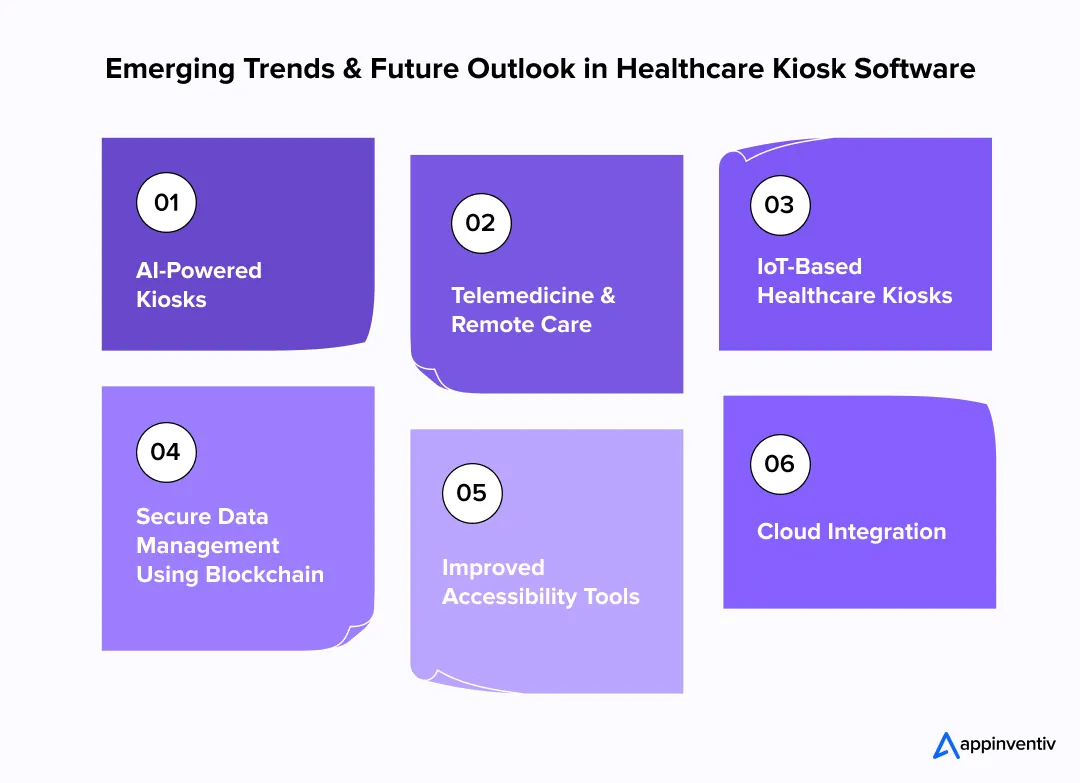
AI-Powered Kiosks: AI-powered healthcare kiosk development is enabling personalized patient interactions, symptom triage, and guided health assistance, improving both patient experience and care delivery.
Telemedicine and Remote Care: With the rise of telehealth, kiosks now serve as telemedicine hubs where patients can consult healthcare providers remotely, expanding access to medical care in underserved and rural areas.
IoT-Based Healthcare Kiosks: IoT integration allows kiosks to collect and transmit real-time patient data such as vital signs and blood pressure, providing healthcare teams with immediate, actionable insights.
Cloud Integration: Cloud-enabled kiosks support enhanced scalability, real-time data synchronization, and remote monitoring, ensuring continuous system availability across healthcare networks.
Improved Accessibility Tools: Modern kiosks are becoming more multilingual, voice-activated, and adaptive for patients with disabilities or limited technical familiarity, improving overall accessibility.
Secure Data Management Using Blockchain: Blockchain is being explored to create secure and transparent systems for handling patient data, strengthening trust and data protection in healthcare kiosk environments.
These trends highlight the expanding role of kiosks in shaping efficient, connected, and patient-centric healthcare delivery.
Modernize Hospital Operations Today
Reduce wait times and costs with interoperable kiosk systems.

Why Appinventiv is the Right Partner for Healthcare Kiosk Software Development?
We are Appinventiv, a company dedicated to developing tailored healthcare software that will transform operational efficiency, strengthen patient engagement, and refine care delivery. We have 10 years of experience in the healthtech business, providing 500+ digital health solutions and supporting 450+ healthcare customers worldwide.
Our healthcare kiosk developers are aware of the complexities of the health sector, and we are interested in designing scalable, secure, and compliant kiosk platforms that beautifully integrate with your current EMR/EHR systems, telemedicine solutions, and payment solutions. It can be patient flow, administrative workflow or even the general patient experience; our custom solutions are tailored to your unique requirements.
The healthcare space apps that we have created include:
- YouComm is a health app for patient engagement and health measurements.
- The Soniphi Vitality application combines personalized care, health checks, and remote care.
- Health-e-People, which builds on mobile technology to screen health and manage wellness.
- DiabeticU is a diabetes management app that helps patients track their health and receive education.
Through collaboration with Appinventiv’s healthcare kiosk developers, you will have access to a team of experts who can develop meaningful digital health applications without compromising data security or HIPAA compliance. We provide full support, from the beginning of the consultation through ongoing maintenance after deployment, so that your kiosks and healthcare software will evolve with your needs.
We can discuss how Appinventiv, a top healthcare software development company, can help your healthcare organization adopt innovative digital health kiosk solutions that enhance care, reduce costs, and improve patient satisfaction.
Frequently Asked Questions
Q. What is a healthcare kiosk software solution?
A. Patient check-in, payment, and appointment scheduling are automated with a healthcare kiosk software solution. It is automated with EMR/EHR systems, payment gateways, and telehealth platforms to deliver a self-service experience with no wait times, streamlined operations, and patient satisfaction.
Q. Can kiosks be integrated with existing healthcare systems?
A. Indeed, healthcare kiosks are easily compatible with EMR/EHR systems, billing systems, and telemedicine services, thereby facilitating real-time data synchronization and enhancing organizational workflow processes.
Q. What are the main benefits of using healthcare kiosk software?
A. Key benefits include:
- Operational efficiency: Eliminates menial tasks, freeing personnel to focus on other important tasks.
- Economy: saves on the cost of administration and mistakes.
- Better patient experience: Faster check-in and payment.
- Accuracy of the data: Integrates with EMR/EHR systems to update data in real time.
- Scalability: Easily scalable to new locations.
Q. Why Healthcare Providers Invest in Kiosk Solutions?
A. Kiosks are investments healthcare providers make to increase efficiency, lower costs, and improve patient satisfaction. Kiosks automate administrative processes, support the growing number of patients, and accelerate the digital transformation of the healthcare system.
Q. Why Partner with Appinventiv for your Ideal Healthcare Kiosk Software Development?
Appinventiv is a provider of personalized kiosk products with more than 10 years of healthcare expertise. Our kiosks are VR-friendly, integrate with EMR/EHR systems, telemedicine platforms, and payment gateways, and ensure security and regulatory compliance.
Q. What technologies are used to develop healthcare kiosk software?
A. Key technologies include:
- Data synchronization and monitoring of cloud-based solutions.
- AI in automated triage and health evaluation.
- IoT for device integration.
- Encryption is required to comply with HIPAA and GDPR.
- Multiproject development to guarantee cross-platform development.











![What Is a Markup Language? [+ 7 Examples]](https://mgrowtech.com/wp-content/uploads/2025/06/markup-language-sm-350x250.png)