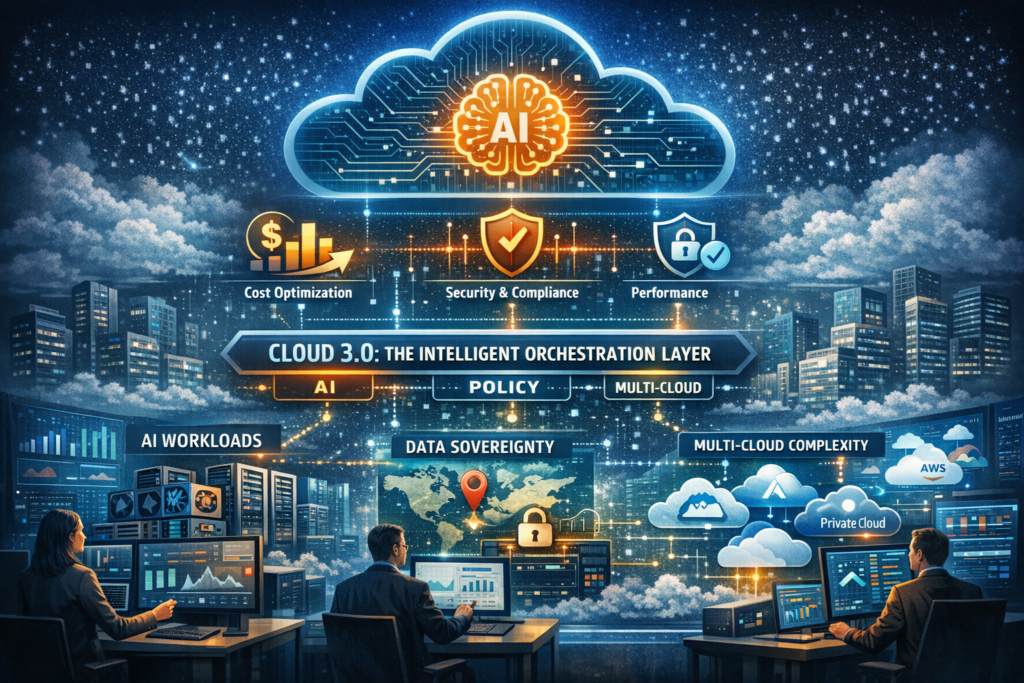
Cloud computing is no longer just about hosting applications or scaling infrastructure. In 2026, it becomes a decision-making layer that directly influences cost, performance, security, and compliance across the enterprise.
Organizations have already adopted cloud at scale. However, they now face new problems. AI workloads increase compute demand. Multi-cloud environments introduce operational complexity. Regulatory requirements force stricter control over data location and access. As a result, traditional cloud strategies no longer meet enterprise needs.

Figure: Cloud 3.0: A Future of Intelligence
Industry leaders reinforce this shift. Enterprise architects and cloud strategists increasingly describe cloud as an intelligent orchestration layer rather than a traditional infrastructure. Instead of asking where to deploy workloads, organizations now ask how to continuously optimize them.
Cloud 3.0 addresses this challenge. It introduces an AI-driven, policy-controlled, multi-environment cloud model that aligns infrastructure decisions with business outcomes in real time.
What Is Cloud 3.0?
Cloud 3.0 is an advanced cloud computing model that integrates AI-driven orchestration, automated governance, and multi-environment workload management into a unified system.
You can define Cloud 3.0 as:
A cloud architecture that uses AI and policy engines to automatically decide where and how workloads should run across hybrid, multi-cloud, and edge environments.
Unlike earlier cloud models, Cloud 3.0 doesn’t rely on static deployment decisions. Instead, it continuously evaluates performance requirements, cost constraints, compliance policies, and security posture, and dynamically adjusts workload placement.
The following are some key characteristics of Cloud 3.0:
- AI-driven infrastructure management
- Intent-based workload placement
- Real-time governance and compliance enforcement
- Unified visibility across cloud environments
- Continuous cost optimization through FinOps
Cloud 3.0 transforms the cloud from a passive platform into an active control system.
Also Read: Top 10 Enterprise Tech Trends to Watch in 2026
Evolution: From Cloud 1.0 to Cloud 3.0
Cloud computing has evolved through three distinct phases, each solving a different enterprise problem.
Cloud 1.0: Accessibility and Cost Efficiency
Cloud 1.0 introduced SaaS and basic infrastructure services. Organizations moved workloads from on-premises systems to cloud providers to reduce capital expenditure and improve accessibility.
Limitation:
Limited control and customization. Enterprises relied heavily on provider capabilities.
Cloud 2.0: Scalability and Performance
Cloud 2.0 enabled large-scale adoption through containers, Kubernetes, and multi-cloud strategies. Organizations built scalable, distributed systems and improved application performance.
Limitation:
Complexity increased. Platform teams struggled with cost management, governance, and visibility across environments.
Cloud 3.0: Intelligence and Control
Cloud 3.0 introduces intelligence into cloud operations. AI engines, policy frameworks, and automation systems dynamically manage infrastructure.
| Phase | Focus | Limitation |
| Cloud 1.0 | Hosting | Limited control |
| Cloud 2.0 | Scalability | Cost and complexity |
| Cloud 3.0 | Intelligence | Requires governance maturity |
In Cloud 3.0, the cloud platform becomes self-optimizing, policy-aware, and business-aligned.
Key Pillars of Cloud 3.0 Architecture
Cloud 3.0 relies on five foundational pillars that enable intelligent and controlled cloud operations.

Figure: Key pillars of Cloud 3.0 architecture
- AI-Driven Cloud Operations (AIOps)
AI becomes the core engine of cloud operations. Systems analyze telemetry data, detect anomalies, and automatically optimize resources.
You can expect:
- predictive scaling
- automated incident response
- self-healing infrastructure
This reduces operational overhead and improves system reliability.
- Hybrid and Multi-Cloud by Default
Enterprises no longer depend on a single cloud provider. Cloud 3.0 adopts a multi-environment strategy that includes:
This approach improves flexibility and reduces vendor lock-in. It also allows organizations to place workloads based on performance, cost, and compliance needs.
- Edge and Distributed Cloud
Edge computing becomes critical as applications require low latency and real-time processing. Cloud 3.0 extends workloads closer to users and devices.
Use cases include:
- AI inference at the edge
- IoT systems
- real-time analytics
This reduces latency and enhances user experience.
- Built-In Governance and Compliance
Cloud 3.0 integrates governance into the architecture rather than treating it as an afterthought.
Key capabilities include:
- policy-based access control
- automated compliance checks
- real-time enforcement of security policies
This ensures that every workload aligns with regulatory and organizational requirements.
- FinOps-Driven Cloud Consumption
Cloud 3.0 embeds financial accountability into infrastructure decisions. FinOps practices enable continuous cost monitoring and optimization.
You can:
- track cost by workload
- enforce budget constraints
- optimize resource usage automatically
This transforms cost management into a real-time control mechanism.
Also Read: DPUs/SmartNICs for AI fabrics: Practical Offload Patterns for East–West Traffic
How Cloud 3.0 Works?
Cloud 3.0 operates through a continuous decision loop that aligns infrastructure with business intent.
Step-by-Step Workflow
- Define Intent – You specify requirements such as performance targets, cost limits, and compliance rules.
- AI Evaluation – The system analyzes available environments across cloud, edge, and on-premises infrastructure.
- Workload Placement – The platform selects the optimal location for deployment based on defined intent.
- Continuous Monitoring – The system tracks performance, cost, and security metrics in real time.
- Automated Optimization – AI engines adjust resources, scale workloads, or relocate them as conditions change.
This creates a closed-loop system where cloud operations continuously improve without manual intervention.
Why Enterprises Are Moving to Cloud 3.0
Several forces are pushing organizations toward Cloud 3.0 adoption.

Figure: Cloud 3.0 enterprise shift
AI Workload Expansion
AI and machine learning workloads demand high-performance infrastructure and generate unpredictable resource usage. Traditional cloud models cannot efficiently optimize these workloads.
Rising Cloud Costs
Organizations struggle with cloud cost visibility and control. Inefficient resource allocation leads to overspending. Cloud 3.0 introduces FinOps-driven optimization to address this issue.
Security and Compliance Complexity
Multi-cloud environments increase security risks and compliance challenges. Organizations must enforce consistent policies across distributed systems.
Vendor Lock-In Concerns
Enterprises want flexibility to avoid dependency on a single provider. Multi-cloud strategies allow better negotiation, resilience, and control.
Enterprise discussions across LinkedIn and practitioner communities highlight a growing concern around cloud dependency and sovereignty risk. Many organizations now evaluate cloud providers based on regulatory alignment and long-term control, not just features or pricing.
Cloud 3.0 and Security: From Protection to Continuous Prevention
Cloud 3.0 changes how you design and operate security. Traditional models focus on perimeter defense and reactive incident response. Cloud 3.0 shifts security toward continuous validation, identity control, and automated prevention.
In a multi-cloud and AI-driven environment, you cannot rely on static controls. Workloads move dynamically. AI systems interact with multiple services. Attack surfaces expand beyond traditional boundaries.
Key Security Principles in Cloud 3.0
- Zero trust architecture – You must verify every request based on identity, context, and policy.
- Identity-first security – You should treat identity as the primary security control, not network location.
- AI-driven threat detection – Security systems must detect anomalies and respond automatically in real time.
- Continuous posture management – You must monitor and validate security configurations across all environments.
Also Read: Vector Databases vs Traditional Databases: What Enterprises Should Know
Security practitioners across LinkedIn emphasize that AI-driven systems increase the attack surface, especially with autonomous workflows and API-heavy architectures. Experts highlight that organizations must shift toward preemptive and automated defense models to stay ahead of AI-powered threats.
Cloud 3.0 integrates security directly into the platform, ensuring protection scales with infrastructure complexity.
Cloud 3.0 and FinOps: Cost Becomes a Real-Time Decision Layer
In Cloud 3.0, cost becomes a real-time decision parameter that influences how and where workloads run.
Traditional cost management relies on after-the-fact analysis. This approach fails in dynamic environments where workloads scale, shift, and consume resources unpredictably.
The following are some key FinOps capabilities in Cloud 3.0:
- Real-time cost visibility – You can monitor spending at workload, team, and service levels.
- Automated cost optimization – Systems adjust resources to minimize waste without impacting performance.
- Budget-aware workload placement – AI engines consider cost constraints when deploying workloads.
- Cross-team accountability – Engineering, finance, and operations share responsibility for cloud spend.
FinOps Foundation leaders consistently highlight that cost optimization requires engineering ownership. Organizations that embed FinOps into platform decisions achieve better cost control than those treating it as a finance-only function.
Cloud 3.0 and Sovereignty: Regional Strategy Becomes Critical
Cloud 3.0 introduces a new requirement: designing infrastructure around geography, regulation, and control.
Data residency laws, regional compliance requirements, and geopolitical factors influence where workloads must run. Enterprises can no longer assume a globally uniform cloud architecture.
Key Sovereignty Considerations
- Data residency requirements – You must store and process data within specific regions.
- Regulatory compliance – You must align with laws such as GDPR and industry-specific regulations.
- Vendor dependency risk – You must avoid over-reliance on a single provider or region.
- Control over critical workloads – You must maintain operational independence and continuity.
Discussions among enterprise architects and sysadmins highlight growing concern about reliance on foreign cloud providers. Organizations increasingly evaluate cloud strategies based on sovereignty, control, and long-term resilience, not just cost and features.
Cloud 3.0 enables you to design region-aware architectures that meet both technical and regulatory requirements.
Benefits of Cloud 3.0 for Enterprises
Cloud 3.0 delivers measurable advantages across performance, cost, security, and operations.
Key Benefits
- Faster decision-making – AI-driven systems optimize workloads in real time.
- Improved cost efficiency – FinOps integration reduces waste and aligns spend with value.
- Enhanced security posture –
Continuous monitoring and automation reduce risk exposure. - Greater flexibility –
Multi-cloud and hybrid strategies enable workload portability. - Higher resilience –
Distributed architectures improve fault tolerance and availability. - Better compliance – Built-in governance ensures alignment with regulatory requirements.
Cloud 3.0 enables you to balance performance, cost, and risk simultaneously, a feat traditional models cannot achieve.
Challenges of Cloud 3.0 Adoption
Cloud 3.0 introduces new capabilities, but it also creates new challenges that you must address proactively.
Key Challenges:
- Operational complexity – Managing multiple environments increases coordination overhead.
- Skills gap – Teams need expertise in AI, automation, governance, and FinOps.
- Governance maturity – You must define and enforce policies across distributed systems.
- Integration challenges – You must connect tools, platforms, and environments seamlessly.
- Tool sprawl – You must avoid fragmented solutions that reduce visibility and control.
To succeed with Cloud 3.0, you must invest in platform standardization and process alignment.
How to Prepare for Cloud 3.0?
You should approach Cloud 3.0 adoption as a strategic transformation, not a technology upgrade.
Practical Steps
- Define a clear cloud strategy – Align cloud initiatives with business goals and outcomes.
- Implement FinOps early – Establish cost visibility and accountability from the start.
- Adopt a platform engineering model – Build internal platforms that standardize tools and workflows.
- Invest in AI-driven operations – Use AIOps to automate monitoring and optimization.
- Build a governance framework – Define policies for security, compliance, and workload placement.
- Enable cross-team collaboration – Align engineering, security, and finance teams around shared goals.
These steps help you transition from traditional cloud models to intelligent, controlled cloud environments.
Conclusion: Cloud 3.0 Defines the Future of Enterprise Cloud Strategy
Cloud 3.0 transforms cloud computing into an intelligent, policy-driven operating model. It integrates AI, automation, governance, and cost control into a unified system that continuously adapts to business needs.
Enterprises succeed not just by adopting cloud, but by using it intelligently.
AI-driven infrastructure improves performance and efficiency. FinOps ensures financial discipline. Security evolves into continuous prevention. Sovereignty shapes architectural decisions.
Organizations that adopt Cloud 3.0 early gain a competitive advantage. They control cost, reduce risk, and deliver faster outcomes.
For CIOs, CTOs, and CISOs, the priority is building an intelligent, governed, and aligned cloud environment. Cloud 3.0 is the foundation of modern enterprise technology execution.