Fractional executive referrals are the fastest path from “hunting for clients” to “booked out 90 days.” The fractional executives who stop chasing leads share one thing in common: three to five strategic referral partners who understand their work, trust their capability, and regularly connect them to ideal clients — without any cold outreach required.
Three fractional executives walked into a BNI meeting at 7 AM on a Tuesday. One left with a $5,000-per-month retainer. The other two drove home with a stack of business cards and zero leads. Same room. Same handshakes. The only difference? Strategy.
Most fractional execs chase referrals the wrong way. They show up to events, swap cards, and wait. They follow up once, maybe twice, then move on when nothing materializes by week three. Or they try to pull referrals from clients who are barely satisfied with the work — a recipe for silence.
Here’s what they’re missing: fractional executive referrals work completely differently than referrals for a plumber or a real estate agent. You’re not selling to your referral partners. You’re building a system where the right people understand what you do, trust you deeply, and think of you automatically when a client problem surfaces. That takes intention — and it takes time. But the math is almost unfair once it’s working.
What Fractional Executive Referrals Actually Look Like (Most People Get This Wrong)
A referral network is not a networking group. That’s a critical distinction, and most fractional executives miss it entirely.
A networking group is a room full of people who want the same thing you do — more clients. You swap cards, attend events, and hope someone thinks of you eventually. A referral network is something different. It’s a strategic collection of people who understand your specific work, trust your capability, and have daily access to your ideal clients. They refer you because it serves their clients — not because they owe you a favor.
A referral network is a strategic collection of people who understand your specific work, trust your capability, and have daily access to your ideal clients.
The key insight is this: you have to become referable before you worry about referrals.
For traditional service businesses — plumbers, landscapers, cleaning companies — referrability is straightforward. The work either fixed the problem or it didn’t, and your referral partner can see the result. For fractional executives, it’s trickier. Your work lives inside someone’s strategy, their org structure, their revenue growth. Your referral partner never sees it directly. So they’re betting their reputation on your credibility alone.
💡 STRATEGY ALERT
Most fractional execs build networks of peers — other consultants, coaches, fellow fractionals. That’s a support group, not a referral network. You need connectors: people who interact with your ideal clients daily and see their problems up close. Peers can’t send you what they don’t have access to.
The Three Types of Referral Partners and Which Ones Actually Produce
Not all referral relationships are worth your time at the same level. Before you invest months into someone, know which type of partner you’re dealing with.
Type 1: Direct Connectors — Your Highest-Value Partners
Direct connectors have constant access to your ideal client. They see the problems your ideal clients struggle with on a daily basis — cash flow, scaling friction, people issues, revenue ceilings. When those conversations happen, they naturally reach for specialist help. If you’ve positioned yourself correctly, they reach for you.
Who they are:
- Accountants and bookkeepers (see cash flow and scaling challenges constantly)
- Financial advisors (see revenue and business structure questions)
- Business attorneys (see operational and legal risk before it becomes a crisis)
- Commercial loan officers (see revenue and cash flow problems on every application)
- HR consultants (see people and process issues)
- Insurance brokers (see risk and compliance across dozens of businesses)
Research from the U.S. Chamber of Commerce Small Business Index shows that small business owners cite cash flow and revenue concerns as their top two challenges — consistently, quarter after quarter. Your direct connector partners hear about these problems before the business owner even knows they need help. Position yourself well, and you’re the name they drop.
How to partner with them: Stop asking for referrals. Start helping them serve their clients better. Share insights about the specific problems you solve. Offer to co-present or co-create content. Answer their questions when clients have implementation gaps.
Type 2: Complementary Service Providers — Medium Value, Worth the Time
Complementary service providers serve your ideal client without competing with you. They interact with your target market regularly and can identify the moment their client needs additional expertise.
Who they are:
- Web designers and developers (especially for fractional marketing execs)
- Virtual assistants and operations managers (for scaling challenges)
- Graphic designers (for brand and positioning work)
- Sales coaches and trainers (for revenue growth)
- Business coaches (for general strategy)
These partnerships work best when the work is sequential, not simultaneous. Your client finishes a web design project and realizes they need fractional marketing strategy. The timing creates a natural handoff. How to partner with them: Create explicit handoff agreements. Define where your work starts and theirs ends. Share clear frameworks about your specialty so they know exactly which client problems belong in your lane.
Type 3: Peer Networks — Low Referral Value, High Sanity Value
Other fractional execs, consultants, and coaches. You understand each other’s work deeply, which makes conversation easy. But you rarely have direct access to each other’s ideal clients.
Be honest about what these relationships are: collaboration opportunities, overflow pipelines, and morale boosters. Don’t expect a steady stream of inbound referrals. Do expect support, second opinions, and the occasional project partnership that neither of you could handle alone.
| Partner Type | Referral Frequency | Best For | How Often to Touch |
|---|---|---|---|
| Direct Connector | 2–4 referrals/year (potentially more) | Building a sustainable pipeline | Monthly check-ins + quarterly in-person |
| Complementary Provider | 1–2 referrals/year | Expanding reach without competition | Quarterly check-ins + as-needed collaboration |
| Peer Network | 0–1 referral/year | Support, collaboration, credibility | Monthly group meetings or quarterly 1:1s |
The 90-Day Lag Nobody Warns You About
I want to save you from the frustration I see over and over. You meet a great accountant at an event, follow up twice, and nothing happens by week three. So you move on and chalk it up as a dead end. That’s the wrong call — and it’s killing your fractional executive referrals pipeline before it has a chance to produce.
Referrals don’t happen immediately. There’s a 60–90 day activation period from when you first meet a potential referral partner to when they send their first real client your way. Your referral partner needs to:
- Remember you and what you do (this takes repetition — hearing your name once doesn’t stick)
- Understand your ideal client well enough to recognize the fit when they see it
- Have a client who actually needs your work at that moment
- Trust you enough to put their reputation on the line for the introduction
According to research on networking effectiveness, consistent engagement over months separates high-performing referral networks from passive ones. Most fractional execs quit right when the relationship is about to produce.
⚠️ REALITY CHECK
Your first referral from any partner typically comes 60–90 days after initial contact. If you’re three months in with consistent touchpoints and still nothing, then yes — either the relationship isn’t right or your positioning needs work. But three weeks of silence means nothing. Stay the course and keep showing up.
The partners who send the most business are the ones you’ve invested in over 6–12 months. They sent nothing in month one. By month six, they were thinking of you every time a relevant client problem surfaced.
How to Make Yourself Referable (The Part Nobody Talks About)
You could meet a hundred accountants and still get zero referrals if your positioning is weak. Referrability depends on three things, and all three have to be in place before the referrals start flowing.
1. Absolute Clarity About Who You Help
Your referral partner needs to be able to picture your ideal client. Not “small business owners.” Not “growth-stage companies.” Something specific enough that when the right person walks into their office, a light goes on.
Strong positioning sounds like this:
- “I work with SaaS companies between $500K and $2M ARR who are ready to scale their operations but their founder is still doing everything.”
- “I help home service businesses — HVAC, plumbing, electrical — systematize their customer acquisition so the owner stops being the bottleneck.”
- “I advise e-commerce founders on packaging strategy and pricing before they raise their Series A.”
When your accountant has a client who matches that description exactly, they think of you immediately. Without that specificity, they shrug and move on.
2. Visible Expertise in Your Specific Area
Your referral partner can’t see your work. But they can see your thinking. They need proof — not your word for it — that you actually know what you’re talking about. Visible thought leadership is the shortcut to credibility.
How to show expertise:
- Share content — LinkedIn posts, articles, case studies — that solves specific problems your ideal client faces
- Answer questions their clients bring to them when those questions land in your specialty
- Talk about specific problems you solve, not vague “business growth” language
If you’re a fractional CFO, your accountant referral partner should see you discussing cash flow modeling, burn rate, and runway calculations — not general “financial strategy.” Speak the language of your specialty, out loud, where they can see it.
3. A First-Referral Experience That Makes Them Want to Do It Again
This is the hinge point. When an accountant refers you to a client, they put their reputation on the line. Full stop. If you deliver, they refer again. If you disappoint — or go quiet after the introduction — they won’t. Customer experience directly determines referral behavior.
This means:
- Respond fast. Delays on a warm introduction signal you don’t value their trust.
- Close the loop. Tell your referral partner what happened. Did you land the project? Why or why not? They need that feedback to refer better next time.
- Treat the referral like gold. A referred client is already predisposed to work with you because someone they trust said so. Don’t handle them like a cold lead.
The Month-by-Month Playbook for Fractional Executive Referrals
Let me give you the exact sequence. This isn’t theory — it’s the approach that works.
Month 1: Map Your Ideal Client’s Professional Ecosystem
Start with your ideal client’s world. Who does your ideal client meet with regularly? Who advises them before they make big decisions? Who sees their problems before they do?
Action steps:
- List the top five types of professionals who serve your ideal client
- Research 10–15 individuals in each category via LinkedIn, local business directories, and professional associations
- Prioritize by geography (if you do in-person work) or by industry specialization
- Build a simple spreadsheet: name, company, specialty, and your planned approach
Example: If you’re a fractional operations executive who works with home service companies, your target partners might include:
- Small business accountants who specialize in contractors
- Business loan officers at community banks
- HVAC and plumbing supply company owners (they understand the industry from the inside)
- Payroll service providers who work with construction companies
- Equipment and tool rental companies
Month 2: Make Contact and Start Earning Trust
Don’t ask for referrals. Ask for insight. Frame this entire phase as relationship-building, not business development. Strong initial conversations require genuine curiosity.
Action steps:
- Send a personalized LinkedIn message or email: “I noticed you work with [industry type]. I’d love to buy you coffee and learn about the common challenges you’re seeing.” Include a specific detail — it has to be clearly personal, not a template.
- Offer something useful first: share an article about trends in their niche, ask a genuine question about their business, or share a pattern you’re seeing in the market.
- Schedule 15–20 minute coffee chats, in-person or Zoom. The only goal is conversation.
- Listen for the problems their clients bring to them. That’s your positioning data.
What to actually say: “I work with [specific client type] on [specific problem]. I noticed a lot of the companies you work with seem to struggle with [related problem]. Have you seen that?” You sound insightful without being pushy.
Month 3–4: Get Specific and Show Your Work
By now you’ve met 5–10 potential referral partners. Some conversations were duds. A few had real chemistry. Focus your energy on the two or three where something clicked.
Action steps:
- Focus deeper time on the 2–3 people who showed genuine interest
- Create a one-page overview of the exact problems you solve and who your ideal client is. Share it: “I realize we didn’t get into the specifics of my work. Here’s a quick overview. Does this sound like anyone you’re working with right now?”
- Share content that demonstrates your expertise — a LinkedIn article, a case study, a short white paper
- Ask a specific question about their business: “What’s the biggest challenge you’re seeing in [your market] right now?” Genuine interest beats any pitch.
Month 4–6: Create Visible Reasons to Think of You
The relationship is established, but referrals haven’t materialized yet. Your job now is to stay top-of-mind and give them reasons to connect your name to their client’s problems.
Action steps:
- Send a monthly touchpoint that’s not about you needing something: “I saw an article about [topic relevant to their niche]. Thought of you immediately.” Or: “One of my clients solved [problem] in a clever way — thought it might be useful.”
- Offer to answer questions their clients bring to them: “Sometimes your clients ask about [your expertise area] and you don’t have an answer ready. Happy to jump on a quick call to help.”
- Look for collaboration: co-present at an industry event, create content together, offer to be a guest expert in their newsletter.
- Engage genuinely with their LinkedIn content. Comment thoughtfully, not just with emojis.
Month 6+: Activate, Amplify, and Expand
By month six, if the relationship is solid, you should be seeing your first referral or two come through. Whether you are or not, shift into maintenance and amplification mode.
Action steps:
- When you get a referral, respond with gratitude and a clear update on the outcome. Feedback strengthens referral relationships over time.
- After completing a referred project, ask if your referral partner can share the success — a testimonial, a brief case study, even a word-of-mouth story to their other clients.
- Expand the relationship: “Who else in your network would benefit from knowing what we do together?” That opens the door to second-degree referrals.
- Transition from monthly digital touchpoints to quarterly in-person ones — the relationship has matured enough to deserve that investment.
🛑 DON’T COPY BLINDLY
This entire timeline assumes the referral partner actually has access to your ideal client. If you’re investing six months in an accountant who serves retail businesses and you focus exclusively on SaaS, no amount of relationship-building produces referrals. Vet the fit before you invest the time.
BNI vs. DIY vs. Mastermind — Which Referral Channel Is Right for You?
You have three main channels for building fractional executive referrals. Each has real trade-offs, and the right choice depends on your market, your personality, and your ideal client.
Option 1: BNI — Business Network International
How it works: Weekly one-hour meetings where members give referrals to each other. You commit to attending and contributing referrals to the group consistently.
Best for: Fractional execs in smaller markets, people who thrive with structure and accountability, those who want pre-vetted connections. Read the full BNI review for the complete picture.
Trade-offs:
- Membership dues: $500–$1,200 per year
- Time commitment: one hour per week plus monthly social events
- Commitment contract: usually 6–12 months minimum
- Referral pressure: you’re expected to give referrals even when the fit isn’t right
The reality: BNI works best if your ideal client is a local business owner and you’re willing to show up consistently. If you’re trying to build relationships with accountants and lenders — not fellow entrepreneurs — BNI’s model gets frustrating fast. You’re networking with potential clients instead of the connectors who can refer them.
Option 2: DIY Referral Network — The Accountant/Lender/Attorney Strategy
How it works: You strategically identify and develop relationships with three to five direct connectors in your geographic area or industry. You manage the relationships individually, without formal group structure.
Best for: Fractional execs who want to own their most valuable relationships, people who prefer one-on-one over group settings, those with limited local market options.
Trade-offs:
- Time investment: one to two hours per month per relationship
- Success depends entirely on your positioning and follow-through — no accountability structure
- Slower ramp-up (first referrals typically come after six months)
- Requires consistent, self-motivated outreach
The reality: This is the highest-ROI option if you do it with discipline. One accountant partner sending you two to three referrals per year at $4,000 per month average means $8,000–$12,000 in annual recurring revenue from a single relationship. Scale that to three strong partnerships and you have a self-sustaining pipeline.
Option 3: Mastermind or Peer Network
How it works: A group of six to twelve complementary service providers who meet monthly to share referrals, strategies, and advice. Often facilitated by a paid mastermind leader.
Best for: Fractional execs with complementary offerings — a fractional CMO, fractional CFO, and fractional HR director all serve the same client at different levels and can refer naturally to each other.
Trade-offs:
- Cost: $200–$500 per month depending on the group
- Group dynamics: you’re reliant on everyone else showing up and engaging
- Referral quality depends entirely on group composition
- Competition risk: you may be sharing your best referral sources with others in the group
The reality: Masterminds work when the group is intentionally composed. “We all have the same ideal client” is a problem. “We each serve a different aspect of the same client’s needs” is the model that actually generates consistent referrals.
When Fractional Executive Referrals Aren’t Happening — a Diagnostic Checklist
You’ve been building relationships for three months and haven’t gotten a single referral. Before you walk away, ask yourself these four questions. Research on why referral networks stall consistently points to positioning gaps and expectation mismatches — not relationship quality.
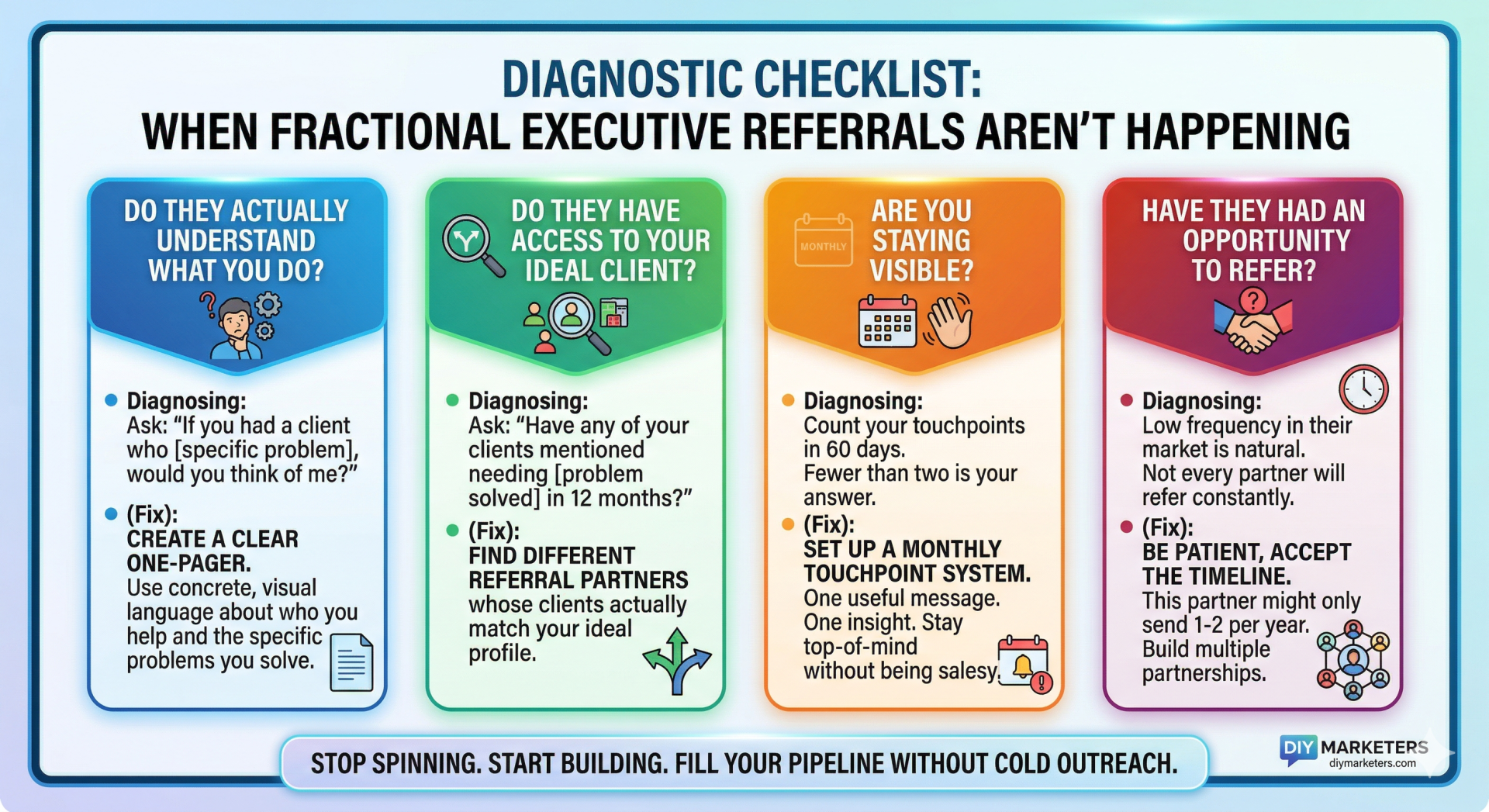
Do They Actually Understand What You Do?
You’ve told them. But have they truly understood? With fractional consulting work, what you do is abstract to people outside the industry.
Diagnose it: Call your referral partner and ask, “If you had a client who [specific problem], would you think of me?” If they pause or ask for clarification, your positioning isn’t clear enough yet.
Fix it: Create a one-page description of your ideal client and the specific problem you solve. Use concrete, visual language: “When a company hits $1M in revenue, they hit a growth ceiling because the owner is still doing everything. I come in and systematize the three biggest time-sucks so the owner can focus back on revenue.”
Do They Have Access to Your Ideal Client?
The accountant you’ve been cultivating serves restaurant owners. You work with software companies. The fit will never work regardless of how warm the relationship becomes.
Diagnose it: Ask directly: “In the last 12 months, have any of your clients mentioned needing [the problem you solve]?” A consistent “no” is data.
Fix it: Either expand your ideal client definition to match their ecosystem, or find a different referral partner whose clients actually need your work.
Are You Staying Visible?
You met once two months ago. Of course they haven’t referred you. You’re not top-of-mind because you’ve disappeared.
Diagnose it: Count how many times you’ve reached out in the last 60 days. Fewer than two? That’s your answer.
Fix it: Set up a monthly touchpoint system. One message. One insight. One reason for them to think about your work. Brief and valuable, not salesy.
Have They Actually Had an Opportunity to Refer?
Sometimes the relationship is perfect and your positioning is crystal clear, but they haven’t had a client who needed you yet. That’s not failure — that’s math.
Diagnose it: Ask: “How many clients in [your market] have dealt with [the problem you solve] in the last six months?” Low numbers mean naturally lower referral frequency.
Fix it: Accept that this partner might only send one or two referrals per year — and that’s completely fine. Diversified customer acquisition always beats depending on a single source. Build multiple partnerships so you’re never waiting on one person.
Frequently Asked Questions About Fractional Executive Referrals
How many referral partners do I actually need?
Aim for three to five strong direct connectors — accountants, lenders, attorneys. One strong partnership might send you two to four referrals per year. Three strong partnerships give you six to twelve referrals annually, which is enough to build a sustainable practice without constant business development activity. Beyond five, you’re spreading yourself too thin on relationship maintenance.
Should I give referrals if I’m not getting any back yet?
Yes — but do it strategically, not artificially. If an accountant is a good potential partner and you genuinely encounter someone who would benefit from their services, refer them. Don’t manufacture referrals just to balance a scorecard. Referral relationships aren’t 1:1 exchanges. Sometimes one person refers more than the other, and that’s fine as long as the fit between your networks is real.
What do I do when a referral partner keeps sending me poor-fit clients?
Address it directly and kindly. After two or three clients who don’t fit, call and say: “I appreciate the referrals — I want to make sure I’m being clear about my ideal client. The clients I’m most successful with are [specific description]. Does that match the people you’re working with right now?” This recalibrates expectations without damaging the relationship.
How often should I stay in touch with referral partners?
Monthly at minimum — via email, message, or a brief call. Quarterly in-person or Zoom coffee chats are ideal. One genuinely useful touch per month beats three “just checking in” messages every time. Stay top-of-mind without becoming background noise.
Can I build a strong referral network entirely online?
Yes, especially if you work in a specialized industry where geography doesn’t limit your client base. The trade-off is speed — online relationship activation is slower. A 30-minute Zoom coffee with an accountant might require two to three months of LinkedIn exchanges to arrange. In-person meetings accelerate trust significantly. A hybrid approach works best: build the initial connection online, then move to quarterly in-person when possible.
Additional Reading from DIYMarketers
My Brutally Honest BNI Review: Is It a Referral Goldmine or a Massive Time-Suck? — The complete breakdown of BNI’s model, pricing, and whether it’s worth your time as a fractional executive.
7 Networking Groups Like BNI — Which One Is Best for You? — Solid alternatives to BNI if you want structure without the same format or time commitment.
Why Your Referral Marketing Stops Working (And How to Fix It in 24 Hours) — Diagnosing the real reasons your referral pipeline goes cold.
Fractional Executive Pricing: How Corporate Refugees Are Solving the Small Business Problem — Pricing your fractional services so the referrals are financially worth pursuing.
16 Referral Incentive Ideas Your Network Will Love — How to structure referral rewards that actually motivate people to send you business.
Get Customers — The foundational approach to customer acquisition for small business, because referrals are one channel — not your whole strategy.