Why agreeing on a policy for how AI is used in marketing is an essential part of the future marketing playbook for all businesses
ChatGPT has thrust Generative AI into prominence for marketers and many others whose activities involve content creation. Many have been ‘wowed’ by the power of this and similar tools for the speed of generating copy and content to save time. Yet time to produce content is only one part of effective content marketing. Without a policy for managing how AI is used by marketers within a business, we’ll see that there are many risks that need to be controlled.
It reminds me of a similar situation to fifteen plus years ago when social media marketing was first widely adopted. As its use evolved, it was often used on an ad hoc basis in different parts of a business and often by junior marketers or interns without the oversight of more experienced marketing professionals. Many examples of reputational damage, particularly for customer service were soon shared and businesses realized that governance policies were a must-have and often this included writing into contracts what was expected of employees.
We have been keen to support marketers from the get-go in exploiting the fantastic opportunities of using ChatGPT through our articles on using ChatGPT in marketing and our ChatGPT cheatsheet. Yet, in our content for premium members such as our Quick Wins on Using ChatGPT in marketing we have urged caution and advised that businesses from small to large should create an AI copywriting policy or AI playbook.
I suggest either term could be relevant for your business to use since, depending on the size and type of business, the emphasis may need to be more on governance to control the use of AI, to manage the risk, or more about making the most of the opportunity by using AI in a positive rather than a negative way. So the purpose of each is:
- Using AI for Marketing governance policy – Emphasis on controlling use of AI to reduce risks of reputational damage (with a dual-benefit of improving internal cohesion)
- Using AI for Marketing playbook – Emphasis on use AI to improve marketing effectiveness.
See our article explaining Marketing Playbooks to understand the benefits of encouraging teams to follow a playbook to improve marketing effectiveness in a business.
Whatever you call your document, many of the sections will need to be the same, so, towards the end of the article, Business Members can use our AI and governance policy template to structure their own document.

Download our premium member resource – AI for Marketing playbook and governance policy template
Create your own AI marketing strategy and governance policy using Smart Insights simple template and use-cases for improving use of AI within your business to increase productivity, maintain brand trust and reduce costs.
Access the AI for marketing playbook and governance policy template
Why an AI marketing policy or playbook is needed
You may remember Mark Schaefer’s excellent Content Shock concept and infographic, which highlighted the challenge of the growth of content marketing. But this was published over ten years ago, and with AI this challenge has become greater still. Although many poor examples of AI content quality don’t get cut through and to be effective, AI-generated content must pass the Marketing 101 tests of effective marketing content. Effective content must:
- Engage audiences to support conversion to lead and sale to support business goals
- Improve the reputation of brands and businesses by alignment with brand value
- Provide Google with positive organic search signals through good dwell times
The danger is, that without practical controls, using AI for marketing may achieve the polar opposites of these goals. The risk is that if the opportunity of using AI for copywriting isn’t managed, it can give rise to the problems outlined below.
What parts should an AI governance policy for marketing contain?
With governance policies, it’s best to start by considering the risks, i.e., what the risks are, rating their probability and impact, and how they can be mitigated. This 2023 survey reviewing The Marketer and the Machine highlights some of the main risks. The survey sample was 500 B2C marketers in the US (250) and UK (250) at director-level or above at companies with 500 or more employees and $500+ million in annual revenues. This adds to our coverage of the practical risks of ineffective we looked at above by presenting some of the ethical risks
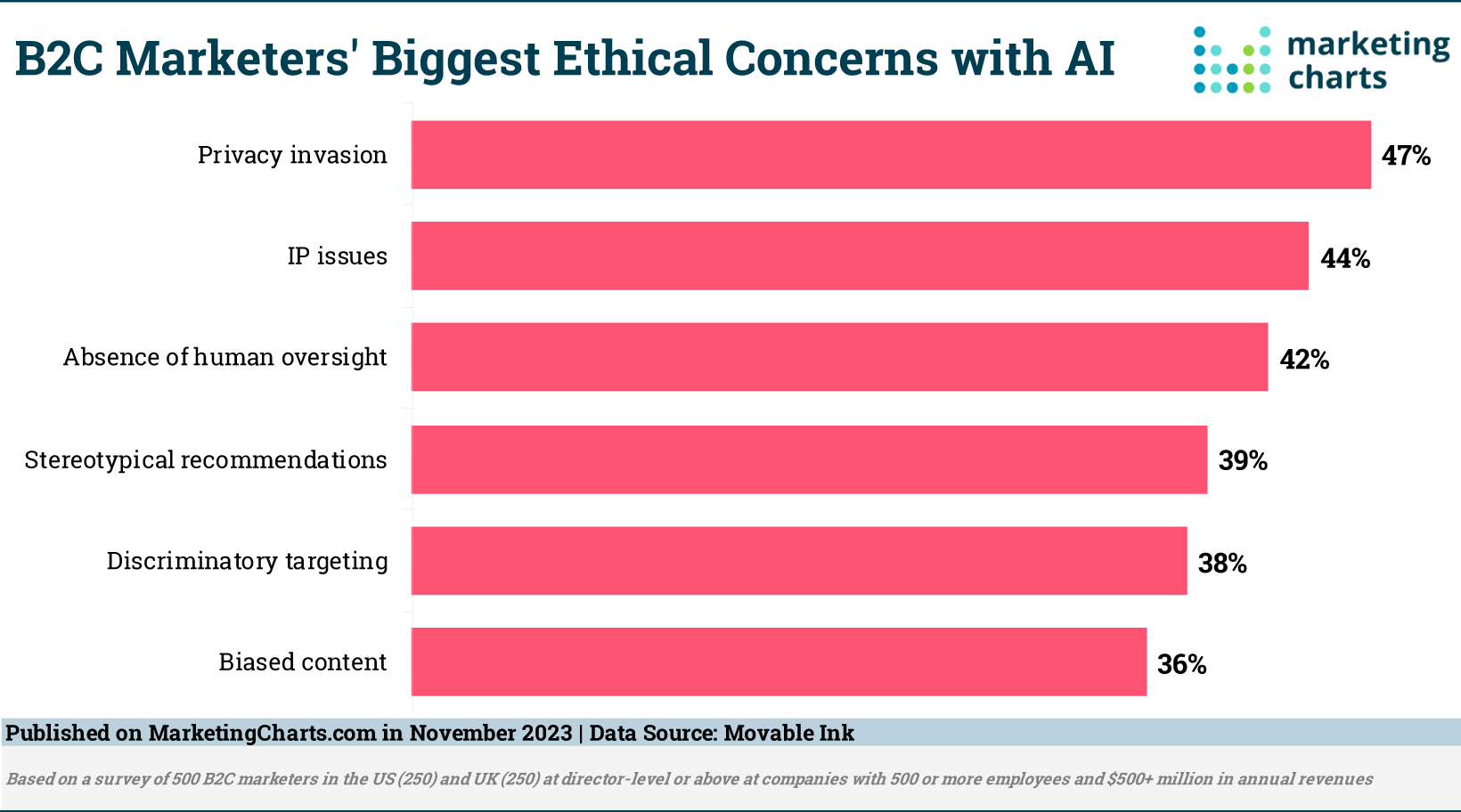
Adding these ethical risks to the practical risks I mentioned earlier, gives these five types of risks that must be managed through an AI marketing policy:
- Content quality risks that make copy and visuals ineffective in supporting marketing aims for channels like organic search or email marketing
- Reputational risks from poor quality or off-brand content
- Customer privacy risks
- Ethical risks from not recognizing diversity and inclusion (avoiding discrimination)
- Intellectual Property risks – security and legal
When I’ve talked to marketers at conferences recently, I’ve found a few in larger organizations are discussing or have set up policies to make sure AI is used in the right way commercially and ethically.
This is less relevant for smaller organizations, but every business should consider what AI should and shouldn’t be used to support their goals. Business Members can use our template to determine the scope or policy required for their current organizational usage.
Download our premium member resource – AI for Marketing playbook and governance policy template
Create your own AI marketing strategy and governance policy using Smart Insights simple template and use-cases for improving use of AI within your business to increase productivity, maintain brand trust and reduce costs.
Access the AI for marketing playbook and governance policy template
An example AI for marketing policy for Smart Insights
To help advise others on structuring a policy we’re following good practice ourselves and have created our own playbook. We call it this since as a small business, our main aim is using AI to improve our communications effectiveness while maintaining our brand effectiveness. The emphasis is on copywriting since we don’t invest in using AI to improve targeting outside of Google and LinkedIn Ads, although we have tested AI targeting in email marketing in the past.
Section 1. What we use AI for content and copy creation for
This explains the use cases for different marketing activities for which we use AI. It explains what’s in and what’s out!
Promotional product content
We use ChatGPT to support our writing process, e.g., engagement hooks in copy.
We don’t use ChatGPT for creating product or promotional content out-right.
We use Custom Instructions to tailor content for our products and audience.
We use some AI generated images via the ChatGPT Plus version (DALL-E).
Product content
Our product is digital, comprising downloadable templates and e-learning courses advising how to improve marketing effectiveness and knowledge. Since these are based on real-world expertise and deployment developed over many years we don’t use AI for these currently.
We have developed a Custom GPT based on Smart Insights expertise, but see its application as limited currently since it requires Members to use the Plus license which few have. We are working on refining this so it is more accessible.
We have reviewed whether AI generated video is suitable and don’t think the quality is there yet. (Tools for testing AI-based videos are highlighted in our Quick Win).
Web blog content
We use ChatGPT as a collaborative tool to structure the skeleton of new blog content – headings and titles. We may use it for some content development, but have found in our tests that human-generated text is most effective for what we are creating.
Email marketing
We use ChatGPT to review alternative headlines which we test or select and then amend.
We don’t use ChatGPT for generating full body copy for email, but may use it for structuring emails, or understanding approaches.
Social media updates
We use ChatGPT to generate alternative headlines for social media, e.g., LinkedIn updates and to add Emojis to these. We don’t see the value of using ChatGPT to write body copy since generally it’s not authentic and editing time takes longer than writing original content.
Section 2. How should we use AI to support the copy plan-edit-review process?
We mainly see Generative AI tools as part of a collaborative writing process between the author and AI.
We use the free AI tool Grammarly to review all web copy and extensions to check links.
A separate human-based review of all human and AI-generated blog and member content must be completed!
Section 3. Which tools do we use?
Most in the team use the standard ChatGPT which we find adequate for the use-cases listed above.
We have a license for ChatGPT Plus to explain the features in our content for premium members and for R&D.
We use Google Bard for summarizing PDFs since it seems superior for this. It’s also better for more current information since the LLM is more up-to-date.
We have reviewed the plugins available for ChatGPT Plus and prompting tools like the AIPRM Chrome extension, but don’t consider these worthwhile.
Alternative paid copywriting tools
We have also reviewed these tool. In particular Jasper provides templates that help define common processes and procedures for using AI in a team.
- Jasper.AI – Offers to write long content such as blog posts, reports email and stories in 25 languages
- Writesonic – Offers AI article ideas or posts, landing pages, SEO articles, Facebook and Google Ads
- Hyper Writer – Includes a Blog creator, Facebook and LinkedIn post creator and email responder
These provide more control for larger businesses and agencies through templates for different tasks, but the cost of these is currently worthwhile for us.
Predictive Analytics tools for improved audience targeting
Smart Insights has engaged in a major data analytics project that involved using machine learning to predict the propensity of our Free Members to upgrade to premium subscriptions package. This propensity could then inform how we target offers at Free Members. The approach is described in our Members AI and Machine Learning briefing.
Section 4. What is our privacy policy for protecting customer and employee information?
We have reviewed the risk and impact of how our use of Generative AI will infringe customer or employee privacy. We believe this risk is low for generative AI.
Note that OpenAI’s usage policies generally advise against sharing private or sensitive data.
Section 5. How are we protecting our intellectual property (IP?)
When new product information or details of team member research are entered into a tool such as ChatGPT there is a theoretical risk since it is stored on a separate server which OpenAI employees could access.
We don’t consider this a major risk for us.
Other examples of AI Marketing policies
There are relatively few published examples of AI policies, but you may these useful to inform your approach:
The Zoe Communications principles are interesting since they show that they don’t currently see ChatGPT as suitable for writing articles on their or their client’s blogs on its own, but it is suitable for use in their blog writing process and for social media posting.
Download our premium member resource – AI for Marketing playbook and governance policy template
Create your own AI marketing strategy and governance policy using Smart Insights simple template and use-cases for improving use of AI within your business to increase productivity, maintain brand trust and reduce costs.
Access the AI for marketing playbook and governance policy template