In this article, you will learn how to evaluate large language models using practical metrics, reliable benchmarks, and repeatable workflows that balance quality, safety, and cost.
Topics we will cover include:
- Text quality and similarity metrics you can automate for quick checks.
- When to use benchmarks, human review, LLM-as-a-judge, and verifiers.
- Safety/bias testing and process-level (reasoning) evaluations.
Let’s get right to it.
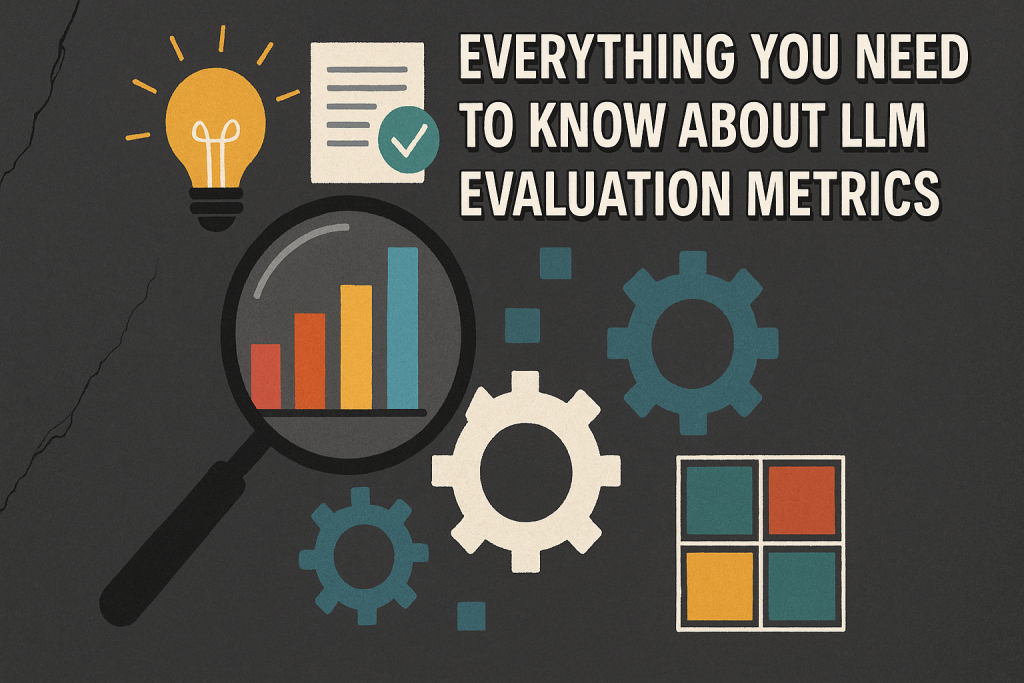
Everything You Need to Know About LLM Evaluation Metrics
Image by Author
Introduction
When large language models first came out, most of us were just thinking about what they could do, what problems they could solve, and how far they might go. But lately, the space has been flooded with tons of open-source and closed-source models, and now the real question is: how do we know which ones are actually any good? Evaluating large language models has quietly become one of the trickiest (and surprisingly complex) problems in artificial intelligence. We really need to measure their performance to make sure they actually do what we want, and to see how accurate, factual, efficient, and safe a model really is. These metrics are also super useful for developers to analyze their model’s performance, compare with others, and spot any biases, errors, or other problems. Plus, they give a better sense of which techniques are working and which ones aren’t. In this article, I’ll go through the main ways to evaluate large language models, the metrics that actually matter, and the tools that help researchers and developers run evaluations that mean something.
Text Quality and Similarity Metrics
Evaluating large language models often means measuring how closely the generated text matches human expectations. For tasks like translation, summarization, or paraphrasing, text quality and similarity metrics are used a lot because they provide a quantitative way to check output without always needing humans to judge it. For example:
- BLEU compares overlapping n-grams between model output and reference text. It is widely used for translation tasks.
- ROUGE-L focuses on the longest common subsequence, capturing overall content overlap—especially useful for summarization.
- METEOR improves on word-level matching by considering synonyms and stemming, making it more semantically aware.
- BERTScore uses contextual embeddings to compute cosine similarity between generated and reference sentences, which helps in detecting paraphrases and semantic similarity.
For classification or factual question-answering tasks, token-level metrics like Precision, Recall, and F1 are used to show correctness and coverage. Perplexity (PPL) measures how “surprised” a model is by a sequence of tokens, which works as a proxy for fluency and coherence. Lower perplexity usually means the text is more natural. Most of these metrics can be computed automatically using Python libraries like nltk, evaluate, or sacrebleu.
Automated Benchmarks
One of the easiest ways to check large language models is by using automated benchmarks. These are usually big, carefully designed datasets with questions and expected answers, letting us measure performance quantitatively. Some popular ones are MMLU (Massive Multitask Language Understanding), which covers 57 subjects from science to humanities, GSM8K, which is focused on reasoning-heavy math problems, and other datasets like ARC, TruthfulQA, and HellaSwag, which test domain-specific reasoning, factuality, and commonsense knowledge. Models are often evaluated using accuracy, which is basically the number of correct answers divided by total questions:
|
Accuracy = Correct Answers / Total Questions |
For a more detailed look, log-likelihood scoring can also be used. It measures how confident a model is about the correct answers. Automated benchmarks are great because they’re objective, reproducible, and good for comparing multiple models, especially on multiple-choice or structured tasks. But they’ve got their downsides too. Models can memorize the benchmark questions, which can make scores look better than they really are. They also often don’t capture generalization or deep reasoning, and they aren’t very useful for open-ended outputs. You can also use some automated tools and platforms for this.
Human-in-the-Loop Evaluation
For open-ended tasks like summarization, story writing, or chatbots, automated metrics often miss the finer details of meaning, tone, and relevance. That’s where human-in-the-loop evaluation comes in. It involves having annotators or real users read model outputs and rate them based on specific criteria like helpfulness, clarity, accuracy, and completeness. Some systems go further: for example, Chatbot Arena (LMSYS) lets users interact with two anonymous models and choose which one they prefer. These choices are then used to calculate an Elo-style score, similar to how chess players are ranked, giving a sense of which models are preferred overall.
The main advantage of human-in-the-loop evaluation is that it shows what real users prefer and works well for creative or subjective tasks. The downsides are that it is more expensive, slower, and can be subjective, so results may vary and require clear rubrics and proper training for annotators. It is useful for evaluating any large language model designed for user interaction because it directly measures what people find helpful or effective.
LLM-as-a-Judge Evaluation
A newer way to evaluate language models is to have one large language model judge another. Instead of depending on human reviewers, a high-quality model like GPT-4, Claude 3.5, or Qwen can be prompted to score outputs automatically. For example, you could give it a question, the output from another large language model, and the reference answer, and ask it to rate the output on a scale from 1 to 10 for correctness, clarity, and factual accuracy.
This method makes it possible to run large-scale evaluations quickly and at low cost, while still getting consistent scores based on a rubric. It works well for leaderboards, A/B testing, or comparing multiple models. But it’s not perfect. The judging large language model can have biases, sometimes favoring outputs that are similar to its own style. It can also lack transparency, making it hard to tell why it gave a certain score, and it might struggle with very technical or domain-specific tasks. Popular tools for doing this include OpenAI Evals, Evalchemy, and Ollama for local comparisons. These let teams automate a lot of the evaluation without needing humans for every test.
Verifiers and Symbolic Checks
For tasks where there’s a clear right or wrong answer — like math problems, coding, or logical reasoning — verifiers are one of the most reliable ways to check model outputs. Instead of looking at the text itself, verifiers just check whether the result is correct. For example, generated code can be run to see if it gives the expected output, numbers can be compared to the correct values, or symbolic solvers can be used to make sure equations are consistent.
The advantages of this approach are that it’s objective, reproducible, and not biased by writing style or language, making it perfect for code, math, and logic tasks. On the downside, verifiers only work for structured tasks, parsing model outputs can sometimes be tricky, and they can’t really judge the quality of explanations or reasoning. Some common tools for this include evalplus and Ragas (for retrieval-augmented generation checks), which let you automate reliable checks for structured outputs.
Safety, Bias, and Ethical Evaluation
Checking a language model isn’t just about accuracy or how fluent it is — safety, fairness, and ethical behavior matter just as much. There are several benchmarks and methods to test these things. For example, BBQ measures demographic fairness and possible biases in model outputs, while RealToxicityPrompts checks whether a model produces offensive or unsafe content. Other frameworks and approaches look at harmful completions, misinformation, or attempts to bypass rules (like jailbreaking). These evaluations usually combine automated classifiers, large language model–based judges, and some manual auditing to get a fuller picture of model behavior.
Popular tools and techniques for this kind of testing include Hugging Face evaluation tooling and Anthropic’s Constitutional AI framework, which help teams systematically check for bias, harmful outputs, and ethical compliance. Doing safety and ethical evaluation helps ensure large language models are not just capable, but also responsible and trustworthy in the real world.
Reasoning-Based and Process Evaluations
Some ways of evaluating large language models don’t just look at the final answer, but at how the model got there. This is especially useful for tasks that need planning, problem-solving, or multi-step reasoning—like RAG systems, math solvers, or agentic large language models. One example is Process Reward Models (PRMs), which check the quality of a model’s chain of thought. Another approach is step-by-step correctness, where each reasoning step is reviewed to see if it’s valid. Faithfulness metrics go even further by checking whether the reasoning actually matches the final answer, ensuring the model’s logic is sound.
These methods give a deeper understanding of a model’s reasoning skills and can help spot errors in the thought process rather than just the output. Some commonly used tools for reasoning and process evaluation include PRM-based evaluations, Ragas for RAG-specific checks, and ChainEval, which all help measure reasoning quality and consistency at scale.
Summary
That brings us to the end of our discussion. Let’s summarize everything we’ve covered so far in a single table. This way, you’ll have a quick reference you can save or refer back to whenever you’re working with large language model evaluation.
| Category | Example Metrics | Pros | Cons | Best Use |
|---|---|---|---|---|
| Benchmarks | Accuracy, LogProb | Objective, standard | Can be outdated | General capability |
| HITL | Elo, Ratings | Human insight | Costly, slow | Conversational or creative tasks |
| LLM-as-a-Judge | Rubric score | Scalable | Bias risk | Quick evaluation and A/B testing |
| Verifiers | Code/math checks | Objective | Narrow domain | Technical reasoning tasks |
| Reasoning-Based | PRM, ChainEval | Process insight | Complex setup | Agentic models, multi-step reasoning |
| Text Quality | BLEU, ROUGE | Easy to automate | Overlooks semantics | NLG tasks |
| Safety/Bias | BBQ, SafeBench | Essential for ethics | Hard to quantify | Compliance and responsible AI |