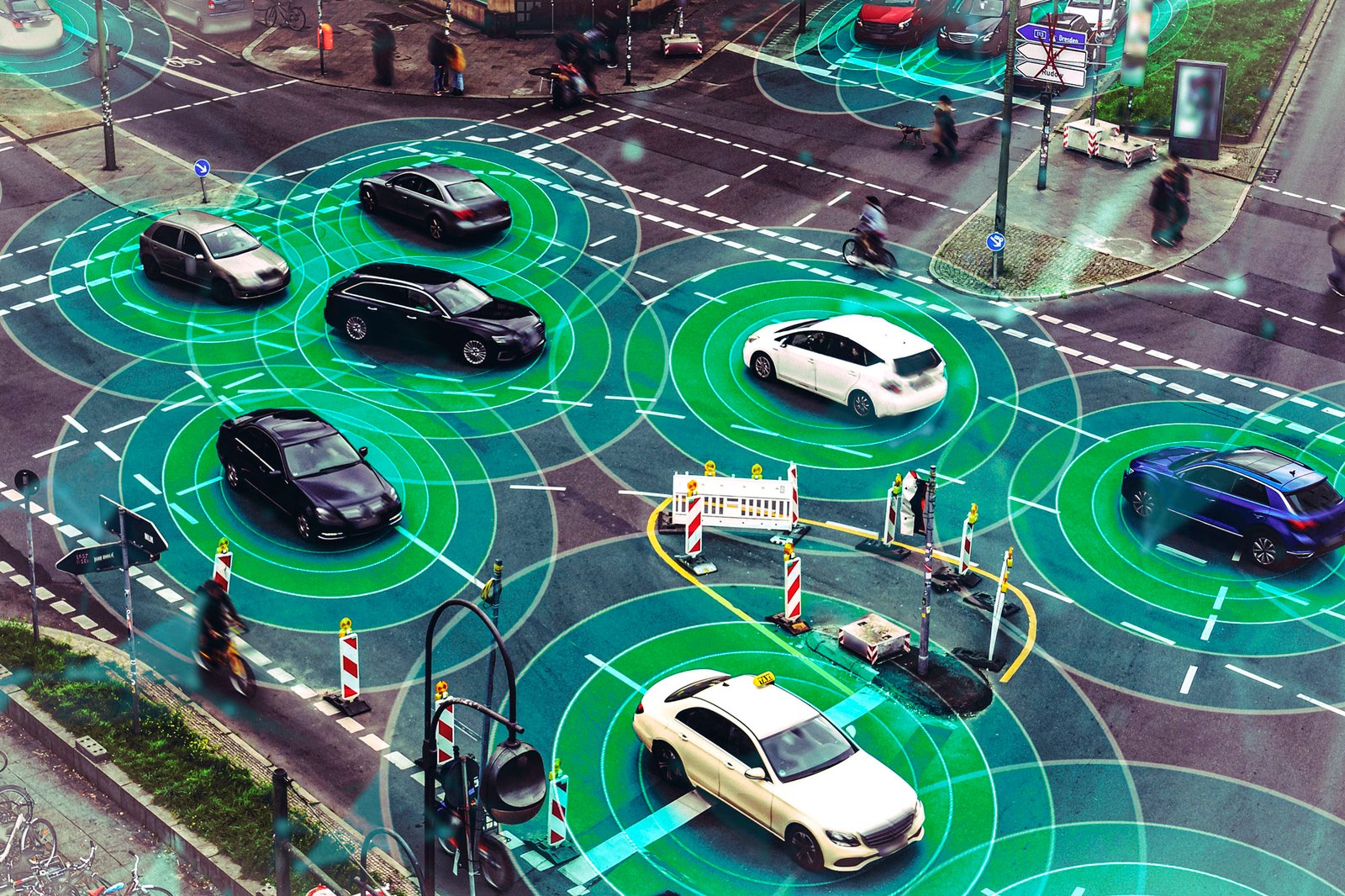
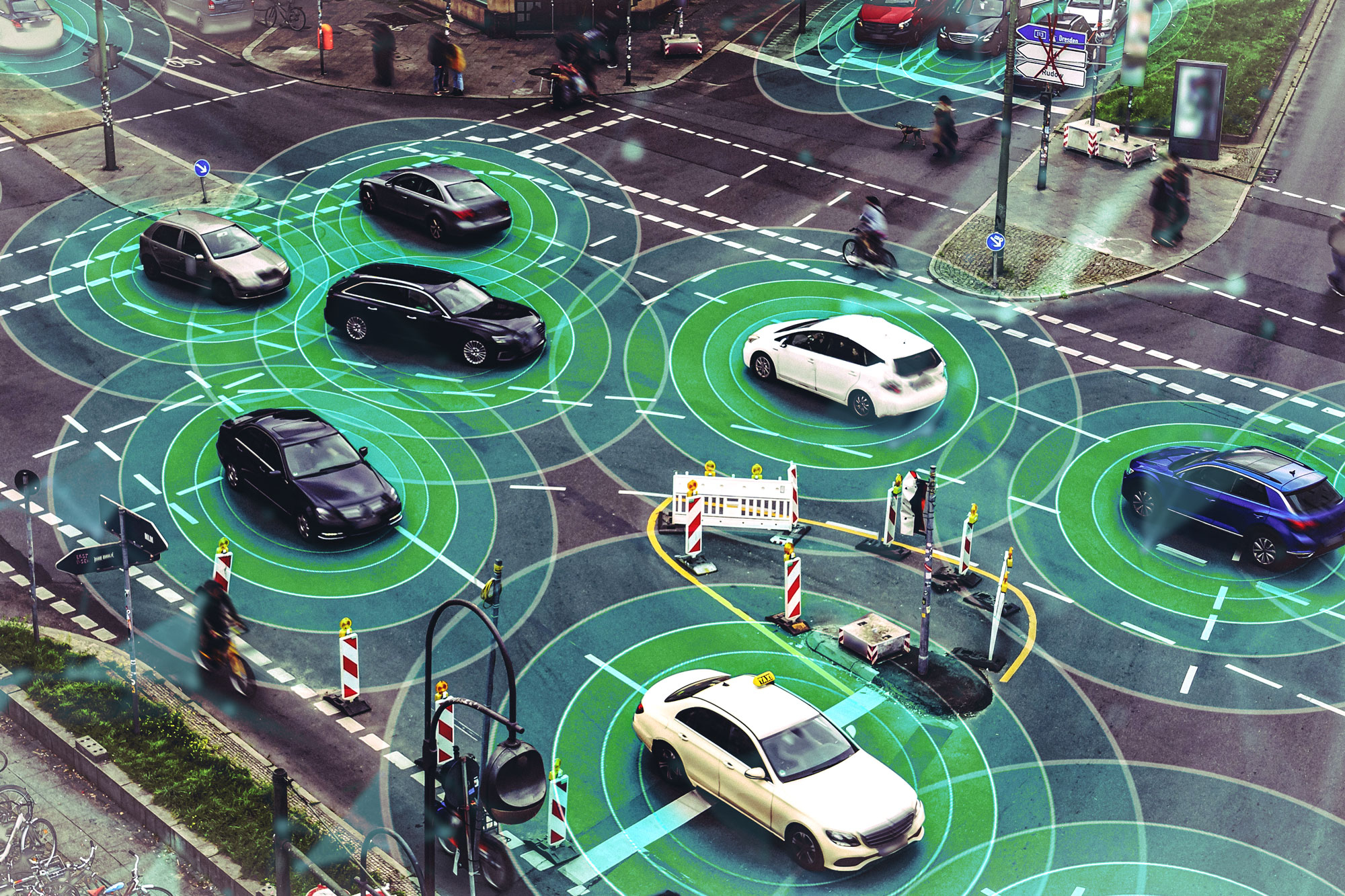
Any motorist who has ever waited through multiple cycles for a traffic light to turn green knows how annoying signalized intersections can be. But sitting at intersections isn’t just a drag on drivers’ patience — unproductive vehicle idling could contribute as much as 15 percent of the carbon dioxide emissions from U.S. land transportation.
A large-scale modeling study led by MIT researchers reveals that eco-driving measures, which can involve dynamically adjusting vehicle speeds to reduce stopping and excessive acceleration, could significantly reduce those CO2 emissions.
Using a powerful artificial intelligence method called deep reinforcement learning, the researchers conducted an in-depth impact assessment of the factors affecting vehicle emissions in three major U.S. cities.
Their analysis indicates that fully adopting eco-driving measures could cut annual city-wide intersection carbon emissions by 11 to 22 percent, without slowing traffic throughput or affecting vehicle and traffic safety.
Even if only 10 percent of vehicles on the road employ eco-driving, it would result in 25 to 50 percent of the total reduction in CO2 emissions, the researchers found.
In addition, dynamically optimizing speed limits at about 20 percent of intersections provides 70 percent of the total emission benefits. This indicates that eco-driving measures could be implemented gradually while still having measurable, positive impacts on mitigating climate change and improving public health.
“Vehicle-based control strategies like eco-driving can move the needle on climate change reduction. We’ve shown here that modern machine-learning tools, like deep reinforcement learning, can accelerate the kinds of analysis that support sociotechnical decision making. This is just the tip of the iceberg,” says senior author Cathy Wu, the Class of 1954 Career Development Associate Professor in Civil and Environmental Engineering (CEE) and the Institute for Data, Systems, and Society (IDSS) at MIT, and a member of the Laboratory for Information and Decision Systems (LIDS).
She is joined on the paper by lead author Vindula Jayawardana, an MIT graduate student; as well as MIT graduate students Ao Qu, Cameron Hickert, and Edgar Sanchez; MIT undergraduate Catherine Tang; Baptiste Freydt, a graduate student at ETH Zurich; and Mark Taylor and Blaine Leonard of the Utah Department of Transportation. The research appears in Transportation Research Part C: Emerging Technologies.
A multi-part modeling study
Traffic control measures typically call to mind fixed infrastructure, like stop signs and traffic signals. But as vehicles become more technologically advanced, it presents an opportunity for eco-driving, which is a catch-all term for vehicle-based traffic control measures like the use of dynamic speeds to reduce energy consumption.
In the near term, eco-driving could involve speed guidance in the form of vehicle dashboards or smartphone apps. In the longer term, eco-driving could involve intelligent speed commands that directly control the acceleration of semi-autonomous and fully autonomous vehicles through vehicle-to-infrastructure communication systems.
“Most prior work has focused on how to implement eco-driving. We shifted the frame to consider the question of should we implement eco-driving. If we were to deploy this technology at scale, would it make a difference?” Wu says.
To answer that question, the researchers embarked on a multifaceted modeling study that would take the better part of four years to complete.
They began by identifying 33 factors that influence vehicle emissions, including temperature, road grade, intersection topology, age of the vehicle, traffic demand, vehicle types, driver behavior, traffic signal timing, road geometry, etc.
“One of the biggest challenges was making sure we were diligent and didn’t leave out any major factors,” Wu says.
Then they used data from OpenStreetMap, U.S. geological surveys, and other sources to create digital replicas of more than 6,000 signalized intersections in three cities — Atlanta, San Francisco, and Los Angeles — and simulated more than a million traffic scenarios.
The researchers used deep reinforcement learning to optimize each scenario for eco-driving to achieve the maximum emissions benefits.
Reinforcement learning optimizes the vehicles’ driving behavior through trial-and-error interactions with a high-fidelity traffic simulator, rewarding vehicle behaviors that are more energy-efficient while penalizing those that are not.
The researchers cast the problem as a decentralized cooperative multi-agent control problem, where the vehicles cooperate to achieve overall energy efficiency, even among non-participating vehicles, and they act in a decentralized manner, avoiding the need for costly communication between vehicles.
However, training vehicle behaviors that generalize across diverse intersection traffic scenarios was a major challenge. The researchers observed that some scenarios are more similar to one another than others, such as scenarios with the same number of lanes or the same number of traffic signal phases.
As such, the researchers trained separate reinforcement learning models for different clusters of traffic scenarios, yielding better emission benefits overall.
But even with the help of AI, analyzing citywide traffic at the network level would be so computationally intensive it could take another decade to unravel, Wu says.
Instead, they broke the problem down and solved each eco-driving scenario at the individual intersection level.
“We carefully constrained the impact of eco-driving control at each intersection on neighboring intersections. In this way, we dramatically simplified the problem, which enabled us to perform this analysis at scale, without introducing unknown network effects,” she says.
Significant emissions benefits
When they analyzed the results, the researchers found that full adoption of eco-driving could result in intersection emissions reductions of between 11 and 22 percent.
These benefits differ depending on the layout of a city’s streets. A denser city like San Francisco has less room to implement eco-driving between intersections, offering a possible explanation for reduced emission savings, while Atlanta could see greater benefits given its higher speed limits.
Even if only 10 percent of vehicles employ eco-driving, a city could still realize 25 to 50 percent of the total emissions benefit because of car-following dynamics: Non-eco-driving vehicles would follow controlled eco-driving vehicles as they optimize speed to pass smoothly through intersections, reducing their carbon emissions as well.
In some cases, eco-driving could also increase vehicle throughput by minimizing emissions. However, Wu cautions that increasing throughput could result in more drivers taking to the roads, reducing emissions benefits.
And while their analysis of widely used safety metrics known as surrogate safety measures, such as time to collision, suggest that eco-driving is as safe as human driving, it could cause unexpected behavior in human drivers. More research is needed to fully understand potential safety impacts, Wu says.
Their results also show that eco-driving could provide even greater benefits when combined with alternative transportation decarbonization solutions. For instance, 20 percent eco-driving adoption in San Francisco would cut emission levels by 7 percent, but when combined with the projected adoption of hybrid and electric vehicles, it would cut emissions by 17 percent.
“This is a first attempt to systematically quantify network-wide environmental benefits of eco-driving. This is a great research effort that will serve as a key reference for others to build on in the assessment of eco-driving systems,” says Hesham Rakha, the Samuel L. Pritchard Professor of Engineering at Virginia Tech, who was not involved with this research.
And while the researchers focus on carbon emissions, the benefits are highly correlated with improvements in fuel consumption, energy use, and air quality.
“This is almost a free intervention. We already have smartphones in our cars, and we are rapidly adopting cars with more advanced automation features. For something to scale quickly in practice, it must be relatively simple to implement and shovel-ready. Eco-driving fits that bill,” Wu says.
This work is funded, in part, by Amazon and the Utah Department of Transportation.