Meta Advertiser Field Notes
Weekly observations from inside Meta ads
A handful of small but meaningful updates stood out this week, from customer acquisition and attribution to audience segments and delivery. None require a full deep dive, but they’re all worth your attention right now.
- Customer Lifecycle Strategy
- Engage-through attribution rollout
- Audience segments use case
- Incremental attribution windows
- Adaptive Ranking Model for Instagram
Let’s get to it…
1. Customer Lifecycle Strategy
I normally refrain from sharing information about a new feature unless one of these three things is true:
- I have the feature
- Meta mentions the feature
- Someone I know and trust has it
So while I’ve heard rumblings about this one for more than a week, I’ve been more than a little skeptical about the information I’ve seen. But I’ve heard enough now that it does appear to be a thing.
This screenshot has been shared repeatedly on LinkedIn…

From what I have been able to sort out, it appears at the top of an ad set when creating a Sales campaign. As you can see from the screenshot, you’re given two options:
Reach new and existing customers: Choose this if your strategy is to get conversions with a lower cost per result and you don’t need to exclude people based on if they made a purchase.
Acquire new customers: Choose this if conversions from people who have never made a purchase generate more value for your business. This may increase your cost per result.
“Reach New and Existing Customers” would be the default option, and it’s what happens naturally now anyway. This should be the chosen method for most advertisers, but there may be exceptions when you’d want to only reach completely new people.
I’ve seen all sorts of weird speculation that choosing “Acquire New Customers” will automate the process of excluding your customers. You no longer need to create custom audiences to exclude them, and Meta will use their data and magical wand to exclude those people for you. And that all sounded like a bunch of nonsense.
I had my theories about how this would work that were far less mysterious. And based on the latest screenshot I’ve seen shared, my theories were correct.

Take a close look at that screenshot under the selection of “Acquire New Customers.” Meta lists the custom audiences that will be excluded based on that selection.
In other words, Meta is only able to exclude your current customers because you’ve defined the Existing Customers audience segment in your Advertising Settings.

This is a bit of a 2026 twist on the Existing Customer Budget Cap that originally existed for Advantage+ Shopping Campaigns. ASC was the reason that defining your existing customers became necessary in the first place, and audience segments were born.
Back to the second screenshot, you’ll see there’s one more option: “Reach engaged or non-engaged audiences.” In the example, “Reach both” is selected.
Once again, this appears to be pulling from your audience segments. You can also choose to exclude people who have engaged with your business in some way but haven’t purchased. These people are defined in your audience segments as Engaged Audience.
There’s a whole lot to discuss here regarding whether it’s a reasonable strategy to exclude those who have bought or engaged with your business before. That’s a separate topic for another day.
For now, it does appear that this is a thing. But it’s also not as interesting as many are suggesting. If you wanted to exclude these people before, you could have manually. And, of course, the accuracy of those exclusions will be dependent on how you define your audience segments in the first place.
2. Engage-Through Attribution Rollout
A month ago, Meta announced some significant changes to attribution. Not only does click-through attribution now require a click on a link, but engage-through attribution replaces engaged-view. All of the social and other clicks that were previously counted under click-through attribution move to engage-through.
Earlier this week, advertisers started seeing the changes reflected in the ad set.

And now we’re also seeing it in the reporting tools. When using the breakdown by attribution settings, “1-day engagement” replaces “1-day engaged-view.”

And you’ll also see this reflected when using the Compare Attribution Settings feature.

What’s confusing about using these tools is what becomes of the data that was previously defined under the old definitions of click-through and engaged-view attribution. Just keep this in mind when viewing historical data prior to, or overlapping with, the rollout of these changes.
3. Audience Segments Use Case
Audience segments are one of my favorite features, and I know I talk about them a lot. While the primary use case of audience segments is to prove how much remarketing happens naturally, there’s another way to use this feature to help explain performance fluctuations.
Here’s an example…
I have a campaign that has been running for eight weeks and performance has decreased over time. I used the breakdown by audience segments, and I found it interesting how the percentage of ad spend dedicated to remarketing (as defined by the Engaged Audience and Existing Customers audience segments) declined over time.
- Week 1: 19.6%
- Week 2: 19.9%
- Week 3: 21.6%
- Week 4: 27.5%
- Week 5: 26.7%
- Week 6: 8.4%
- Week 7: 2.4%
- Week 8: 2.4%
So, Meta spent as much as 27.5% of my budget on remarketing in those initial weeks. But this slice dropped to 2.4% during the most recent weeks. Not coincidentally, the cost per conversion has risen during that time.
The natural reaction might be to assume something is wrong. Why would Meta shift so dramatically in remarketing? But the reality is that hidden beneath the surface was a 9.0 frequency for remarketing audiences during this time, which was double that of the new audience.
In other words, Meta leaned into remarketing early to get the best results. But as these audiences were exhausted, effectiveness decreased. Meta then relied less on remarketing, which meant new audiences became the primary source of conversions.
The decline in performance that I saw wasn’t much of a decline at all. The new audience performance remained mostly the same. It’s just that remarketing became less available to bring down my costs.
This doesn’t mean that my remarketing audiences are completely exhausted. I also haven’t created new ads in a few weeks. Once I do, those new ads are likely to be shown to my remarketing audiences again.
This example is a reminder that your performance fluctuations can often be explained by natural delivery shifts. Don’t forget to use the breakdown by audience segments to help diagnose it.
4. Incremental Attribution Windows
Beginning about a year ago, advertisers have had the option of Standard or Incremental attribution in the ad set when maximizing the number of conversions.
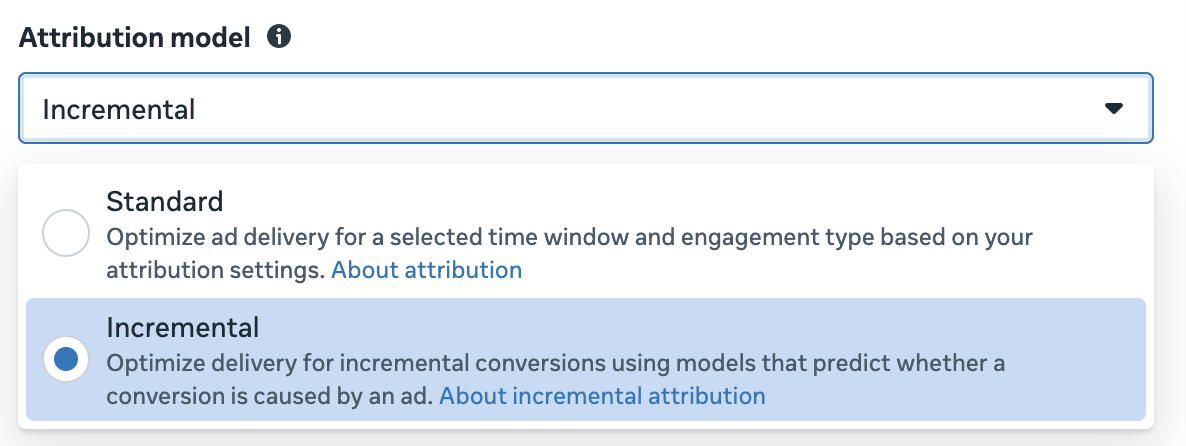
When Incremental attribution is selected, Meta will use models that predict whether a conversion was caused by your ad. This is different from Standard attribution, which focuses on conversions that happen after clicks or views within a defined window of time.
It’s important to remember this because the breakdown by attribution settings won’t work when using Incremental attribution. Typically, this breakdown will segment your results by attribution window.
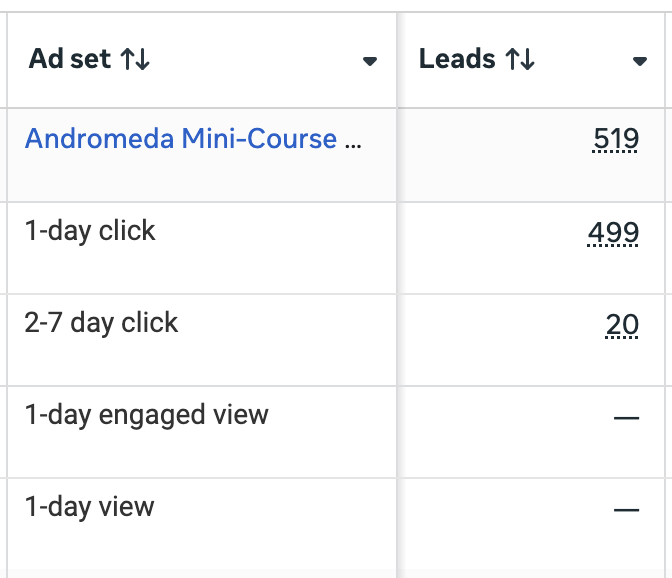
But these rows will not appear if you used Incremental attribution. The reason for that is breakdowns will only segment results relevant to your settings. Since you aren’t using Standard attribution, rows for those windows wouldn’t be relevant.
Of course, you can uncover conversion results outside of your settings by using the Compare Attribution Settings feature. When used, you can add columns for the click-through, engage-through, and view-through windows and see how they compare to your Incremental results.

I’ve found that Incremental results tend to be consistent with click-through conversions, though they don’t match up exactly. View-through and engage-through can be incremental, too.
5. Adaptive Ranking Model for Instagram
Meta recently detailed improvements made to show more relevant ads to people on Instagram. This was shared on its Engineering Blog, so the audience understands the technical details that will make little sense to the rest of us normies.

Here’s why Meta says they developed the Adaptive Ranking Model:
This increase in scale & complexity exacerbates a fundamental ‘inference trilemma’: the challenge of balancing the increased model complexity and associated need for compute and memory with the low latency and cost efficiency required for a global service serving billions of people. To overcome this, we have developed the Meta Adaptive Ranking Model, which effectively bends the inference scaling curve with high ROI and industry-leading efficiency.
Uhh….
Thankfully, Andrew Hutchinson at Social Media Today helped interpret.
The bottom line is less compute power and more relevant ads. Meta says that since launching the Adaptive Ranking Model on Instagram in Q4 of 2025, advertisers have seen a 3% increase in conversions and a 5% increase in click-through rate for targeted users. Maybe not significant, but relevant.
We’ve heard a lot about Meta’s developments related to new hardware and software to improve ad performance. While Andromeda, GEM, and Lattice get a lot of attention, add Adaptive Ranking Model to the list of technologies that Meta is working on to help advertisers reach their ideal customers most efficiently.
Your Turn
What do you think about these updates?
Let me know in the comments below!



![What are the latest Hootsuite product features? [Feb 2026]](https://mgrowtech.com/wp-content/uploads/2026/04/hootsuite-february-product-features-350x250.png)