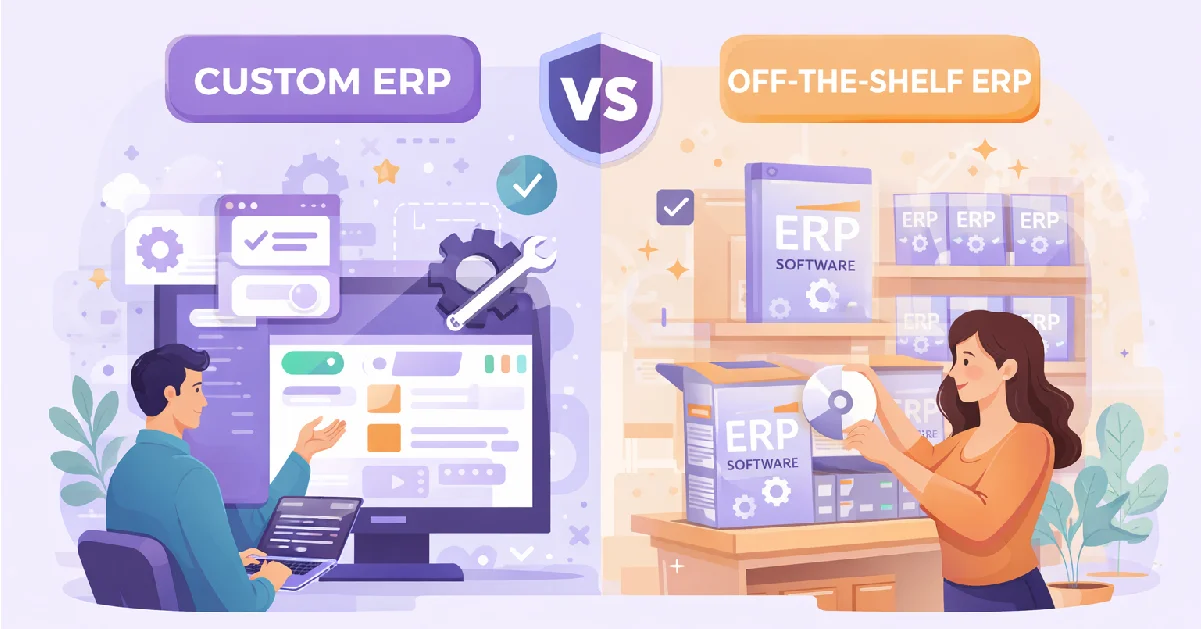
Every business hits this crossroad. Systems slow down. Teams complain. Data lives everywhere. And someone finally says it. We need an ERP. Now the real fight starts. Custom ERP or off-the-shelf ERP. One promises control. The other promises speed. Both promise efficiency. Neither delivers it.
Off-the-shelf ERPs look clean and confident. They are ready. Proven. Market tested. But they also force your business to adjust. Not the other way round. Custom ERP sounds powerful. Tailor-made. Built for you. But it demands time, money, and patience. And clarity. Which most businesses lack.
This is not a tech debate. It’s a business decision. A risky one. Choose wrong, and you pay for years. So which ERP actually fits your business? Not on paper. In reality.
What is custom ERP?
Custom ERP is not a product you buy. It’s a system you build. It is designed from scratch. Around your business. Your workflows. Your rules. Not around industry averages.
Every module exists for a reason. Inventory, finance, HR, and CRM. Only what you need. Nothing extra. No forced features. No unused dashboards. Custom ERP adapts as your business grows. Processes change. The system changes, too. You don’t wait for vendor updates. You decide.
But let’s be clear. Custom ERP is not for confused businesses. If your processes are broken, it will only automate the mess. It needs clarity. Strong planning. And long-term thinking. Without that, it becomes expensive regret.
What is Off-the-Shelf ERP?
Off-the-shelf ERP is a ready-made system. Built once. Sold to many. It comes with predefined modules. Finance, HR, inventory, and sales. You install it. Configure a little. Start using it.
These systems follow standard business processes. That’s the catch. Your business adjusts to the software. Not the opposite. Setup is faster. Risk feels lower. Support is available. Updates are regular. That’s why growing businesses choose it first.
But you pay for what you don’t use. Extra features. Extra complexity. Extra cost over time. Off-the-shelf ERP works best when your operations are simple. And your expectations are realistic.
Custom ERP vs Off-the-Shelf ERP

Cost comparison
Off-the-shelf ERP looks cheaper at first. License fees are clear. Implementation feels controlled. But costs keep stacking. Customisation charges. User limits. Upgrade fees. Support plans. Custom ERP hits hard in the beginning. Development cost is high. No denying that. But long-term, it can be stable. You pay once. You own it. No surprise bills every year.
Implementation time
Off-the-shelf ERP is faster. Weeks or a few months. Templates exist. Processes are predefined. Custom ERP takes time. Sometimes, a lot of time. Because you are building logic, not installing software, rush it, and it breaks. Simple.
Flexibility and scalability
Off-the-shelf ERP bends only so much. Beyond that, you adjust your operations. Or compromise. Custom ERP is flexible by design. New workflows. New integrations. New markets. It scales with your business, not against it.
Customization limits
Off-the-shelf ERP allows surface-level changes. Fields. Reports. Some workflows. Core logic stays locked. Always. Custom ERP has no such walls. If you can define it, it can be built.
Maintenance and upgrades
Off-the-shelf ERP upgrades are vendor-controlled. Sometimes helpful. Sometimes disruptive. You upgrade even when you don’t want to. Custom ERP maintenance is your responsibility. More control. More accountability. No forced changes.
Data ownership and control
With off-the-shelf ERP, data lives on its terms. Cloud policies. Access rules. Compliance limits. Custom ERP gives full control over where data lives. How it’s secured. Who touches it? For some businesses, this alone decides everything.
User adoption and training
Off-the-shelf ERP comes with learning curves. Generic screens. Complex menus. Custom ERP feels familiar. Built around how your team already works. Less resistance. Faster adoption.
Which Businesses Should Choose Custom ERP?

Businesses with complex workflows
If your operations don’t follow standard rules, off-the-shelf ERP will fight you daily. Too many exceptions. Too many workarounds. Custom ERP makes sense here. It mirrors reality. Not theory.
Rapidly scaling businesses
Growth breaks systems fast. New teams. New locations. New logic. Off-the-shelf tools start lagging. Custom ERP grows with you. No waiting for vendor roadmaps.
Companies with unique industry requirements
Some industries don’t fit templates. Manufacturing hybrids. Service-product models. Niche compliance needs. Custom ERP handles what standard ERPs ignore. Because it’s built for that exact problem.
Data-sensitive and compliance-driven businesses
If data control is non-negotiable, choice becomes obvious. Finance, healthcare, and regulated sectors. Custom ERP lets you decide on storage, access, and security layers. No third-party compromises.
Businesses are tired of ERP limitations
Already using off-the-shelf ERP and hitting walls. Manual workarounds everywhere. Excel is still running the show. That’s the sign. Custom ERP stops the patchwork and fixes the core.
Organisations with clear processes and vision
Custom ERP rewards clarity. If your workflows are documented and stable, it works beautifully. If not, it will expose every flaw. This is not beginner software.
Which Businesses Should Choose Off-the-Shelf ERP?

Small and early-stage businesses
If your operations are still evolving, a custom ERP is a waste. You don’t even know your final processes yet. Off-the-shelf ERP gives structure fast. That’s enough.
Businesses with standard workflows
Retail. Trading. Basic services. If your processes look like everyone else’s, stop overthinking. Prebuilt modules will do the job.
Companies with tight budgets
Custom ERP demands upfront commitment. If cash flow is fragile, don’t gamble. Off-the-shelf ERP spreads the cost over time. Safer choice.
Teams needing quick deployment
No patience for long development cycles. No appetite for testing phases. Off-the-shelf ERP goes live faster. Period.
Organisations lacking technical leadership
Custom ERP without strong decision-makers is dangerous. No product owner. No clarity. No accountability. Off-the-shelf ERP comes with guidance and support. That safety net matters.
Businesses are okay with compromise
This is the hard truth. If you can adjust processes to software rules, off-the-shelf works. If not, it will frustrate you daily.
Common Mistakes Businesses Make While Choosing ERP

Choosing ERP based on price alone
Cheap ERP is rarely cheap long-term. Low license cost hides high dependency. Businesses realise it too late. When switching becomes painful.
Ignoring future growth
ERP is not for today. It’s for the next five years. Many choose systems that fit the current size only. Growth arrives. System collapses.
Overestimating customization needs
Not everything needs to be custom. Some businesses build ERP for ego, not necessity. Result. Complex system. Low adoption.
Underestimating internal readiness
ERP fails inside the company, not in software. No process clarity. No ownership. No training. Then they blame the tool.
Trusting vendor promises blindly
Sales demos look perfect. Reality hits later. Hidden limits. Extra costs. Slow support. Due diligence is skipped. Mistake.
Ignoring user adoption
If teams hate using it, ERP is useless. Simple fact. Usability matters more than feature lists.
No clear success metrics
Many implement ERP without defining success. No KPIs. No benchmarks. Then they can’t even say if it worked.
Conclusion
Choosing an ERP is not about trends. It’s about fit. Timing. And honesty. Custom ERP gives control. Flexibility. Long-term power. But only if your business is ready for it. Without clarity, it becomes expensive chaos. Off-the-shelf ERP offers speed. Structure. Predictability. But it demands compromise. And discipline. Ignore its limits, and frustration follows.
Businesses serious about ERP software development must look beyond features. They must question readiness, not just requirements. That’s where real value is created.
And for companies exploring ERP software development in Bangalore, the choice matters even more. The ecosystem is strong. Options are plenty. But success depends on picking what truly supports how you operate, not how vendors sell it. Choose wisely. ERP stays longer than you think.