
Key takeaways:
- Building a calorie counting app with Cronometer-level accuracy in Australia typically costs between AUD 70,000 and AUD 700,000+, depending on data depth, compliance posture, and analytics sophistication.
- Underestimating compliance, data licensing, and post-launch governance is the most common cause of budget overruns for Australian nutrition platforms.
- The hard cost driver is not screens. It’s nutrition data integrity, database licensing, and the operational workload of keeping food, recipes, and nutrients accurate over time.
- Monetisation choices (subscription tiers, professional plans, B2B licensing) directly change architecture, security controls, and long-term operating cost.
A calorie counting app like Cronometer is not a lightweight consumer utility. It is a nutrition intelligence platform that has to stay credible under scrutiny. Users expect macro tracking, but the real differentiator is consistent micronutrient coverage, verified food entries, repeatable calculations, and a UX that makes high-frequency logging feel effortless.
This is where many product teams misjudge the effort. They budget as if they’re building a standard fitness product, then discover late that nutrition data is a product in its own right. Database licensing, data QA workflows, recipe logic, branded foods, regional differences, and ongoing schema updates create a cost curve that does not flatten after launch.
In the Australian market, these realities place the cost to build a calorie counting app like Cronometer between AUD 70,000 and AUD 700,000+. A focused MVP sits at the lower end, while platforms designed for long-term accuracy, advanced analytics, enterprise-grade security, and compliance-driven scalability push toward the upper range.
This blog breaks down where those costs come from, how architecture and data decisions shape budgets, and what businesses should factor in to build the best calorie counting app in Australia that remains accurate, compliant, and commercially viable over time.
Plan Your Nutrition App Investment with Cost Certainty
Understand the real cost, compliance scope, and delivery risks before you build.

What Makes Cronometer the Gold Standard for Accuracy?
Cronometer’s strength lies in how nutrition information is structured, validated, and maintained across the platform, rather than how many foods appear in a search list. Each entry follows consistent measurement rules, clear nutrient definitions, and predictable calculation logic, which removes ambiguity in daily and long-term tracking.
Accuracy in Cronometer is enforced at the system level. The platform supports repeatable nutrition calculations across recipes, branded foods, and serving variations, with controlled updates to its underlying databases rather than open, crowdsourced edits. This ensures consistency over time, even as food data evolves.
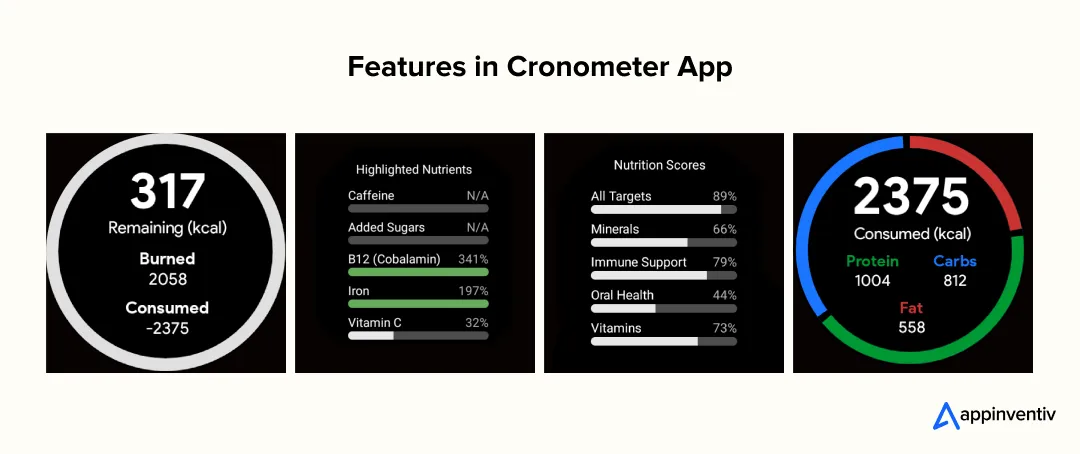
Unlike a basic app for calorie counting, a Cronometer-class product supports:
- Micronutrient Granularity: Tracking 80+ nutrients (vitamins, minerals, amino acids).
- Data Provenance: Tracing every food entry to a lab-verified source like AUSNUT 2011-13 or the NCCDB.
- Recipe Logic: Handling complex many-to-many relationships between ingredients and cooked servings.
This reliance on licensed, research-quality food databases fundamentally changes the product architecture. It introduces requirements around data licensing, ingestion pipelines, update governance, and clear visual separation between verified and user-added data. The result is a platform where scientific credibility is built into the system design, which is why Cronometer is widely regarded as the benchmark for precision-driven nutrition tracking.
It simply means that building the best calorie counting app in Australia requires moving away from crowdsourced, unverified data (the primary flaw in a “free” tracker).
A Comprehensive View of the Costs Involved in Developing a Calorie Counting App in Australia
Cost clarity comes from splitting the work into three layers: product scope (what you promise), data depth (what you can prove) and operating model (what you can sustain). It also helps to anchor the market context. Australia’s diet and nutrition apps market was estimated at $43.6 million in 2024, with forecasts indicating growth to $101.5 million by 2030. Growth usually increases competition for experience, accuracy, and retention, which eventually increases calorie tracker app development costs.
Cost Breakdown by App Complexity in Australia
The ranges below assume an Australian enterprise-grade delivery standard, with secure architecture, robust QA, and production readiness.
| Complexity tier | Typical scope markers | Estimated cost (AUD) | Timeline |
|---|---|---|---|
| Tier 1: MVP tracker | Basic food search, barcode scan (limited), goals, history, basic insights | 70,000–150,000 | 3–5 months |
| Tier 2: Consumer-grade nutrition platform | Verified food pipeline, recipes, better analytics, wearables, subscriptions | 150,000–350,000 | 5–8 months |
| Tier 3: Enterprise-grade nutrition intelligence | Provenance, richer micronutrients, coach/pro plans, strong governance, high-scale infra | 350,000–700,000+ | 8–12+ months |
Pro Tip: For an Australian calorie counting app, data residency is non-negotiable. Storing sensitive health data on local AWS/Azure regions to comply with the Privacy Act 1988 is a primary cost driver in the “Enterprise” tier.
Cost Breakdown by Development Stage
This stage-wise breakdown shows how costs accumulate across the full delivery lifecycle, not just during development. Each phase carries its own risk, effort, and budget impact.
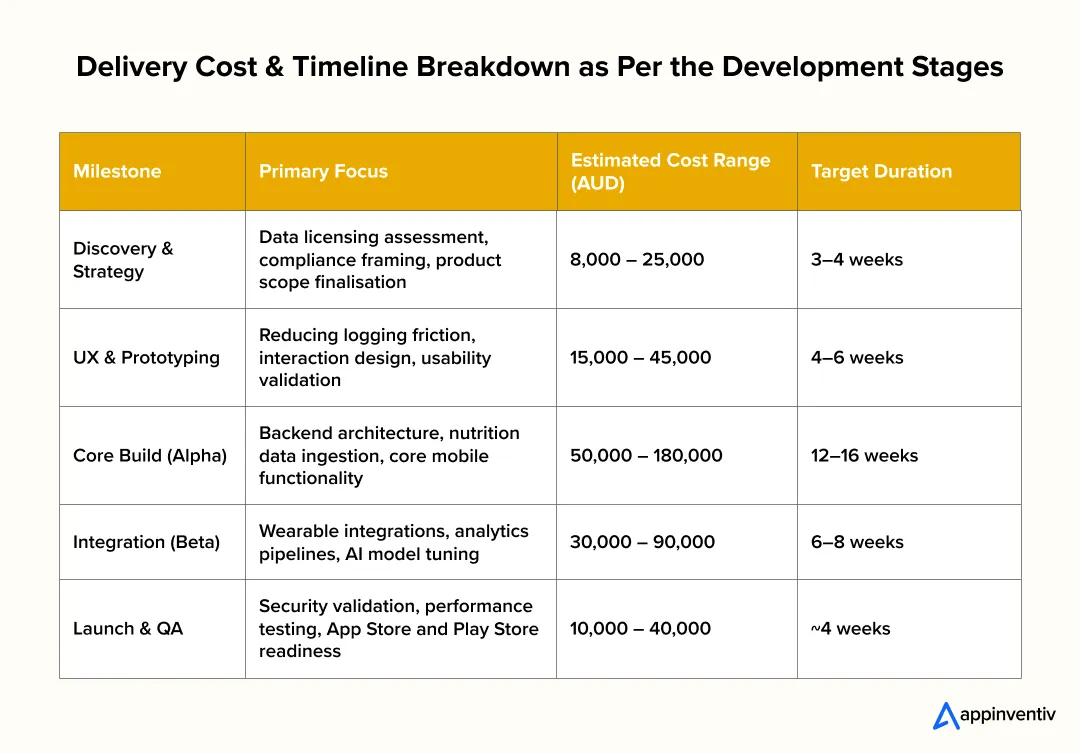
| Stage | Key work included | Estimated cost (AUD) |
|---|---|---|
| Discovery and requirements | Data strategy, product scope, governance, success metrics, backlog | 8,000–35,000 |
| UX and prototyping | Logging flows, search UX, streak mechanics, accessibility, prototype testing | 15,000–70,000 |
| Mobile + backend build | Apps, APIs, database, ingestion jobs, notifications, subscriptions | 50,000–320,000+ |
| Integration (Beta) | Wearable integrations, analytics pipelines, AI model tuning | 30,000 – 90,000 |
| Testing and launch readiness | Security testing, performance, accuracy QA, store compliance | 10,000–60,000 |
| Post-launch ops | Monitoring, bug fixes, API updates, feature evolution | ~15–20% of build cost per year |
How to Estimate the Total Cost to Build a Calorie Counting App like Cronometer
A mobile app development company in Australia typically estimates cost using a blended model that accounts for delivery effort, data obligations, and compliance readiness.
A simplified baseline approach is:
| Total Cost = Delivery Hours × Hourly Rate of Developers + Data and Compliance Overheads |
For example, if the development requires 2,400 hours and the developers’ delivery rate is AUD 80/hour, the total cost to develop an app like Cronometer will be 2,400 × 80 = AUD 192,000 (before database licensing, security validation, and ongoing operations)
What moves the number in real life:
- compressed timelines (more parallel work, more QA load)
- higher data depth and ingestion automation
- stricter security controls and evidence collection for audits
Strategic Insight: While offshore rates may seem tempting to lower the “total cost to build a calorie counting app like Cronometer,” Australian enterprises often opt for local or hybrid teams to ensure data residency compliance and alignment with the Office of the Australian Information Commissioner (OAIC) standards.
Key Factors Affecting the Calorie Counting App Development Cost in Australia
Once the headline range is clear, product leaders typically ask a more practical question: what actually pushes a calorie counting app development cost in Australia from the lower band into six-figure or seven-figure territory?
In practice, cost escalation is driven by a small number of structural decisions. These decisions affect not only build cost, but also audit exposure, delivery risk, and long-term ownership. Let’s explore these cost driving elements in detail:
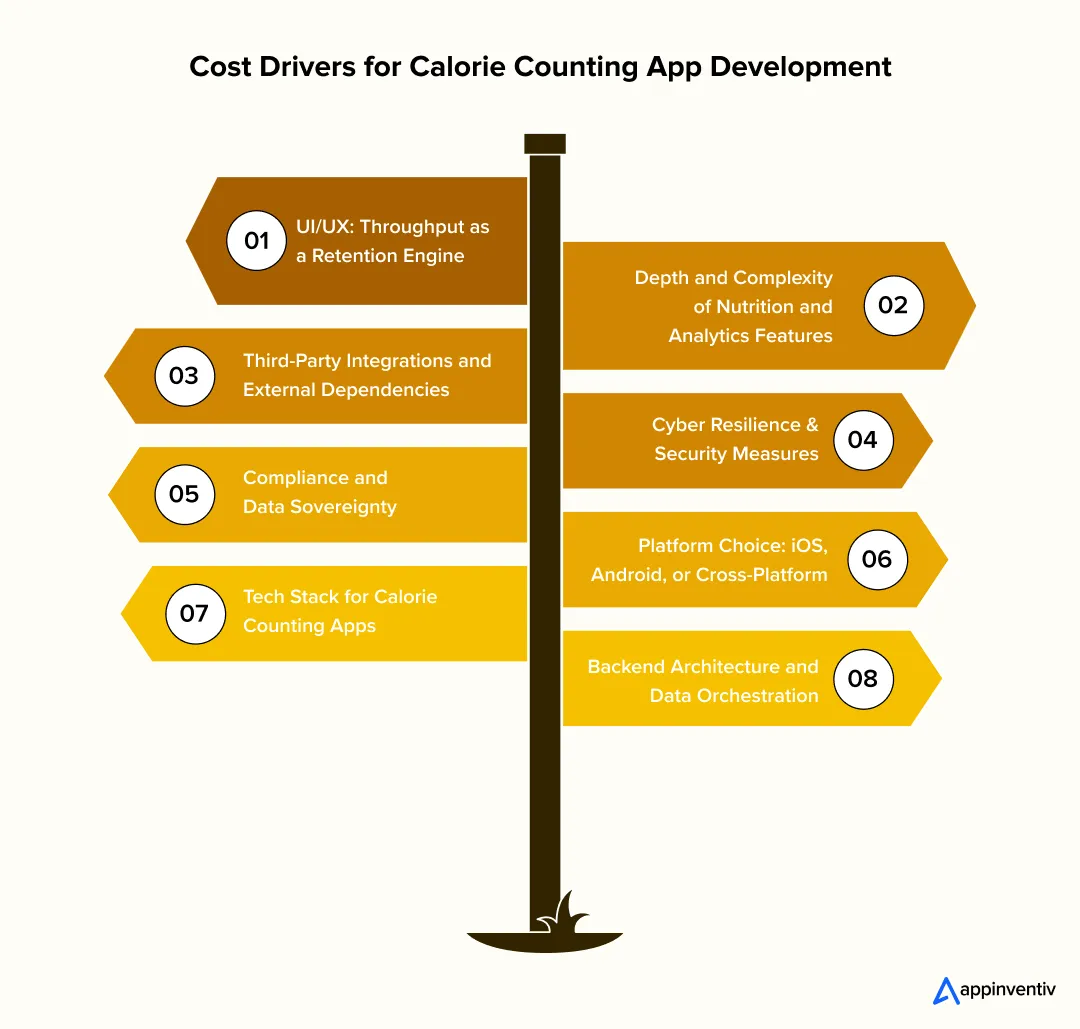
UI/UX: Throughput as a Retention Engine
In a calorie counting app like Cronometer, UI/UX design is not merely “polish”; it is the engine for user retention. If a user cannot log a meal in under five seconds, the churn rate spikes. Enterprise-grade apps budget heavily for “reduced friction” features.
Cost Breakdown for UI/UX Design
| UI/UX level | Typical inclusions | Cost (AUD) |
|---|---|---|
| Basic UI/UX | Clean flows, standard components, basic dashboards | 10,000–25,000 |
| Advanced UI/UX | Haptic feedback for logging, micro-interactions, advanced charts, A/B-ready UX | 25,000–80,000 |
Backend Architecture and Data Orchestration
The backend is where the cost to build a calorie counting app often doubles. Unlike a generic free calorie counter app in Australia, a Cronometer-like platform requires a “High-Integrity Data Ingestion” engine.
Cost Breakdown for Backend Development
| Backend level | What changes | Cost (AUD) |
|---|---|---|
| Basic platform backend | Standard APIs, user profiles, simple food tables | 20,000–60,000 |
| Data-intensive backend | Ingestion pipelines, provenance, dedupe, search indexing, analytics jobs | 60,000–160,000+ |
Third-Party Integrations and External Dependencies
Integration cost is rarely driven by the initial connection. It is driven by reconciliation rules, edge cases, and ongoing change management. For nutrition platforms, common integrations include nutrition databases, barcode providers, wearables, payment gateways and health platforms in Australia.
Cost Breakdown for Third Party Integrations
| Integration Type | Examples | Cost (AUD) |
|---|---|---|
| Wearables | Apple Health, Google Fit, Garmin, Oura, WHOOP. | $20,000 – $50,000 |
| Data Sources | AUSNUT 2011-13, USDA, Brand-specific Retailer APIs (Woolworths/Coles). | $15,000 – $40,000 |
| Monetisation | Stripe (AU), RevenueCat for Subscription lifecycle management. | $10,000 – $25,000 |
Cyber Resilience & Security Measures
In Australia, the security model must align with the ASD Essential Eight maturity framework. Under the 2026 Privacy Act Reforms, penalties for data breaches can reach AUD 50 million.
Cost Breakdown for Security Measures Implementation
| Security posture | What it usually includes | Cost (AUD) |
|---|---|---|
| Foundational | encryption in transit and at rest, secure auth, secrets management | 20,000–45,000 |
| Advanced | threat modelling, pen testing, device hardening, DDoS controls | 45,000–110,000 |
| High assurance | zero trust patterns, SIEM integration, continuous monitoring evidence | 110,000–220,000+ |
Compliance and Data Sovereignty
For an Australian calorie counter app, compliance is not about listing laws. It is about building a product that can explain what data you collect, why you collect it, who can access it, how long it is retained, how consent is recorded and changed, how decisions are made when analytics or recommendations are involved and so on. Enterprise leads (insurers, hospitals) will demand proof of Data Sovereignty. These obligations significantly impact Australian calorie counter app development costs.
Cost Breakdown for Compliance Standards
| Compliance Level | Specific Requirements | Cost Impact (AUD) |
|---|---|---|
| Privacy by Design | Alignment with Privacy Act 1988 and the 2026 OAIC “Serious Interference” guidelines. | $25,000 – $50,000 |
| Health Data Security | AES-256 encryption, Multi-Factor Authentication (MFA), and Zero-Trust access logs. | $40,000 – $85,000 |
| Clinical Conformance | Adherence to the Australian Digital Health Agency (ADHA) mHealth Assessment Framework. | $50,000 – $110,000 |
Platform Choice: iOS, Android, or Cross-Platform
For most products, a cross-platform approach is defensible. For high performance logging, scanner workflows, and native health platform integration depth, native can be justified. However, whatever platform you choose, it impacts your app development cost in Australia.
Cost Breakdown for Platform Choice
| Build approach | Best fit | Cost impact |
|---|---|---|
| Cross-platform | faster time to market, consistent UX, balanced budget | +0% baseline |
| Native | deeper OS integration, performance tuning | +20–40% |
| Hybrid | cross-platform core with native modules | +10–25% |
Tech Stack for Calorie Counting Apps
The technology stack behind a calorie counting app directly influences cost, accuracy, performance, and long-term maintainability. For a Cronometer-like platform, the stack must support reliable data ingestion, precise nutrition calculations, and scalable analytics without compromising security or compliance. Tech stack decisions made early often determine whether the product can evolve safely as data volume, users, and regulatory expectations increase.
Cost Breakdown for Tech Stack Selection
| Layer | Recommended Technology | Why it matters for AU Enterprises |
|---|---|---|
| Frontend | Flutter 4.x / React Native | Ensures 30% cost efficiency with native-grade performance for scanner UI. |
| Backend | Python (FastAPI) / Node.js | Optimised for AI model serving and handling high-volume API requests. |
| Database | PostgreSQL (JSONB) + Redis | Handles complex nested nutrient schemas and provides sub-second search caching. |
| AI/ML | TensorFlow Lite / PyTorch Mobile | Enables on-device food recognition, reducing server latency and egress costs. |
| Infrastructure | AWS (Sydney Region) / Azure | Mandatory for Australian Data Residency and low-latency local performance. |
Also Read: How to Build an AI App in Australia: A Complete Guide
Depth and Complexity of Nutrition and Analytics Features
This is the point where many calorie tracking products underestimate effort and cost. Once you move beyond basic calorie totals, nutrition becomes a structured data problem involving precision, repeatability, and long-term data integrity. Each additional layer of insight increases the complexity of calculations, data storage, and validation workflows, which directly impacts development effort and ongoing operational cost.
Cost Breakdown for Feature Complexity
| Feature Tier | Features of a Cronometer-like App | Estimated Cost (AUD) |
|---|---|---|
| Core Tracking | Goal configuration, daily calorie targets, fast food logging, meal history, and baseline nutrition summaries. | 15,000 – 45,000 |
| Nutrition Depth | Micronutrient tracking, verified food databases, recipe and meal composition logic, portion handling, and nutrient consistency checks. | 45,000 – 110,000 |
| Advanced Analytics | Long-term nutrition trends, adherence scoring, personalised insights, professional or coach dashboards, and user segmentation. | 80,000 – 180,000+ |
Hidden App Development Costs Most Businesses Overlook
While the initial build gets the product to market, 60% of the total cost of ownership (TCO) over three years occurs post-launch. In the Australian market, failing to budget for the “Data & Resilience” tax is the leading cause of mid-market project stagnation.
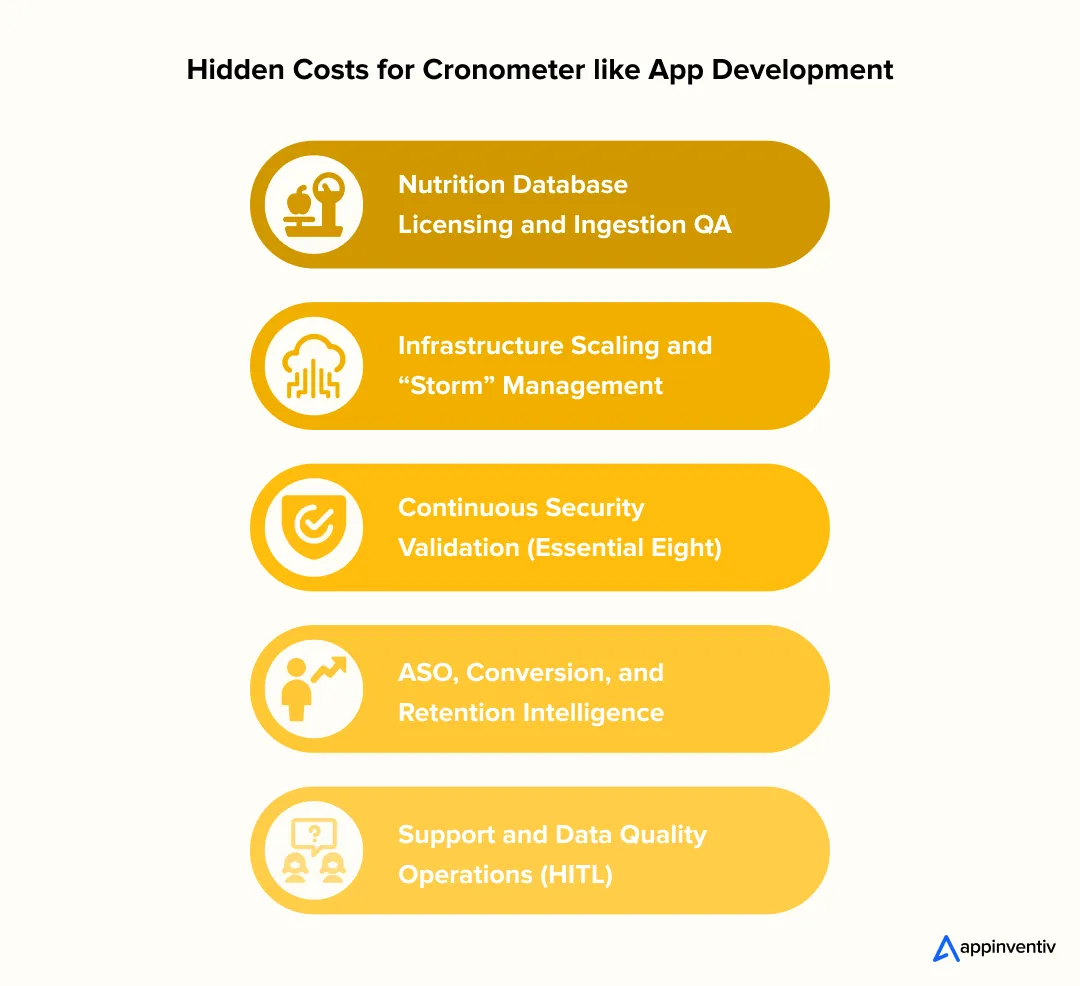
1. Nutrition Database Licensing and Ingestion QA
Maintaining a “Cronometer-grade” platform requires constant synchronisation with lab-verified sources.
- The Reality: If you license research-grade data like NCCDB or AUSNUT, you inherit their update cadence. This requires a dedicated ingestion pipeline to map new food IDs without breaking existing user logs.
- Estimated Cost: AUD 10,000 – $100,000 per year (including licensing fees and manual dietitian QA for branded food verification).
2. Infrastructure Scaling and “Storm” Management
Nutrition apps experience massive, non-linear traffic spikes (e.g., the “New Year Resolution” surge or national health campaigns).
- The Reality: You aren’t just paying for hosting; you are paying for Auto-Scaling Infrastructure across AWS Sydney or Azure Melbourne to ensure sub-second search speeds during peak loads.
- Hidden Drivers: High-frequency barcode scans, image-heavy meal uploads, and asynchronous wearable sync jobs.
3. Continuous Security Validation (Essential Eight)
In Australia, security is a rhythm, not a one-off task.
- The Reality: To remain compliant with the ASD Essential Eight, you must budget for monthly patching cycles, quarterly penetration testing, and continuous evidence collection for executive audits.
- Annual Cost: Expect to allocate 15–20% of the initial build cost annually to maintain a “High-Resilience” posture.
4. ASO, Conversion, and Retention Intelligence
If your monetisation model relies on subscriptions, your app requires a “Growth Engine” backend.
- The Reality: You will pay for third-party tools (like RevenueCat or AppsFlyer) and internal engineering for paywall A/B testing, churn reduction workflows, and deep-funnel analytics.
- Strategic Need: Localised ASO for Australian suburb-specific search intent.
5. Support and Data Quality Operations (HITL)
Users who find an incorrect calorie count on a “verified” entry will lose trust immediately.
- The Reality: You need a Human-in-the-Loop (HITL) operational model to triage data error reports and update food metadata without eroding the platform’s scientific credibility.
How to Optimise App Development Costs Without Compromising Quality
For Australian enterprises, optimising the cost to build a calorie counting app like Cronometer is a strategic exercise in reducing the Total Cost of Ownership (TCO). High-performing teams in 2026 don’t just “build apps”; they engineer scalable assets that qualify for government incentives and app funding in Australia, as well as minimise recurring operational waste.
1. Execute a “Single-Utility” MVP with Global Architecture
Launch with a focused feature set such as high-precision micronutrient tracking for a specific dietary niche (e.g., Keto or Plant-based) but ensure the underlying data schema is built for enterprise expansion.
- The Benefit: Reduces initial calorie counting app development cost in Australia by 40% while avoiding the “Legacy Rebuild” costs when you eventually scale to a full-service platform.
2. Leverage the Australian R&D Tax Incentive
Many businesses overlook that innovative software engineering, specifically developing proprietary AI models for food recognition or novel data ingestion pipelines, can qualify for the Australian Government’s R&D Tax Incentive.
- The Benefit: Eligible entities can receive a refundable tax offset of up to 43.5%, effectively subsidising nearly half of the experimental development costs.
3. Adopt a Cross-Platform “Code-Sharing” Strategy
Utilising top cross-platform frameworks like Flutter or React Native allows for a single codebase to serve both iOS and Android users.
- The Benefit: This approach reduces development and QA effort by 30–40% without sacrificing the 60fps performance required for smooth calorie logging and radar-style data charts.
4. Implement “FinOps” and Serverless Data Processing
Cloud costs for health data can spiral due to continuous wearable syncing. Optimise by moving from “Always-On” servers to Serverless Architecture (AWS Lambda / Azure Functions).
- The Benefit: You only pay for the exact milliseconds a user spends logging a meal. This reduces hosting overheads by up to 50% during off-peak hours (12 AM – 6 AM).
5. Prioritise “Data Integrity” Over “UI Polish”
In the precision nutrition market, a bug in a micronutrient calculation is a “Level 1” failure, whereas a slightly unpolished button is “Level 4.”
- The Benefit: Direct 70% of the initial budget toward backend robustness and BOM/NCCDB data accuracy. A stable, accurate backend reduces long-term “Correction Costs”.
How to Develop a Calorie Counting App Like Cronometer
For Australian enterprises, the steps to develop a calorie tracking app represent a sophisticated engineering program rather than a simple build. Success depends on the orchestration of data integrity, compliance readiness, and delivery velocity. Let’s unveil the nutrition app development process in Australia:
1. Discovery, Data Strategy & Compliance Audit
Before a single line of code is written, you need to define the platform’s “Trust Architecture”. This phase aligns the cost to develop an app like Cronometer with long-term commercial viability.
- Key Actions: Negotiating NCCDB/AUSNUT licensing, mapping 2026 Privacy Act consent flows, and defining Australian data residency requirements (Sydney/Melbourne AWS regions).
- Enterprise Milestone: Completion of a “Compliance-First” product roadmap.
2. UX/UI and Product Architecture Design
In high-precision nutrition, UI is a structural component. At this stage, you need to prioritise “Reduced Cognitive Load” to ensure users can log complex meals without fatigue.
- Key Actions: Designing portion-selection logic, micronutrient visibility hierarchy, and AI-Natural Language Processing (NLP) wireframes for voice-to-log features.
- Technical Design: Mapping the many-to-many database schema for ingredients, recipes, and verified nutrient sources.
3. Full-Stack Development & Data Ingestion Engineering
Development focuses on the backend’s ability to handle high-concurrency requests and precise mathematical calculations.
- Backend: Building a Python-based ingestion engine to sanitise raw GRIB2 or XML food data and establishing a Zero-Trust API layer.
- Frontend: Developing low-latency interfaces using Flutter or native Swift/Kotlin to ensure smooth 60fps radar and chart rendering.
- Integrations: Establishing secure WebSocket connections for wearable biometrics (Apple Health, Google Fit) and barcode scanning.
4. Testing, Clinical Validation & Launch Readiness
App testing extends beyond functional bugs into the realm of Clinical and Data Integrity.
- Key Actions: Validating nutrition calculation engines against lab benchmarks, performing “Storm-Spike” load testing for high-traffic events, and conducting independent Penetration Testing.
- Governance Check: Final audit of the Notifiable Data Breaches (NDB) scheme readiness and consent logging.
5. Post-Launch Iteration & AI Evolution
A modern calorie tracker app is a living ecosystem. Post-launch work focuses on “Information Gain”, using AI analytics to see where users struggle to find foods and refining search algorithms.
- Continuous Improvement: Integrating AI-Nowcasting (predictive nutrient suggestions) and expanding into B2B/Clinical dashboards based on user behavioral data.
If you want to ship a nutrition platform that stands up to scrutiny, we can scope the data model, ingestion plan, and security controls upfront.

How to Build a Better App Than Cronometer
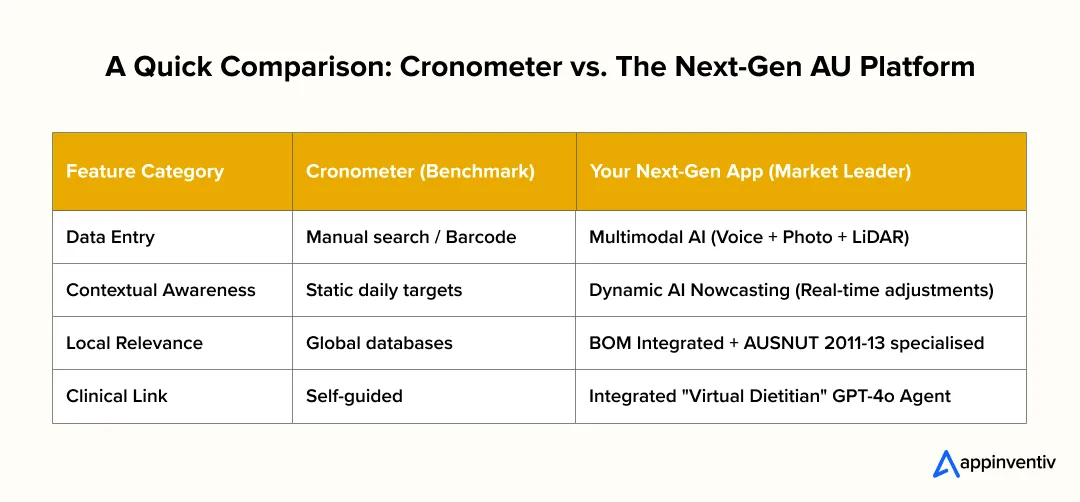
While Cronometer is the gold standard for historical accuracy, the next market leader in Australia will win by reducing the cognitive load of the user through AI and localised clinical validation. Here is how you can outperform an incumbent:
1. Shift from Manual Logging to “AI-Nowcasting”
The primary reason users abandon calorie trackers is the “burden of entry.” A superior app must transition from reactive logging to proactive suggestions.
- Computer Vision 2.0: Implementing LiDAR-supported portion estimation. Using the depth sensors on modern iPhones to calculate volume (ml/cm³) rather than just identifying “Chicken and Rice.”
- Predictive Macro-Suggestions: Instead of waiting for the user to log, the app uses historical patterns and wearable signals (e.g., a high-intensity workout detected via Apple Watch) to send a “Nowcasting” push: “High recovery need detected. Suggesting 30g protein snack now to hit your daily target.”
2. Solve the “Australian Cultural Food Gap”
Research from the University of Sydney (2024) highlighted that many global AI nutrition apps struggle with the diverse Asian and fusion cuisines common in Australian metros, often miscalculating calories in mixed dishes like Pho or Laksa by up to 49%.
- The Opportunity: Building a proprietary training set for diverse AU-specific cuisines.
- Clinical Edge: Partner with Accredited Practicing Dietitians (APDs) to verify “Mixed Dish” logic, ensuring your app is the most accurate for Australia’s multicultural population.
3. Integrated “Safety Suite” for the Australian Climate
Differentiate by linking nutrition to environmental health – a growing concern for the 2026 Australian consumer.
- Hydration Intelligence: Automatically adjusting water targets based on BOM (Bureau of Meteorology) heatwave alerts and sweat-loss data from wearables.
- Vitamin D Tracker: Using local UV index data to suggest “Sun Windows” for natural Vitamin D synthesis without exceeding safe exposure limits.
How Do Calorie Counting Apps Like Cronometer Make Money?
Monetisation choices directly influence both build cost and operating complexity. Australian platforms that succeed tend to diversify revenue while protecting data integrity. Some common Cronometer app monetisation models include:
| Monetisation Model | How it works | What it changes in the build |
|---|---|---|
| Freemium + subscription | free basics, paid analytics and advanced features | paywalls, entitlement system, churn workflows |
| Professional plans | coach or dietitian dashboards, client sharing | roles, permissions, consent logging, audit trails |
| B2B partnerships | corporate wellness or insurer partnerships | reporting, security evidence, integration readiness |
| Data licensing (careful) | aggregated insights, strictly governed | governance, anonymisation, legal review, controls |
Why Partner With an App Development Company Like Appinventiv
Building a Cronometer-class product in Australia is an execution challenge across data integrity, scalable engineering, and compliance-ready operations. This is exactly where most calorie tracking apps fail: they ship a good-looking interface, then struggle to maintain trustworthy nutrition data and predictable product operations as the user base grows.
At Appinventiv Software Australia, we build these platforms with board-level realities in mind: governance, security evidence, data provenance, and long-term ownership. That means cost transparency, modular architecture, and delivery discipline that keeps risk visible early, not hidden until the end.
Our Capability Signals for Australian Enterprises:
- Healthcare Mastery: Successfully delivered 3000+ digital platforms, including AI-driven diabetes care tools like DiabeticU and voice-based wellness platforms like Soniphi.
- Compliance at the Core: The health and fitness apps we build are engineered for TGA and the Australian Privacy Act 1988 standards from Day 1.
- Operational Efficiency: We’ve helped clients achieve a 35% gain in operational efficiency through AI automation and modular backend architectures.
- Local Expertise, Global Scale: With 5+ agile delivery centers in Australia and a team of 1,700+ tech experts, we combine global insights with local delivery execution, ensuring your data residency and hosting needs are met via AWS Sydney/Melbourne.
If your goal is a high-trust nutrition platform, we can help you define the data strategy, uncover the estimated cost to build a calorie counting app like Cronometer, and build an operating model that stays credible after launch.
FAQs
Q. What is Cronometer?
A. Cronometer is a nutrition-focused platform built around verified food databases and micronutrient accuracy rather than crowdsourced calorie estimates. It is commonly used as a benchmark for precision-driven nutrition applications.
Q. How much does it cost to build a calorie counting app like Cronometer in Australia?
A. The calorie counting app development cost in Australia typically ranges between AUD 70,000 and AUD 700,000, based on data depth, compliance maturity, and analytics sophistication.
Typical cost ranges in Australia:
- AUD 70,000–150,000: Focused MVP with core calorie tracking and limited verified datasets
- AUD 150,000–350,000: Consumer-ready platform with micronutrient tracking, subscriptions, and analytics
- AUD 350,000–700,000+: Advanced nutrition intelligence platform with AI insights, integrations, and enterprise-grade governance
Final budgets are shaped by long-term data licensing, security posture, and compliance obligations, not just initial build scope.
Q. How long does it take to develop a calorie tracker app?
A. Timelines for calorie counting app development in Australia scale with data complexity and governance requirements.
Typical delivery timelines:
- 3–6 months: MVP with core tracking and basic reporting
- 6–9 months: Mid-scale platform with verified databases and analytics
- 9–12+ months: Advanced platforms with AI-driven insights and enterprise compliance
Projects that underestimate compliance and data modelling typically experience timeline extensions during later phases.
Q. How do you build a food tracking app in Australia?
A. Here are the typical execution phases of a calorie tracker app:
- Data strategy and licensing alignment
- Product architecture and UX logic design
- Controlled development and integration
- Security, privacy, and launch readiness
- Iterative optimisation post-launch
Q. What factors affect the cost of developing a food tracker app in Australia?
A. The primary cost drivers for an Australian calorie counting app include:
- Nutrition database licensing and update cycles
- Backend architecture and long-term data retention
- Analytics depth and personalisation logic
- Security maturity and privacy compliance
- Platform strategy and integration scope
These factors influence both upfront investment and total cost of ownership.