Reading Time: 5 minutes
In the world of marketing, you are managing a complex, multi-channel orchestra. You have multiple business goals such as driving repeat purchases, preventing churn, increasing average order value, and dozens of campaigns running simultaneously across email, push, SMS, in-apps and other channels.
The problem is that traditional automation platforms force you into a stressful balancing act:
The Segmentation Straitjacket – You’re limited to manual segments. Every customer in that segment gets the same message, at the same time, on the same channel, regardless of their individual intent or fatigue level.
The Channel Overload Trap – You know you need to be omnichannel, but managing frequency across channels is a nightmare. You risk oversending on expensive messaging channels (such as SMS or WhatsApp) or flooding the customer with irrelevant noise, which can lead directly to unsubscribes and churn.
The Slow Learning Loop – Your goal is to consistently learn and iterate, but manual A/B testing is slow and only tests one variable at a time. It can take weeks to figure out which combination of campaign, channel, and timing is truly optimal.
The result is a marketing team that is busy, but not effective. They are caught in the reactive sending trap, manually moving customers between journeys instead of focusing on strategic growth.
Imagine a future where your marketing strategy is powered by intelligence, not endless manual work.
Campaign Decisioning is purpose-built to bring that future to life — a revolutionary approach that uses goal-based AI Agents to learn from your customers, experiment across channels, and optimize their entire lifecycle automatically, so you can focus on growth, not operational complexity.
Introducing Merlin AI Campaign Decisioning Agent: Your Autonomous Growth Partner
Campaign Decisioning allows you to create Decisioning Agents that are purpose-built to solve a specific business challenge. You simply define the goal, set the boundaries, and let the reinforcement learning engine automatically manage the complexity of multi-campaign, multi-channel orchestration.
This shifts your role from a Campaign Manager to a Growth Strategist.
Here’s how Campaign Decisioning works:
Define the Goal, Not the Segment
The first and most critical step is defining the business objective you want the Agent to achieve.
Instead of manually defining a segment like “Users who purchased once 30 days ago,” you simply set the Agent’s goal as “Drive Repeat Purchase”.
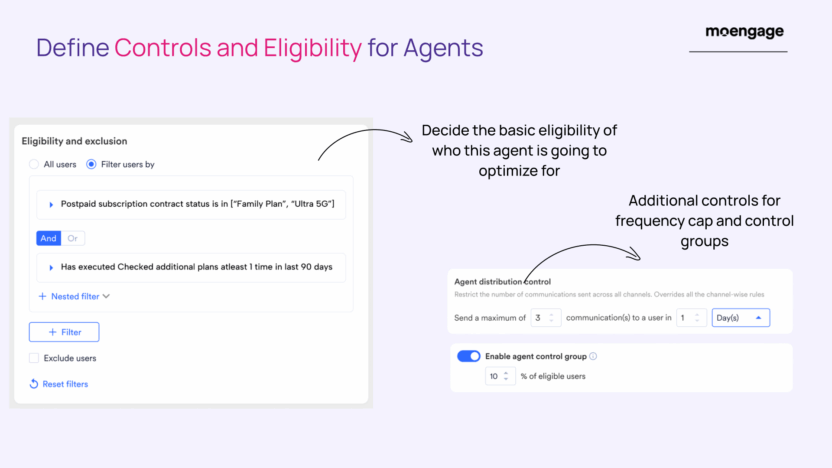
Configure Eligibility and Guardrails
You define the audience that the Agent should focus on (e.g., “all customers who have made their first purchase”).
Crucially, you also set essential Guardrails that the Agent must never cross, such as a Frequency Cap (e.g., “maximum of 2 communications per week via this Agent”) or a Cost Cap for expensive channels like SMS.
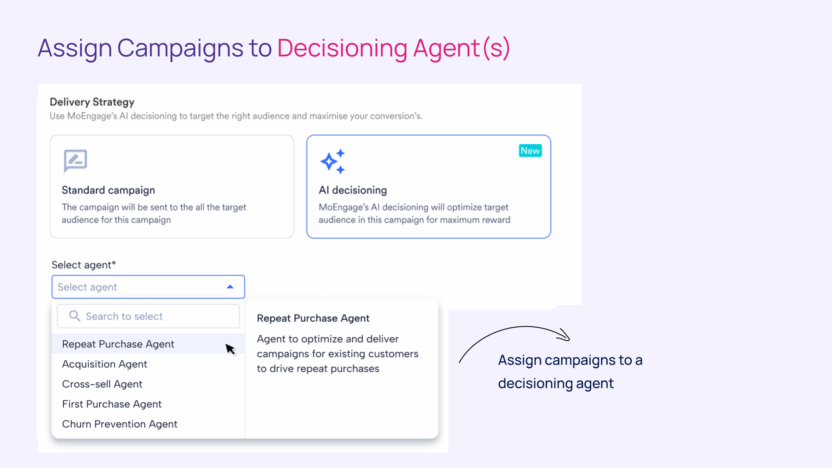
Assign Campaigns for AI-Powered Decisioning and Experimentation
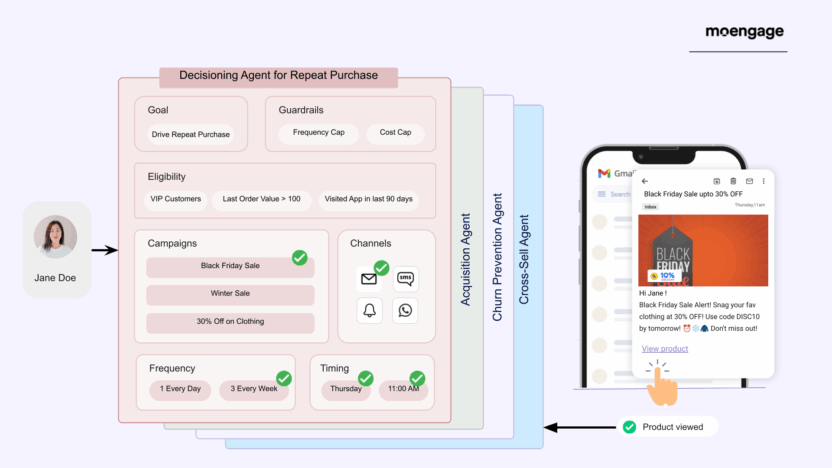
You create a library of campaigns with different value propositions, creatives, and messages (e.g., “Black Friday Sale,” “Winter Sale,” “30% Off on Clothing”). You then assign these campaigns to your Decisioning Agent.
Campaign Decisioning that Continuously Learns to Scale Results
Intelligent Optimization
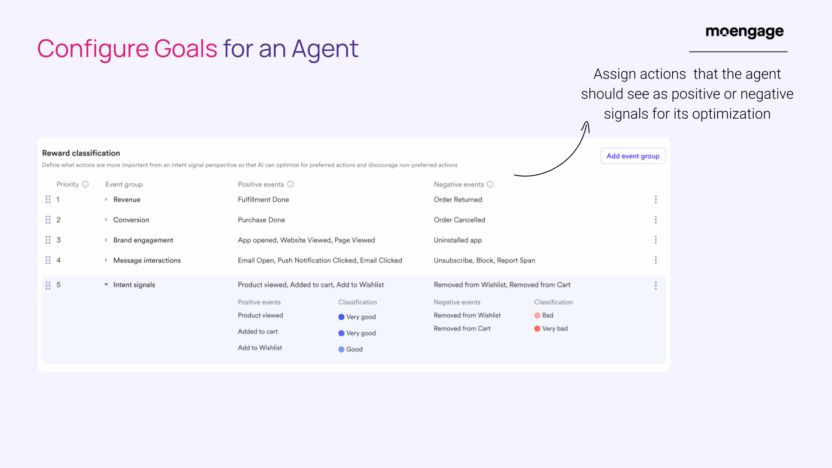
The Agent leverages reinforcement learning, taking every customer interaction (clicks, conversions, channel engagement, uninstalls) as a positive or negative signal. It then autonomously experiments with which campaign, which channel (Email, Push, SMS), and which time to send the message for every single customer.
Maximized ROI
The Agent is constantly learning. It will use expensive channels such as WhatsApp or SMS only when its prediction model shows a high likelihood of conversion, ensuring you optimize your Return on Marketing Spend.
The Continuous Feedback Loop
Unlike traditional journeys that end when a customer converts, the Decisioning Agent is constantly learning and optimizing. It uses the feedback loop to continuously improve, taking into consideration Positive Signals, such as: Did the customer convert after an email? Did they add a product to their cart after a push notification?
As well as Negative Signals, such as – Did the customer ignore two pushes in a row? Did they immediately delete the email?
The Agent continuously learns from this data, making sure the next interaction with that specific customer—or similar customers—is even more relevant and effective.
Use Cases for Campaign Decisioning
|
Use Case Category |
Before Campaign Decisioning |
With Campaign Decisioning |
| Increase LTV | All first-time buyers receive the same 10% email discount, regardless of whether they would have previously made a purchase with or without an incentive. | A Repeat Purchase Agent dynamically chooses to send a small discount, a personalized product recommendation, or a VIP loyalty reward, maximizing long-term profitability. |
| Retention & Win-Back | A generic “We miss you” email is sent after 30 days of inactivity, often too late or with an irrelevant message. | A Re-Activation Agent identifies high-risk customers, selects the most effective channel (e.g., low-cost push first), and tests various value propositions (e.g., a personalized incentive vs. a content highlight) to re-engage them at the earliest sign of dormancy. |
| Cost Optimization | You send too many expensive SMS/WhatsApp campaigns that don’t always convert, resulting in a wasted budget. | An Agent learns which customers only convert via SMS/ WhatsApp for certain campaigns and suppresses low-impact sends, driving a high-impact campaign only to the customers most likely to convert on that specific channel. |
| Cross-Sell and Upsell | You push a generic accessory bundle to everyone who buys a mobile phone, ignoring their preference for specific brands or product types. | A Cross-Sell Agent identifies the optimal time post-purchase and selects the best complementary product to promote based on individual affinity and past behaviour, increasing Average Order Value. |
The Future of Engagement is Intelligent Decisioning and Orchestration
We are moving into an era where marketing success hinges on delivering an infinitely relevant experience. MoEngage’s Campaign Decisioning is the tool that makes this possible. By entrusting the operational complexity of channel mix, frequency, and timing to a constantly optimizing AI Agent with a human in the loop, you free your marketing team to focus on the creative, the strategy, and the next big growth opportunity.
It’s time to stop manually stitching together campaigns and start orchestrating business outcomes with intelligence.
Campaign Decisioning is currently in private beta for select MoEngage customers. If you are interested in being a part of this private beta, reach out to your MoEngage Account Manager today!
The post Campaign Decisioning: Right Channel, Right Time, Real Impact appeared first on MoEngage.