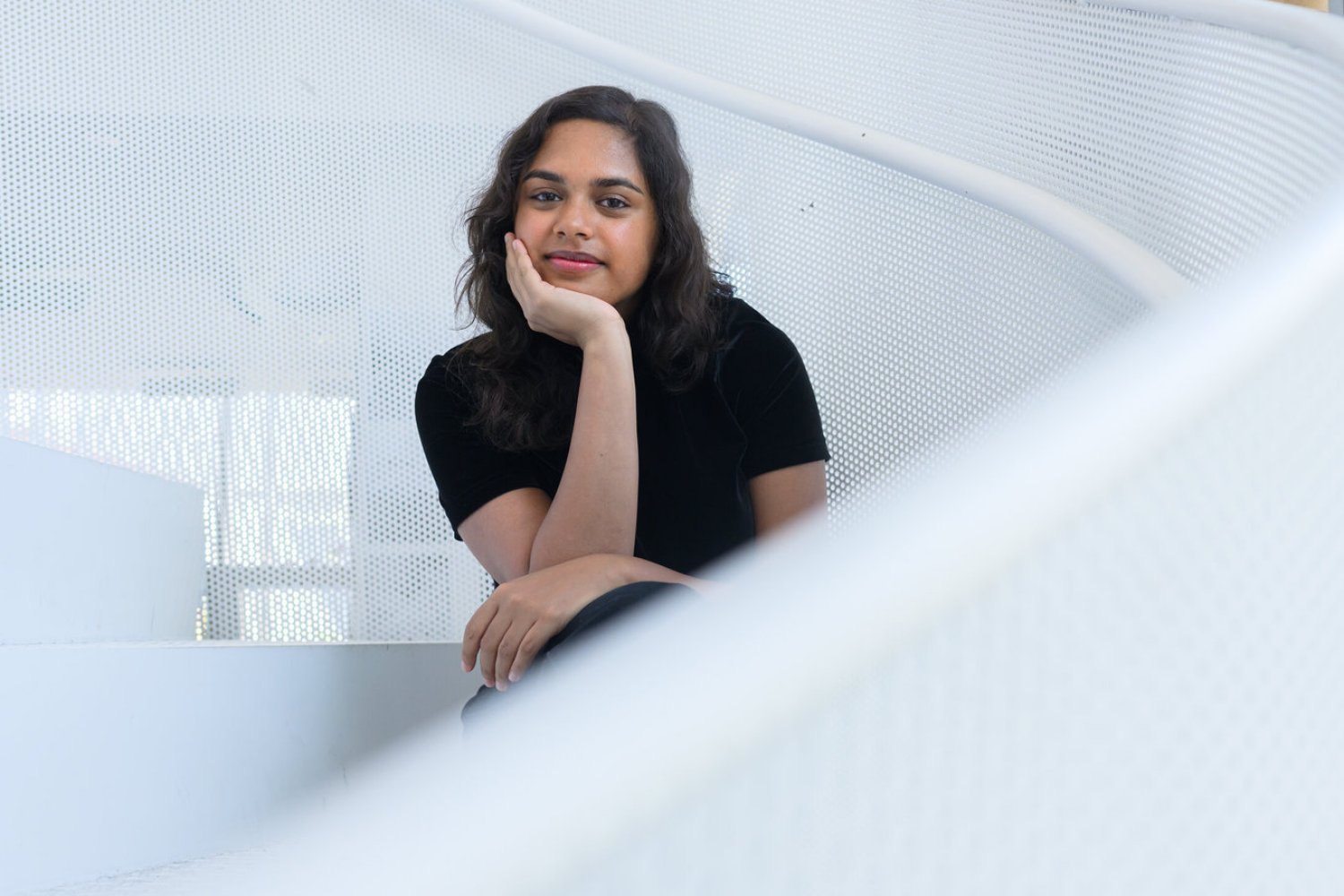
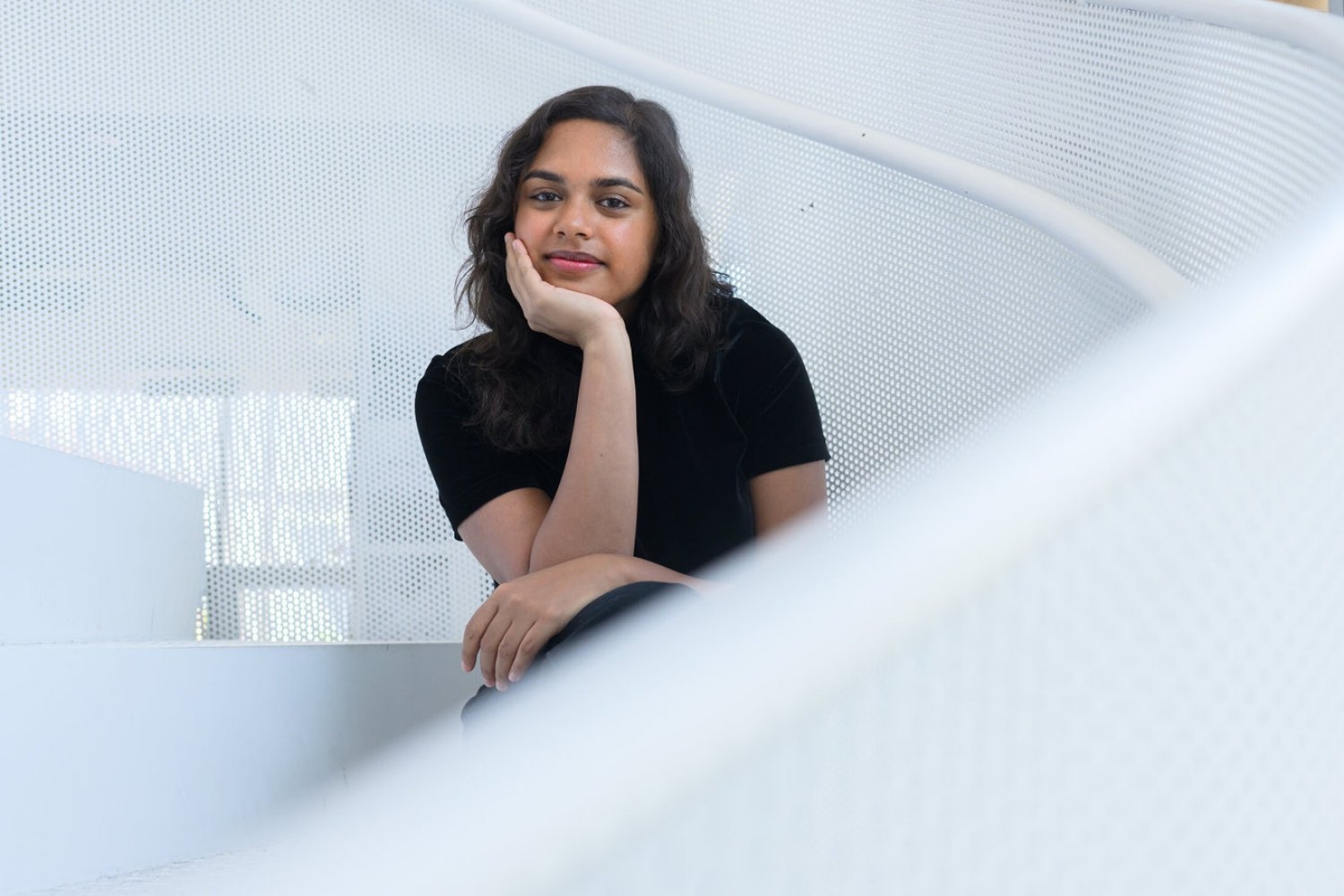
Computational neuroscientist and singer/songwriter Kimaya (Kimy) Lecamwasam, who also plays electric bass and guitar, says music has been a core part of her life for as long as she can remember. She grew up in a musical family and played in bands all through high school.
“For most of my life, writing and playing music was the clearest way I had to express myself,” says Lecamwasam. “I was a really shy and anxious kid, and I struggled with speaking up for myself. Over time, composing and performing music became central to both how I communicated and to how I managed my own mental health.”
Along with equipping her with valuable skills and experiences, she credits her passion for music as the catalyst for her interest in neuroscience.
“I got to see firsthand not only the ways that audiences reacted to music, but also how much value music had for musicians,” she says. “That close connection between making music and feeling well is what first pushed me to ask why music has such a powerful hold on us, and eventually led me to study the science behind it.”
Lecamwasam earned a bachelor’s degree in 2021 from Wellesley College, where she studied neuroscience — specifically in the Systems and Computational Neuroscience track — and also music. During her first semester, she took a class in songwriting that she says made her more aware of the connections between music and emotions. While studying at Wellesley, she participated in the MIT Undergraduate Research Opportunities Program for three years. Working in the Department of Brain and Cognitive Sciences lab of Emery Brown, the Edward Hood Taplin Professor of Medical Engineering and Computational Neuroscience, she focused primarily on classifying consciousness in anesthetized patients and training brain-computer interface-enabled prosthetics using reinforcement learning.
“I still had a really deep love for music, which I was pursuing in parallel to all of my neuroscience work, but I really wanted to try to find a way to combine both of those things in grad school,” says Lecamwasam. Brown recommended that she look into the graduate programs at the MIT Media Lab within the Program in Media Arts and Sciences (MAS), which turned out to be an ideal fit.
“One thing I really love about where I am is that I get to be both an artist and a scientist,” says Lecamwasam. “That was something that was important to me when I was picking a graduate program. I wanted to make sure that I was going to be able to do work that was really rigorous, validated, and important, but also get to do cool, creative explorations and actually put the research that I was doing into practice in different ways.”
Exploring the physical, mental, and emotional impacts of music
Informed by her years of neuroscience research as an undergraduate and her passion for music, Lecamwasam focused her graduate research on harnessing the emotional potency of music into scalable, non-pharmacological mental health tools. Her master’s thesis focused on “pharmamusicology,” looking at how music might positively affect the physiology and psychology of those with anxiety.
The overarching theme of Lecamwasam’s research is exploring the various impacts of music and affective computing — physically, mentally, and emotionally. Now in the third year of her doctoral program in the Opera of the Future group, she is currently investigating the impact of large-scale live music and concert experiences on the mental health and well-being of both audience members and performers. She is also working to clinically validate music listening, composition, and performance as health interventions, in combination with psychotherapy and pharmaceutical interventions.
Her recent work, in collaboration with Professor Anna Huang’s Human-AI Resonance Lab, assesses the emotional resonance of AI-generated music compared to human-composed music; the aim is to identify more ethical applications of emotion-sensitive music generation and recommendation that preserve human creativity and agency, and can also be used as health interventions. She has co-led a wellness and music workshop at the Wellbeing Summit in Bilbao, Spain, and has presented her work at the 2023 CHI conference on Human Factors in Computing Systems in Hamburg, Germany and the 2024 Audio Mostly conference in Milan, Italy.
Lecamwasam has collaborated with organizations near and far to implement real-world applications of her research. She worked with Carnegie Hall’s Weill Music Institute on its Well-Being Concerts and is currently partnering on a study assessing the impact of lullaby writing on perinatal health with the North Shore Lullaby Project in Massachusetts, an offshoot of Carnegie Hall’s Lullaby Project. Her main international collaboration is with a company called Myndstream, working on projects comparing the emotional resonance of AI-generated music to human-composed music and thinking of clinical and real-world applications. She is also working on a project with the companies PixMob and Empatica (an MIT Media Lab spinoff), centered on assessing the impact of interactive lighting and large-scale live music experiences on emotional resonance in stadium and arena settings.
Building community
“Kimy combines a deep love for — and sophisticated knowledge of — music with scientific curiosity and rigor in ways that represent the Media Lab/MAS spirit at its best,” says Professor Tod Machover, Lecamwasam’s research advisor, Media Lab faculty director, and director of the Opera of the Future group. “She has long believed that music is one of the most powerful and effective ways to create personalized interventions to help stabilize emotional distress and promote empathy and connection. It is this same desire to establish sane, safe, and sustaining environments for work and play that has led Kimy to become one of the most effective and devoted community-builders at the lab.”
Lecamwasam has participated in the SOS (Students Offering Support) program in MAS for a few years, which assists students from a variety of life experiences and backgrounds during the process of applying to the Program in Media Arts and Sciences. She will soon be the first MAS peer mentor as part of a new initiative through which she will establish and coordinate programs including a “buddy system,” pairing incoming master’s students with PhD students as a way to help them transition into graduate student life at MIT. She is also part of the Media Lab’s Studcom, a student-run organization that promotes, facilitates, and creates experiences meant to bring the community together.
“I think everything that I have gotten to do has been so supported by the friends I’ve made in my lab and department, as well as across departments,” says Lecamwasam. “I think everyone is just really excited about the work that they do and so supportive of one another. It makes it so that even when things are challenging or difficult, I’m motivated to do this work and be a part of this community.”








![How to create a social media report [free template included]](https://mgrowtech.com/wp-content/uploads/2026/01/social-media-report-120x86.png)