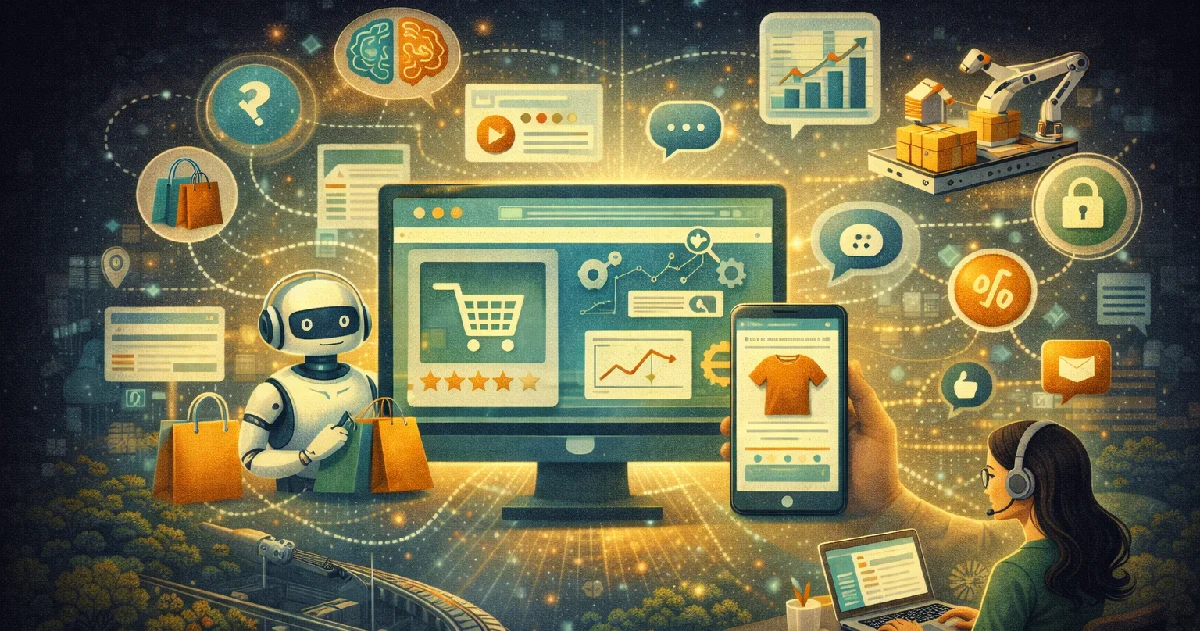
E-commerce is getting bigger day by day. And now it’s not just about listing products and running ads. It’s about predicting customer intent, personalizing experiences in real time, and optimising decisions at scale. Now you’ll need artificial intelligence (AI) and machine learning (ML). Because today’s online shoppers need relevance, and common for all or any generic product recommendations, static pricing, and manual customer support don’t cut it anymore. You will need a lot of data for that, and AI-powered systems analyse massive amounts of data, browsing behavior, purchase history, location, and preferences to deliver smarter, faster, and more human-like interactions.
AI and ML provide us with personalized product suggestions, dynamic pricing, demand forecasting, and even fraud detection. So AI and ML are changing the way eCommerce businesses used to operate behind the scenes and engage customers on the front end. And if we talk about modern e-commerce platforms, they are already being built with AI-first thinking. Whether businesses are working with global agencies or experienced e-commerce website developers in Bangalore, the focus has shifted toward integrating intelligent systems that improve conversions, retention, and operational efficiency. Let’s talk about all of these and about benefits, cases, and best practices to understand it even more.
How Do Artificial Intelligence and Machine learning Work in eCommerce?
Artificial intelligence and Machine learning in e-commerce start with data. A lot of it. Every click, search, scroll, and purchase gets recorded. Even actions that lead to nothing matter. The system watches patterns. Repeats them. Learns slowly over time.
Machine Learning works by analysing past behaviour. What customers viewed. What they ignored. What pushed them to buy? There are no fixed rules here. The model adjusts based on probability. It improves with volume. Less traffic means slower learning. No shortcuts.
These systems are trained using historical data. Then tested. Then corrected. This cycle keeps running continuously in the background. As more users interact with the platform, predictions become slightly more accurate. Not perfect. Just better than before.
Artificial intelligence operates in real time. It decides what product to show. When to offer a discount. Or when a chatbot should step in. All of this happens in milliseconds. That’s why performance and automation are now core priorities during e-commerce web development in Bangalore and other major tech markets.
Personalization is powered by algorithms working quietly. Recommendation engines compare user behaviour with similar profiles. Patterns emerge. Suggestions feel relevant. Nothing magical here. Just data and math doing their job.
Human control still matters. AI systems need direction. People define goals. People correct mistakes. Without supervision, models drift or over-optimise the wrong things. Experienced e-commerce website developers commonly follow this balanced approach in Bangalore.
Key Benefits of AI & ML in eCommerce

Smarter personalization
AI and ML help platforms understand user intent better. Product suggestions feel natural. Homepages adapt subtly. Customers see what actually matters to them, not random bestsellers. This improves engagement without forcing decisions.
Better conversion rates
ML models analyse what leads to a purchase and what causes drop-offs. Based on this, layouts, recommendations, and offers adjust over time. Results don’t spike instantly. They improve steadily, which is more sustainable.
Efficient customer support
AI-driven chatbots handle repetitive queries. Order status. Returns. Basic product doubts. Human teams focus on complex issues instead of routine tasks. Response time improves, and workload reduces. A practical win.
Improved inventory planning
ML predicts demand based on historical data and trends. Overstocking reduces. Stockouts happen less often. Inventory decisions become proactive instead of reactive. This directly impacts cash flow.
Reduced operational costs
Automation handles repetitive processes. Reporting. Customer segmentation. Campaign triggers. Teams spend less time managing chaos and more time on strategy. This efficiency is a major reason AI integration is now standard in e-commerce web development in Bangalore and beyond.
Stronger fraud detection
AI flags unusual activity instantly. Suspicious transactions don’t go unnoticed. False positives are minimised over time. Security improves without hurting genuine buyers.
Scalable growth support
AI and ML scale with the business. As traffic grows, intelligence grows too. That’s why experienced e-commerce website developers in Bangalore design platforms with AI-readiness from the start, not as an afterthought.
Practical Use Cases of AI & ML in eCommerce

Personalised product recommendations
AI tracks browsing patterns, purchase history, and similar user behaviour. Based on this, it suggests products that actually match intent. Not random add-ons. This increases average order value without pushing customers too hard.
Search and product discovery
ML improves on-site search by understanding user intent, not just keywords. Misspelled queries. Vague searches. Partial product names. Results still make sense. Customers find products faster, and drop-offs reduce.
Chatbots and virtual assistants
AI-powered bots handle common customer queries instantly. Order status. Returns. Payment issues. They work 24/7 and reduce dependency on large support teams. Human agents step in only when needed.
Dynamic pricing and offers
ML models analyze demand, seasonality, and competitor pricing. Prices and discounts adjust in real time. Not aggressively. Strategically. This helps protect margins while staying competitive.
Fraud detection and payment security
AI identifies unusual transaction patterns. Sudden spikes. Location mismatches. Repeated failed attempts. Suspicious activity gets flagged instantly without affecting genuine customers.
Marketing automation and campaign optimization
AI decides when to send emails, what content to show, and which users to target. Campaigns improve over time based on performance data. This capability is now commonly integrated during e-commerce web development in Bangalore and similar innovation-driven markets.
Operational intelligence at scale
AI monitors performance across the platform. Identifies bottlenecks. Flags inefficiencies. This is why modern e-commerce website developers in Bangalore design systems that support AI-driven insights from the ground up.
Best Practices for Implementing AI & ML in eCommerce

Start with clean, quality data
Garbage in, garbage out. Too many companies dive into AI with messy, incomplete, or outdated data. Your ML models can only be as smart as the data you feed them. Audit, clean, and structure first. No shortcuts.
Define clear objectives
AI for the sake of AI is a waste. Knowing exactly what you want is personalization, fraud reduction, inventory forecasting, and measuring it. Without goals, improvements are random, and ROI disappears.
Test before full-scale deployment
Pilot projects first. Small segments. A/B test results. Watch for unintended consequences, recommendations that annoy users, or dynamic pricing that backfires. Scaling without testing is expensive and risky.
Focus on user experience, not tech hype
Algorithms should enhance shopping, not confuse or overwhelm. Too many pop-ups, aggressive upsells, or irrelevant suggestions destroy trust. Keep AI subtle, smooth, and helpful.
Continuously retrain models
Customer behaviour changes constantly. ML models need regular retraining with fresh data. Static models get stale fast and stop delivering value. Make retraining part of the workflow.
Ensure transparency and ethics
AI can feel invasive if done wrong. Make privacy policies clear. Don’t overstep boundaries with hyper-targeting. Ethical AI improves customer trust, which is as valuable as conversions.
Invest in scalable infrastructure
AI systems need speed and capacity. Slow servers, limited storage, or weak pipelines break functionality. Experienced e-commerce website developers in Bangalore plan infrastructure with scale in mind from the start.
Measure and iterate constantly
KPIs matter, like conversion rate, engagement, retention, and fraud reduction. Track continuously, adjust strategies, and never assume a model is “done.” The moment you stop iterating, performance drops.
Collaborate across teams
AI isn’t just a tech problem. Marketing, operations, product, and support teams all contribute. Silos kill efficiency. Shared insights make AI smarter and results faster.
Conclusion
AI and ML are no longer optional in eCommerce—they’re the backbone of smarter, faster, and more personalized shopping experiences. From improving recommendations and search to optimising pricing, inventory, and customer support, the potential is huge. Businesses that adopt these technologies strategically gain a clear edge, while those that ignore them risk falling behind.
For brands aiming to implement AI-driven solutions effectively, working with experienced e-commerce website developers in Bangalore can make the process smoother, ensuring systems are designed with scalability, performance, and user experience in mind. Similarly, a thoughtful e-commerce website development company integrates AI capabilities from the ground up, allowing businesses to turn data into actionable insights without overcomplicating their tech stack.