Before generative AI even existed, writing assistants had already become popular extensions for reviewing person-created writing and recommending substantial grammatical and style changes. With the advent of generative AI, though, now powerful generative AI writing assistant software is supercharged with features that aim to streamline and maximize writers’ outputs.
Voice mimicry is one of these especially powerful features. It reviews large amounts of text to then make new text with the same breadth of vocabulary, syntax, style, and cadence as the material the AI writing assistant had been trained on.
Though undoubtedly useful, buyers are left wondering: Is such precise imitation ethical, or even truly beneficial in the long-term?
Why voice mimicry matters in AI writing assistants
Years before ChatGPT launched in late 2022, technology was already under development to mimic the sounds of human voices based on provided samples for virtual assistants. When it comes to the written word, voice mimicry is quickly becoming one of the most important differentiators in AI writing assistant software. This capability allows tools to replicate a specific tone, style, or writing voice. This is often a company’s brand identity, based on its defined brand guidelines or an individual author’s writing patterns.
This matters because writing is not just about accuracy, but also about identity.
On a large scale, businesses rely on consistent messaging to build trust with their readers and convert them into new customers. On a smaller scale, individual writers want their writing to feel authentic rather than generic to better convey themselves to their personal readers, build connections with them, and grow their own brands. AI writing assistants already improve grammar, clarity, and efficiency, but without tonal matching, they risk producing content that feels standardized or impersonal.
Voice mimicry bridges that gap. It enables teams to scale content production without sacrificing personality, and it allows individuals to maintain authenticity even when using automation. And this feature’s importance can’t be understated: according to Education Week, mimicry has already been both extremely helpful and troublesome. Luckily, G2 Data sheds some light on the issue.
What does G2 Data show about voice mimicry in AI writing assistants?
G2 review data shows that voice mimicry features exist across the AI Writing Assistant category, but at different levels of maturity. Despite this lack of standardization, among 5,000 unique buyer reviews for AI writing assistant products on G2, approximately 1 in 10 mentioned voice mimicry features. The majority of those were positive, amounting to a total of 7% of reviews praising the feature. This may seem like a small share, but it’s notable for a capability that is neither standardized nor fully mature across the category.
This means buyers are not only noticing voice mimicry, but they are also actively seeking it out, purchasing it, and making a point to let their peers know how well the feature works.
At the most advanced level, tools like Jasper explicitly learn and replicate individual writing styles. G2 reviewers note that “Jasper can mimic my voice once I write,” and that it “learned my voice tone,” highlighting true personalization capabilities based on user input. As previously noted, however, tools typically focus on brand voice rather than individual voice. Grammarly, for example, is frequently praised for helping teams, “ensure consistency… with built-in style guides and tone settings,” and for enabling organizations to “stay on-brand and revoice materials written by various team members.”
Other AI writing assistants, including Junia AI and GravityWrite, emphasize similar voice mimicry capabilities with specific “brand voice” or “tone adaptation” functions. This is due to these tools’ programming; they rely on predefined rules, templates, or guidelines rather than true learning from individual writing samples. In other words, instead of mimicking tone from training data, the AI follows predefined standards set by users to match a specific tone and style from the start. This is especially helpful when the buyer works for a brand where marketing, PR, and advertising professionals have all approved particular forms of messaging.
What buyers love about voice mimicry
The most salient reason why buyers like voice mimicry is for messaging consistency in their writing, as this core component of voice mimicry makes the remaining mentioned benefits of this feature possible.
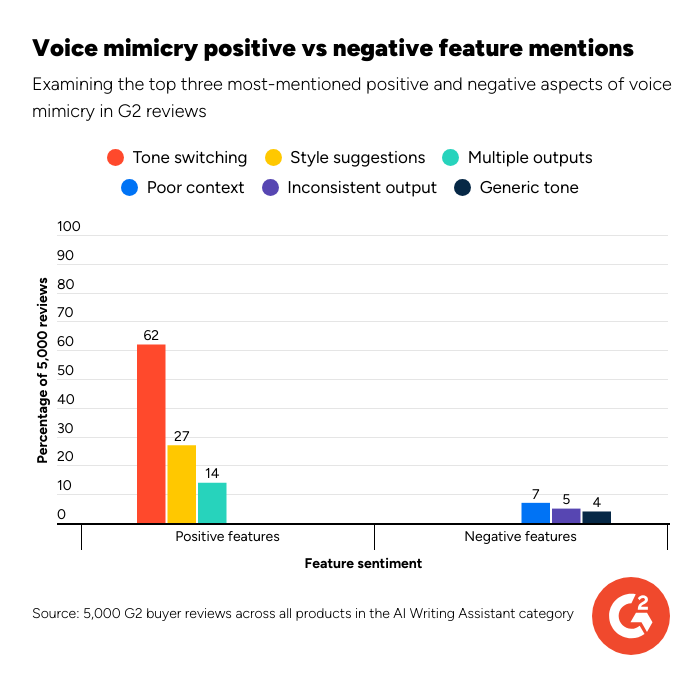
According to data within the 5,000 analyzed reviews, 62% of all positive reviews that mention voice mimicry mention tone control, which precisely aids in messaging consistency and scalable personalization — another added benefit. This means a single message from the buyer’s team can simultaneously reach different audiences with each audience getting its own tailored version of the messaging. The AI writing assistant has been trained or otherwise programmed to convey that same idea to each audience in a particularly tone-controlled way.
What buyers struggle with
Despite what buyers may love about AI writing assistants with voice mimicry features, there are still pain points. Among the analyzed reviews, there were three most-mentioned points of frustration among buyers. Negative sentiments among reviews tend to cluster less frequently due to the unique pain points among buyers; this makes any similar complaints more compelling despite less frequency.
The first recognized negative sentiment among the analyzed reviews, which represented 7% of negative reviews that mentioned voice mimicry, stated that despite advances in this area of AI, outputs can have poor context understanding for suggested text that also do not properly apply a mimicked tone for the writer’s or brand’s voice. Beyond that, 5% of those negative reviews that mention voice mimicry cite inconsistent output quality and 4% mention the AI as having, despite everything, a generic and robotic tone.
Another significant barrier to more widespread adoption of AI writing assistants with voice mimicry capabilities is the amount of setup and training required of buyers. The writing assistants often need to supply writing samples to the AI to train on, and oftentimes the more samples the AI has, the better and more believable it can sound. Even if the AI doesn’t train on materials to mimic them and is instead pre-programmed with particular brand guidelines, ensuring the AI writing assistant has accurately adopted brand messaging will take review, tweaking the technology, and further training to ensure long-term success. This is especially true when it comes to industry jargon and niche industry language, humorous tones, and complex brand personalities.
Beyond these concerns, there’s no shortage of ethical dilemmas regarding “authenticity” in the realm of brand personas. Public discussions around AI-generated written voices highlight the public’s growing unease around consent in voice replication and ownership of one’s established writer’s voice.
What this means for AI writing assistant buyers
Keeping all this information in mind, it’s important to consider the following truths when considering the usefulness of an AI writing assistant with voice mimicry capabilities.
- Voice mimicry technology is a work-in-progress. Buyers should approach the feature with an experimental mindset. Compare the two main pathways for implementation: materials training, or pre-defined programming.
- Buyers should think of their particular goals. If the goal is basic content generation, tone controls may be sufficient enough. If voice mimicry can establish increased brand consistency across teams, prioritize tools with style guides and brand voice features. If personalized, human-like output is what’s most important, look for platforms that can learn from writing samples and adapt over time.
- AI writing assistants are collaborative tools, not inhuman replacements. Though powerful and useful, AI writing assistants with various degrees of written voice mimicry require training, fine tuning, and review. Since writer or brand voice is crucial for public relations and staying power with audiences, all of these tasks ought to be done by people who can be held accountable.
The opportunity is clear: as written voice modeling improves, AI writing assistants will move closer to producing content that is not only believably human-sounding, but often indistinguishable from the people and brands they represent.
To learn more about AI writing assistants and compare highly-reviewed products in the space, refer to the G2 Grid® for AI Writing Assistants and learn what buyers think.