
Key takeaways:
- Use Cases: High-impact use cases of AI in logistics in Australia are concentrated in routing, warehousing, and demand forecasting, where decisions are frequent and cost-sensitive.
- Implementation: Successful adoption depends on sequencing—data readiness, integration with legacy systems, and embedding AI into real workflows.
- Cost: The cost to implement AI in logistics in Australia typically ranges from AUD 70,000 to AUD 700,000+, driven more by integration and data complexity than model development.
- Challenges: The biggest barriers to AI adoption in logistics are fragmented data, legacy systems, and organisational resistance rather than limitations in AI capability.
The Australian logistics landscape in 2026 is defined by a shift in how boards view emerging technology. For years, artificial intelligence in logistics in Australia was relegated to experimental silos. Today, the conversation is about architectural integration.
Enterprise leaders are no longer asking for proof of concept; they are demanding proof of resilience. With inflationary pressures on fuel and a persistent shortage of skilled labour across the eastern seaboard and the Nullarbor, the margin for operational error has effectively disappeared.
This move toward systemic intelligence necessitates moving past basic automation toward decision-making engines that navigate the specific geographical and regulatory constraints of the Australian market.
Consequently, whether managing “Coordinated Freight” requirements or adhering to the latest updates in the Security of Critical Infrastructure (SOCI) Act, the implementation of AI in logistics in Australia is now a matter of national supply chain sovereign capability.
The following blog examines high-impact AI logistics use cases in Australia, the structural barriers to adoption, and the investment frameworks required to move from pilot projects to enterprise-grade deployment.
Move AI from Raw Concept to Operational Reality
AI in logistics delivers value only when it is embedded into daily decision-making. We help you design and deploy systems that work within your existing infrastructure and governance requirements.

What Are the Key Applications of AI in Australian Logistics?
In most Australian logistics environments, AI is not being deployed everywhere. It is being applied where decisions are frequent, margins are tight, and outcomes can be tracked. That’s where AI in logistics in Australia is starting to show real commercial value.
Below are the key applications of AI in Australian logistics that are actually moving operational metrics.
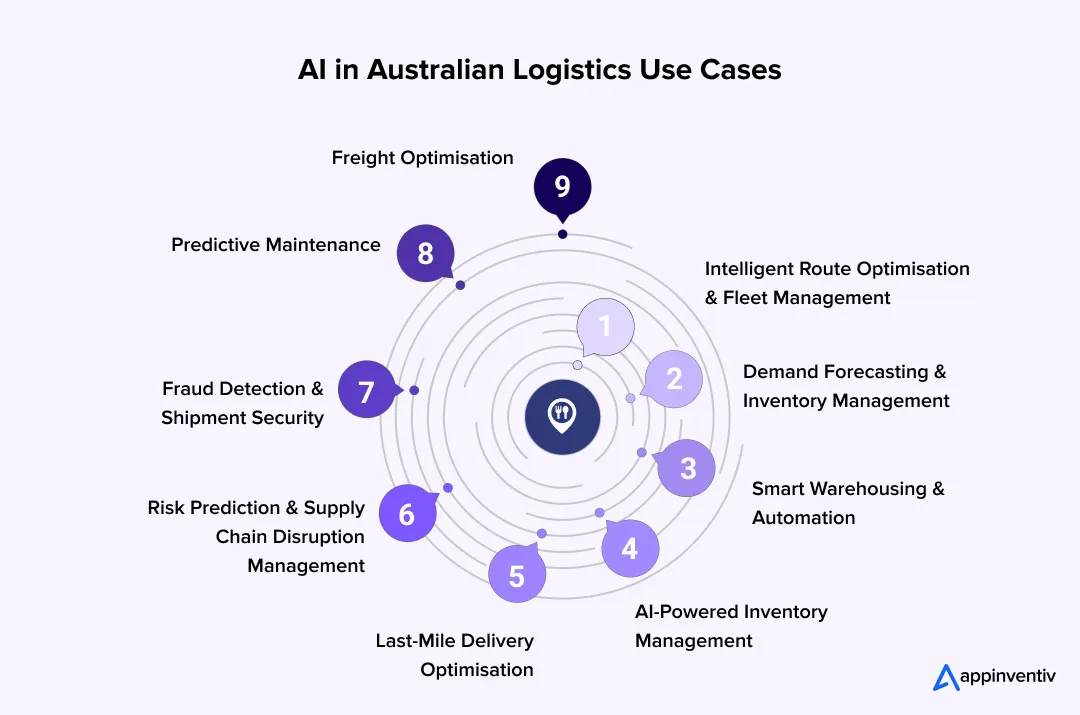
1. Last-Mile Delivery Optimisation
The final leg of delivery is the most expensive and complex due to urban congestion and strict delivery windows. Static dispatching cannot account for the “failed delivery” costs that plague Australian eCommerce logistics.
AI-powered dispatching orchestrates the transition to electric fleets, balancing battery range against delivery density. By using agentic AI in logistics, local firms are achieving higher on-time rates while meeting new carbon reporting expectations mandated by Australian ESG regulations.
2. Intelligent Route Optimisation and Fleet Efficiency
Route planning across Australia is rarely predictable. Distance, traffic variability, and fuel exposure all add complexity.
AI models adjust routes in real time based on these variables. The outcome is measurable: lower idle times and an average fuel consumption reduction of 5–15% on long-haul corridors like the Brisbane-to-Perth run. This remains one of the most proven AI logistics use cases in Australia.
3. Demand Forecasting and Inventory Management
Overstocking and stock-outs represent a significant capital drain for Australian wholesalers. Legacy forecasting often relies on historical sales that fail to account for modern market volatility.
Generative AI in transportation and logistics solves this by synthesising fragmented data from ERPs, global shipping signals, and local consumer sentiment. This precision allows firms to pre-position inventory in satellite hubs, improving demand forecast accuracy by up to 30%.
4. Smart Warehousing and Automation
Manual warehouse operations struggle with the persistent labour shortages seen across Western Sydney and Outer Melbourne. High turnover and human error in picking lead to costly reversals.
Modern AI-driven robotics use computer vision and reinforcement learning to adapt to varying pallet types without manual reprogramming. In high-volume distribution centres, this “ambient intelligence” is lifting warehouse productivity by an average of 25%.
5. Risk Prediction and Supply Chain Disruption Management
Traditional supply chain management is reactive, often relying on manual spreadsheets that lag behind real-world events. In the 2026 Australian landscape, where port congestion and extreme weather are frequent, this lag translates to significant demurrage costs and lost sales.
AI-driven Digital Twins solve this by creating a real-time virtual replica of the entire network. These systems use agentic AI in Australian logistics to move beyond simple “alerts” to active “orchestration.” Gartner predicts that by 2031, such autonomous systems will resolve 60% of supply chain disruptions without human intervention.
6. Fraud Detection and Shipment Security
Cargo theft and sophisticated “double-brokering” scams have become more prevalent in the trans-Tasman and domestic markets. Traditional security measures often flag issues after the loss has occurred.
AI implementation in Australian logistics now offers real-time correlation of driver license scans, plate recognition, and routing history. These systems identify irregular “dwell times” or unauthorised route diversions, reducing direct fraud losses and improving audit readiness.
7. Predictive Maintenance and Freight Optimisation
Fixed service schedules often lead to “over-servicing” or, worse, unexpected breakdowns on remote routes where recovery costs are astronomical.
AI-powered predictive maintenance detects engine temperature spikes or vibration changes before a failure occurs. This proactive approach is estimated to reduce total transportation costs by 15–20% for early adopters who have successfully integrated AI with their existing Telematics and ERP systems.
Align AI Adoption with Real Business Outcomes
AI adoption should directly impact cost, utilisation, and delivery performance. We focus on use cases that deliver measurable outcomes in Australian logistics environments.

What Are Some Most Impacting AI Adoption Challenges in Logistics and How to Overcome Them?
Navigating the transition from a pilot project to an enterprise-grade deployment requires addressing deep-seated structural issues. In the Australian market, these hurdles are often compounded by geographical isolation and specific regulatory frameworks. Below is a breakdown of the primary challenges of AI adoption in logistics Australia paired with practitioner-led solutions.
Challenges and Solutions of AI Adoption in Logistics Australia
- Fragmented and Low-Quality Data
- Legacy System Constraints
- Lack of Skilled AI Talent
- Cybersecurity and Compliance Pressure
- Resistance to Change
1. Data Fragmentation
The Challenge: Most logistics firms operate with “data islands.” Fleet telematics, customer ERPs and warehouse management systems (WMS) in Australian industries rarely speak the same language. This lack of a single source of truth makes it impossible for AI to provide accurate, real-time insights, leading to “garbage in, garbage out” scenarios.
The Solution:
- Consolidate disparate data streams into a single, cloud-based repository stored locally to meet Australian data sovereignty requirements.
- Build custom middleware to standardise data formats across legacy and modern platforms via an API-first approach.
- Use machine learning to identify and fix anomalies in historical shipping data before feeding it into predictive models.
2. Legacy System Rigidity
The Challenge: Many core transport systems in Australia are decades old and lack the “hooks” necessary for modern AI interaction. Replacing these entirely is often too costly and carries immense operational risk, creating a stalemate in digital transformation.
The Solution:
- Deploy AI modules as independent microservices that communicate with the legacy core through secure gateways.
- Use modern bridge technologies to extract data from on-premise servers to the cloud without disrupting daily operations.
- Map out a 24-month roadmap that prioritises upgrading the most critical modules, such as dispatch or billing, first.
3. The Talent Gap
The Challenge: There is an acute shortage of AI professionals who understand both advanced machine learning and the Australian National Heavy Vehicle Law (NHVL). This barrier to finding skilled AI logistics software developers in Australia often leads to technically sound models that fail when faced with local operational realities.
The Solution:
- Hire an AI logistics consultant in Australia to lead the initial architectural design and strategy.
- Train existing dispatchers and warehouse managers to act as supervisors for AI outputs to ensure the “human-in-the-loop” remains effective.
- Outsource AI development services in Australia to manage the technical stack while the internal team focuses on strategic outcomes.
4. Cybersecurity and Compliance Pressure
The Challenge: 2026 has seen a surge in board-level accountability for cyber resilience. Logistics networks are now considered “critical infrastructure” under the SOCI Act, meaning any AI vulnerability could lead to significant legal and financial penalties.
The Solution:
- Ensure all model training and data storage occur within Australian borders to comply with the Privacy Act and data residency needs.
- Regularly stress-test AI models for “prompt injection” or data poisoning that could compromise routing logic.
- Maintain transparent, immutable logs of all AI-driven decisions to satisfy regulatory inspections and insurance requirements.
5. Resistance to Change
The Challenge: Operational staff frequently fear that implementing AI in a logistics company in Australia will lead to job displacement. This leads to subtle sabotage or a refusal to use the new systems, resulting in poor adoption rates and zero ROI.
The Solution:
- Communicate clearly how AI removes repetitive manual entry, allowing staff to focus on complex problem-solving.
- Build intuitive interfaces for drivers and warehouse staff to reduce the technical friction of daily adoption.
- Link departmental bonuses to efficiency gains achieved through AI to ensure collective buy-in across the organisation.
Across these areas, the barriers to AI in logistics in Australia are consistent. The organisations that move forward are not the ones with the most advanced models, but the ones that align data, systems, and teams around execution.
How Much Does It Cost to Implement AI in Logistics?
Budgeting for AI in the logistics industry in Australia for 2026 requires moving beyond simple software licensing. For Australian businesses, the “sticker price” of an AI model is often the smallest part of the total investment.
Real-world costs are driven by the complexity of your data environment, the depth of integration required with local transport management systems, and the strict governance standards of the Australian market.
Here are some high influential factors that have the largest impact on cost:
- Data infrastructure readiness: Building pipelines, cleaning historical data, and enabling real-time access
- System integration complexity: Connecting AI with ERP, WMS, TMS, and third-party logistics systems
- AI model development and tuning: Use case-specific models, continuous optimisation, and testing
- Cloud and compute infrastructure: Storage, processing, and scaling requirements
- Ongoing maintenance and monitoring: Model retraining, performance tracking, and system updates
Typically, most AI projects in 2026 fall within the AUD 70,000 to AUD 700,000+ range. Below is a breakdown of how these investments typically manifest across different tiers of complexity.
Also Read: Mobile App Development Cost in Australia: 2026 Guide
Typical Investment Range by Project Scope
| Implementation Level | Estimated Cost (AUD) | Typical Timeline | Typical Use Case |
|---|---|---|---|
| Targeted Deployment | 70,000 – 150,000 | 3 – 5 Months | Route optimisation, demand forecasting |
| Mid-Scale Implementation | 150,000 – 400,000 | 6 – 9 Months | Warehouse + inventory + routing |
| Enterprise Platform | 400,000 – 700,000+ | 10 – 14+ Months | Fully connected logistics ecosystem |
Know the True Cost of AI in Logistics for Your Custom Project
Share your vision with us and understand what drives cost before you commit to implementation.

How to Implement AI in Logistics in Australia?
Transitioning from a promising pilot to a scaled, enterprise-wide deployment requires a disciplined framework. Successful delivery follows a structured six-step progression that balances immediate operational gains with long-term architectural stability.
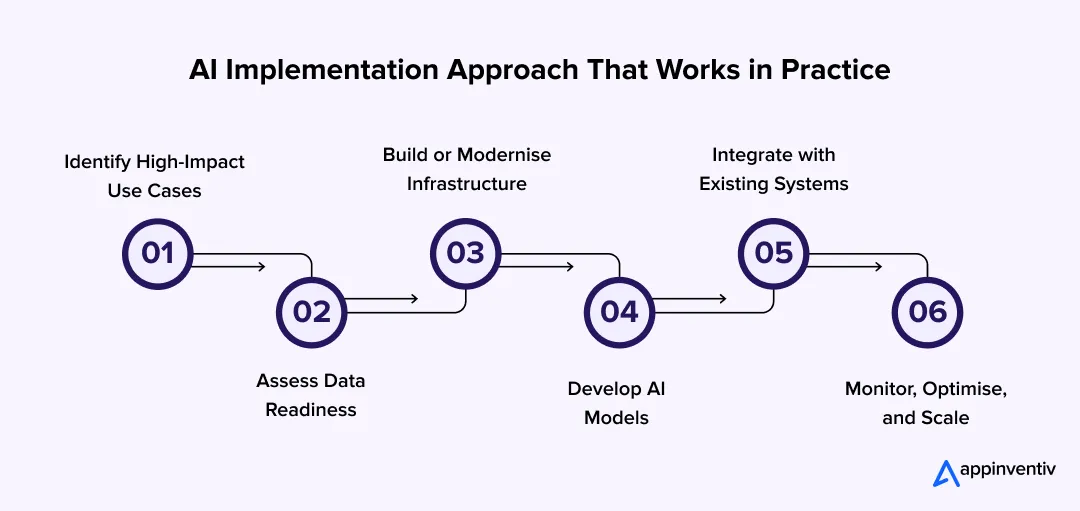
1. Prioritise Use Cases That Tie Directly to Cost and Service
AI tends to deliver early value where operational decisions are repetitive and financially visible. Routing inefficiencies, demand mismatches, and warehouse bottlenecks fall into this category.
Rather than spreading effort across multiple areas, you should narrow your focus to one or two use cases where outcomes can be measured quickly. This keeps investment grounded and avoids dilution.
2. Assess Data Readiness
What looks usable on paper often breaks under scrutiny. Data gaps, inconsistent formats, and delays become visible once teams attempt to operationalise models.
In practice, effort is redirected toward:
- Aligning data definitions across systems
- Resolving missing or delayed data streams
- Establishing a reliable flow of operational data
This work is rarely visible externally, but it determines whether AI outputs can be trusted.
3. Build or Modernise Infrastructure
Legacy platforms are part of the landscape. Replacing them outright introduces more risk than value in most cases.
A more practical approach to modernise legacy systems in Australia involves:
- Creating integration layers that sit alongside existing systems
- Isolating AI workloads without disrupting core operations
- Modernising selectively where constraints are highest
This allows progress without triggering large-scale system replacement.
4. Design and Develop AI Models
AI models tend to fail when they are built in isolation from how teams actually operate.
What works better is aligning outputs with existing decision points. For example, routing recommendations that fit dispatch workflows, or forecasting outputs that plug into planning cycles.
This keeps adoption practical. Teams are not asked to change everything at once.
5. Embed AI Into Existing Operations
AI only becomes valuable when it influences decisions consistently. That usually requires:
- Integrating outputs into existing tools and dashboards
- Reducing the gap between recommendation and action
- Ensuring decisions can be traced and explained when needed
Without this, AI remains advisory rather than operational.
6. Monitor, Optimise, and Scale AI Logistics System
Conditions in logistics shift constantly. Demand patterns change, routes evolve, and external disruptions are frequent.
Systems that deliver sustained value are the ones that are continuously adjusted. Models are retrained, assumptions are revisited, and performance is monitored against operational metrics.
What is the Future of AI in Logistics in Australia?
The next phase of AI in logistics in Australia will be defined less by new use cases and more by how deeply AI is embedded into operational decision-making.
We are already seeing early movement toward agentic AI in logistics in 2026, where systems do not just recommend actions but execute them within defined constraints. This includes autonomous scheduling, dynamic inventory rebalancing, and self-adjusting transport networks.
At the same time, generative AI in Australian logistics is beginning to support planning functions. Scenario modelling, disruption simulations, and network design decisions are becoming faster and more data-driven.
This reflects that what will shape the future of AI in logistics in Australia is not capability alone. It will come down to:
- How well organisations manage data ownership and sovereignty
- The ability to integrate AI into legacy-heavy environments
- Governance frameworks that ensure auditability and control
- Scaling AI beyond pilots into enterprise-wide systems
Aussie innovators who solve for these will move toward more autonomous, resilient logistics operations. Others will continue to operate with AI as a supporting layer rather than a core capability.
How Appinventiv Helps You Leverage AI Logistics Use Cases in Australia?
Successfully deploying artificial intelligence in logistics in Australia requires more than just technical coding. It demands an understanding of the specific operational DNA of the local supply chain. Moving from legacy constraints to a modern, automated enterprise involves experienced logistics software developers in Australia who prioritise sovereign data security and measurable commercial outcomes.
At Appinventiv, we provide the strategic and technical depth needed to implement AI in a logistics company in Australia while maintaining rigorous security standards.
Through our dedicated AI logistics implementation services in Australia, we help leadership teams bridge the gap between complex data sets and real-world fleet performance. Recent market data indicates that Australian enterprises moving toward “intermediate” AI maturity report an average 61% gain in operational efficiency.
Local Expertise and Proven Impact
Our presence in the Australian market is backed by our proven track record of high-growth delivery and a deep bench of local consultants.
- 5+ Agile delivery centres across Australia ensure projects are managed by teams who understand local regulatory environments and the National Heavy Vehicle Law.
- 10+ years of experience in APAC delivery provides the maturity and expertise needed to navigate complex multi-modal transport networks spanning the eastern seaboard to Perth.
- 3000+ digital assets deployment in Australia across various sectors demonstrates our ability to scale software from initial concept to national rollout.
- Our ranking among APAC’s high-growth companies by Statista and the Financial Times for two consecutive years reflects our commitment to sustainable innovation.
Tangible Business Outcomes
We focus on the metrics that matter to a COO or CFO, ensuring that our AI development services in Australia translate into a stronger bottom line.
- 35% Efficiency Gains in Australian Enterprises through the targeted automation of scheduling, warehouse picking, and inventory forecasting.
- 96% Client Retention Rate driven by a focus on long-term value, audit readiness, and continuous model optimisation.
- 99.50% Security Compliance SLA ensures that your transition to AI adheres to the highest standards for data protection under the SOCI Act and Privacy Act.
Plan, build, and deploy AI in Logistics in Australia with our team of 1600+ tech experts.
FAQs
Q. What is AI-powered logistics?
A. AI-powered logistics refers to the use of intelligent systems to improve decision-making across transport, warehousing, and supply chain operations. In practice, this includes routing optimisation, demand forecasting, inventory control, and risk prediction.
Within AI in logistics in Australia, it is less about automation in isolation and more about improving operational efficiency and cost control through data-driven decisions.
Q. How is AI transforming the logistics industry in Australia in 2026?
A. The impact is most visible in areas where decisions are frequent and cost-sensitive.
AI is improving route efficiency, reducing fuel consumption, aligning inventory with demand, and increasing warehouse throughput. It is also helping organisations respond earlier to disruptions across geographically dispersed networks.
Q. What are the main benefits of AI in logistics companies in Australia?
A. The benefits are typically measured in operational terms rather than technical ones:
- Lower transport and fuel costs
- Improved delivery timelines and reliability
- Better inventory utilisation and reduced holding costs
- Increased warehouse efficiency without proportional labour growth
These outcomes are driving the adoption of artificial intelligence in logistics in Australia at an enterprise level.
Q. What are the key skill gaps for AI adoption in Australian logistics?
A. The skill gap is not limited to data scientists.
Organisations often lack professionals who understand both logistics operations and AI system design. This creates challenges in implementation, integration, and scaling.
As a result, many enterprises choose to hire AI logistics consultants in Australia or partner with specialised teams.
Q. What are the steps to build an AI roadmap for an Australian logistics company?
A. A practical roadmap to implement AI usually includes:
- Identifying high-impact use cases linked to cost or service metrics
- Assessing data readiness across systems
- Designing integration with existing platforms
- Running controlled pilots before scaling
- Continuously monitoring and refining performance
This aligns with how organisations successfully implement AI in logistics company Australia.
Q. What is the ROI of AI adoption in Australian logistics operations?
A. ROI is typically driven by cost savings and efficiency gains.
Aussie businesses see returns through reduced fuel usage, better asset utilisation, fewer stock imbalances, and improved service reliability. The key is linking AI outputs directly to measurable operational metrics.
Q. How much does it cost to implement AI in logistics?
A. The cost of AI implementation varies based on scope and complexity.
- AUD 70,000 – 150,000: Targeted use cases
- AUD 150,000 – 400,000: Multi-functional implementations
- AUD 400,000 – 700,000+: Enterprise-scale platforms
The Aussie logistics AI platform development cost is largely influenced by data readiness, system integration, and scale.
Q. What are the key AI trends in Australian logistics in 2026?
A. The Australian market in 2026 is shifting from basic automation toward systemic intelligence, where AI serves as a core operating system. Key AI trends include:
- Transition to Agentic AI: Systems are moving beyond simple alerts. These autonomous agents now independently renegotiate freight rates and reroute shipments based on live port or road disruptions.
- Sovereign AI Sovereignty: With stricter SOCI Act requirements, 72% of Australian firms now prioritise vendors offering local data residency and on-shore model processing to ensure compliance.
- Operational Digital Twins: Advanced network simulations are now standard. These allow leadership to run “what-if” scenarios for extreme weather, triggering automated contingency plans before bottlenecks occur.
- AI-Driven ESG Tracking: AI is being used to verify the carbon footprint of every shipment, specifically orchestrating electric van fleets in suburban Sydney and Melbourne to meet mandatory emissions reporting.
- Intelligent Document Processing (IDP): Manual customs and invoice handling are now viewed as compliance risks. IDP has become the baseline for automated clearance, reducing retrieval times.