- Healthcare chatbots in the UAE are moving beyond queries to support triage, patient communication, and real clinical workflows across hospitals.
- Effective healthcare chatbot development depends on clean data, strong system integrations, and alignment with regulations like DHA, DOH, and MOHAP.
- Development costs typically range from AED 147,000 to AED 1,470,000+, depending on complexity, integrations, and clinical use cases.
- Custom-built solutions offer better scalability, deeper AI chatbot integration with hospital management systems, and full control over patient data.
- The shift toward Agentic AI chatbot development for healthcare means systems will not just respond, but also execute tasks across hospital workflows.
Walk into any hospital today, and you’ll see the same pattern. Front desks are flooded with calls, staff are juggling repetitive queries, and patients are left waiting for simple updates. This is exactly where AI chatbot development for healthcare is starting to make a real difference.
Hospitals across the UAE are no longer testing ideas; they’re putting healthcare AI solutions into everyday workflows to handle routine conversations and reduce operational pressure.
But these systems are not just about answering FAQs. A well-built chatbot can serve as a patient communication chatbot, guide users through triage, and even support internal teams with quick access to information.
That’s also why the Agentic AI chatbot for healthcare is gaining attention, where chatbots go beyond conversations and actually trigger actions across systems. In practice, chatbot development for the healthcare industry is becoming less about “chat” and more about end-to-end support.
This shift is part of a broader regional trend. According to PwC Middle East, AI is expected to contribute up to $320 billion to the Middle East economy by 2030, with healthcare being one of the key sectors driving adoption.
So the real focus now is simple: how do you build a system that actually works in a hospital setting, not just on paper?
Still Handling Patient Queries Manually?
See how hospitals in the UAE are reducing workload and response time with AI chatbots before you fall behind.
Types of Healthcare Chatbots Used in the UAE
If you look at how hospitals in the UAE are actually using chatbots, it’s not a one-size-fits-all approach. Most organizations deploy different types based on where the pressure is, whether that’s patient inflow, support staff workload, or ongoing care.
Here’s a clear breakdown:
- AI triage chatbot / Symptom checker chatbot: Patients describe what they’re feeling, often in simple words, and get a basic direction on where to go next. This helps reduce that initial confusion, especially when departments are crowded.
- Patient communication chatbot / FAQ chatbot: Handles everyday questions like timings, services, or doctor availability. It takes a lot of repetitive work away from staff who would otherwise have to answer the same questions all day. In many UAE hospitals, similar systems are already in use. For example, Medcare’s chatbots like Leo and Mira help patients manage appointments and queries without needing to call the hospital.
- Appointment scheduling chatbot: Let patients book, cancel, or reschedule without calling. It also sends reminders, which helps keep things running smoothly and avoids missed appointments. Tools like AVY by Avivo Group follow a similar approach by helping patients find doctors and book visits online.
- Clinical support chatbot: Used by staff to quickly check guidelines or information while attending to patients. It saves time when things are busy and reduces the need to switch between systems.
- AI chatbot for remote patient monitoring / Health monitoring chatbot: Patients can share updates from home, like recovery progress or symptoms. This works well when regular hospital visits aren’t needed.
- Medication reminder chatbot: Sends reminders to help patients stay on track with their medications. It’s simple, but it helps avoid missed doses. Platforms like Medzy by GSK focus on this area by helping patients understand treatments and stick to prescriptions.
- Telemedicine chatbot: Helps patients get started with virtual consultations. It collects basic details and connects them to the right doctor without confusion.
- Mental health chatbot: Mental health chatbot gives patients a way to talk through how they’re feeling. It’s not a replacement for care, but it helps when someone needs immediate support.
- Insurance assistance chatbot: Answers questions around coverage, claims, or billing. This reduces the back-and-forth between patients and hospital staff.
- Feedback & patient engagement chatbot: Follows up after visits, collects feedback, and sends reminders. It helps hospitals stay connected with patients beyond the visit.
- AI medical assistant chatbot / Hybrid AI chatbot: Combines multiple functions into one system. Patients and staff don’t have to jump between tools; everything is handled in one place.
- Government health chatbot: Used to share health updates, guidelines, and public information. It helps keep communication clear during important announcements.
- 24/7 support chatbots in hospitals: Some hospitals, such as NMC Healthcare, use chatbots to provide round-the-clock support, answering queries instantly and reducing staff workload.
Most hospitals don’t try to set everything up at once. They usually start with something simple, like handling queries or appointments, and then build on it once they see how it performs in real situations.
Also read: The Role of AI in Revolutionizing Healthcare in the UAE
Step-by-Step Process for AI Chatbot Development for Healthcare
When a hospital in Dubai or Abu Dhabi decides to build a chatbot, the work doesn’t start with tools or models. It starts with clarity. What exactly should this system handle, and where does human intervention still matter? In chatbot development for the healthcare industry, getting this wrong early creates problems later, especially when patient safety and compliance are involved.
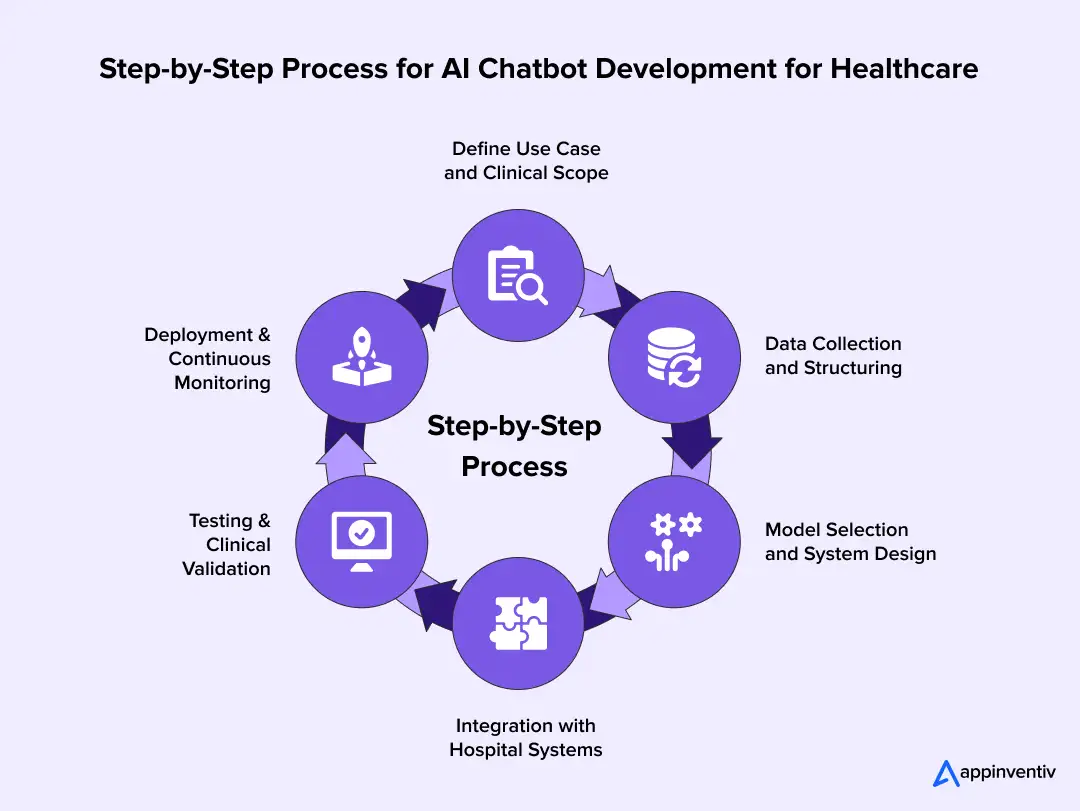
1. Define Use Case and Clinical Scope
Before anything technical, the team needs to define boundaries. A chatbot handling appointment bookings is very different from an AI triage chatbot guiding patient symptoms.
- Identify the primary goal: triage, patient communication chatbot, or clinical support chatbot
- Define who will use it: patients, doctors, or admin teams
- Map out decision limits, especially where the chatbot must hand off to a human
- Set clear escalation flows for high-risk scenarios
In cities like Sharjah and Ajman, many hospitals begin with patient communication use cases first. It’s simpler, lower risk, and easier to validate before expanding into clinical areas.
Before moving into data or models, teams often define success metrics early, such as reducing call volume, improving response time, or increasing patient engagement. This helps keep the development process focused on measurable outcomes.
2. Data Collection and Structuring
This is where most delays happen. Hospitals often have data, but it’s scattered, inconsistent, or not ready for use.
- Collect FAQs, chat transcripts, and workflow data
- Align medical terminology using standards like ICD or SNOMED
- Build structured intent libraries instead of relying on raw text
- Prepare datasets for multilingual healthcare chatbot development, especially Arabic and English
For hospitals in Ras Al Khaimah and Fujairah, language handling becomes a real challenge. A system that works well in English but struggles in Arabic will fail quickly in real settings.
3. Model Selection and System Design
At this stage, decisions become more technical. The goal is not just to “make it smart,” but to make it predictable and safe.
- Use rule-based systems for controlled, low-risk tasks
- Use NLP pipelines for structured conversations
- Use LLM-based systems where flexibility and context matter
- Use generative AI models (GPT-based systems) for handling open-ended conversations, especially where responses cannot be fully predefined.
- Add AI guardrails to prevent incorrect or unsafe responses
- Use retrieval-based setups to pull verified clinical information
In more advanced cases, Agentic AI chatbot for healthcare enables the system to trigger actions, such as booking appointments or updating records, rather than just replying.
4. Integration with Hospital Systems
A chatbot that cannot connect to existing systems adds very little value. AI Integration is what makes it useful in day-to-day operations.
- Connect with hospital management systems for scheduling and workflows
- Integrate with EMR or EHR platforms using standards like FHIR
- Enable secure access with proper authentication layers
- Maintain logs for tracking and compliance
In Dubai and Abu Dhabi, this step is often non-negotiable because most hospitals already run multiple connected systems.
5. Testing and Clinical Validation
This is not just about checking if the chatbot responds. It’s about ensuring it responds correctly, every time it matters.
- Test real patient scenarios, not just predefined flows
- Involve doctors to validate medical accuracy
- Check edge cases where symptoms are unclear or overlapping
- Monitor when and how often the chatbot escalates
Along with technical testing, hospitals often involve clinical teams to review responses in controlled scenarios. This step ensures the system does not provide misleading guidance, especially in symptom-related interactions.
For any system acting as an AI chatbot for clinical decision support, this stage needs careful review. Mistakes here are not just technical; they affect real outcomes.
6. Deployment and Continuous Monitoring
Once live, the system still needs attention. Hospitals change, patient behavior shifts, and new data keep coming in.
- Deploy across channels like websites, apps, and messaging platforms
- Track performance through response accuracy and user drop-offs
- Update models regularly with new interactions
- Maintain audit trails for compliance
Smaller hospitals in Umm Al Quwain often start with limited deployments, closely monitor performance, and then scale gradually based on results.
In reality, chatbot development for the healthcare industry is not a one-time setup. It’s a cycle of building, testing, and refining. The more grounded each step is in real hospital workflows, the more reliable the system becomes when it’s actually used.
Build vs Buy in Healthcare Chatbot Development: Which Approach Works Better
This is a decision most hospital teams face early on. Do you go with a ready-made platform or invest in chatbot development for healthcare that’s built around your systems? At first, buying feels easier. When evaluating options, chatbot development for healthcare industry often shifts toward custom builds as complexity increases. But once hospitals in Dubai or Abu Dhabi start connecting chatbots to real workflows, the differences become clearer.
Build vs Buy Comparison:
| Factor | Buy (Platform-Based Chatbot) | Build (Custom Chatbot Development) |
|---|---|---|
| Setup Time | Quick launch using templates | Takes time due to planning and development |
| Customization | Limited flexibility | Fully tailored chatbot development for the healthcare industry needs |
| Integration Capability | Basic integrations | Deep AI chatbot integration with hospital management systems, EHR, APIs |
| Use Case Support | FAQs, basic patient communication chatbot | AI triage chatbot, clinical support chatbot, AI chatbot for remote patient monitoring |
| Scalability | Difficult to expand | Built to grow across departments and use cases |
| Data Control | Managed by a platform provider | Full control over patient data and security |
| Compliance Flexibility | Limited control | Easier alignment with UAE healthcare regulations and standards |
| Multilingual Support | Basic translation | Strong multilingual chatbot development (Arabic + English context) |
| Cost Over Time | Lower upfront, ongoing subscription costs | Higher upfront, but better long-term value |
| Ownership | Vendor dependent | Full ownership and flexibility |
In many cases, teams combine development with AI strategy consulting in Dubai to make sure the solution is aligned with long-term hospital goals, not just immediate needs.
Why Building is the Better Long-Term Choice
In real-world settings, especially across hospitals in Sharjah, Ajman, or Ras Al Khaimah, needs don’t stay fixed. What begins as a simple patient communication chatbot often grows into something more involved, like an AI chatbot for hospitals handling triage or internal support.
That’s where building makes a difference. With custom healthcare AI solutions, you’re not limited by a platform. You can expand into advanced use cases like an AI chatbot for clinical decision support, improve integrations over time, and keep full control over how patient data is handled.
In the long run, chatbot development for healthcare also becomes possible only when the system is built with flexibility in mind. Instead of just responding to queries, it can start handling actions across workflows. That’s difficult to achieve with off-the-shelf tools.
So while buying works for a quick start, building is what holds up once the chatbot becomes part of everyday hospital operations.
Also read: How Much Does It Cost to Build an AI App in Dubai?
Core Technologies Behind Healthcare AI Chatbots Development
If a patient types “chest pain since morning,” the reply they see is just the final step. Behind it, multiple layers work together to interpret the message, retrieve the right data, and decide what to do next. In hospitals across Dubai or Abu Dhabi, this setup needs to be stable because it connects directly with real workflows, not just conversations.
Here’s how that stack usually comes together:
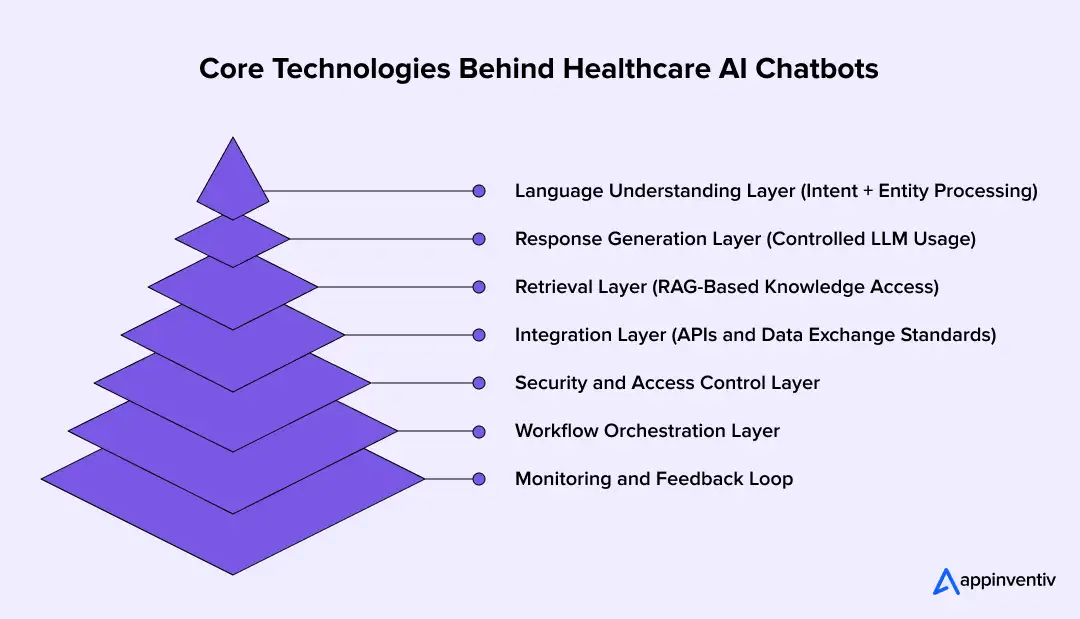
1. Language Understanding Layer (Intent + Entity Processing)
This is where the system figures out what the patient actually means. Since people describe things differently, the system has to interpret intent and extract useful details from unstructured input.
At this stage, the focus is on converting free text into structured data that the rest of the system can use reliably.
- Maps the message to an intent like symptom check, booking, or follow-up
- Uses intent recognition to classify what the user wants and entity extraction to capture details like symptoms, duration, or severity from unstructured input
- Uses embeddings to handle different ways of phrasing the same thing
- Keeps session context so multi-step conversations don’t reset
For multilingual chatbot development, teams often handle Arabic and English separately instead of relying on direct translation.
2. Response Generation Layer (Controlled LLM Usage)
Once the system understands the request, it must formulate a clear, relevant response. This is where LLMs are used, but with strict control in place.
The goal here is not just to generate responses, but to keep them consistent and safe for a healthcare setting.
- Prompts are structured with clear instructions to keep responses within scope
- Conversation history is included, so replies stay consistent
- Parameters are tuned to reduce randomness
- Output filters block unsafe or non-compliant responses
In practice, this layer is usually combined with rule logic so replies stay predictable.
3. Retrieval Layer (RAG-Based Knowledge Access)
Instead of relying solely on generated text, the system draws on verified sources. This ensures that responses are grounded in real data.
This layer becomes important when accuracy matters, especially for anything related to symptoms or clinical guidance.
- Converts queries into embeddings and matches them with indexed knowledge bases
- Fetches relevant clinical guidelines, SOPs, or internal content
- Combines retrieved data with the final response
- Keeps answers grounded in approved information
- Uses patient context (where permitted), such as previous interactions or basic history, to make responses more relevant instead of treating every query in isolation
This is what makes a clinical support chatbot usable in real scenarios.
4. Integration Layer (APIs and Data Exchange Standards)
This is where the chatbot connects to hospital systems and starts doing actual work. Without this layer, it would respond but not take action.
In real hospital environments, this layer handles most of the operational complexity.
- Uses APIs to connect with hospital management systems
- Integrates with EHR or EMR platforms using standards like FHIR
- Adds a middleware layer to manage routing and data transformation
- Handles asynchronous calls where real-time access isn’t required
In larger hospitals, especially in Dubai or Abu Dhabi, this layer can get complex because multiple systems are involved.
5. Security and Access Control Layer
Since patient data is involved, this layer ensures everything is handled securely. It controls how data is accessed, stored, and tracked.
This is not an optional layer. Without it, the system cannot be used in a real healthcare environment.
- Uses encryption for data in transit and at rest
- Applies role-based access so only the right users see the data
- Uses token-based authentication for secure system access
- Maintains logs for traceability and audits
Across Sharjah, Ajman, and Ras Al Khaimah, this is treated as a baseline requirement.
6. Workflow Orchestration Layer
This is where the system starts doing more than just replying. It connects different systems and completes tasks in the background.
This layer is what turns a chatbot into something that actually supports operations, rather than just handling conversations.
- Triggers workflows like booking, escalation, or notifications
- Connects multiple APIs to complete multi-step actions
- Applies conditional logic based on inputs and system state
- Supports event-driven updates when something changes
This layer supports setups like Agentic AI chatbot for healthcare, where the system actively participates in workflows.
7. Monitoring and Feedback Loop
Once the system is live, it needs to be tracked and improved continuously. Real usage often reveals issues that testing does not.
This layer helps teams understand what’s working and what needs adjustment over time.
- Logs conversations to track accuracy and failure points
- Monitors metrics like response time, intent accuracy, and escalations
- Uses feedback to refine intent mapping and responses
- Flags unusual patterns or repeated errors
Hospitals in Fujairah and Umm Al Quwain often refine performance here before expanding further.
When all these layers are connected properly, the chatbot becomes part of the hospital’s workflow. It handles conversations, connects systems, and supports daily operations without disrupting how things already work. This is what makes modern systems in chatbot development for healthcare industry usable in real hospital environments
AI Healthcare Chatbot Development Cost in the UAE
If you sit down with a hospital team in Dubai or Abu Dhabi, one thing becomes clear quickly. The cost depends less on the chatbot itself and more on what you expect it to handle. A basic patient communication chatbot that manages appointments is one thing. A system that supports triage or clinical workflows is a very different investment.
Here’s a straightforward breakdown of hospital chatbot development pricing to set expectations:
| Chatbot Type / Scope | Estimated Cost (USD) | Estimated Cost (AED) | What You’re Paying For |
|---|---|---|---|
| Basic patient communication chatbot | $40,000 – $80,000 | AED 147,000 – AED 294,000 | Appointment booking, FAQs, simple workflows |
| AI chatbot for hospitals (mid-level) | $80,000 – $180,000 | AED 294,000 – AED 660,000 | System integrations, multilingual support, structured flows |
| AI triage chatbot / clinical support chatbot | $150,000 – $300,000 | AED 550,000 – AED 1,100,000 | Symptom handling, decision logic, validation layers |
| Advanced systems (Agentic AI chatbot for healthcare) | $250,000 – $400,000+ | AED 918,000 – AED 1,470,000+ | Workflow automation, deeper integrations, real-time actions |
What Actually Impacts the Cost
In real projects, the chatbot itself is only one part of the effort. Most of the cost comes from everything around it.
- Integration work: Connecting with hospital systems is usually the biggest piece, especially in larger setups in Dubai or Abu Dhabi, where multiple systems need to work together.
- Compliance and security: Properly handling patient data adds layers of checks, controls, and documentation.
- Language requirements: Multilingual chatbot development, especially Arabic and English, needs careful testing. It’s not just translation, it’s context.
- Use case depth: A chatbot answering FAQs is simple. One acting as a clinical support chatbot or handling triage requires much tighter logic and validation.
- Ongoing effort: After launch, there’s still hosting, updates, and improvements. This doesn’t stop once the system goes live.
Hospitals in Sharjah and Ajman often start small, test their performance, and then expand. The same approach shows up in Ras Al Khaimah, Fujairah, and even Umm Al Quwain, where teams prefer to scale once they’re confident it’s working smoothly.
Lower-cost estimates often apply to basic chatbot setups with limited functionality. In real hospital environments, especially in the UAE, costs are higher because systems require deeper integrations, compliance handling, and multilingual support. In chatbot development for healthcare industry, cost is tied to how deeply the system connects with real hospital workflows.
Also Read: Healthcare Software Development in Middle East Cost Guide
Not Sure What Your Chatbot Will Cost?
Get a tailored cost estimate that accounts for your hospital’s workflows, integrations, and compliance needs.

Essential Features of a Healthcare AI Chatbot
When hospitals in Dubai or Abu Dhabi look at a chatbot, the question is pretty direct. Will this actually help staff and patients, or will it just handle basic queries and stop there? What makes the difference is the features underneath and how well they fit into daily hospital work.
Here are the features that actually matter:
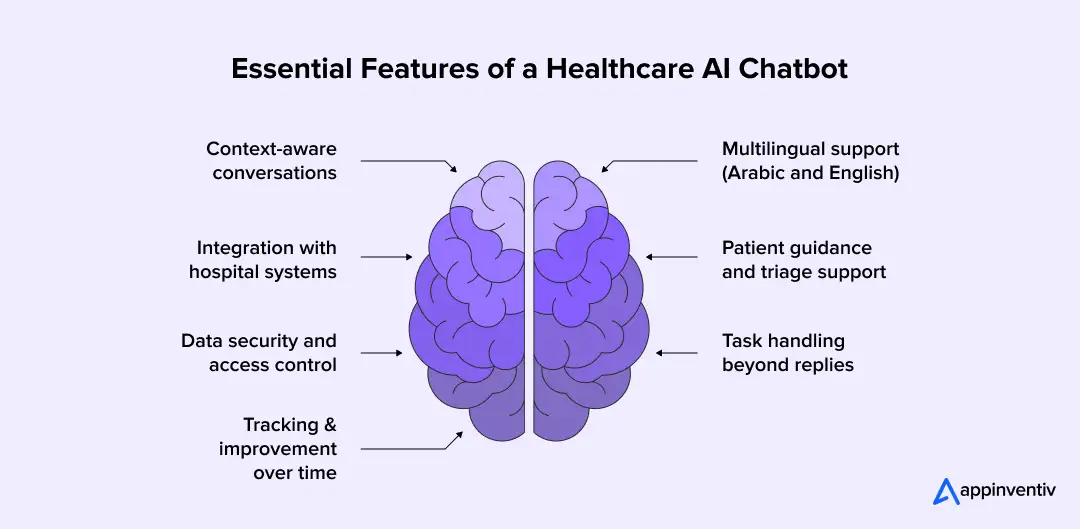
- Context-aware conversations: Conversations don’t happen in one message. Patients ask things step by step. The chatbot should remember what was said earlier and respond without making users repeat themselves.
- Multilingual support (Arabic and English): Patients often mix Arabic and English in the same conversation. The system should understand both and keep medical terms clear. This matters across cities like Sharjah and Fujairah.
- Integration with hospital systems: The chatbot should connect with existing tools. It should access schedules, check records, and complete actions like booking without extra steps. This is where AI chatbot integration with hospital management systems becomes useful.
- Patient guidance and triage support: The system should help patients explain symptoms and guide them to the right place. It should also flag urgent cases so staff can step in quickly. This is the role of an AI triage chatbot in real use.
- Data security and access control: Patient data must stay protected. Systems use TLS for data in transit and AES for storage. Access is controlled through roles, and secure tokens like OAuth or JWT manage system connections. Hospitals in Ajman and Ras Al Khaimah expect this to be the baseline.
- Task handling beyond replies: The chatbot should do more than answer questions. It should book appointments, send reminders, and route requests. This is where Agentic AI chatbot development for healthcare starts to show value.
- Tracking and improvement over time: Once live, the system should be monitored closely. It should track how people use it, where they drop off, and where responses fail. This helps teams fix issues and improve performance step by step.
UAE Healthcare Compliance and Data Regulations
If you’re building for a hospital in the UAE, this is the part where most teams slow down and double-check everything. In places like Dubai or Abu Dhabi, compliance is not just a box to tick. It directly affects how your system is built, where the data sits, and who can access it.
Even a simple chatbot conversation can involve sensitive patient details. That means the system needs to be designed carefully from the start, not adjusted later.
1. Handling Patient Data Carefully
Every interaction, whether it’s a symptom query or a follow-up message, can involve personal health information. That needs to be protected at all times.
- Data should be encrypted using standards like TLS (in transit) and AES (at rest) to prevent unauthorized access
- Access should be limited based on roles, not open to everyone
- Avoid storing more patient information than necessary
- Keep records in a way that can be reviewed if needed
For any AI chatbot for patient communication in hospitals, this becomes part of everyday operation, not just a technical detail.
2. Where the Data Is Stored
In the UAE, data location matters. Hospitals often prefer, or require, that patient data remain within approved regions.
- Use hosting setups that meet local data requirements
- Be cautious about sending data outside the country
- Keep sensitive information within controlled environments
Hospitals in Dubai and Abu Dhabi are especially strict about this when new systems are introduced.
3. Working Within Local Regulations
Each emirate has its own authority, and expectations can vary slightly by location.
- Dubai follows DHA guidelines
- Abu Dhabi follows DOH requirements
- Other emirates like Sharjah, Ajman, and Fujairah fall under MOHAP
Any healthcare AI solutions need to align with these bodies, especially when patients are directly interacting with the system.
4. Connecting Safely with Hospital Systems
Once the chatbot connects with hospital systems, things get more sensitive. You’re no longer just handling conversations; you’re interacting with real records.
- Use secure APIs with proper authentication
- Limit access to only the data that’s needed
- Keep track of all system activity
- Follow structured standards when exchanging data
This is especially important for setups like an AI chatbot for clinical decision support, where accuracy and security go hand in hand.
5. Keeping Track of System Activity
After deployment, hospitals need visibility into what’s happening inside the system.
- Maintain logs of interactions and actions
- Track who accessed patient data and when
- Watch for unusual patterns or repeated errors
- Review systems regularly to stay compliant
Hospitals in Ras Al Khaimah and Umm Al Quwain often rely on these checks during audits.
6. Getting Language and Context Right
In the UAE, language is part of the experience. Many patients switch between Arabic and English, sometimes in the same conversation.
- Multilingual chatbot development needs to handle both languages properly
- Medical terms should not get lost in translation
- Responses should make sense culturally, not just technically
In the end, compliance is not a separate step. It runs through everything, from how the chatbot is built to how it’s used every day. If this part is handled well, the system fits smoothly into hospital workflows. If not, it becomes difficult to use, no matter how well it performs otherwise.
Key Use Cases Across UAE Healthcare Systems
Walk into a hospital in Dubai on a weekday morning, and you’ll notice a pattern. Phones don’t stop ringing, the same questions keep coming up, and staff spend a good part of their day on repetitive tasks. This is exactly where chatbots are being put to use, not as something complex, but as a practical layer to handle everyday interactions.
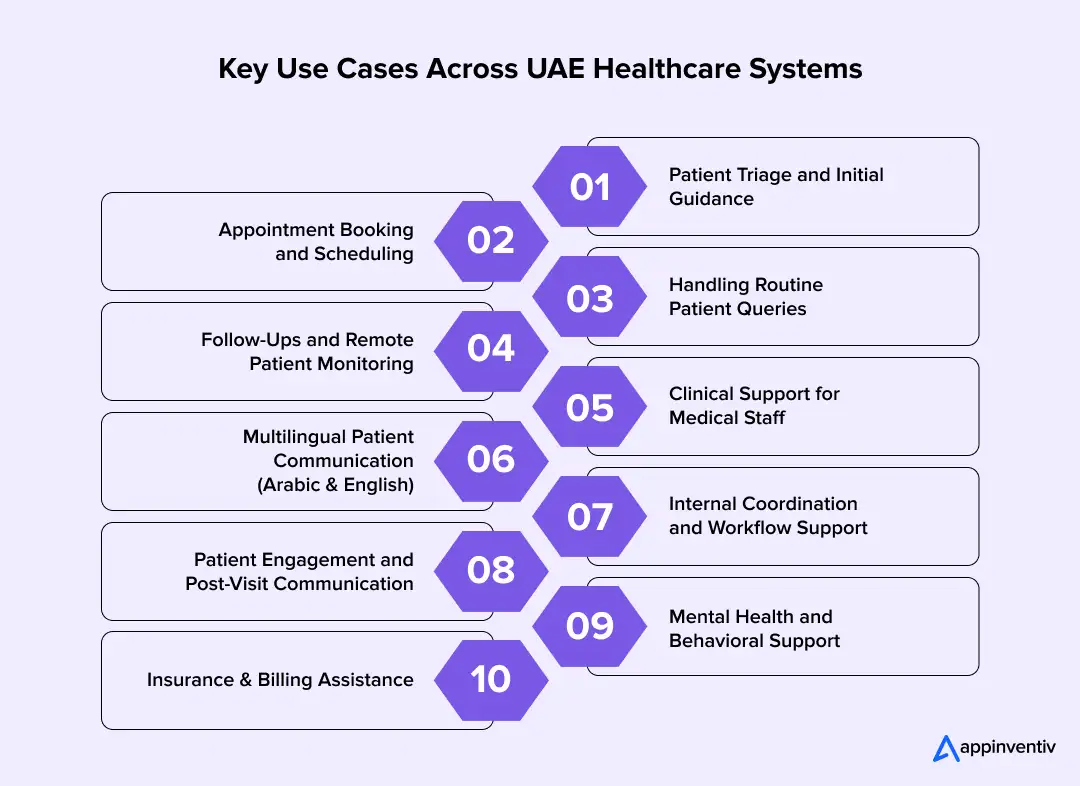
Here’s where they’re making the most difference:
- Patient triage and initial guidance: Patients can describe symptoms and get a basic direction on what to do next. A triage chatbot system for hospitals helps reduce confusion and keeps patient flow more organized.
- Appointment booking and scheduling: This is usually the first step hospitals take. An AI chatbot for hospitals manages bookings, rescheduling, and reminders, taking a lot of pressure off the front desk.
- Handling routine patient queries: A patient communication chatbot answers common questions about timings, departments, or procedures. In cities like Sharjah and Ajman, this alone cuts down a large volume of calls.
- Follow-ups and remote check-ins: With an AI chatbot for remote patient monitoring, patients can share updates without coming in every time. This works well for ongoing treatments and recovery tracking.
- Support for medical staff: A clinical support chatbot gives quick access to protocols or reference information, so staff don’t have to switch between multiple systems during busy hours.
- Language flexibility for patients: Conversations often move between Arabic and English. Multilingual chatbot development ensures patients can communicate comfortably, especially in places like Ras Al Khaimah and Fujairah.
- Internal coordination and small tasks: Some hospitals use an AI virtual assistant chatbot to handle simple internal updates or coordination, which saves time across teams.
- Keeping patients connected after visits: A healthcare AI chatbot for patient engagement sends reminders, follow-ups, and basic updates so patients stay informed even after leaving the hospital.
- Mental health and behavioral support: Some systems use structured approaches like Cognitive Behavioral Therapy (CBT) to guide conversations. While not a replacement for professionals, they help provide immediate support when access is limited.
- Insurance and billing assistance: Chatbots are also being used to handle insurance-related queries, such as checking coverage, claim status, or guiding patients through billing steps. This reduces administrative load, especially in larger hospitals in Dubai and Abu Dhabi.
Most hospitals don’t try to do everything at once. They start with one or two areas, usually appointments or basic communication, and expand only after they see it working well in real conditions.
Key Challenges and How to Overcome Them in Healthcare Chatbot Development
Most teams start healthcare chatbot development with a clear plan. Then the system meets real hospital workflows in Dubai or Abu Dhabi, and things get a bit messy. Not because the idea is wrong, but because day-to-day operations are far more complex than expected.
Here are the challenges that usually come up, and how teams deal with them in practice:
1. Data Is Scattered and Hard to Use
Hospitals already have a lot of data, but it’s rarely in one place or in a usable format. Different departments follow different structures, which creates confusion when building a chatbot.
Challenge: Data is inconsistent and not ready for direct use
What helps:
- Clean and organize data before using it
- Use standard medical terms instead of mixed formats
- Start small with a limited dataset, then expand
- Separate clinical data from general queries
This becomes even more important when working on multilingual chatbot development, where language differences can add another layer of complexity.
2. Getting Responses Right in Real Situations
In testing, everything looks fine. But once real patients start interacting, the way questions are asked can vary a lot.
Challenge: The chatbot gives unclear or incorrect responses in real conversations
What helps:
- Use verified sources instead of relying only on generated answers
- Add checks for sensitive cases like symptom-related queries
- Clearly define when the chatbot should hand over to a human
- Keep improving based on actual conversation data
For something like an AI triage chatbot, even small mistakes can create confusion, so this needs careful handling.
3. Connecting with Existing Hospital Systems
Most hospitals, especially in Abu Dhabi or Dubai, already use multiple systems that don’t always connect easily.
Challenge: Integrating with hospital management systems, records, and scheduling tools
What helps:
- Build a separate layer to handle integrations instead of direct connections
- Start with one system and expand gradually
- Test how data moves between systems before going live
Without proper AI chatbot integration with hospital management systems, the chatbot is limited in what it can actually do.
4. Managing Patient Data Safely
Handling patient information is always sensitive. Even small mistakes can create compliance issues.
Challenge: Keeping data secure while still making the system useful
What helps:
- Limit data access to only what’s needed
- Encrypt data and track how it’s used
- Maintain logs for audits and reviews
This applies across all emirates, whether it’s Sharjah, Ajman, or Ras Al Khaimah.
5. Handling Arabic and English Properly
In the UAE, conversations often switch between Arabic and English. If the chatbot cannot handle both well, users quickly lose trust.
Challenge: Misunderstanding intent due to language differences
What helps:
- Train the system on local language patterns
- Avoid direct translations and focus on meaning
- Test with real users across different regions
Hospitals in Fujairah and Umm Al Quwain often notice this early when systems behave differently across languages.
6. Getting Staff and Patients to Actually Use It
Even a well-built system can fail if people don’t use it. This usually happens when it feels slow or unfamiliar.
Challenge: Low adoption from staff or patients
What helps:
- Start with simple, high-usage tasks like appointments
- Use familiar platforms like WhatsApp
- Keep responses quick and easy to follow
- Always provide an option to speak to a human
In places like Ajman and Sharjah, gradual rollout helps teams get comfortable before expanding further.
7. Expanding Beyond the First Use Case
Many systems work well for one function but struggle when extended to others. What starts as a simple appointment bot often becomes harder to manage when teams try to add triage, follow-ups, or internal workflows on top of it.
Challenge: Difficulty scaling across departments
What helps:
- Build flexible systems that can grow over time
- Keep different functions separated instead of mixing everything
- Improve continuously based on how people use it
8. Lack of Human Judgment and Emotional Context
Even well-built systems cannot fully understand emotional nuance or complex patient situations.
Challenge: Chatbots may fail to handle sensitive or emotionally charged interactions
What helps:
- Clearly define boundaries where human intervention is required
- Avoid using chatbots for high-risk emotional or mental health scenarios without escalation.
- Design conversations to guide users toward human support when needed
In reality, these challenges are part of the process. Every hospital runs into them at some point. What makes the difference is addressing them early and building around real workflows instead of assumptions.
Future of AI Chatbots in UAE Healthcare: From Chatbots to Agentic AI
A couple of years ago, most hospital chatbots only answered basic questions. Now, if you speak to teams in Dubai or Abu Dhabi, the expectation has shifted. It’s not just about replying faster; it’s about actually helping things move without adding more work for staff. This shift is closely tied to the broader wave of AI innovations in Dubai, where healthcare is becoming one of the key areas seeing real adoption.
Here’s how that shift is playing out:
- From replies to real actions: Earlier, chatbots would stop at answering. Now, with Agentic AI chatbot development for healthcare, they’re starting to complete tasks, like booking appointments or sending requests to the right department, without someone stepping in.
- Supporting doctors during busy hours: A clinical support chatbot is slowly becoming part of daily routines. Instead of searching across systems, staff can quickly pull up what they need while handling patients.
- Better patient direction from the start: An AI triage chatbot is improving how patients are guided. Instead of guessing where to go, they get a clearer direction, which helps reduce crowding in the wrong areas.
- Staying connected after patients leave: With an AI chatbot for remote patient monitoring, hospitals can track recovery or ongoing conditions without asking patients to come in each time.
- Handling real conversations, not just scripts: In the UAE, people switch between Arabic and English naturally. Multilingual healthcare chatbot development is getting better at handling this without breaking the flow, especially in cities like Sharjah and Fujairah.
- Working smoothly with existing systems: Behind the scenes, systems are becoming more connected. AI chatbot integration with hospital management systems means fewer manual steps and less switching between tools.
- One system instead of many tools: Instead of using separate solutions, hospitals are moving toward a single AI medical assistant chatbot that can handle both patient and staff needs in one place.
- From waiting to acting early: Instead of reacting to questions, systems are starting to send reminders, follow-ups, and small nudges that help patients stay on track.
If you look at where this is heading, it’s not really about chat anymore. It’s about how much of the day-to-day work these systems can quietly handle without getting in the way.
Don’t Fall Behind the Next Wave of Healthcare AI
Hospitals are already moving toward systems that handle workflows, not just conversations.

AI Chatbot Development Company in Dubai: Why Appinventiv
When hospitals look for an AI chatbot development company in Dubai, they’re usually not just looking for a vendor. They need a team that understands how things actually run on the ground, from patient flow and staff workload to system integrations and compliance requirements.
Appinventiv approaches healthcare chatbot development with that in mind. Instead of building generic solutions, the focus is on systems that fit into real hospital workflows. This means aligning with regulations like DHA in Dubai, DOH in Abu Dhabi, and MOHAP across emirates such as Sharjah and Ajman, while ensuring smooth AI chatbot integration with hospital management systems.
The same approach can be seen in their work beyond healthcare. In the Flynas airline app case study, the platform was redesigned with smarter flows and chatbot-led interactions, leading to a 40% increase in engagement and improved booking conversions. The takeaway is simple. When systems are built around real user behavior, they perform better.
That thinking carries directly into healthcare, whether it’s building a patient communication chatbot, supporting clinical workflows, or moving toward Agentic AI chatbot development for healthcare.
If you’re planning AI chatbot development for healthcare, the next step is choosing a team that understands both the technology and the environment it operates in. Connect with Appinventiv to explore how a solution can be built around your hospital’s needs and scaled over time.
FAQs
Q. Is it possible for the chatbot to handle medical queries in multiple languages?
A. Yes, and this is essential in the UAE, where patients often switch between Arabic and English in the same conversation. A well-built system does more than translate text; it understands intent and preserves medical meaning across both languages.
In real hospital settings, this ensures patients get accurate guidance without confusion. It also improves trust, especially when dealing with symptom-related queries or follow-ups.
Q. Can the chatbot be designed to support remote patient monitoring?
A. Yes. An AI chatbot for remote patient monitoring allows patients to share updates, report symptoms, and receive reminders without frequent hospital visits. This works especially well for recovery tracking and chronic care.
From the hospital’s side, it creates a continuous connection with patients. Teams can monitor progress, flag issues early, and reduce unnecessary in-person visits.
Q. Is it possible to integrate telemedicine consultations within the chatbot?
A. Yes. The chatbot can act as the starting point for virtual consultations by collecting patient details and scheduling appointments. It can also guide users toward the right specialist based on their needs.
This reduces friction for patients who might otherwise struggle with booking processes. It also helps hospitals manage virtual care more efficiently without adding manual steps.
Q. What are the ROI and efficiency benefits of healthcare chatbots?
A. Most of the efficiency comes from handling repetitive tasks. Chatbots manage appointment bookings, answer common queries, and send reminders, which reduces the load on the front desk and support teams.
Over time, this leads to faster response times and smoother workflows. Staff can focus more on patient care instead of routine administrative work.
Q. How long does it take to develop and deploy a hospital chatbot solution?
A. The timeline depends on the scope. A basic patient communication chatbot can be deployed within a few weeks, especially if it handles only limited use cases, such as FAQs or scheduling.
More advanced systems take longer. When integrations, multilingual support, and clinical workflows are involved, development can take several months.
Q. Is healthcare chatbot development compliant with UAE regulations?
A. Yes, but compliance depends on how the system is designed. The chatbot must align with DHA, DOH, and MOHAP guidelines, especially when handling patient data.
This includes secure storage, controlled access, and proper audit tracking. Without these measures, the system cannot be safely used in a real healthcare environment.
Q. Can a chatbot integrate with existing hospital systems?
A. Yes. Through proper AI chatbot integration with hospital management systems, the chatbot can connect with EHR, scheduling systems, and internal workflows. This allows it to take real actions, not just respond.
Q. What is the cost of healthcare chatbot development in the UAE?
A. The cost typically ranges from AED 147,000 to AED 1,470,000+, depending on how advanced the system is. Basic chatbots with limited functionality sit on the lower end.
As complexity increases with integrations, multilingual capabilities, and clinical features, the investment also rises. Most hospitals scale gradually based on their needs.