• About Us
  • Disclaimer
  • Contact Us
  • Privacy Policy
Sunday, February 22, 2026
mGrowTech
No Result
View All Result
  • Technology And Software
    • Account Based Marketing
    • Channel Marketing
    • Marketing Automation
      • Al, Analytics and Automation
      • Ad Management
  • Digital Marketing
    • Social Media Management
    • Google Marketing
  • Direct Marketing
    • Brand Management
    • Marketing Attribution and Consulting
  • Mobile Marketing
  • Event Management
  • PR Solutions
  • Technology And Software
    • Account Based Marketing
    • Channel Marketing
    • Marketing Automation
      • Al, Analytics and Automation
      • Ad Management
  • Digital Marketing
    • Social Media Management
    • Google Marketing
  • Direct Marketing
    • Brand Management
    • Marketing Attribution and Consulting
  • Mobile Marketing
  • Event Management
  • PR Solutions
No Result
View All Result
mGrowTech
No Result
View All Result
Home Al, Analytics and Automation

A New Google AI Research Proposes Deep-Thinking Ratio to Improve LLM Accuracy While Cutting Total Inference Costs by Half

Josh by Josh
February 22, 2026
in Al, Analytics and Automation
0


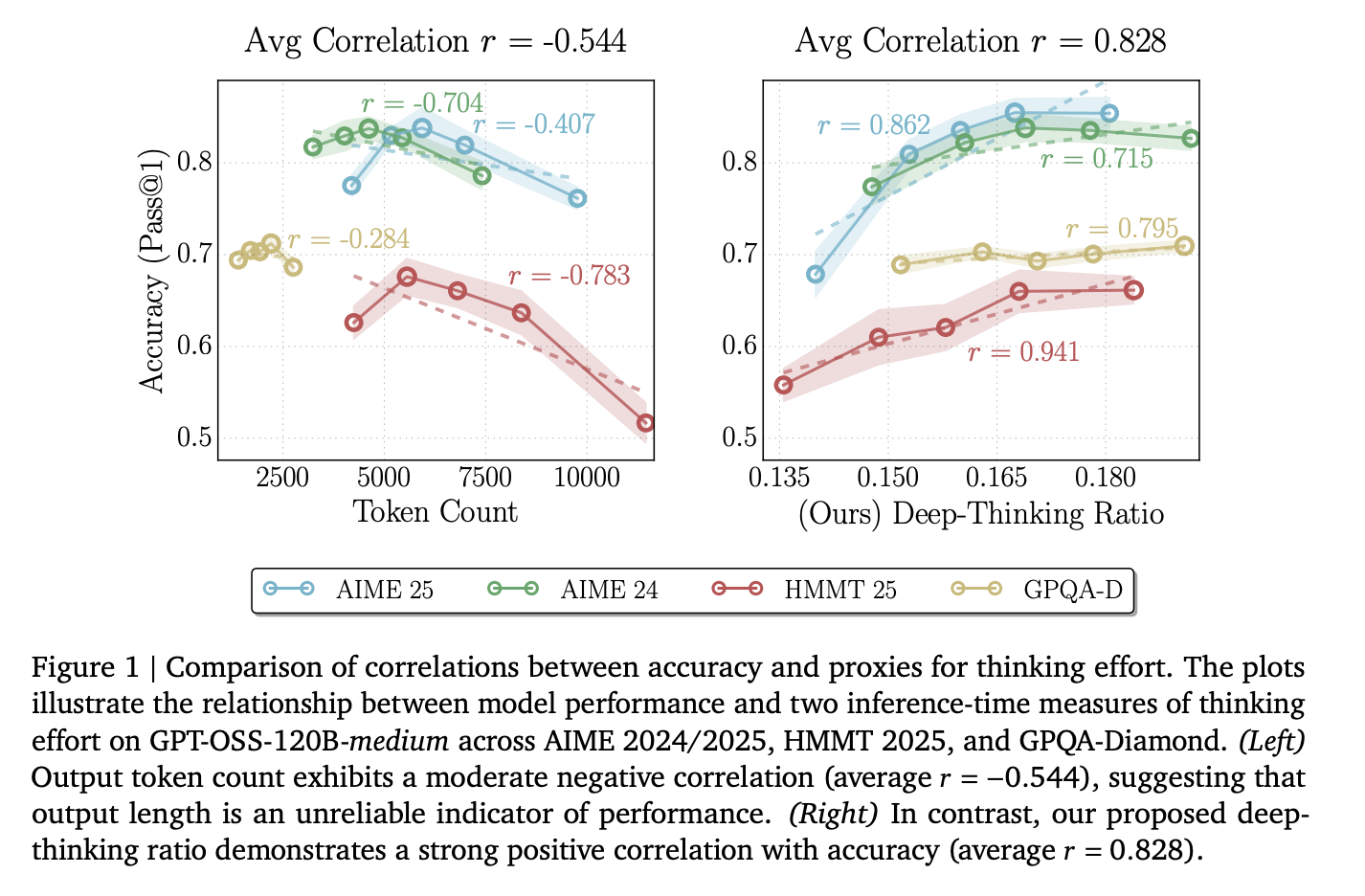
For the last few years, the AI world has followed a simple rule: if you want a Large Language Model (LLM) to solve a harder problem, make its Chain-of-Thought (CoT) longer. But new research from the University of Virginia and Google proves that ‘thinking long’ is not the same as ‘thinking hard’.

The research team reveals that simply adding more tokens to a response can actually make an AI less accurate. Instead of counting words, the Google researchers introduce a new measurement: the Deep-Thinking Ratio (DTR).
https://arxiv.org/pdf/2602.13517

The Failure of ‘Token Maxing‘

Engineers often use token count as a proxy for the effort an AI puts into a task. However, the researchers found that raw token count has an average correlation of r= -0.59 with accuracy.

This negative number means that as the model generates more text, it is more likely to be wrong. This happens because of ‘overthinking,’ where the model gets stuck in loops, repeats redundant steps, or amplifies its own mistakes. Relying on length alone wastes expensive compute on uninformative tokens.

What are Deep-Thinking Tokens?

The research team argued that real ‘thinking’ happens inside the layers of the model, not just in the final output. When a model predicts a token, it processes data through a series of transformer layers (L).

  1. Shallow Tokens: For easy words, the model’s prediction stabilizes early. The ‘guess’ doesn’t change much from layer 5 to layer 36.
  2. Deep-Thinking Tokens: For difficult logic or math symbols, the prediction shifts significantly in the deeper layers.

How to Measure Depth

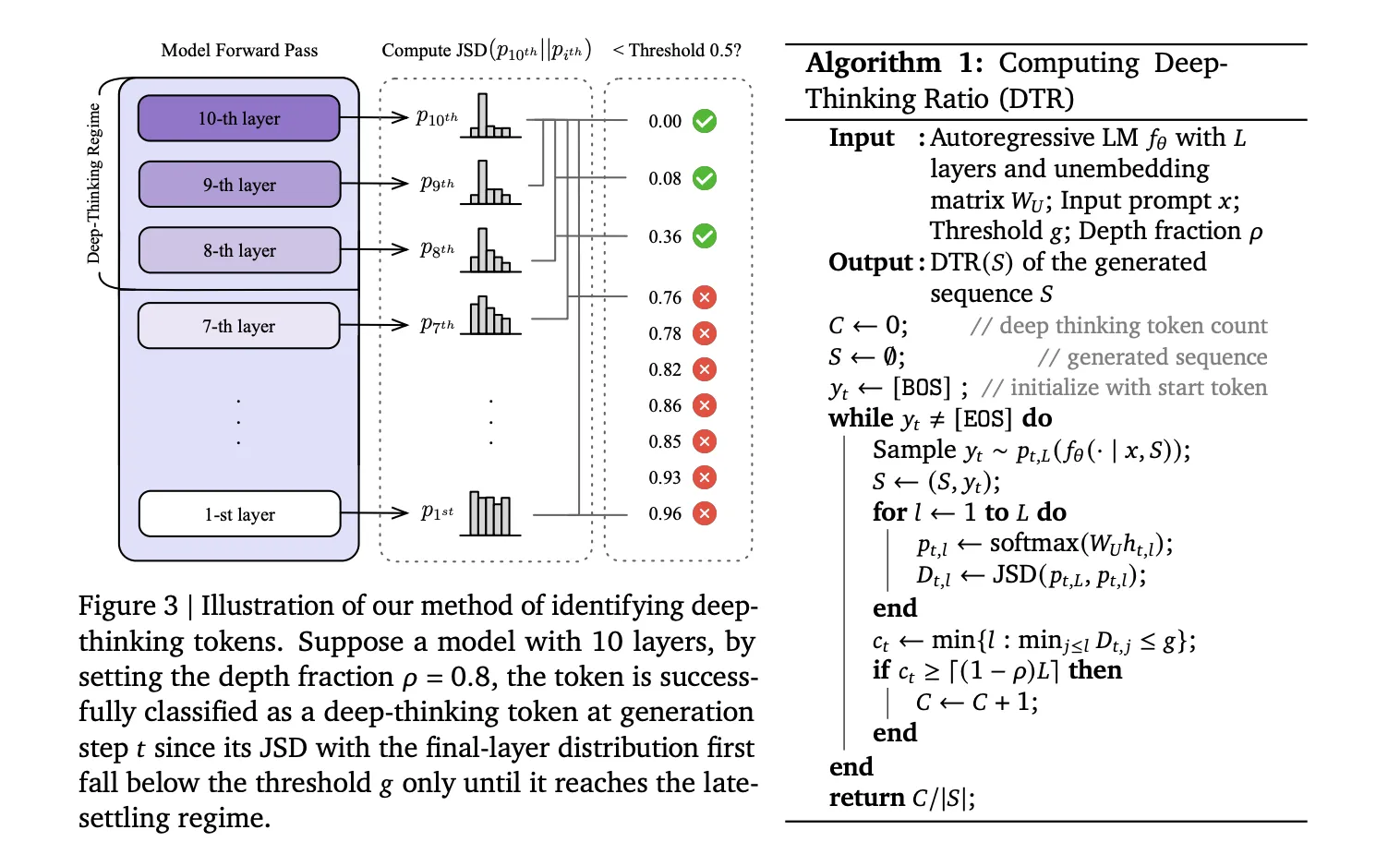
To identify these tokens, the research team uses a technique to peek at the model’s internal ‘drafts’ at every layer. They project the intermediate hidden states (htl) into the vocabulary space using the model’s unembedding matrix (WU). This produces a probability distribution (pt,l) for every layer.

They then calculate the Jensen-Shannon Divergence (JSD) between the intermediate layer distribution and the final layer distribution (pt,L):

Dt,l := JSD(pt,L || pt,l)

A token is a deep-thinking token if its prediction only settles in the ‘late regime’—defined by a depth fraction (⍴). In their tests, they set ⍴= 0.85, meaning the token only stabilized in the final 15% of the layers.

The Deep-Thinking Ratio (DTR) is the percentage of these ‘hard’ tokens in a full sequence. Across models like DeepSeek-R1-70B, Qwen3-30B-Thinking, and GPT-OSS-120B, DTR showed a strong average positive correlation of r = 0.683 with accuracy.
https://arxiv.org/pdf/2602.13517

Think@n: Better Accuracy at 50% the Cost

The research team used this innovative approach to create Think@n, a new way to scale AI performance during inference.

Most devs use Self-Consistency (Cons@n), where they sample 48 different answers and use majority voting to pick the best one. This is very expensive because you have to generate every single token for every answer.

Think@n changes the game by using ‘early halting’:

  • The model starts generating multiple candidate answers.
  • After just 50 prefix tokens, the system calculates the DTR for each candidate.
  • It immediately stops generating the ‘unpromising’ candidates with low DTR.
  • It only finishes the candidates with high deep-thinking scores.

The Results on AIME 2025

Method Accuracy Avg. Cost (k tokens)
Cons@n (Majority Vote) 92.7% 307.6
Think@n (DTR-based Selection) 94.7% 155.4

On the AIME 25 math benchmark, Think@n achieved higher accuracy than standard voting while reducing the inference cost by 49%.

Key Takeaways

  • Token count is a poor predictor of accuracy: Raw output length has an average negative correlation (r = -0.59) with performance, meaning longer reasoning traces often signal ‘overthinking’ rather than higher quality.
  • Deep-thinking tokens define true effort: Unlike simple tokens that stabilize in early layers, deep-thinking tokens are those whose internal predictions undergo significant revision in deeper model layers before converging.
  • The Deep-Thinking Ratio (DTR) is a superior metric: DTR measures the proportion of deep-thinking tokens in a sequence and exhibits a robust positive correlation with accuracy (average r = 0.683), consistently outperforming length-based or confidence-based baselines.
  • Think@n enables efficient test-time scaling: By prioritizing and finishing only the samples with high deep-thinking ratios, the Think@n strategy matches or exceeds the performance of standard majority voting (Cons@n).
  • Massive cost reduction via early halting: Because DTR can be estimated from a short prefix of just 50 tokens, unpromising generations can be rejected early, reducing total inference costs by approximately 50%.

Check out the Paper. Also, feel free to follow us on Twitter and don’t forget to join our 100k+ ML SubReddit and Subscribe to our Newsletter. Wait! are you on telegram? now you can join us on telegram as well.


Source_link

READ ALSO

Sophie AI Chatbot App: Pricing Breakdown and Core Feature Overview

NVIDIA Releases DreamDojo: An Open-Source Robot World Model Trained on 44,711 Hours of Real-World Human Video Data

Related Posts

Sophie AI Chatbot App: Pricing Breakdown and Core Feature Overview
Al, Analytics and Automation

Sophie AI Chatbot App: Pricing Breakdown and Core Feature Overview

February 21, 2026
NVIDIA Releases DreamDojo: An Open-Source Robot World Model Trained on 44,711 Hours of Real-World Human Video Data
Al, Analytics and Automation

NVIDIA Releases DreamDojo: An Open-Source Robot World Model Trained on 44,711 Hours of Real-World Human Video Data

February 21, 2026
Al, Analytics and Automation

A Coding Guide to High-Quality Image Generation, Control, and Editing Using HuggingFace Diffusers

February 21, 2026
TheDream AI Image Generator Prices, Capabilities, and Feature Breakdown
Al, Analytics and Automation

TheDream AI Image Generator Prices, Capabilities, and Feature Breakdown

February 21, 2026
Al, Analytics and Automation

How to Design a Swiss Army Knife Research Agent with Tool-Using AI, Web Search, PDF Analysis, Vision, and Automated Reporting

February 20, 2026
Exposing biases, moods, personalities, and abstract concepts hidden in large language models | MIT News
Al, Analytics and Automation

Exposing biases, moods, personalities, and abstract concepts hidden in large language models | MIT News

February 20, 2026
Next Post
Sony’s WH-CH720N headphones offer excellent value at full price, but right now they’re a steal.

Sony’s WH-CH720N headphones offer excellent value at full price, but right now they're a steal.

POPULAR NEWS

Trump ends trade talks with Canada over a digital services tax

Trump ends trade talks with Canada over a digital services tax

June 28, 2025
Communication Effectiveness Skills For Business Leaders

Communication Effectiveness Skills For Business Leaders

June 10, 2025
15 Trending Songs on TikTok in 2025 (+ How to Use Them)

15 Trending Songs on TikTok in 2025 (+ How to Use Them)

June 18, 2025
App Development Cost in Singapore: Pricing Breakdown & Insights

App Development Cost in Singapore: Pricing Breakdown & Insights

June 22, 2025
Google announced the next step in its nuclear energy plans 

Google announced the next step in its nuclear energy plans 

August 20, 2025

EDITOR'S PICK

The Quantum Echoes algorithm breakthrough

The Quantum Echoes algorithm breakthrough

October 27, 2025
Please Buy Adpulp A Coffee

Please Buy Adpulp A Coffee

June 7, 2025
‘New media’ is just right-wing media 

‘New media’ is just right-wing media 

October 17, 2025

Ditch the trends and write the future yourself

November 6, 2025

About

We bring you the best Premium WordPress Themes that perfect for news, magazine, personal blog, etc. Check our landing page for details.

Follow us

Categories

  • Account Based Marketing
  • Ad Management
  • Al, Analytics and Automation
  • Brand Management
  • Channel Marketing
  • Digital Marketing
  • Direct Marketing
  • Event Management
  • Google Marketing
  • Marketing Attribution and Consulting
  • Marketing Automation
  • Mobile Marketing
  • PR Solutions
  • Social Media Management
  • Technology And Software
  • Uncategorized

Recent Posts

  • Navigating Regulations in Apparel Marketing
  • How Conversion Rate Optimization Boosts Sales and Business Growth
  • Sony’s WH-CH720N headphones offer excellent value at full price, but right now they’re a steal.
  • A New Google AI Research Proposes Deep-Thinking Ratio to Improve LLM Accuracy While Cutting Total Inference Costs by Half
  • About Us
  • Disclaimer
  • Contact Us
  • Privacy Policy
No Result
View All Result
  • Technology And Software
    • Account Based Marketing
    • Channel Marketing
    • Marketing Automation
      • Al, Analytics and Automation
      • Ad Management
  • Digital Marketing
    • Social Media Management
    • Google Marketing
  • Direct Marketing
    • Brand Management
    • Marketing Attribution and Consulting
  • Mobile Marketing
  • Event Management
  • PR Solutions