Multi-Agent Systems: The Next Frontier in AI-Driven Cyber Defense
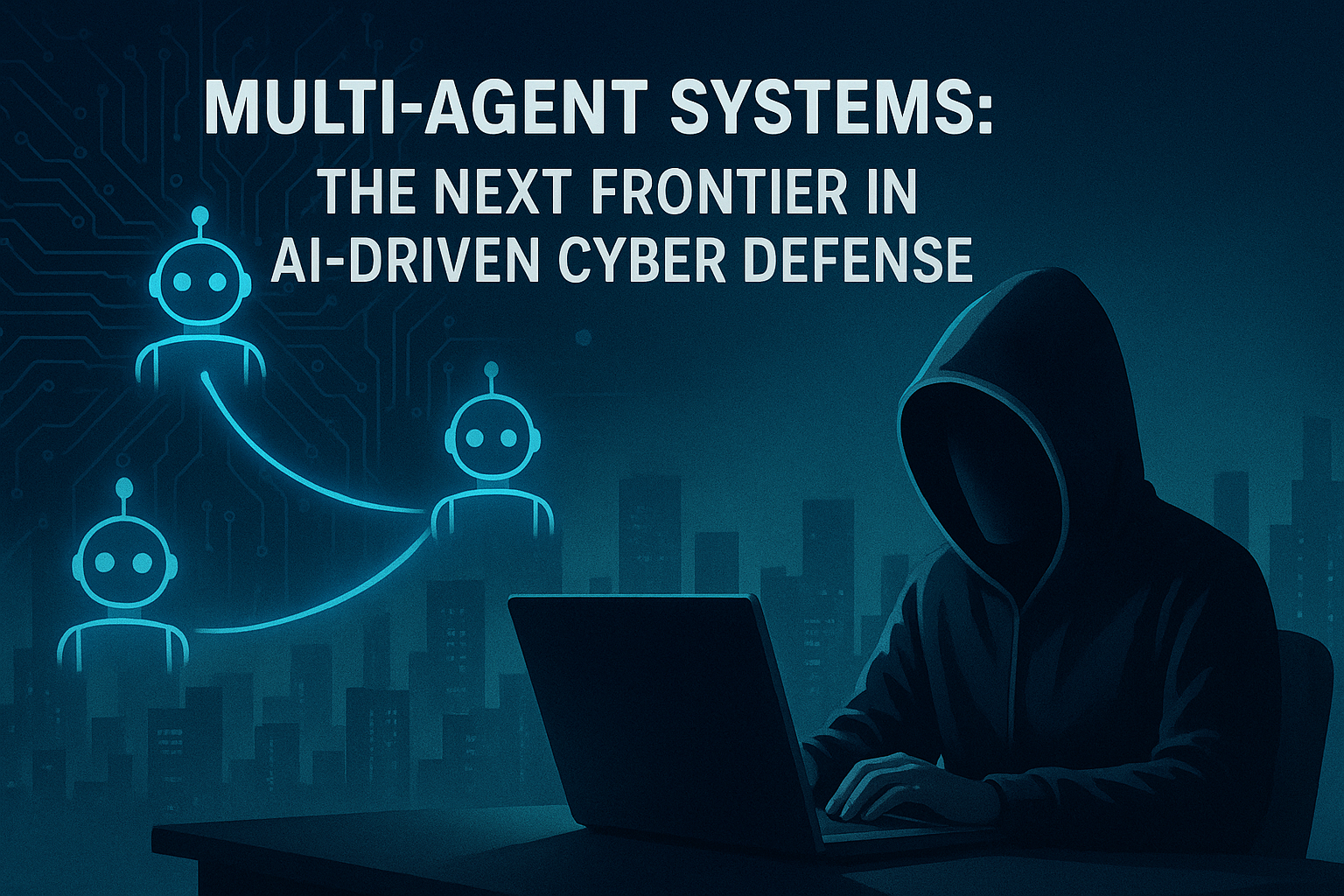
Image by Editor | ChatGPT
Introduction
The increasing sophistication of cyber threats calls for a systemic change in the way we defend ourselves against them. Traditional security solutions, and legacy solutions, function in silos, and often struggle with dynamic and coordinated attacks. Multi-agent systems (MAS), on the other hand, utilize collaboration and agent dependent solutions, which enable a combination of AI agents to work together, mimicking human collaboration, as a “system”, while providing machine speed and scale when enhancing the cybersecurity posture of an organization.
The Power of Decentralized, Collaborative AI
At the heart of a MAS are many intelligent agents that act together, where agents are software entities capable of autonomous actions. In cyber security, the agents in a multi-agent system are intelligent systems that can observe their environments, arbitrate optimal actions, and act collectively to collaboratively detect, respond and respectively reduce cyber threat risk. AI agents are special because they can dynamically analyze new data or context from their investigations and autonomously adapt their actions based on similarities and growth, as they can presumably synthesised large amounts of information across multiple domains and generally develop from experimentation.
The main advantages of using MAS in cybersecurity include the following:
- Scalability: Agents can be added or removed at will and, because of this, MAS can be more easily scaled to a diverse range of network sizes and complexities from small businesses to huge enterprises
- Adaptability: Agents adapt to new data points, in that they can learn and adjust their algorithms for detection and response, they can adapt to new data without human intervention, allowing organizations to have a strong (proactive) defence against threats which evolve
- Fault Tolerant: Failures in one agent do not prevent other agents from operating leading to guaranteed continued protection and resilience
- Collaboration: Agents share information and coordinate responses, resulting in faster mitigation, fewer false positives, and a larger understanding of the threat landscape and increased situational awareness
Practical Applications in Cyber Defense
Multi-Agent Systems are already revolutionizing security operations in several key areas:
Distributed Intrusion Detection Systems (DIDS)
Traditional Intrusion Detection Systems (IDS) typically offer a centralized approach to analysis, which can lead to latencies, or possible delays. With MAS, DIDS allow agents to monitor their own slice of the network in isolation, but share information to make sense of how seemingly coordinated attacks across multiple network segments occurred. For example, one agent may identify suspicious traffic patterns around a server, while another agent may relate this suspicious activity to anomalous user logins on a different endpoint, which collectively points to a multi-stage attack.
Automated Incident Response
MAS has the potential to automate complex incident response processes, and potentially prevent delays in incident response by allowing agents to perform the appropriate response tasks without the need for human intervention. Agents can be assigned to isolate infected machines, block suspicious IP’s, quarantine files, or roll back compromised configurations. This capability can reduce incident response time to minutes; ultimately preventing an attacker from harming even more systems. For example, an AI agent may identify a malware, analyze it, identify how it propagates, and could easily instruct agents to block its network connections, quarantine affected machines, etc.
Threat Intelligence Sharing
Agents in an MAS environment can also use communication and real-time threat intelligence from other agents that are leveraging external databases, threat intelligence platforms or other MAS deployments. It has collective defense capabilities which enhances an organizations’ capabilities to spot, understand, and defend against current or emerging threats while they are still forming into attacks by creating a “common picture” of adversarial tactics, techniques, and procedures.
Cloud Security Posture Management (CSPM)
The multifaceted nature of multi-cloud environments poses enormous challenges for security teams. AI agents may be able to assess the context of alerts produced by CSPM tools and prioritize high-risk misconfigurations, and in some cases, autonomously remediate the issues by updating infrastructure-as-code or raising a pull request for the human user. AI agents can also understand the correlation of data across multiple cloud providers and offer a coherent and unified security posture.
The Human-Agent Collaboration
Even though MAS allows for automation and intelligence-behavior of unprecedented amounts, the human component is extremely important. In fact, MAS does not aim to replace security analysts, but to supplement their work. AI agents are adept at repetitive high workloads, processing large amounts of data, and distinguishing anomalies, as well as other jobs, more quickly than a person. Consequently, AI agents allow human analysts to concentrate on high-complexity threats, strategic actions, and make any calls requiring human judgement and intuition etc.
The future of cyber defense resides in the collaborative model. Humans will be needed to provide oversight, define high-level objectives, and validate agent behaviors and actions so that these advanced systems operate ethically and by policy.
Challenges and Future Directions
Although MAS holds great promise as a suitable technology for realizing cyber defense solutions, there are challenges in deploying MAS. These include trustworthiness and explainability of agent decisions, ensuring agent actions/reactions are predictable when interacting with other agents, and agent protection from being compromised. Research exploring ideas such as Multi-Agent Reinforcement Learning (MARL) is looking at how agents may be able to learn and adapt to changing dynamics in a cyber environment, in addition to adversarial robustness to elevate agent robustness against advanced attacks that target the AI.
The continuous advancement of AI and machine learning will evolve the underlying capabilities of MAS, ushering in a new breed of intelligent, resilient, and proactive cyber defense strategies. As cyber threats continue to pose multiple challenges, it can be assumed that Multi-Agent Systems will be an essential part of a comprehensive cybersecurity posture, giving defenders a competitive advantage in an ever-evolving digital arms race.

About Nivedita Kumari
Nivedita Kumari is a seasoned Data Analytics and AI Professional with over 10 years of experience. In her current role, as a Data Analytics Customer Engineer at Google she constantly engages with C level executives and helps them architect data solutions and guides them on best practice to build Data and Machine learning solutions on Google Cloud. Nivedita has done her Masters in Technology Management with a focus on Data Analytics from the University of Illinois at Urbana-Champaign. She wants to democratize machine learning and AI, breaking down the technical barriers so everyone can be part of this transformative technology. She shares her knowledge and experience with the developer community by creating tutorials, guides, opinion pieces, and coding demonstrations. Connect with Nivedita on LinkedIn.