• About Us
  • Disclaimer
  • Contact Us
  • Privacy Policy
Tuesday, June 9, 2026
mGrowTech
No Result
View All Result
  • Technology And Software
    • Account Based Marketing
    • Channel Marketing
    • Marketing Automation
      • Al, Analytics and Automation
      • Ad Management
  • Digital Marketing
    • Social Media Management
    • Google Marketing
  • Direct Marketing
    • Brand Management
    • Marketing Attribution and Consulting
  • Mobile Marketing
  • Event Management
  • PR Solutions
  • Technology And Software
    • Account Based Marketing
    • Channel Marketing
    • Marketing Automation
      • Al, Analytics and Automation
      • Ad Management
  • Digital Marketing
    • Social Media Management
    • Google Marketing
  • Direct Marketing
    • Brand Management
    • Marketing Attribution and Consulting
  • Mobile Marketing
  • Event Management
  • PR Solutions
No Result
View All Result
mGrowTech
No Result
View All Result
Home Al, Analytics and Automation

From 100,000 to Under 500 Labels: How Google AI Cuts LLM Training Data by Orders of Magnitude

Josh by Josh
August 10, 2025
in Al, Analytics and Automation
0
From 100,000 to Under 500 Labels: How Google AI Cuts LLM Training Data by Orders of Magnitude


Google Research has unveiled a groundbreaking method for fine-tuning large language models (LLMs) that slashes the amount of required training data by up to 10,000x, while maintaining or even improving model quality. This approach centers on active learning and focusing expert labeling efforts on the most informative examples—the “boundary cases” where model uncertainty peaks.

The Traditional Bottleneck

Fine-tuning LLMs for tasks demanding deep contextual and cultural understanding—like ad content safety or moderation—has typically required massive, high-quality labeled datasets. Most data is benign, meaning that for policy violation detection, only a small fraction of examples matter, driving up the cost and complexity of data curation. Standard methods also struggle to keep up when policies or problematic patterns shift, necessitating expensive retraining.

Google’s Active Learning Breakthrough

How It Works:

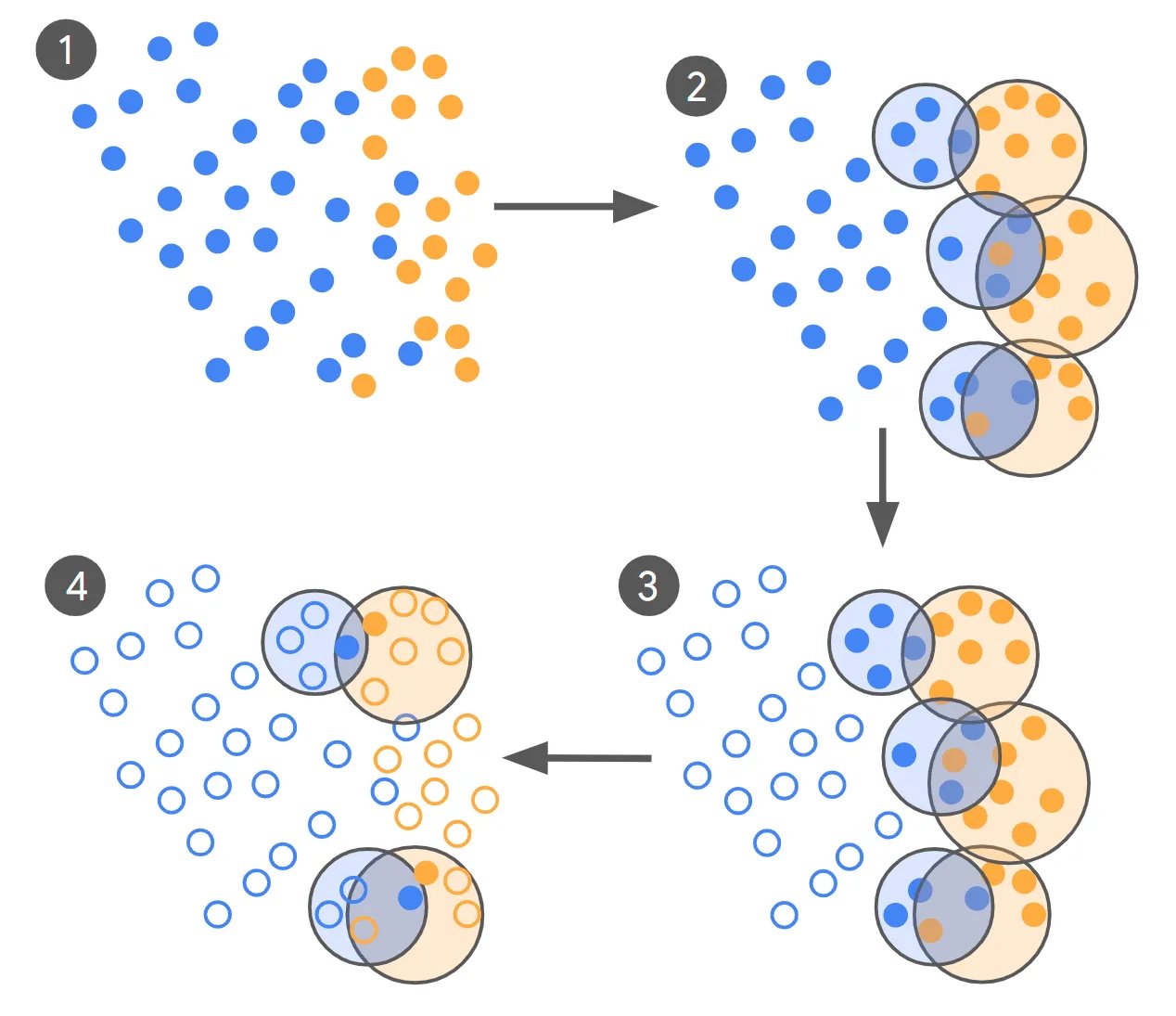
  • LLM-as-Scout: The LLM is used to scan a vast corpus (hundreds of billions of examples) and identify cases it’s least certain about.
  • Targeted Expert Labeling: Instead of labeling thousands of random examples, human experts only annotate those borderline, confusing items.
  • Iterative Curation: This process repeats, with each batch of new “problematic” examples informed by the latest model’s confusion points.
  • Rapid Convergence: Models are fine-tuned in multiple rounds, and the iteration continues until the model’s output aligns closely with expert judgment—measured by Cohen’s Kappa, which compares agreement between annotators beyond chance.
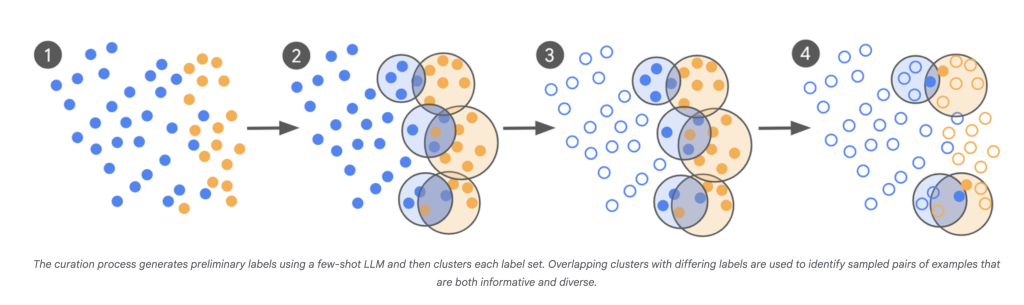
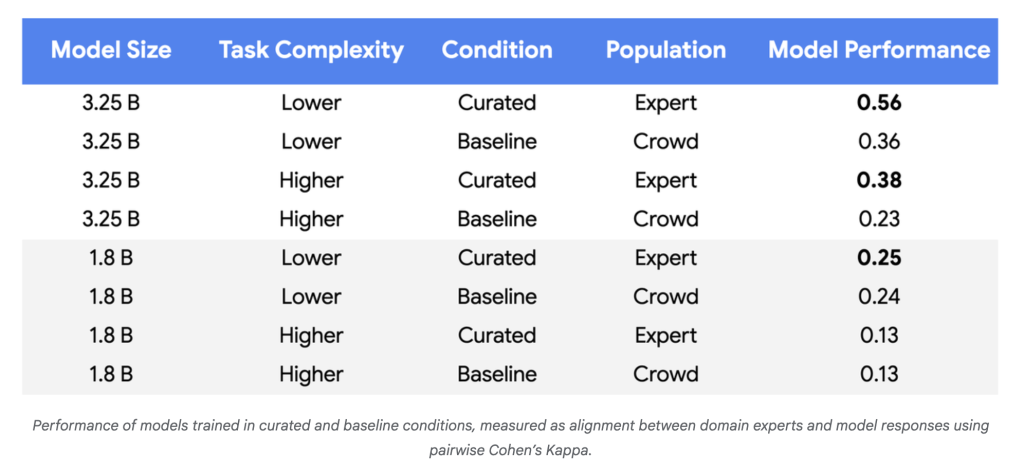
Image source: https://research.google/blog/achieving-10000x-training-data-reduction-with-high-fidelity-labels/

Impact:

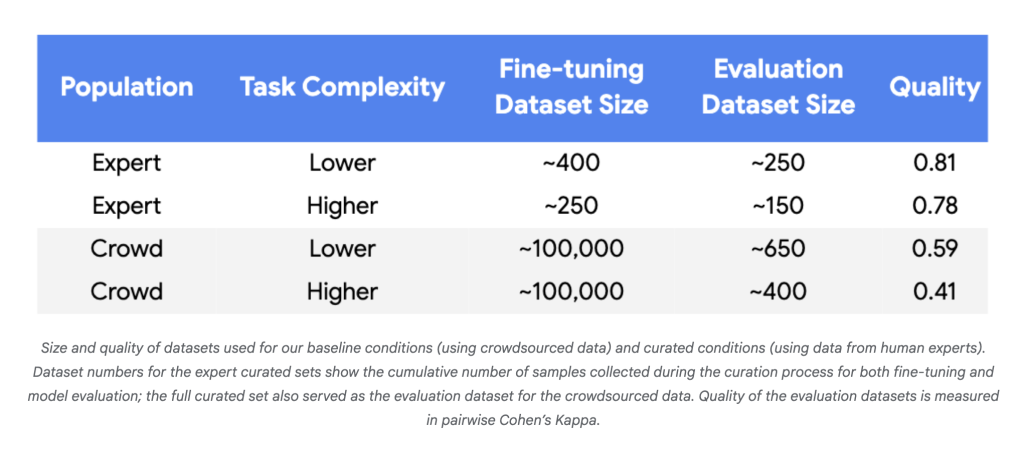
  • Data Needs Plummet: In experiments with Gemini Nano-1 and Nano-2 models, alignment with human experts reached parity or better using 250–450 well-chosen examples rather than ~100,000 random crowdsourced labels—a reduction of three to four orders of magnitude.
  • Model Quality Rises: For more complex tasks and larger models, performance improvements reached 55–65% over baseline, demonstrating more reliable alignment with policy experts.
  • Label Efficiency: For reliable gains using tiny datasets, high label quality was consistently necessary (Cohen’s Kappa > 0.8).
Why It Matters

This approach flips the traditional paradigm. Rather than drowning models in vast pools of noisy, redundant data, it leverages both LLMs’ ability to identify ambiguous cases and the domain expertise of human annotators where their input is most valuable. The benefits are profound:

  • Cost Reduction: Vastly fewer examples to label, dramatically lowering labor and capital expenditure.
  • Faster Updates: The ability to retrain models on a handful of examples makes adaptation to new abuse patterns, policy changes, or domain shifts rapid and feasible.
  • Societal Impact: Enhanced capacity for contextual and cultural understanding increases the safety and reliability of automated systems handling sensitive content.

In Summary

Google’s new methodology enables LLM fine-tuning on complex, evolving tasks with just hundreds (not hundreds of thousands) of targeted, high-fidelity labels—ushering in far leaner, more agile, and cost-effective model development.


Michal Sutter is a data science professional with a Master of Science in Data Science from the University of Padova. With a solid foundation in statistical analysis, machine learning, and data engineering, Michal excels at transforming complex datasets into actionable insights.




Previous articleAI Agent Trends of 2025: A Transformative Landscape


Source_link

READ ALSO

NVIDIA cuTile Python Tutorial: Building Tiled GPU Kernels for Vector Addition, Matrix Addition, and Matrix Multiplication in Colab

ClawHub Security Signals: A Coding Guide to End-to-End Security Signal Analysis and Verdict Classification on the AI Skills Dataset

Related Posts

NVIDIA cuTile Python Tutorial: Building Tiled GPU Kernels for Vector Addition, Matrix Addition, and Matrix Multiplication in Colab
Al, Analytics and Automation

NVIDIA cuTile Python Tutorial: Building Tiled GPU Kernels for Vector Addition, Matrix Addition, and Matrix Multiplication in Colab

June 9, 2026
ClawHub Security Signals: A Coding Guide to End-to-End Security Signal Analysis and Verdict Classification on the AI Skills Dataset
Al, Analytics and Automation

ClawHub Security Signals: A Coding Guide to End-to-End Security Signal Analysis and Verdict Classification on the AI Skills Dataset

June 8, 2026
Microsoft AI Introduces MAI-Transcribe-1.5: 2.4% WER on Artificial Analysis, Best-in-Class FLEURS Accuracy, and Up to 5x Faster Long-Audio Transcription
Al, Analytics and Automation

Microsoft AI Introduces MAI-Transcribe-1.5: 2.4% WER on Artificial Analysis, Best-in-Class FLEURS Accuracy, and Up to 5x Faster Long-Audio Transcription

June 8, 2026
Building Reflective Prompt Optimization with GEPA: Multi-Component Prompts, Structured Feedback, and Held-Out Validation
Al, Analytics and Automation

Building Reflective Prompt Optimization with GEPA: Multi-Component Prompts, Structured Feedback, and Held-Out Validation

June 7, 2026
Best 21 Low-Code and No-Code AI Tools in 2026
Al, Analytics and Automation

Best 21 Low-Code and No-Code AI Tools in 2026

June 7, 2026
Tod Machover receives George Peabody Medal for contributions to music and technology | MIT News
Al, Analytics and Automation

Tod Machover receives George Peabody Medal for contributions to music and technology | MIT News

June 6, 2026
Next Post
After researchers unmasked a prolific SMS scammer, a new operation has emerged in its wake

After researchers unmasked a prolific SMS scammer, a new operation has emerged in its wake

POPULAR NEWS

Trump ends trade talks with Canada over a digital services tax

Trump ends trade talks with Canada over a digital services tax

June 28, 2025
15 Trending Songs on TikTok in 2025 (+ How to Use Them)

15 Trending Songs on TikTok in 2025 (+ How to Use Them)

June 18, 2025
Communication Effectiveness Skills For Business Leaders

Communication Effectiveness Skills For Business Leaders

June 10, 2025
App Development Cost in Singapore: Pricing Breakdown & Insights

App Development Cost in Singapore: Pricing Breakdown & Insights

June 22, 2025
Comparing the Top 7 Large Language Models LLMs/Systems for Coding in 2025

Comparing the Top 7 Large Language Models LLMs/Systems for Coding in 2025

November 4, 2025

EDITOR'S PICK

LSEG and Anthropic Join Forces to Redefine Financial Insight

LSEG and Anthropic Join Forces to Redefine Financial Insight

October 29, 2025
Everything we launched in Buffer in 2025

Everything we launched in Buffer in 2025

January 14, 2026
Honor says its ‘Robot phone’ with moving camera can dance to music

Honor says its ‘Robot phone’ with moving camera can dance to music

March 1, 2026
MIT scientists build the world’s largest collection of Olympiad-level math problems, and open it to everyone | MIT News

MIT scientists build the world’s largest collection of Olympiad-level math problems, and open it to everyone | MIT News

April 24, 2026

About

We bring you the best Premium WordPress Themes that perfect for news, magazine, personal blog, etc. Check our landing page for details.

Follow us

Categories

  • Account Based Marketing
  • Ad Management
  • Al, Analytics and Automation
  • Brand Management
  • Channel Marketing
  • Digital Marketing
  • Direct Marketing
  • Event Management
  • Google Marketing
  • Marketing Attribution and Consulting
  • Marketing Automation
  • Mobile Marketing
  • PR Solutions
  • Social Media Management
  • Technology And Software
  • Uncategorized

Recent Posts

  • 5 Active Directory Misconfigurations That Still Lead to Domain Compromise in 2026
  • NVIDIA cuTile Python Tutorial: Building Tiled GPU Kernels for Vector Addition, Matrix Addition, and Matrix Multiplication in Colab
  • See the top Google Trends searches for the 2026 NBA Finals
  • LinkedIn Crossclimb Answer Today for June 8, 2026 (Puzzle #769)
  • About Us
  • Disclaimer
  • Contact Us
  • Privacy Policy
No Result
View All Result
  • Technology And Software
    • Account Based Marketing
    • Channel Marketing
    • Marketing Automation
      • Al, Analytics and Automation
      • Ad Management
  • Digital Marketing
    • Social Media Management
    • Google Marketing
  • Direct Marketing
    • Brand Management
    • Marketing Attribution and Consulting
  • Mobile Marketing
  • Event Management
  • PR Solutions