[ad_1]
For the past few months, when I really needed to get something done, I put on a special pair of headphones that could read my mind. Well, kind of. The headphones are equipped with a brain-computer interface that picks up electrical signals from my brain and uses algorithms to interpret that data. When my focus starts to slip, the headphones know it, and an app tells me to take a break.
It sounds like something out of science fiction, but a decade-old startup called Neurable is pioneering the technology, and it’s preparing to put the brain-tracking tricks into more gadgets. Earbuds, glasses, helmets — anything that can get an electrode near your head could provide a real-time stream of data about what’s going on inside of it. Neurable’s technology uses a combination of electroencephalography (EEG) sensors to collect brain data and algorithms to interpret those signals. Beyond measuring attention, the company is now using that data to track and improve brain health.
I want to emphasize again that this technology does not actually read your mind in the sense of knowing your thoughts. But, it knows when you’re entertained or distracted and could one day detect symptoms of depression or, on a much more consequential front, early signs of Alzheimer’s disease.
I came across Neurable on a longer mission to understand the future of health-tracking technology by testing what’s out there now. It’s one that left me anxious, covered in smart rings and continuous glucose monitors, and more confused about the definition of well-being. That’s because almost all health trackers that are popular on the market right now — Apple Watches, Oura Rings, Whoop Bands — are downstream sensors. They measure consequences, like elevated heart rate or body temperature, rather than the root cause of that state. By tapping directly into your brainwaves, a brain-computer interface can spot issues sometimes years before they would show up.
It could one day detect symptoms of depression or, on a much more consequential front, early signs of Alzheimer’s disease.
“Biologically, your brain is designed to hide your weaknesses: It’s an evolutionary effect,” Neurable’s co-founder and CEO Ramses Alcaide, a neuroscientist, told me. “But when you’re measuring from the source, you pick up those things as they’re occurring, instead of once there’s finally downstream consequences, and that’s the real advantage of measuring the brain.”
Other major tech companies are also exploring ways to incorporate non-invasive brain-computer interfaces into headphones. A couple years ago, Apple quietly applied for a patent for an AirPod design that uses electrodes to monitor brain activity, and NextSense, which grew out of Google’s moonshot division, wants to build earbud-based brain monitors for the mass market. There’s also been a recent boom in activity around invasive brain-computer interfaces being developed by companies like Elon Musk’s Neuralink and even Meta that surgically implant chips into people’s brains. It’s safe to say that’s not currently a mass-market approach.
Still, while all of those mega market cap companies ponder the possibilities of their own brain-powered projects, Neurable’s is on the market. It’s on my head right now, actually, and it works.
The cutting edge of neurotech
Spun out of the University of Michigan’s Direct Brain Interface Lab in 2015, Neurable initially planned to break into the gaming industry. An early version of its technology used EEG sensors in a VR headset to power the world’s first brain-controlled video game but pivoted to wearables before launching a wildly successful Indiegogo campaign for a futuristic set of headphones. That attracted the attention of major hardware makers and a partnership with Master & Dynamic.
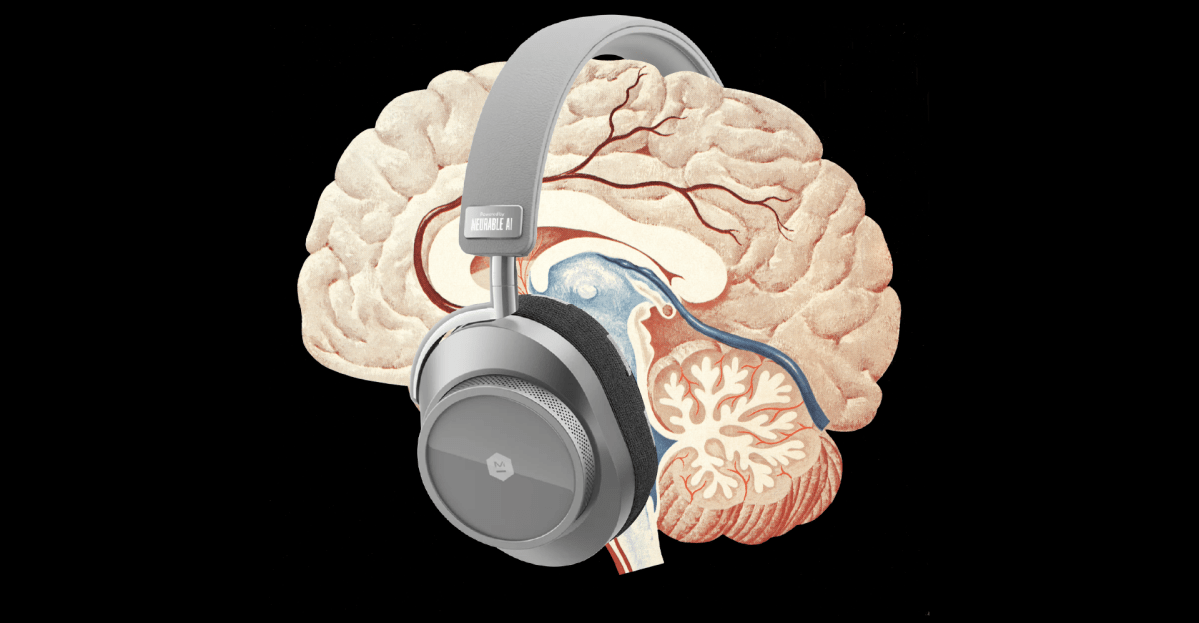
The Master & Dynamic MW75 Neuro — the $700 pair of headphones I tested — looks like any other set of noise-canceling headphones, except for the badge that reads, “Powered by Neurable AI.” When you connect them to the Neurable app is when things get fun.
Inside the Neurable app is a little video game that lets you fly a rocket ship with your brain — and serves as a proof of concept. The trick is you have to focus on a set of numbers on the screen. The more intensely you focus, the higher the numbers go, and the faster the rocket ship flies. If you start to get distracted by, say, thinking about flying an actual rocket ship, the numbers go down, and the rocket ship slows. It’s one of the coolest innovations I’ve ever seen, if only because it’s so simple.
The EEG sensors in Neurable’s products can pick up a range of brainwave frequencies, which are associated with different behaviors and activities. The beta frequency band provides some information about attention state as well as anxiety, while alpha indicates a mind at rest.
While EEG sensors and brain-computer interfaces are most often seen in labs, putting these sensors into a device that people wear every day stands to transform our understanding of the mind. “Non-invasive EEG is cheap and completely safe,” said Bin He, a professor of biomedical engineering at Carnegie Mellon University, whose lab built a drone you can fly with your mind over a decade ago. “AI, or deep-learning technology, however has drastically improved the performance of [brain-computer interfaces] to read the minds of individuals.”
If you changed the technology’s mission from measuring focus to, say, symptoms of depression, you could imagine how an everyday gadget could offer some life-changing interventions. The possibilities are as endless as the list of issues that can affect the brain. The Pentagon has been using Neurable’s portable technology to study traumatic head injuries in soldiers, for instance, and that research could have practical applications in sports. Alcaide also mentioned Alzheimer’s and Parkinson’s as potential targets for their technology. Symptoms for these diseases don’t appear for years after onset, but early markers could show up in the kind of EEG data their technology captures from everyday wear.
If you changed the technology’s mission from measuring focus to, say, symptoms of depression, you could imagine how an everyday gadget could offer some life-changing interventions.
For now, however, the MW75 Neuro headphones are primarily used to sharpen your attention — with the new and added benefit of giving you a snapshot of your brain health. This involves starting a session with the headphones on and letting the sensors collect the electrical signals your brain’s sending off. Your focus is measured as low, medium, or high, and when you’re flagging for a while, the app will prompt you to take a break. You can also turn on a feature called Biofeedback, which plays music of varying intensity in order to nudge your focus toward the high range. The Brain Health reports are still in beta mode but will show you daily estimates of how you’re doing in terms of things like anxiety resistance, cognitive speed, and wakefulness.
The way you know that the device isn’t actually reading your mind comes down to science and a strong data policy. Neurable’s technology picks up raw voltage — not actual thoughts — from your neurons and uses AI to decode the data and identify signals associated with focus, the company’s co-founder Adam Molnar explained to me recently. Neurable encrypts and anonymizes the data coming out of your head and onto its sensors and then again when it goes to your phone, so it’s far removed from any personal data. Furthermore, he said, Neurable has no ambitions to be a data company.
“Our business model doesn’t depend on identity. We don’t sell ads. So there’s no benefit,” Molnar said. “It’s actually more of a liability for us to be able to have data map back to an individual.”
It’s hard for me to say how much more productive I became thanks to the brain-reading headphones. As with many other health trackers, there’s sort of a placebo cat effect: Simply deciding to track the behavior changed my state of mind and made me behave a certain way. So, setting up a focus session inevitably made me pay closer attention to how well I was focusing, how often I took breaks, and if I was choosing to be more mindful.
This is actually what makes me so curious about an earbud version of what Neurable’s doing. I wear AirPods for most of the day, whether it’s taking calls for work, listening to podcasts, or just drowning out the sounds outside my Brooklyn apartment. If these earbuds were also collecting data about my cognitive well-being during all those activities, I’d be interested in knowing what I could glean from that information, if only to better understand what’s rotting my brain. And I’m sure plenty of companies would be happy to collect more data about their users’ states of mind at any given time. Imagine if the TikTok algorithm knew you weren’t interested in something — not because you swiped through it but rather because your brainwaves said so.
Neurable’s website has mockups of EEG-equipped earbuds, helmets, and smart glasses, and it’s clear that the company is eager to move beyond its first product. The company doesn’t just want to make gadgets, either. It wants to be the leading platform for brain-powered technology. “Just like Bluetooth is in every single device, and everyone should have access to Bluetooth, we believe that everyone should have access to neuro tech,” Alcaide told me.
We’re years away from the most far-fetched applications of brain-computer interfaces, but we’re heading in that direction.
“There’s so many things you can do with neuro tech, whether it’s tracking health conditions, whether it’s controlling devices, whether it is understanding yourself better,” he said. “It would be a disservice to the world if the only solutions that came out were our own.”
Neurable is indeed one of many startups trying to bring neuro tech to the masses, although they’re the only ones selling a product I’d actually wear in public. Several other EEG-based gadgets out there take the form of headbands, many of which are geared toward sleep health or meditation. A company called Emotiv, which also partnered with Master & Dynamic, will start selling its own EEG-equipped earbuds this fall. It remains to be seen if and when Apple will make brain-reading AirPods, but they’ve already partnered with a brain interface startup called Synchron, which allows people to control iPhones with their minds (Haven’t you always wanted to become one with your iPhone?).
This is where we circle back to the point where science fiction meets reality. We’re years away from the most far-fetched applications of brain-computer interfaces, but we’re heading in that direction. Whether that future ends up looking miraculous or like a Black Mirror episode is up to us — and to the companies, like Neurable, pioneering it.
A version of this story was also published in the User Friendly newsletter. Sign up here so you don’t miss the next one!
[ad_2]
Source_link