• About Us
  • Disclaimer
  • Contact Us
  • Privacy Policy
Saturday, June 13, 2026
mGrowTech
No Result
View All Result
  • Technology And Software
    • Account Based Marketing
    • Channel Marketing
    • Marketing Automation
      • Al, Analytics and Automation
      • Ad Management
  • Digital Marketing
    • Social Media Management
    • Google Marketing
  • Direct Marketing
    • Brand Management
    • Marketing Attribution and Consulting
  • Mobile Marketing
  • Event Management
  • PR Solutions
  • Technology And Software
    • Account Based Marketing
    • Channel Marketing
    • Marketing Automation
      • Al, Analytics and Automation
      • Ad Management
  • Digital Marketing
    • Social Media Management
    • Google Marketing
  • Direct Marketing
    • Brand Management
    • Marketing Attribution and Consulting
  • Mobile Marketing
  • Event Management
  • PR Solutions
No Result
View All Result
mGrowTech
No Result
View All Result
Home Al, Analytics and Automation

Key Factors That Drive Successful MCP Implementation and Adoption

Josh by Josh
July 27, 2025
in Al, Analytics and Automation
0


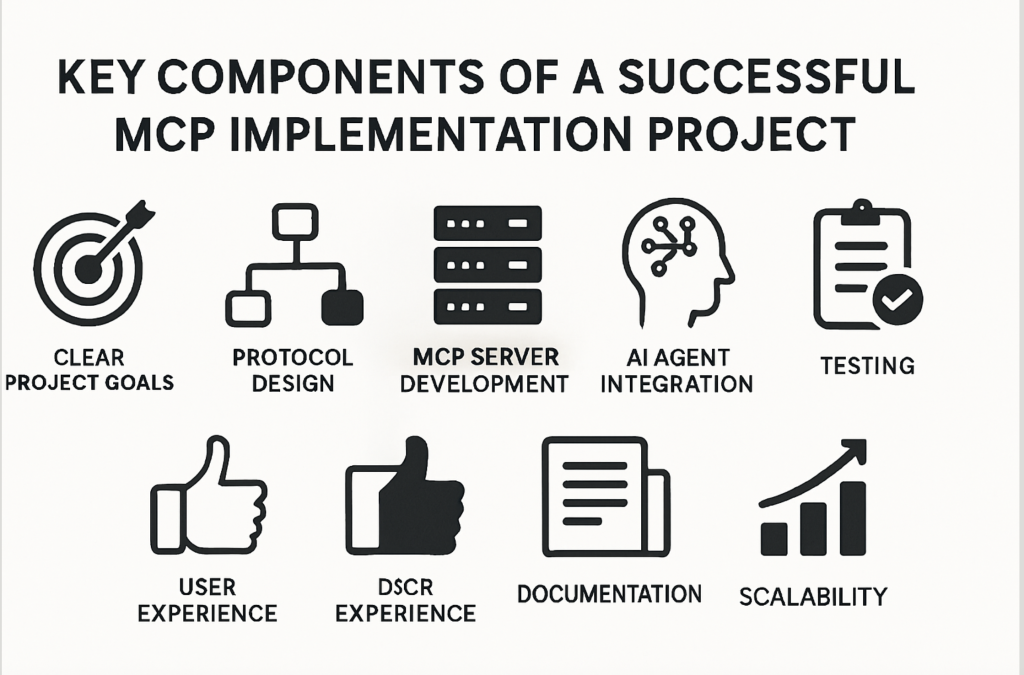
The Model Context Protocol (MCP) is changing how intelligent agents interact with backend services, applications, and data. A successful MCP implementation project hinges on much more than writing protocol-compliant code. Systematic adoption involves architecture, security, user experience, and operational rigor. Here’s a data-driven look at essential components that ensure MCP projects deliver value and resilience in production environments.
Source: Marktechpost.com

1. Clear Project Goals, Use Cases, and Stakeholder Buy-In

  • Define business and technical problems you’re solving with MCP: Example use cases include multi-app workflow automation, AI-powered content generation, or agent-based DevOps operations.
  • Engage users and IT early: Successful MCP teams conduct requirements workshops, interviews, and prioritize quick pilot wins.

2. Protocol, Integration, and Architecture Design

  • Mapping AI agent, MCP middleware, and target applications: The principle of loose coupling (stateless API endpoints) is key. Most advanced teams use HTTP/2 or websockets for real-time data push, avoiding heavy polling and reducing latency by up to 60% in agent workflows.
  • Contextual payloads: Embedding rich context (user, task, permissions) in protocol messages leads to higher agent accuracy and fewer ambiguous requests—critical for safety and compliance.

3. Robust Security & Permissions

Data Point: A 2024 GitLab DevSecOps survey found 44% of teams place security as the #1 blocker to AI workflow adoption.

  • Authentication: OAuth 2.0, JWT tokens, or mutual TLS remain best practices for MCP endpoints.
  • Granular permissions: Implement role-based access control (RBAC), with audit logging for every AI-triggered action.
  • User consent & transparency: End users should be able to view, approve, and revoke MCP access to data and controls.

4. MCP Server Development & Extensibility

  • Reusable, scalable, and stateless MCP servers: Architect servers that scale horizontally (containerized, cloud-native). Container orchestration (Kubernetes, Docker Swarm) is common for elastic scaling.
  • Open API definitions: Use OpenAPI/Swagger to document endpoints, enabling rapid onboarding of AI agents and developers.
  • Extensibility: Modular plugin or handler architecture supports future integrations without core refactoring—a trait in the most successful MCP deployments.

5. AI Agent Integration, Memory, and Reasoning

  • Contextual memory: Store recent actions (with expiry) or full session transcripts for auditability and continuity.
  • Failure handling: Implement structured error payloads and fallback logic—critical for scenarios where agent actions are irreversible or costly.

6. Comprehensive Testing and Validation

  • Automated test suites: Use mocks and stubs for MCP integration points. Cover input validation, error propagation, and edge cases.
  • User acceptance testing: Pilot workflows with real users, collect telemetry, and iterate quickly based on feedback.

7. User Experience and Feedback Mechanisms

  • Conversational UX: For agent-driven flows, natural language feedback and confirmations are critical. Well-designed systems show intent recognition rates >90% (Google Dialogflow research).
  • Continuous feedback loop: Integrate NPS surveys, bug reporting, and feature requests directly into the MCP-enabled tools.

8. Documentation and Training

  • Comprehensive, up-to-date documentation: Top-performing teams publish API docs, setup guides, and integration playbooks.
  • Hands-on training: Interactive demos, sample code, and “office hours” help drive adoption among developers and non-developers alike.

9. Monitoring, Logging, and Maintenance

  • Dashboards: Real-time monitoring of agent initiations, action completions, and API errors.
  • Automated alerting: Set up threshold-based alerts for critical paths (e.g., failed authentication spikes).
  • Maintenance routines: Schedule regular reviews of dependency versions, security policies, and context/permissions scope.

10. Scalability and Extensibility

  • Horizontal scaling: Use managed container services or function-as-a-service models for rapid scale-out and cost efficiency.
  • Consistent versioning: Adopt semantic versioning and maintain backward compatibility—enabling agents (and users) to operate during upgrades.
  • Plug-in architecture: Future-proofing your MCP implementation with plug-in compatible modules allows for the integration of new tools, agents, or services with minimal friction.

Conclusion

A successful MCP implementation is as much about robust architecture and security as it is about creating seamless, valuable user experiences. Teams that invest in clear vision, security, comprehensive testing, and continuous feedback are best positioned to harness MCP for transformative AI-powered workflows and applications. With the protocol ecosystem maturing rapidly and examples from industry adoption emerging each month, the playbook above helps ensure MCP projects deliver on their intelligent automation promise.


Michal Sutter is a data science professional with a Master of Science in Data Science from the University of Padova. With a solid foundation in statistical analysis, machine learning, and data engineering, Michal excels at transforming complex datasets into actionable insights.



READ ALSO

When it comes to predicting people’s preferences, it pays to consider “the power of three” | MIT News

Moonshot AI Releases Kimi K2.7-Code: a Coding Model Reporting +21.8% on Kimi Code Bench v2 Over K2.6


Previous articleNVIDIA AI Dev Team Releases Llama Nemotron Super v1.5: Setting New Standards in Reasoning and Agentic AI


Source_link

Related Posts

When it comes to predicting people’s preferences, it pays to consider “the power of three” | MIT News
Al, Analytics and Automation

When it comes to predicting people’s preferences, it pays to consider “the power of three” | MIT News

June 13, 2026
Moonshot AI Releases Kimi K2.7-Code: a Coding Model Reporting +21.8% on Kimi Code Bench v2 Over K2.6
Al, Analytics and Automation

Moonshot AI Releases Kimi K2.7-Code: a Coding Model Reporting +21.8% on Kimi Code Bench v2 Over K2.6

June 13, 2026
Scikit-LLM vs. Traditional Text Classifiers: When Should You Use an LLM?
Al, Analytics and Automation

Scikit-LLM vs. Traditional Text Classifiers: When Should You Use an LLM?

June 13, 2026
Jinhua Zhao named head of the Department of Urban Studies and Planning | MIT News
Al, Analytics and Automation

Jinhua Zhao named head of the Department of Urban Studies and Planning | MIT News

June 12, 2026
Moonshot AI Launches Kimi Work, a Local Desktop Agent Reportedly Running on Kimi K2.6 With a 300-Sub-Agent Agent Swarm
Al, Analytics and Automation

Moonshot AI Launches Kimi Work, a Local Desktop Agent Reportedly Running on Kimi K2.6 With a 300-Sub-Agent Agent Swarm

June 12, 2026
Using Scikit-LLM with Open-Source LLMs
Al, Analytics and Automation

Using Scikit-LLM with Open-Source LLMs

June 12, 2026
Next Post
Grow a Garden Static Mutation Multiplier

Grow a Garden Static Mutation Multiplier

POPULAR NEWS

Trump ends trade talks with Canada over a digital services tax

Trump ends trade talks with Canada over a digital services tax

June 28, 2025
15 Trending Songs on TikTok in 2025 (+ How to Use Them)

15 Trending Songs on TikTok in 2025 (+ How to Use Them)

June 18, 2025
Communication Effectiveness Skills For Business Leaders

Communication Effectiveness Skills For Business Leaders

June 10, 2025
App Development Cost in Singapore: Pricing Breakdown & Insights

App Development Cost in Singapore: Pricing Breakdown & Insights

June 22, 2025
Comparing the Top 7 Large Language Models LLMs/Systems for Coding in 2025

Comparing the Top 7 Large Language Models LLMs/Systems for Coding in 2025

November 4, 2025

EDITOR'S PICK

Flex and Priority tiers in the Gemini API

Flex and Priority tiers in the Gemini API

April 3, 2026
B2B Advertising and Testing –

B2B Advertising and Testing –

June 4, 2025
How Data Analytics is Transforming UK Businesses in 2025

How Data Analytics is Transforming UK Businesses in 2025

November 12, 2025
Gemini in Google Sheets just achieved state-of-the-art performance

Gemini in Google Sheets just achieved state-of-the-art performance

March 15, 2026

About

We bring you the best Premium WordPress Themes that perfect for news, magazine, personal blog, etc. Check our landing page for details.

Follow us

Categories

  • Account Based Marketing
  • Ad Management
  • Al, Analytics and Automation
  • Brand Management
  • Channel Marketing
  • Digital Marketing
  • Direct Marketing
  • Event Management
  • Google Marketing
  • Marketing Attribution and Consulting
  • Marketing Automation
  • Mobile Marketing
  • PR Solutions
  • Social Media Management
  • Technology And Software
  • Uncategorized

Recent Posts

  • Mobile App User Acquisition Consulting Guide
  • A 6-step framework for boosting social GEO
  • 40 YouTube stats marketers need to know in 2026
  • OpenAI faces investigation from state attorneys general
  • About Us
  • Disclaimer
  • Contact Us
  • Privacy Policy
No Result
View All Result
  • Technology And Software
    • Account Based Marketing
    • Channel Marketing
    • Marketing Automation
      • Al, Analytics and Automation
      • Ad Management
  • Digital Marketing
    • Social Media Management
    • Google Marketing
  • Direct Marketing
    • Brand Management
    • Marketing Attribution and Consulting
  • Mobile Marketing
  • Event Management
  • PR Solutions