[ad_1]
Introduction: What is Context Engineering?
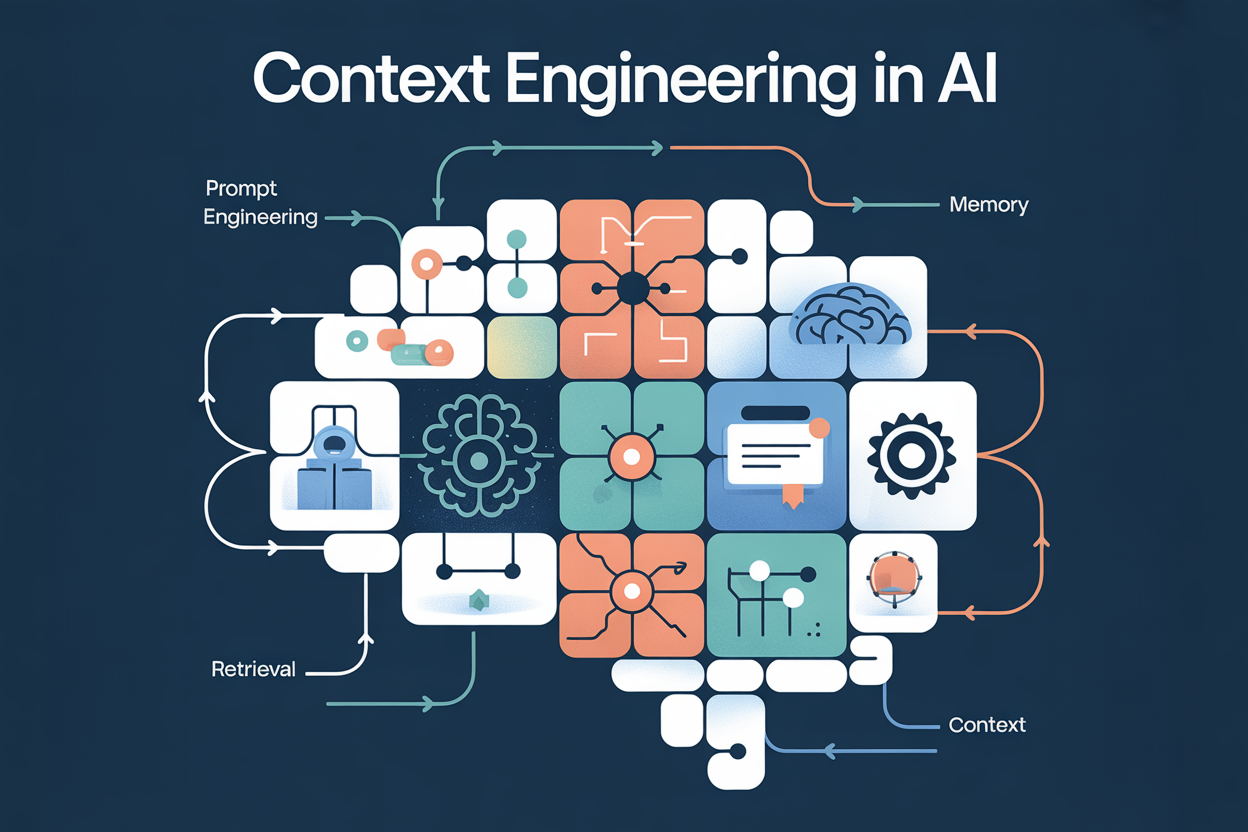
Context engineering refers to the discipline of designing, organizing, and manipulating the context that is fed into large language models (LLMs) to optimize their performance. Rather than fine-tuning the model weights or architectures, context engineering focuses on the input—the prompts, system instructions, retrieved knowledge, formatting, and even the ordering of information.
Context engineering isn’t about crafting better prompts. It’s about building systems that deliver the right context, exactly when it’s needed.
Imagine an AI assistant asked to write a performance review.
→ Poor Context: It only sees the instruction. The result is vague, generic feedback that lacks insight.
→ Rich Context: It sees the instruction plus the employee’s goals, past reviews, project outcomes, peer feedback, and manager notes. The result? A nuanced, data-backed review that feels informed and personalized—because it is.
This emerging practice is gaining traction due to the increasing reliance on prompt-based models like GPT-4, Claude, and Mistral. The performance of these models is often less about their size and more about the quality of the context they receive. In this sense, context engineering is the equivalent of prompt programming for the era of intelligent agents and retrieval-augmented generation (RAG).
Why Do We Need Context Engineering?
- Token Efficiency: With context windows expanding but still bounded (e.g., 128K in GPT-4-Turbo), efficient context management becomes crucial. Redundant or poorly structured context wastes valuable tokens.
- Precision and Relevance: LLMs are sensitive to noise. The more targeted and logically arranged the prompt, the higher the likelihood of accurate output.
- Retrieval-Augmented Generation (RAG): In RAG systems, external data is fetched in real-time. Context engineering helps decide what to retrieve, how to chunk it, and how to present it.
- Agentic Workflows: When using tools like LangChain or OpenAgents, autonomous agents rely on context to maintain memory, goals, and tool usage. Bad context leads to failure in planning or hallucination.
- Domain-Specific Adaptation: Fine-tuning is expensive. Structuring better prompts or building retrieval pipelines lets models perform well in specialized tasks with zero-shot or few-shot learning.
Key Techniques in Context Engineering
Several methodologies and practices are shaping the field:
1. System Prompt Optimization
The system prompt is foundational. It defines the LLM’s behavior and style. Techniques include:
- Role assignment (e.g., “You are a data science tutor”)
- Instructional framing (e.g., “Think step-by-step”)
- Constraint imposition (e.g., “Only output JSON”)
2. Prompt Composition and Chaining
LangChain popularized the use of prompt templates and chains to modularize prompting. Chaining allows splitting tasks across prompts—for example, decomposing a question, retrieving evidence, then answering.
3. Context Compression
With limited context windows, one can:
- Use summarization models to compress previous conversation
- Embed and cluster similar content to remove redundancy
- Apply structured formats (like tables) instead of verbose prose
4. Dynamic Retrieval and Routing
RAG pipelines (like those in LlamaIndex and LangChain) retrieve documents from vector stores based on user intent. Advanced setups include:
- Query rephrasing or expansion before retrieval
- Multi-vector routing to choose different sources or retrievers
- Context re-ranking based on relevance and recency
5. Memory Engineering
Short-term memory (what’s in the prompt) and long-term memory (retrievable history) need alignment. Techniques include:
- Context replay (injecting past relevant interactions)
- Memory summarization
- Intent-aware memory selection
6. Tool-Augmented Context
In agent-based systems, tool usage is context-aware:
- Tool description formatting
- Tool history summarization
- Observations passed between steps
Context Engineering vs. Prompt Engineering
While related, context engineering is broader and more system-level. Prompt engineering is typically about static, handcrafted input strings. Context engineering encompasses dynamic context construction using embeddings, memory, chaining, and retrieval. As Simon Willison noted, “Context engineering is what we do instead of fine-tuning.”
Real-World Applications
- Customer Support Agents: Feeding prior ticket summaries, customer profile data, and KB docs.
- Code Assistants: Injecting repo-specific documentation, previous commits, and function usage.
- Legal Document Search: Context-aware querying with case history and precedents.
- Education: Personalized tutoring agents with memory of learner behavior and goals.
Challenges in Context Engineering
Despite its promise, several pain points remain:
- Latency: Retrieval and formatting steps introduce overhead.
- Ranking Quality: Poor retrieval hurts downstream generation.
- Token Budgeting: Choosing what to include/exclude is non-trivial.
- Tool Interoperability: Mixing tools (LangChain, LlamaIndex, custom retrievers) adds complexity.
Emerging Best Practices
- Combine structured (JSON, tables) and unstructured text for better parsing.
- Limit each context injection to a single logical unit (e.g., one document or conversation summary).
- Use metadata (timestamps, authorship) for better sorting and scoring.
- Log, trace, and audit context injections to improve over time.
The Future of Context Engineering
Several trends suggest that context engineering will be foundational in LLM pipelines:
- Model-Aware Context Adaptation: Future models may dynamically request the type or format of context they need.
- Self-Reflective Agents: Agents that audit their context, revise their own memory, and flag hallucination risk.
- Standardization: Similar to how JSON became a universal data interchange format, context templates may become standardized for agents and tools.
As Andrej Karpathy hinted in a recent post, “Context is the new weight update.” Rather than retraining models, we are now programming them via their context—making context engineering the dominant software interface in the LLM era.
Conclusion
Context engineering is no longer optional—it is central to unlocking the full capabilities of modern language models. As toolkits like LangChain and LlamaIndex mature and agentic workflows proliferate, mastering context construction becomes as important as model selection. Whether you’re building a retrieval system, coding agent, or a personalized tutor, how you structure the model’s context will increasingly define its intelligence.
Sources:
- https://x.com/tobi/status/1935533422589399127
- https://x.com/karpathy/status/1937902205765607626
- https://blog.langchain.com/the-rise-of-context-engineering/
- https://rlancemartin.github.io/2025/06/23/context_engineering/
- https://www.philschmid.de/context-engineering
- https://blog.langchain.com/context-engineering-for-agents/
- https://www.llamaindex.ai/blog/context-engineering-what-it-is-and-techniques-to-consider
Feel free to follow us on Twitter, Youtube and Spotify and don’t forget to join our 100k+ ML SubReddit and Subscribe to our Newsletter.

Asif Razzaq is the CEO of Marktechpost Media Inc.. As a visionary entrepreneur and engineer, Asif is committed to harnessing the potential of Artificial Intelligence for social good. His most recent endeavor is the launch of an Artificial Intelligence Media Platform, Marktechpost, which stands out for its in-depth coverage of machine learning and deep learning news that is both technically sound and easily understandable by a wide audience. The platform boasts of over 2 million monthly views, illustrating its popularity among audiences.
[ad_2]
Source_link