📌 THE GIST
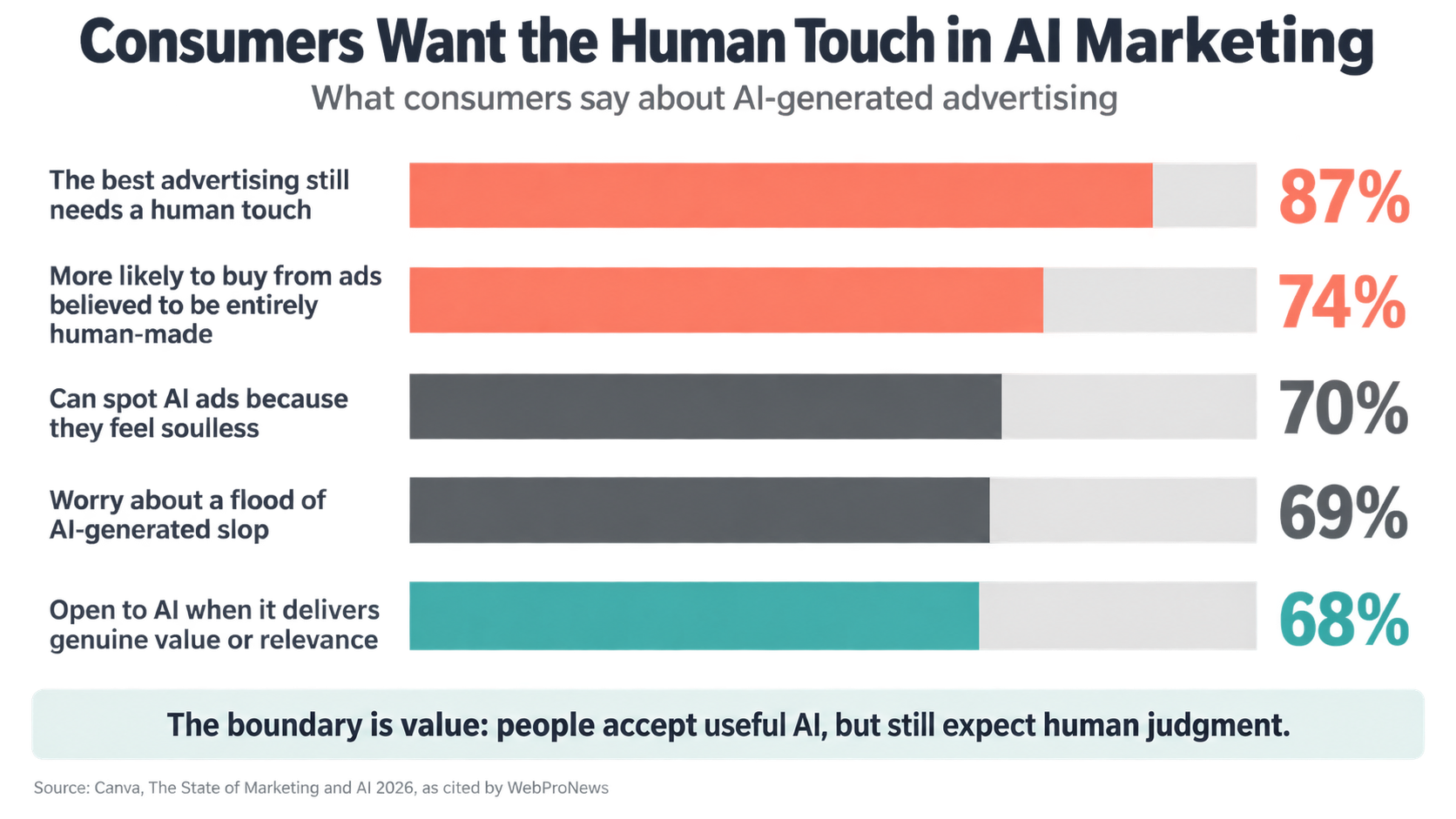
- Canva’s 2026 data found 74% of consumers prefer buying from brands that sound human — and 70% say they can already tell when content was AI-generated. That’s not a perception problem. That’s a revenue problem.
- This is the best competitive news small business owners have gotten in years. Large brands are scaling AI content. You can scale you. Your customers now have a measurably stronger preference for the one that sounds human.
- The DIYMarketers Soul Audit is a five-question check that keeps your voice in every piece of AI-generated content before it goes live. You get the time savings. You keep the soul.
I’m going to give you a stat. And I want you to tell me if you’re surprised or not. Here it is.
Seventy percent of consumers say they can spot AI-generated content. Seventy-four percent say they’re more likely to buy from brands that sound human. I found those numbers in Canva’s 2026 report at 11pm on a Tuesday — and I immediately started thinking about how to make AI content sound like you without throwing out the time savings. Because the answer is not to stop using AI. It’s to use it smarter. (Source: WebProNews / Canva 2026)
So, while most people are thinking “AI is a liability”, I’m thinking ” small business owners just got handed the single biggest competitive advantage over large brands they’ve had in a decade!”
Think about it! While big companies are cranking out AI content at scale. You can produce you at scale. Those are not the same thing — and your customers are now measurably better at telling the difference.
The only catch is you have to know how to use AI without letting it sand off everything that makes your business worth choosing. You need the time savings. You need the productivity. And you need to keep the soul that makes people pick you over the next person who does exactly what you do.
That’s what this article is about. I’m going to show you the fastest way to make AI content sound like you — without rewriting everything from scratch.
Here’s a real example.
I was reviewing a client’s newsletter last year. A bookkeeper, 22 years in business, more personality in one conversation than most brands manage in a decade. Her AI-generated newsletter opened with: “In today’s dynamic business environment, financial clarity is more important than ever.” I laughed. Then I felt bad for laughing. Then I fixed it.
She had the time savings. She’d lost the thing that made her worth hiring. Nobody had told her what to do with the AI output after it was generated. That gap is what the Soul Audit closes.
Why Your AI Content Sounds Like Everyone Else’s
AI tools are trained on enormous amounts of text from across the internet. When you ask an AI to write a LinkedIn post about cash flow, it pulls from thousands of pieces of content written about cash flow — and produces something that sounds like the average of all of them.
The average of all cash flow content is beige. It’s technically correct, reasonably structured, and completely forgettable. And here’s the kicker: your customers have been exposed to enough of it that they now recognize it on sight. That’s what the Canva data is measuring. It’s not that AI content looks different. It’s that it feels different — and the feeling it produces is “nobody specific wrote this for me.”
Your customers don’t hire beige. They hire you — because you said something that stuck, or explained something nobody else had, or caught a mistake they almost made. None of that comes from averaging the internet. The research confirms what most of us already suspected: human specificity is the thing that converts. SEO strategist Ann Smarty frames it this way: AI content trained on the internet produces the average of everything ever written on a topic — which is never the best answer for your specific customer.
⚠️ REALITY CHECK
Think about what this means at scale. Enterprise brands are running AI across every channel simultaneously — email, social, ads, website copy. The result is that everything sounds the same, from their subject lines to their Instagram captions. A small business owner who sounds like a real person is now the anomaly. Anomalies get remembered. Commodities get scrolled past.
Here’s the thing that makes this interesting for small business owners specifically: big brands with 50-person marketing teams are worse at sounding human, not better. HubSpot’s 2026 State of Marketing report found that standing out in an AI-saturated content feed is now the top challenge for marketing teams — and large brands are making it worse by scaling AI output without any voice filter. They have more AI content, produced faster, reviewed by committees who optimize for “on-brand” instead of “sounds like a real person.”
You have an asymmetric advantage. A solopreneur who shows up sounding like themselves in a sea of AI-generated sameness is memorable by default. But only if you show up sounding like yourself.
How to Make AI Content Sound Like You: The Soul Audit
The Soul Audit is not a rewriting exercise. It’s a diagnostic. You read the AI output, run it through five questions, and fix only what fails. Most pieces fail one or two questions — rarely all five. That means most of your editing is targeted, not total.
Run this before anything goes live: email, social post, blog section, website copy, ad.
Question 1: Would a stranger know this is from me?
Swap your logo for a competitor’s name. Read it again. Does anything change? If the answer is no — if the content would work as well coming from literally anyone in your industry — it failed Question 1.
The fix: Add one sentence that only you would write. Your opinion on why this matters. A specific outcome you’ve seen. A detail from your own experience. One sentence is enough to anchor the piece to a real person.
Question 2: Did I have an opinion here — or did I report?
AI summarizes. It’s excellent at collecting information and presenting it neutrally. Your customers don’t need neutral. They need someone to tell them what to do with the information.
Read through the AI draft and find the place where you’d naturally say “and here’s what I think about that.” If the draft never gets to that place, add it. One clear opinion per piece — not a disclaimer, not “it depends” — an actual take.
Question 3: Is there anything in here only I could have written?
This is the specificity test. AI cannot know what happened in your business last Tuesday. It cannot know the name of the client who taught you something important. It cannot know the mistake you made in 2019 that changed how you price your services.
One human data point per piece breaks the pattern entirely. It doesn’t need to be dramatic. “I tested this with three clients in Q2” is enough. “My first attempt at this was a disaster” is enough. One specific, verifiable detail that only you possess.
Question 4: Does this sound like something I’d say out loud?
Read it aloud. Not in your head — out loud. The sentences that make you stumble or wince are the ones your readers will skip. AI defaults to complete, grammatically correct sentences that nobody ever speaks.
The fix is simple: wherever you wince, rewrite in the first person with your actual vocabulary. If you’d never say “leverage synergistic opportunities” in a real conversation, cut it. Write what you’d say instead.
Question 5: Does this use my customer’s language or marketing language?
Your customers describe their problems in specific words — words they’ve used in emails to you, in reviews, in conversations over coffee. AI defaults to category language: “optimize your workflow,” “enhance customer engagement,” “streamline your operations.”
Go back to your last ten client emails or your most recent reviews. Pull out the phrases your actual customers used. Replace the category language with those phrases. This is the fastest way to make AI content resonate — because you’re literally using your audience’s words back at them.
💡 STRATEGY ALERT
Before you prompt AI to write anything for your business, paste in three to five real customer reviews, emails, or testimonials and say: “Write in the voice and language of these customers, not in marketing voice.” The output shifts immediately — and you’ll spend less time fixing it afterward.
How to Use AI for the Right Jobs (So the Soul Audit Is Easier)
The Soul Audit gets faster when AI is doing the right work to begin with. The problem most small business owners have is using AI as a ghostwriter — asking it to produce finished content from scratch. That’s the hardest use case to fix.
AI is excellent at structure, research, and first drafts. You are excellent at truth, specificity, and opinion. Split the jobs accordingly.
Here’s how to think about the workflow:
Give AI the facts, not the voice. Instead of “write me a LinkedIn post about cash flow,” try “here are three facts about cash flow I want to make a point about — structure them into a LinkedIn post I can edit.” You edit less when the raw material is yours.
Use AI to find the gaps, not fill them. Paste a draft you wrote and ask AI: “What questions does a skeptical small business owner have after reading this that I didn’t answer?” Then answer those gaps yourself. You keep the voice. AI finds what’s missing.
Let AI write the boring parts. Transition sentences, subheadings, meta descriptions, email subject line variations — these are high-volume, low-voice tasks where AI saves real time without touching your brand personality.
If you’re serious about understanding workflow thinking for your business, this is exactly the kind of task map that makes AI a tool instead of a liability. The goal is always staying in control of the output, not surrendering it to the prompt.
What Human Marketing Looks Like Side by Side
Theory is useful. Examples are better. Here’s the same message written two ways.
| AI Default Draft | After the Soul Audit |
|---|---|
| “In today’s competitive landscape, consistent follow-up is essential for converting leads into loyal customers.” | “I followed up with a prospect six times over four months before she became a client. Most people would have stopped at two. That client referred three more.” |
| “Leveraging social proof can significantly enhance your brand’s credibility and customer acquisition efforts.” | “One Google review from a happy client has sent me more business than six months of LinkedIn posts. I’m not saying don’t post. I’m saying ask for the review.” |
| “Effective email marketing requires a strategic approach to segmentation and personalization to maximize engagement.” | “My open rates went from 18% to 34% when I stopped writing emails to ‘my audience’ and started writing them to one specific person I knew.” |
Same message. One is from the internet. One is from a person. Your customers can tell the difference — and according to Canva’s data, three-quarters of them are more likely to buy from the one that sounds human.
This is not a skill most people have to learn from scratch. It’s a habit of asking “what do I know about this?” before hitting publish. The reason marketing keeps failing for so many small business owners isn’t the tactics — it’s that the content never sounds like it came from someone with real skin in the game.
How to Train AI to Write More Like You Over Time
The Soul Audit tells you how to make AI content sound like you right now. This section is the longer-term investment — training your AI tools to produce output that needs less fixing from the start.
Most AI tools accept a “system prompt” or custom instruction that runs before every response. Use it. Here’s what to put in yours:
Write out three to five sentences in your own voice on a topic you know well. Describe your audience in the words they use about themselves — not “small business owners” but “people who are doing everything themselves and don’t have time to waste.” Add two or three phrases you’d never say (mine include “leverage,” “synergy,” and “in today’s digital landscape”). Tell the AI your opinion on one contested topic in your field.
That’s your voice document. Paste it into your AI tool’s custom instructions and update it every few months as your voice evolves. The output won’t be perfect, but it’ll be closer — and the Soul Audit will take two minutes instead of five.
If you want to go deeper on which AI tools work best for content creation, that comparison breaks down the specific features that matter for solopreneurs. But the voice document works in all of them.
🛑 DON’T COPY BLINDLY
Consumer ability to detect AI content is getting sharper every quarter — not slower. Canva’s 2026 data is a snapshot, not a ceiling. The brands winning right now are building the habit of sounding human before they need to, not after the backlash hits their engagement numbers. Don’t wait for the data to get worse to take this seriously.
The Fastest Way to Know If Your Current Content Passes
You don’t need a new tool for this. You need two things you already have: your last ten pieces of content and an honest answer to one question. Content Marketing Institute consistently identifies voice consistency as one of the highest-leverage factors in content performance — and the one most often skipped when AI enters the workflow.
Pull up your last ten posts, emails, or articles. Read the first sentence of each. If you covered the author’s name, could you tell who wrote it? If the answer is no more than twice out of ten, your content has a voice problem — and AI didn’t cause it, but AI is making it worse.
The fastest fix: pick the one piece that sounds most like you. Read it. Notice what’s different. That’s your voice. Apply it to the rest.
If you’ve never done a marketing audit on your content, this is a good place to start. Voice consistency is one of the metrics that almost never makes it onto a marketing dashboard — and it’s one of the ones that matters most for whether a stranger decides to trust you.
The most common AI marketing mistake small business owners make isn’t using AI — it’s using AI and forgetting to show up in the output. The Soul Audit is how you make sure that doesn’t happen.
Frequently Asked Questions
How do I know if my AI-generated content sounds like me?
The fastest test is to cover the author’s name and ask a colleague who knows you to read a piece of your AI-generated content and answer one question: “Does this sound like me?” If they hesitate, it doesn’t. A more systematic approach is to run the DIYMarketers Soul Audit on every piece before publishing. Ask whether a stranger would know the content is from you, whether you stated an opinion rather than reporting facts, whether there is a specific detail only you possess, whether it sounds like your voice when read aloud, and whether it uses the language your customers use. Pass all five questions and publish. Fail any one and fix that specific gap before it goes live. Most pieces fail one or two questions, not all five, so the edit is usually targeted rather than a full rewrite. Five minutes per piece is a reasonable average.
Is it wrong to use AI for my marketing content?
AI is a practical necessity for solopreneurs running everything themselves, and using it for marketing content is not a problem. The error is publishing AI output without filtering it through your own voice, opinion, and experience first. Canva’s 2026 data found that 74% of consumers are more likely to buy from brands producing human-made content, and 70% say they can identify AI-generated ads on sight. That preference is about trust, not technology. Your customers want to hear from a real person who understands their specific situation. AI, used with the right process, helps you produce more content in less time. The Soul Audit is that process. It keeps your voice in the output even when AI wrote the first draft, so you get the time savings without sacrificing the relationship your brand has built with your audience.
What types of content are most damaged by AI detection?
Short-form, high-trust content suffers most when it sounds AI-generated. Email newsletters, LinkedIn posts, and one-on-one follow-up messages are the formats where your audience expects to hear a real person, and the gap between “sounds human” and “sounds like a robot” is most visible. Longer content like blog articles has more room for personality to emerge across multiple sections, so a few generic paragraphs are easier for readers to absorb without losing confidence in the source. The places to protect most carefully are your email subject lines, the opening sentence of any piece of content, and any section where you name the reader’s specific problem. These are the trust-building moments. When they sound like averaged internet content, readers stop, notice, and often leave. When they sound like you, readers lean in and keep reading through to the offer.
How do I train AI to write more like me?
Create a voice document and paste it into your AI tool’s custom instructions before your next session. Write three to five sentences in your natural voice about a topic you know well — something you have a real opinion on. Describe your audience in the specific words they use to describe themselves and their problems, not in marketing category language. List two or three phrases you would never say in real conversation. State your actual position on one debated topic in your field. This gives the AI a working model of your voice before it produces a single word. Most major AI tools, including ChatGPT, Claude, and Gemini, support custom instructions that run at the start of every session. Update the document every few months as your voice evolves. The output still needs the Soul Audit, but it will require less revision than output generated from a blank prompt with no voice context at all.
Does AI-generated content hurt my search rankings?
Google’s official position is that AI-generated content is not penalized provided it is helpful, original, and produced for readers rather than to manipulate search rankings. Google’s E-E-A-T framework makes the standard explicit: experience, expertise, authority, and trust — not the production method. The determining factor is not whether a tool was involved in writing. The determining factor is whether the content demonstrates real expertise, experience, authority, and trustworthiness — what Google formally calls E-E-A-T. AI content that passes the Soul Audit, with your specific experience and opinion and your customers’ language woven through it, generally satisfies that standard. Generic AI output that reads like averaged internet content typically does not, and it tends to perform poorly in search over time regardless of how it was produced. The practical takeaway: make your content specific, make it useful to your actual audience, and make sure it reflects your genuine point of view. That is the standard that wins in both search and AI visibility.