Reading Time: 18 minutes
If you’ve sat through a vendor demo this year, you’ve heard “AI agent,” “agentic AI,” and “AI decisioning” used interchangeably, often to describe three completely different pieces of software. This guide aims to fix that, and then take you somewhere more pragmatic than a glossary. We’ll walk through what agentic AI actually is, how it’s different from generative AI and traditional marketing automation, and how agentic marketing works mechanically: guardrails, tool-calling, MCP, feedback loops, and all; using how it’s already running in production today, including MoEngage’s own Merlin AI agents and per-customer decisioning engine.
You’ll get the real benefits alongside the honest catches that come with each one, a look at how personalization, real-time campaign optimization, and churn prevention actually play out across one live campaign day, and the 2026 market data: the acquisitions, the martech spend, the decisioning volume already running at scale. Hard data that shows this isn’t hype. By the end, whether you’re an associate running your first pilot or a leader signing off on governance, you’ll know how to actually build, run, and manage an agentic marketing campaign without losing control of it.
Moving Beyond the AI Word Salad
The word “agent” is used to describe at least four different things, sometimes in the same sentence. A subject-line generator is an “agent.” A chatbot is an “agent.” A system that autonomously decides which of 40,000 customers gets which offer, on which channel, at which hour, is also an “agent.” And this is more than a semantics problem or a buying-decision problem. These tools have wildly different risk profiles, oversight needs, and ROI timelines, and if you can’t tell them apart, you can’t evaluate them properly.
The terminology pile-up, in the order marketers actually encounter it:
- RPA / rules-based automation: The “if this, then that” layer marketing has run on for a decade. If a cart is abandoned for 24 hours, send email #1. This is the foundation everything else got built on top of.
- Chatbots: Conversational interfaces that respond to a user in the moment. Even the LLM-powered ones are largely reactive: they answer what’s asked, in a single back-and-forth, and stop when the conversation ends.
- Copilots: Tools that assist a human who is still doing the task. A copilot drafts five subject lines, or suggests a journey structure, but a person reviews, edits, and hits send. The copilot never acts on its own.
- AI decisioning: A system that makes an ongoing optimization decision per customer: which offer to show, which channel to use, what time to send. It’s often continuously learning from outcomes, but it’s usually deciding within a structure a human already built (the campaign, the journey, the eligible offers). Know more about AI Decisioning here.
- Agentic AI / AI agents: Systems that are handed a goal, then independently plan multiple steps, pull from multiple data sources or tools, execute those steps, watch what happens, and adjust with a human checking in periodically rather than approving every move.
The confusing part is that these aren’t neat, separate boxes; they overlap and stack. A single “agent” in a modern platform might use a decisioning model inside a broader agentic workflow. That’s exactly why a clean way to sort them matters more than a glossary.
Here’s that logic as a decision tree, a quick heuristic anyone on your team can run against a vendor pitch.
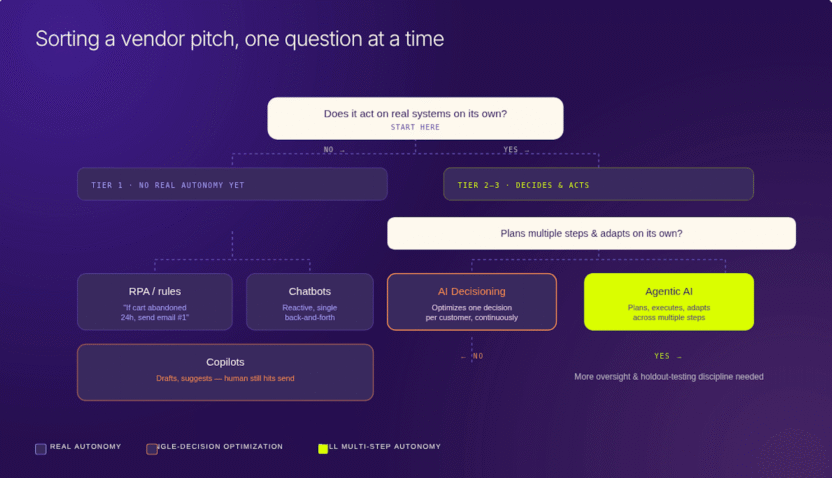
Gray marks the “no real autonomy yet” tier, amber marks single-decision optimization, and teal marks full multi-step autonomy. The further down the tree a tool lands, the more oversight and holdout-testing discipline it needs.
Why this confusion is actually costing marketing teams time
This isn’t just a pedantic naming issue; it has a real cost. When “agent” gets applied to anything with an LLM call, teams end up:
- Evaluating the wrong thing in vendor demos. A team expecting agentic planning gets a copilot, or vice versa, and doesn’t find out until three months into implementation, when the governance and measurement needs turn out to be completely different from what they scoped for.
- Under- or over-building oversight. A copilot needs a review step. An agentic system needs guardrails, an activity log, and a holdout group; treat the two the same, and you either slow down a copilot with unnecessary approval gates or let an agent run unsupervised because it “felt like” the assistive tools you’re used to.
- Losing the ability to prove ROI. If nobody can say precisely which system was live during a campaign, it’s very hard to later prove whether the lift came from better decisioning, better creative, or just a seasonal bump.
The industry itself is shifting terminology in real time. Recent platform moves have specifically framed the change as going from rules-based automation toward systems that observe customer journeys in real time and adapt strategies dynamically, distinct from the older copilot and chatbot categories. That’s a useful signal: when a platform explicitly draws this line in its own positioning, it’s usually because the underlying architecture actually earns the distinction, not just the marketing copy.
Key Takeaways
- “AI agent” isn’t one thing. Chatbots, copilots, AI decisioning, and agentic AI sit on a spectrum of autonomy, and mixing them up leads to the wrong oversight and the wrong ROI story.
- The market is moving from segment-based blasts to per-customer decisioning, and this is already shipping. Inside MoEngage’s Merlin AI agents and decisioning engine (now powered by Aampe), and across the broader MarTech stack.
- Running an agent-led campaign safely means setting a goal, defining guardrails, connecting clean data, and testing against a holdout group, not just switching a toggle on.
- Whether you’re an associate running your first pilot or a leader signing off on governance, the same core question applies: how much is this system deciding on its own, and what’s watching it while it does?
What Even is Agentic AI?
Agentic AI refers to AI systems capable of multi-step reasoning and autonomous action, perceiving their environment, deciding what to do, executing across connected tools, and adapting the approach, with only periodic human direction rather than approval at every step.
This isn’t a marketing-specific idea. The same architecture shows up wherever a system gets handed a goal instead of a script – a coding agent told to fix a bug that reads the codebase, writes a fix, and runs the tests on its own; a research agent given a question that pulls sources, cross-checks them, and revises its own answer. Marketing is one domain this shows up in, not the origin of it.
What Does Agentic AI Mean for Marketing?
It happens to be an unusually good fit, because a marketing campaign already has the three ingredients an agent needs to be useful rather than reckless: a clear goal (for example: reduce cart abandonment), a set of tools to act through – the ESP, the CRM, the ad platform, and a fast, measurable feedback loop, since opens, clicks, and conversions come back within hours, not months. That combination is a big part of why agentic AI reached production in marketing faster than in most other business functions: a team can point an agent at a goal and get a real answer about whether it worked within days.
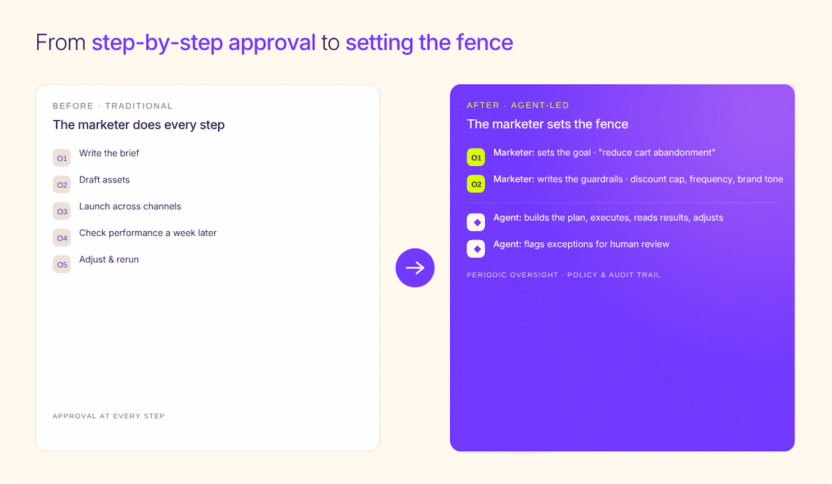
In practice, that changes the shape of the work. Instead of a human building the campaign brief, drafting the assets, launching them, and manually checking performance a week later, the agent runs that entire loop itself: building the plan, executing it across channels, reading the results, and adjusting the approach, while the marketer’s job shifts to setting the goal and the guardrails up front, rather than approving each step along the way.
What Makes an AI System Agentic?
Three things have to be true at once, and most of the confusion in the market comes from tools that only have one or two of them.
First, it needs a goal, not a script.
“increase repeat purchase rate,” not “send this email at this time.”
Second, it needs to actually act, not just suggest.
Able to call real tools and touch real systems rather than hand a draft to a human.
Third, it needs to adapt based on outcomes without being re-prompted.
Noticing a channel underperforming and shifting strategy on its own, rather than waiting for a human to notice and issue a new instruction.
The Difference: Agentic vs Generative vs Traditional AI
How is Agentic AI Different From Generative AI and Traditional Marketing Automation?
These three get conflated constantly because a real deployment often uses all three at once: generative AI writing the copy, traditional automation handling the guardrail logic, agentic AI orchestrating the whole thing. Here’s the split:
| Parameters | Traditional Marketing Automation | Generative AI | Agentic AI |
| What it does | Executes a fixed rule | Creates content on request | Plans, acts, and adapts toward a goal |
| Trigger | Pre-set condition (e.g., cart abandoned 24hrs) | A prompt from a human | An objective, revisited continuously |
| Adaptation | No. Same output, every time | No, only as good as the prompt each time | Yes, changes its own approach based on results |
| Approval | Yes, but only the one scripted action | No, output goes to a human first | Yes, across multiple steps |
| Example | “Send email #1 after 24hrs” trigger | Drafting subject lines, ad copy, or generating images on request | Running and adjusting a full reactivation campaign |
A Quick Recap: Key Features of Agentic Marketing
- Goal-directed, not script-directed. You give it an objective, not a step-by-step instruction set. It decides the steps.
- Multi-step planning and execution. It chains actions across systems: pull data, pick a channel, generate creative, send, monitor, rather than performing one isolated task.
- Cross-system tool-calling. Through protocols like MCP (Model Context Protocol), the agent can actually reach into your CRM, ESP, or ad platform and act, not just generate text describing what it would do.
- Continuous adaptation. It watches outcomes and changes course mid-campaign: pausing an underperforming channel, shifting budget, adjusting timing without waiting for a scheduled review.
- Governed autonomy, not unsupervised autonomy. It operates inside guardrails a marketer sets, like budget caps, brand voice, frequency limits, and logs what it did, so oversight happens through policy and audit trail rather than per-action approval.
Let’s Talk Benefits. Why Agentic Marketing?
5 Key Benefits of Agentic Marketing
Handing decisions to an agent isn’t a technical upgrade so much as a redistribution of who does the deciding, where the team’s hours go, and where the actual proof of results comes from. Worth going through each benefit slowly, because each one also has a version that doesn’t materialize unless something specific is true first, and knowing that condition is most of what separates a team that gets real lift from one that just bought expensive software.
Personalization at a scale no team could hand-manage.
Picture the “high value” bucket again: 50,000 people, one message, one send time. An agent doesn’t personalize the bucket; it replaces the bucket. Aampe’s engine, now inside MoEngage, runs hundreds of millions of individual decision loops rather than a handful of segment rules, which in practice means the person who opens email at 7 am and ignores push gets a genuinely different plan from the person who does the opposite, even if both were sitting in the same segment yesterday. The catch: this benefit is entirely downstream of data quality. An agent making a per-customer decision on stale or fragmented data is not more personal; it’s confidently wrong at a larger scale than a human ever could be.
Faster response to real-time signals.
A weekly campaign review catches a problem, on average, about a week after it started. An agent watching the same signals can reallocate budget, swap the channel, or pause a losing creative the same day a metric turns – the difference between noticing a push notification is cratering open rates on day one, instead of finding out in Friday’s report after a week of wasted spend. The catch here mirrors the first one: speed without a guardrail just means mistakes happen at machine speed too. That’s exactly why the guardrail layer isn’t optional scaffolding.
Frees marketers for judgment, not manual execution.
Before: An associate spends Tuesday morning manually rebuilding a journey in a canvas tool because a promotion changed.
After: the agent updates the journey; the associate spends Tuesday morning deciding which promotion the brand should even be running, and reviewing the two exceptions the agent flagged instead of the two hundred sends it handled on its own.
That reallocation is real but only if leadership actually lets the freed-up hours go toward strategy instead of quietly refilling them with more manual review tickets, which is the single most common way this particular benefit gets promised and never delivered.
Continuous optimization instead of “set and revisit quarterly.”
A manual A/B test needs a large enough sample and a human free to read the results, often a two-to-three-week cycle, minimum. A decisioning or agentic layer runs that comparison continuously in the background and shifts traffic toward the winner without waiting for someone to open a dashboard. Worth keeping the nuance intact: “continuous” doesn’t mean “correct.” It still needs a holdout group to prove the lift is real and not just novelty or a seasonal blip – a discipline that’s easy to skip precisely because the system feels like it’s always working.
Better auditability, if it’s actually built to have any.
The old failure mode: three years from now, nobody on the team remembers who configured the automation that’s still quietly emailing a discount code to churned users. An agent with a proper activity log doesn’t have that problem – every decision it made, and the reasoning behind it, is queryable after the fact. But this benefit is conditional on the platform exposing that log to the marketer, not just to an engineering team. If you can’t pull up why an agent picked a specific offer for a specific customer last Tuesday, you don’t actually have the auditability benefit; you just have a black box with better marketing copy than the one it replaced.
How Does Agentic AI in Marketing Work?
Mechanically, the piece that changed recently is what lets an AI actually do something instead of only describing what it would do. For the last few years, an LLM was a very good copywriter locked in a room. It could draft an email or suggest a subject line, but it couldn’t check your CRM, see if a customer already got three messages this week, or press send. A human still carried its output into the real systems.
MCP (Model Context Protocol) is the standard that changes that. Think of it less like an upgrade to the copywriter’s skills and more like handing them a set of keys to every other room in the building – the CRM, the ESP, the ad platform – that it didn’t have access to before.
Instead of writing “I’d suggest sending this to customers who haven’t purchased in 30 days” and waiting for a person to go check who that actually is, the model opens that door itself, pulls the real list, checks who’s already been messaged this week, and acts. That’s the actual difference between a Copilot suggesting a message and an agent that checks eligibility, pulls recent activity, picks the channel, and sends it. Not a smarter model, but a model with keys.
Knowing MCP exists matters less than seeing what it makes possible day to day, so here’s what a working setup actually looks like, walked through as one campaign rather than four abstract terms.
Say the goal is “reduce cart abandonment among high-value customers.”
That’s the first moving part – a goal, not a script, sitting above everything else. Underneath it sit the guardrails: what the agent is allowed to touch and how far it can go, set by a marketer before anything runs.
- “Never discount more than 15%.”
- “Never message someone twice in 24 hours”
- “Always match the brand tone”
Guardrails aren’t a formality here; they’re the only reason a goal this open-ended is safe to hand off at all. Without them, “reduce abandonment” could technically get satisfied by blasting everyone a 50% coupon every hour, which would hit the number and torch the brand doing it.
With the goal set and the fence built, the agent needs tool access, i.e., the actual keys, via MCP or an equivalent connection, to the CRM (who abandoned a cart and when), the ESP or push provider (how to reach them), and the offer engine (what it’s allowed to send). This is the part that turns “the agent decided X” into “the agent did X.” Without it, everything upstream is still just a well-reasoned suggestion sitting in a report nobody acts on.
Last is the feedback loop. How the agent reads what happened: did the message get opened, did the customer come back, did the discount get redeemed, and decides what to try differently next time. This is the part that actually makes it “agentic” rather than “automated.” A rules-based system keeps sending the exact same message forever regardless of whether it worked. An agent reads the outcome and lets that outcome change its next move.
Put together, none of these four parts do much alone.
- A goal without guardrails is reckless.
- Guardrails without tool access are just policy nobody’s enforcing.
- Tool access without a feedback loop is automation wearing an agent costume.
- A feedback loop without a clear goal has nothing to actually optimize toward.
That’s also the practical reason to know these four apart even if you never touch the MCP layer yourself: when a vendor pitches you an “agent,” these are the four things worth asking about.
A tool missing one of them isn’t broken. It’s just not actually agentic. Yet.
How Can Agentic AI Be Used in Marketing?
Six bullet points about personalization, optimization, and orchestration would technically answer this question and put every reader to sleep doing it. So here’s the more honest version: on any real campaign day, all of it is happening at once, stacked on top of each other, mostly invisible to the marketer who set it in motion.
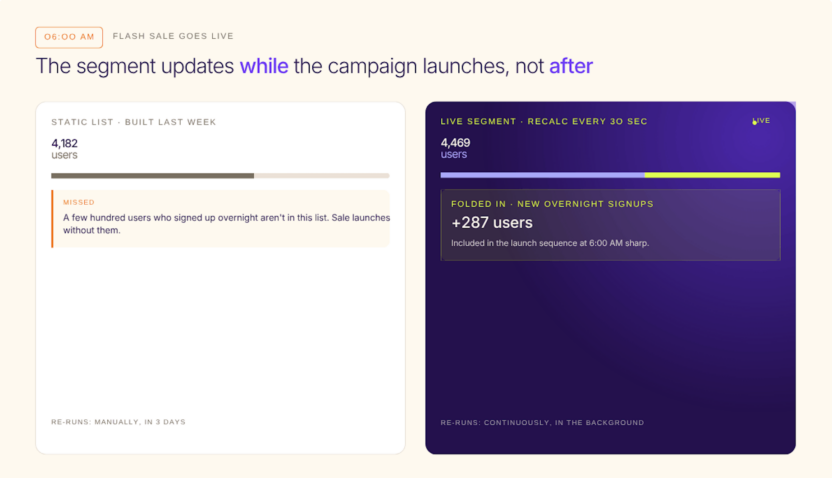
6:00 AM.
A flash sale goes live. Overnight, a few hundred people downloaded the app and signed up, invisible to any segment built before midnight. A static “engaged users” list from last week doesn’t know they exist. This is dynamic audience segmentation at work: an agent recalculating audiences continuously does know, and folds them into the launch the moment it starts, instead of three days from now when someone reruns the segment query.
9:15 AM.
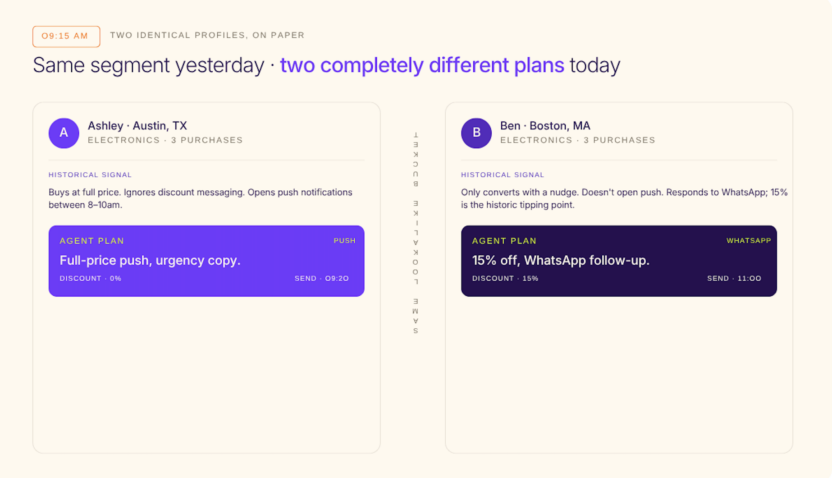
Two customers look nearly identical on paper: same city, same product category, similar purchase history. One gets a full-price push with urgency copy, because their history shows they buy without a discount. The other gets 15% off over WhatsApp, because that’s the channel they actually open and the price point that’s historically moved them. Same sale, two completely different plans, decided per person rather than per lookalike bucket. This is personalized customer engagement, the literal job of something like MoEngage’s Offer Decisioning running underneath.
11:40 AM.
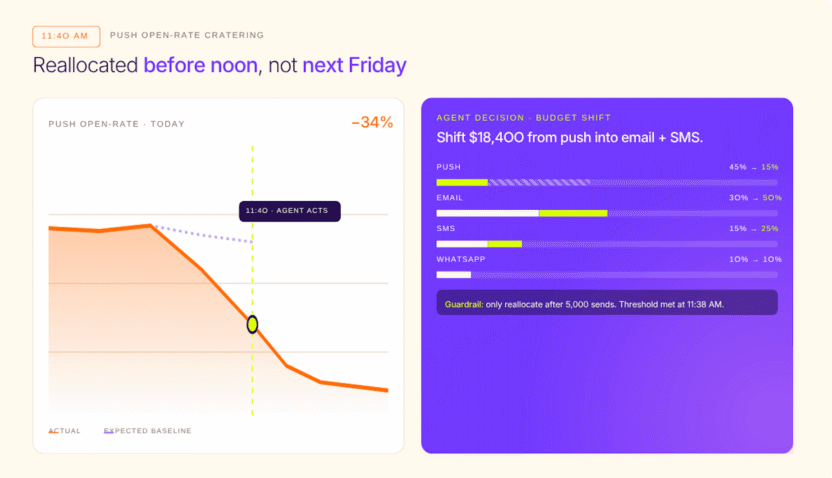
Push open rates start sliding, not particularly because the offer’s bad, but because three other apps on everyone’s phone are also blasting notifications this morning, and push as a channel is getting buried in the noise. A weekly report would catch this Friday, well after the sale’s over. This is campaign optimization in real time: an agent watching the same numbers reallocates spend toward email and SMS before noon, while there’s still a sale left to save. The catch worth keeping here: real-time only works past a minimum sample size. An agent reacting to the first fifty sends is reacting to noise, not signal, which is exactly why this kind of reallocation needs a guardrail that says “don’t shift budget until this many events have happened.”
1:20 PM.
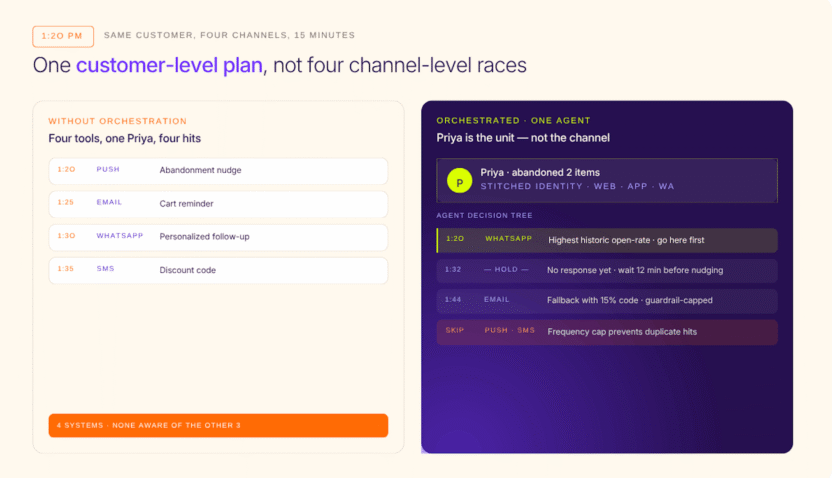
A customer adds two items to her cart, browses away, and doesn’t buy. Over the next fifteen minutes, four separate channel tools each independently decide it’s their job to bring her back: push fires an abandonment nudge at 1:20, email queues its own cart reminder five minutes later, WhatsApp sends a personalized follow-up at 1:30, and an SMS discount code lands by 1:35. Four systems, none aware the other three already fired, all converging on the same person about the same two items within a single quarter-hour.
This is where omnichannel journey orchestration comes into play. One agent treating the customer (not the channel) as the actual unit it’s coordinating, instead of four channel-specific rules each independently declaring victory. The catch: it’s only as good as the identity resolution underneath it. If the same person looks like three different profiles across web, app, and WhatsApp because the data isn’t stitched together, “one journey per customer” is a slide in a deck, not something actually happening this afternoon.
3:00 PM.
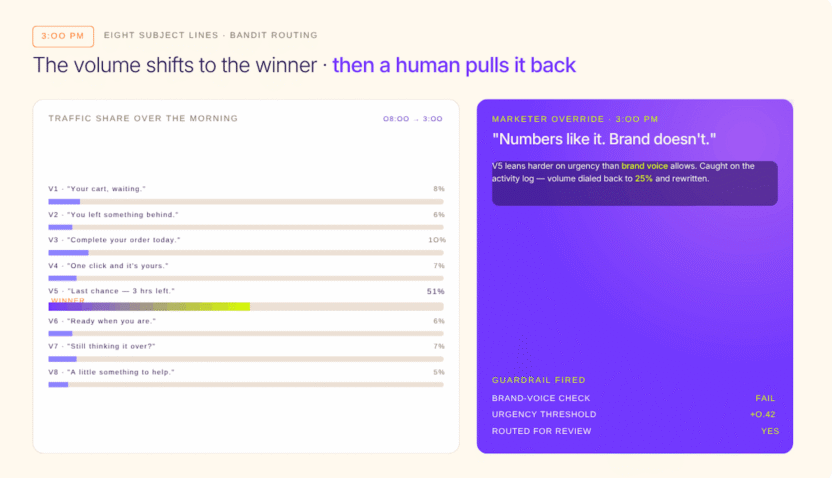
Eight subject line variants have been live since launch, and by mid-afternoon a bandit algorithm has already shifted most of the volume toward the best performer. No one waited two weeks for a clean A/B readout. This is campaign content testing running continuously instead of on a schedule. The winning line, though, leans harder into urgency than brand guidelines usually allow. A marketer catches it on the activity log and dials it back, a reminder that “the numbers like it” and “we should send it” aren’t always the same sentence, and that’s exactly the kind of call a guardrail exists to force back to a human.
6:00 PM.
Buried inside all this sale traffic, a handful of customers who bought early are quietly showing an unrelated signal: session frequency dropping, the kind of pattern that’s historically preceded a cancellation. This is churn prevention and retention happening in the background of an entirely different campaign. The same agent stack watching sale performance is also watching this, and instead of adding more sale noise to an already-fatigued customer, it queues a separate, quieter retention play for after the sale winds down.
9:30 PM.
The sale closes. What gets handed to the marketing lead the next morning isn’t a vague “it went well”, rather an activity log: which customers got which offer, which channel got more budget and when, which creative variant won and why it got flagged, which early churn signals got caught mid-sale instead of a month later. Not a black box with a nice dashboard on top of it.
None of this was six separate features switched on one at a time. It was one system making dozens of small decisions simultaneously, across personalization, spend, channel, creative, and retention inside the guardrails a human set that morning. That’s really the whole pitch, and also the whole risk. The skill in running one of these isn’t picking which single use case to try first. It’s building guardrails tight enough that this many decisions, happening this fast, add up to a good sale instead of a chaotic one.
Agentic AI Marketing Trends in 2026
Zoom out to the market level, and the story isn’t “adoption is rising” – every industry report says that about everything. The more useful story is what’s actually being bought, at what price, and what that buying pattern reveals about where marketing leaders think the real value sits.
The tool count barely moved, and that’s the least interesting number in it.
According to the State of Martech 2026 report, published by Scott Brinker of chiefmartec and Frans Riemersma of MartechTribe, the landscape grew from 15,384 tools in 2025 to 15,505 in 2026 – a net gain of just 121, or 0.79%, the flattest year-over-year growth in the report’s 15-year history.
But that flat headline is hiding real churn: 1,488 new tools were added while 1,367 were removed in the same period – nearly 2,900 tools changing state under a number that looks like nothing happened. Brinker’s own framing is the useful bit here: the landscape is a river, not a lake. A flat total doesn’t mean saturation, it means point tools are quietly getting swapped out for AI-native replacements, category by category, faster than the net number lets on.
Decisioning infrastructure has become the thing platforms buy rather than build.
In a single stretch this year, MoEngage acquired Aampe, BlueConic acquired Blueshift, and Dotdigital acquired Alia Software (completed March 2026, reportedly for up to $60 million). All three deals share the same rationale in how the acquirers described them: not a feature bolt-on, but an agent or decisioning engine that decides what to say, on which channel, and when, replacing static triggers with something that acts per customer. The catch worth naming: an acquisition doesn’t mean the capability is instantly available to every customer on that platform. If your renewal is coming up, the fair question to a vendor citing one of these deals isn’t “did you acquire a decisioning company.” It’s “is it live in my instance yet, or still being integrated?”
AI-native martech is pricing in a real premium, not just a marketing bump.
Per a MarTech SaaS M&A and Venture Capital analysis covering 170+ deals and 80+ funding rounds from January 2025 through May 2026, traditional marketing automation companies transacted at a median M&A revenue multiple of 3.8x (actually below the broader SaaS median)
While AI-native martech companies commanded a median of 7.8x in M&A, and as high as 14.0x in VC rounds. That’s roughly double the multiple for comparable revenue, which is buyers pricing in a belief that agentic and decisioning capability is durable differentiation, not a coat of paint. The catch: a premium multiple on the vendor side doesn’t automatically mean a premium outcome on your side. It means you’re now evaluating a company that’s under real pressure to prove the AI story was worth what they paid for it.
Per-customer decisioning already cleared the pilot stage months ago.
This isn’t a future-state claim: by MoEngage’s own account following the Aampe acquisition, the combined platform runs hundreds of millions of individual per-customer agents and processes more than 200 billion decisions every week, in production, across brands like Grab, Swiggy, and Taxfix. Whatever skepticism is left about whether “per-customer decisioning” is real or just a pitch deck concept, the scale here settles that specific question. It’s operating at a volume no human team could replicate, today, not eventually.
The most useful framing to actually plan around: AI is exposing martech complexity, not removing it.
That’s Brinker’s own read on 2026, and it’s a genuinely useful check on the optimism elsewhere in this list as more of the stack becomes AI-managed; the data fragmentation and governance gaps that were always there stop being background debt and start directly limiting what an agent can safely be trusted to do. A tool count flattening and a wave of decisioning acquisitions both sound like progress. Whether that progress reaches your team specifically still depends on the boring stuff (clean data, clear guardrails) that no acquisition fixes on its own.
Concluding, Not Summarizing:
Somewhere in the next twelve months, one of your competitors is going to hand an agent a goal instead of a task list, and the campaign it runs is going to out-personalize, out-react, and out-optimize whatever your team built by hand that quarter. That’s not a prediction dressed up as marketing copy, it’s just what happens when hundreds of millions of agents are already processing 200 billion decisions a week in production, on someone else’s stack, while yours is still waiting on the weekly reports. The question was never really “should we do this.” The market already answered that one. The only question left is who’s building the guardrails on purpose, and who’s finding out what they should have been after something’s already gone wrong.
So here’s the advice, and it fits in one sentence: pick the smallest goal you can defend to a skeptical CFO, write down what the agent is not allowed to do before you write down what it should, and let the first campaign be boring enough that nobody would notice if it failed quietly. Boring is the point. A well-fenced pilot that works is worth more than an ambitious one that needs an apology in month two.
The teams running this well a year from now won’t be the ones who moved first. They’ll be the ones who can say, the first time something goes sideways, exactly which guardrail caught it and exactly why they’d built that one in particular. It’s a discipline, and it’s available starting with the very next campaign brief you write.
If you’d rather see that discipline already built into the platform instead of assembled by hand, MoEngage’s Merlin AI agents and decisioning engine are running exactly this way for over 1,350 brands today.
Book a demo and bring your hardest guardrail question.
That’s usually the one worth asking first.
The post New to Agentic AI? A Marketer’s Guide to Managing Campaigns With AI Agents appeared first on MoEngage.