[ad_1]
Every brand has something to say. The problem is, most of them sound exactly the same. If you want customers to remember, trust, and choose you, it starts with better brand messaging.
We’ll walk you through the key components of a strong messaging framework, plus practical tips for creating one your whole team can use.
Key takeaways
- Brand messaging is more than a slogan or tagline. It defines how your brand communicates its value, personality, and purpose everywhere it shows up.
- Build your messaging framework around a few essentials: Your mission statement, value proposition, message pillars, voice and tone guidelines, and proof points.
- Watch out for generic messaging. If your competitors could say the same thing, your brand won’t stand out.
- Tools like Perch by Hootsuite centralize approvals so every post ships in your unique brand voice.
What is brand messaging?
Brand messaging is how your brand communicates its value, personality, and purpose through words. It includes things like your value proposition, key messages, and voice and tone guidelines.
When it’s working, your brand sounds like itself everywhere it shows up, whether someone lands on your homepage, scrolls past an Instagram post, or messages customer support.
Do it better with Hootsuite, the all-in-one social media tool. Stay on top of things, grow, and beat the competition.
Brand messaging vs. brand positioning vs. brand voice
These terms get lumped together a lot, but they do different jobs:
- Brand positioning defines where you sit in the market
- Brand messaging turns that strategy into words
- Brand voice shapes how those words sound
Here’s a side-by-side comparison:
| Brand positioning | Brand messaging | Brand voice | |
| What it is | Your place in the market: who you serve, what category you compete in, and why customers choose you | How you communicate your value, personality, and purpose through words | The personality and style behind your messaging |
| What it includes | Positioning statement, target market, and competitive differentiators | Value proposition, key message pillars, and proof points | Personality traits, tone guidelines, and a list of dos and don’ts |
| Audience | Mostly internal. It guides strategy and decisions behind the scenes. | Both internal and external. It shapes all copy. | Mostly external. It’s what audiences actually hear and feel. |
| How often it changes | Rarely. Your market position is a long game. | Occasionally, as your audience and products evolve | Almost never. Consistency is the whole point. |
Why does brand messaging matter?
Brand messaging shapes what people understand, remember, and feel about your brand. Strong messaging helps you:
Create a clear and consistent identity
Your brand is talking all day — through your website, social media posts, ads, sales decks, emails, and support replies. Clear brand messaging makes sure all of those conversations sound like they’re coming from the same place.
Think about the brands you could pick out from a single sentence, even with the logo covered up. That recognition doesn’t happen by accident. It comes from saying the same core things, in the same voice, over and over again.
Liquid Death, for example, stays in character even in its product descriptions. The copy for its pink sweatshirt argues that pink is the best color to kill your thirst and “party on its grave afterwards.”

It’s a product description for a sweatshirt, and it’s still unmistakably Liquid Death. That’s brand messaging doing its job.
Stand apart from competitors
Most competitors can make the same basic claims: great service, high quality, quick support. Great brand messaging cuts through all that corporate beige.
People may forget a feature list, but they remember a sharp POV, a recognizable voice, or a brand that just gets them.
This really matters in crowded categories, where products are genuinely similar. When shoppers can’t tell the difference from the specs alone, they go with the brand they remember. Messaging is how you win the tiebreaker.
Pro tip 💡: Take your homepage copy and swap in a competitor’s name. If the sentence still works, your messaging isn’t doing its job.
Create content faster
Clear brand messaging takes the guesswork out of creating content. Your team knows which angles to lean into, which ones to avoid, and how to talk about your offerings without reaching for empty buzzwords.
That confidence really pays off on social, where timing is everything. Trends take off, peak, and burn out in days, and teams have to quickly decide whether to jump in.
Remember the “very demure, very mindful” trend? By the time some brands posted their version, the internet had moved on. Google Trends captured its whole life span in a single spike:

With clear messaging, teams can safely judge whether to join a trend. Without it, they miss the window or force a fit that isn’t there.
What should a brand messaging framework include?
A brand messaging framework should include your positioning, audience, core messages, and voice, documented in one place your whole team can use. Most frameworks cover seven components:
- Mission and purpose
- Value proposition
- Positioning statement
- Target audience
- Key message pillars
- Voice and tone guidelines
- Proof points
Mission and purpose
Your mission statement is the reason your brand exists beyond making money, all in a sentence or two.
A strong mission aims higher than the product or service itself. For example, Sweetgreen’s mission is bigger than selling salad. It says it’s “leading a movement to reimagine fast food for a new era” by “connecting people to real food.”

Value proposition
Your value proposition explains what customers actually get from choosing you. Think of it as your brand’s elevator pitch.
Your unique value proposition should focus on outcomes, not just the thing you sell. For example, Hello Fresh’s homepage doesn’t lead with “meal kits delivered weekly.” It says, “Whatever your week looks like, dinner’s covered.”
That’s the real value: You’re not really buying a box of ingredients, you’re buying one less thing to think about at 6 p.m.

Positioning statement
Your positioning statement is a snapshot of where you sit in the market: who you’re for, what category you’re in, and why someone would pick you over alternatives.
Keep in mind that your brand positioning statement is completely internal. That means it doesn’t need to sparkle. It just needs to be honest.
For example, “We’re the affordable option for small teams” is a solid positioning statement, even though it’s not billboard material. If your positioning statement sounds like marketing, it’s probably dancing around the hard choices about who you’re for (and who you’re not).
Target audience
This section defines exactly who your messaging is for, including their goals, pain points, needs, and the language they use to describe them. Messaging written for “everyone” lands with no one, so this section keeps your pillars pointed at real people.
Key message pillars
Key message pillars are a handful of ideas you want people to associate with your brand. Each pillar usually covers one important part of your value, such as convenience, expertise, affordability, or customer support.
Voice and tone guidelines
Brand voice is the personality your brand uses when it communicates. It might be warm, direct, playful, expert, or irreverent. Once you land on a voice, it should stay fairly consistent.
Tone, on the other hand, changes with the situation. A playful brand might sound upbeat during a product launch and more thoughtful when responding to a complaint, but it should still feel like the same brand in both.
Without clear guidelines, your message pillars say the right things but in the wrong voice. Check out our full guide to finding your brand voice here.
Proof points
Your message pillars tell people what you want them to believe about the brand. Proof points are the receipts that back them up (think: stats, testimonials, case studies, credentials, guarantees, and product features).
For example:
- Message pillar: Easy to use
- Proof point: Setup takes under 10 minutes
Proof points help your team turn broad claims into credible copy. Without them, every message risks sounding like marketing fluff.
How do you build a brand messaging framework?
Building a brand messaging framework takes six steps:
- Define your purpose and positioning
- Map your audience segments
- Draft your core message pillars
- Set voice and tone guidelines
- Roll it out to your team
- Monitor and refine
1. Define your purpose and positioning
Before you write a single headline, caption, or ad, get clear on what makes your brand worth choosing.
Define the one idea you want customers to associate with your business. Maybe it’s affordability. Maybe it’s exceptional customer service. Maybe it’s expertise. Whatever it is, that idea should show up consistently across every touchpoint.
This is also the time to clarify your positioning: who you serve, what category you compete in, and why customers should choose you over the alternatives.
The biggest mistake at this stage is being too vague. If your positioning could describe three competitors just as easily as your own brand, it’s probably not specific enough.
2. Map your audience segments
Your messaging can’t speak to everyone at once. Even if multiple audiences buy the same product, they often buy it for completely different reasons.
Take a project management tool, for example. Managers might want more visibility into projects. Executives want deadlines met. And employees just want fewer Slack messages. Same product, different motivations.
For each audience segment, identify:
- What they’re trying to achieve
- What’s getting in their way
- What’s stopping them from choosing your brand
3. Draft your core message pillars
Message pillars are the handful of ideas you want people to remember about your brand. Most brands need three to five pillars. Any more than that, and your framework starts to feel more overwhelming than helpful.
For each pillar, include:
- A clear core message
- Why it matters to the specific audience
- Supporting details or benefits
- Proof points that make the claim believable
For example, if one of your pillars is “Spend less time on admin,” your supporting points might include automation, templates, and integrations. Your proof could be customer success stories, hours saved, or product features that back up the promise.
4. Set voice and tone guidelines
You’ve already defined what your brand should say. Now it’s time to decide how it should sound.
Start by picking three to four traits that describe your brand’s personality. For each one, add a “but not” boundary. For instance:
- Confident, but not cocky
- Playful, but not childish
- Expert, but not academic
These boundaries are what make your guidelines usable. Without them, one person’s playful can easily become someone else’s try-hard.
Finally, document how your tone should shift depending on the moment. A product launch might call for more energy, while a customer complaint needs a calmer, more empathetic approach.
5. Roll it out to your team
A messaging framework only works if people actually use it, so store it somewhere everyone can access. Who owns it (and who signs off on content) depends on your team’s size:
| Team size | Who owns the framework | How approvals work |
| Small business | Founder or marketing lead | One decision-maker reviews major campaigns, while everyday content follows guidelines. |
| Mid-size | Brand, content, or marketing lead | Designated reviewers provide feedback through a shared workflow, so approvals stay organized and happen in one place. |
| Enterprise | A dedicated brand team, with regional or product teams adapting the framework as needed | Typically follows a multi-step process involving brand, legal, and compliance teams. Approvals and permissions are often managed in a tool like Perch. |
6. Monitor and refine
Your first framework won’t be your last. Six months from now, a new competitor enters the scene. Your audience’s priorities shift. Your offerings grow. You get the point.
Treat your framework like a living document. Review it regularly and make updates when the evidence points to something meaningful.
The best insights usually come straight from your audience. Sales calls, support tickets, social comments, and performance data can all show you what’s landing and what needs a refresh.
What mistakes weaken brand messaging?
The most common brand messaging mistakes are trying to appeal to everyone, focusing on your brand instead of your audience, and prioritizing content volume over clarity.
We asked two experts — Mallika Malhotra of The Brand CEO, and Ayo Ogunde, Brand Strategist and Fractional CMO — to break down why these mistakes happen and how to fix them.
Trying to appeal to everyone
When it comes to messaging, many brands follow the same flawed logic: If we appeal to everyone, we’ll reach more people. Malhotra disagrees: “Most brands lose people because their messaging is so generic, it could describe a dozen other businesses in the same space.”
The way out is to get really specific. “Being specific means naming exactly who you help, what they’re struggling with, and the result you can get them, not just what you do,” she says.
Malhotra gives the example of a fitness coach. One version of her messaging says, “I’m a fitness coach for women.” Another says “I help women over 40 in menopause who are doing everything right and still not seeing results finally lose weight.”
Which one would you remember?
“The second one names her exact reader, her exact frustration, and the exact result,” Malhotra says. “That’s why she’s not just remembered, she’s referred.”
Focusing only on your brand
Too many brands make themselves the main character. Somewhere along the way, the audience disappears from view.
Businesses work hard to stand out but forget to stay relevant. Their content is all about them: their story, their process, and their wins instead of naming what their audience is actually going through.
If your messaging is packed with “we,” “our,” and “us,” it’s probably time to flip the perspective. When people see themselves in your messaging, they’re much more likely to pay attention.
Malhotra puts it best: “People don’t buy from brands they admire. They buy from brands that make them feel understood.”
Overestimating how much people care
Your brand takes up a lot of space in your head. But for everyone else, it’s one more thing competing for attention.
I have never once lain awake thinking about your brand, and neither has anybody else. Most messaging gets written as though the audience arrived interested. They typically didn’t, so you can’t explain your way in.
It’s such a common blind spot that Ogunde builds it into her process: “I open almost every engagement with that reality check, because messaging written for an interested audience fails in front of a distracted one.”
So write for reality. Assume the reader is scrolling past, half-listening. Messaging that survives that test doesn’t need a captive audience to work.
Posting louder, not clearer
When your messaging isn’t landing, the instinct is to produce more. More posts. More platforms. More noise.
Malhotra sees this all the time: “Brands think the fix is posting more, or showing up on another platform. But if your message isn’t clear, more of it just means more noise.”
More content only amplifies what’s already there. If the message is sharp, it builds momentum. If it’s vague, you’re just repeating the confusion louder.
Before you scale output, pressure-test the message. Can people tell who it’s for? Do they recognize their problem in it? Is the value obvious? Get that right first, then turn up the volume.
How do you keep brand messaging consistent as you grow?
You can keep brand messaging consistent by documenting it in one place, centralizing content planning and approvals, and monitoring how audiences respond over time.
Here’s how each step works in practice.
Document your messaging
Messaging doesn’t fall apart from one bad post. It drifts, one slightly-off caption at a time, until the feed no longer sounds like one brand. And the more your team grows, the faster the drift.
For Malhotra, documentation is the anchor.
“Most brand inconsistency isn’t a communication problem — it’s a documentation problem. The second you bring on another person, ‘I’ll just explain it as we go’ stops working,” she shares.
The fix: One single doc with your ideal customers, positioning, niche, and core messaging. A single source of truth your whole team works from, so nobody has to guess what “on-brand” means.
Centralize planning and approvals
Approvals are one of the simplest ways to keep brand messaging consistent. But problems start when “Can you review this?” requests are buried across Slack and email threads.
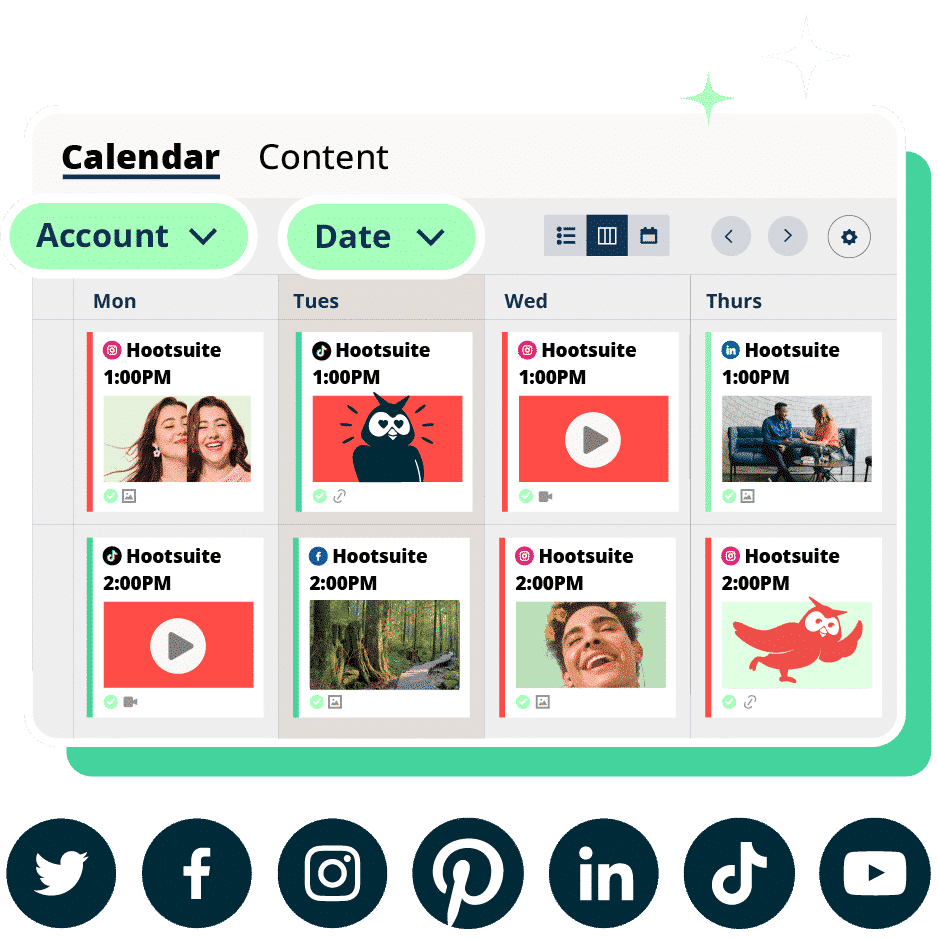
If you’re managing multiple social channels or brands, a social media management tool like Perch can bring your content calendar and approval workflows into one place. Your team can see what’s in progress, what needs review, and what’s ready to go live, without chasing down feedback.

Pro tip 💡: Link your messaging doc directly in your content briefs. Consistency is easier to build in at the start than to edit in at review.
Monitor sentiment and share of voice
Your messaging isn’t a one-and-done exercise. Once it’s out in the world, you need to see how it’s actually landing with your audience.
Social listening tools can help you track sentiment, measure share of voice, and catch shifts in the conversation. If customers keep missing the point, or competitors start creeping in your lane, that’s your cue to revisit the framework.
How does Hootsuite help teams manage brand messaging?
Brand messaging gets messy when guidelines live in one document, approvals happen over Slack or email, and audience feedback sits in another dashboard.
Hootsuite brings those pieces together. Teams can create brand-aligned content, review it before publishing, and monitor how the message lands once it’s out in the world.
Plan and approve on-brand content with Perch
Perch is Hootsuite’s social media planning and publishing tool. It helps teams turn brand messaging into ready-to-publish content without losing the plot between draft and approval.
Use it to plan campaigns, build your content calendar, and schedule posts across major social networks. When it’s time for feedback, your team can review captions, visuals, and channel-specific edits with built-in approval workflows.

Perch also helps teams stay consistent with shared content libraries. Everyone pulls from the same approved assets and templates, so your brand sounds like itself no matter who’s posting.
Monitor brand perception with Lumen
Once your content hits the feeds, Lumen shows you how people are actually responding to it. Lumen tracks brand mentions, sentiment, share of voice, competitor conversations, and emerging trends across 150+ million sources.

If sentiment starts to shift, a campaign message misses the mark, or a competitor begins owning a conversation you care about, Lumen surfaces those signals early. This lets your team respond while the moment still matters, rather than discovering the problem weeks later in a report.

Check tone and alignment with Wisdom
Wisdom, Hootsuite’s social-first AI agent, helps your team put your messaging framework into action.
Instead of staring at a blank page, you can ask Wisdom to draft, rewrite, or adapt social copy based on your brand voice.
For example, ask Wisdom to:
- Rewrite this caption so it sounds more like our brand voice
- Adapt this post for Instagram, LinkedIn, and X
- See if sentiment has changed about [campaign] since launch
- Identify the top themes showing up in our brand mentions

Your team still stays in control of reviewing, approving, and publishing — Wisdom just makes the blank page a lot less blank.
FAQ: Brand messaging
What is brand messaging?
Brand messaging is how a brand communicates its value and personality through words. It includes external brand messaging, which is what customers see in your ads, website, and social content, and internal brand messaging, like the core values and vision statement that guide your team.
What’s the difference between brand messaging and brand positioning?
Brand positioning defines your place in the market, including your target customers, your category, and your key differentiators. Brand messaging turns that positioning into words, from your value proposition to your tone of voice. In short, positioning is the strategy and messaging is how it sounds.
Why is a brand messaging framework important?
A brand messaging framework keeps your content consistent by documenting your brand pillars, audience, and voice in one place. Without it, every campaign reinvents the message, and your content marketing ends up sounding like it comes from different companies.
How does Hootsuite support consistent brand messaging?
Hootsuite helps teams build a brand messaging strategy and stick to it at scale. Perch centralizes content planning and approvals so every post follows your brand guidelines, Lumen monitors how audiences respond to your messaging, and Wisdom drafts on-brand copy from your voice and goals.
Keep your brand messaging consistent with Hootsuite.
- Plan, create, approve, and publish on-brand social content with Perch
- Monitor brand mentions, sentiment, and audience conversations with Lumen
- Manage comments, DMs, and customer conversations in your brand voice with Nest
- Shape stronger, on-brand content faster with Wisdom
Try Hootsuite free today.
[ad_2]
Source_link