[ad_1]
There are countless situations where a fast and responsive digital experience is taken for granted. Whether someone is buying a product online, watching a YouTube video, streaming on Netflix, or making a payment for a new pair of Adidas Sambas, users expect everything to work smoothly. Behind every such interaction, however, there is carefully designed cloud architecture working in the background.
For cloud solution architects and designers, an important question arises: how can an application continue to perform reliably when thousands of users access it simultaneously? More importantly, how can incoming traffic be distributed intelligently before it reaches the application?
This article explores how Azure Front Door addresses these challenges as an entry point for intelligent traffic management. Using the fictional case study of LoopChocolates during its Father’s Day campaign, we examine how Azure Front Door handles traffic spikes, optimizes request routing, and contributes to the scalability and availability of modern cloud-native applications.
Also Read: The Future of Decentralized Web Hosting Crypto Solutions
When Thousands of Customers Arrive at Once
It is early morning on Father’s Day. Across the country, LoopChocolates launches its largest marketing campaign of the year, curated specifically for this day. Weeks of preparation have led to this moment, including personalized gift boxes, limited-edition collections, and same-day delivery promotions. Social media advertisements begin circulating, email campaigns reach thousands of subscribers, and customers eagerly visit the website before popular products sell out. Within minutes, the campaign generates the anticipated surge in application traffic. There are now thousands of simultaneous requests originating from Faisalabad, Lahore, Karachi, Dubai, London, and other locations. Customers are attempting to place orders simultaneously.
Every customer expects:
- The website to load instantly.
- Product images to appear without delay.
- Payments to be processed securely.
- Order confirmations to arrive within seconds.
Even a few minutes of downtime during a campaign of this scale could translate into thousands of dollars in lost revenue, abandoned shopping carts, and damaged customer trust.
Initially, solving this problem appears very easy. Perhaps deploying additional virtual machines can allow the application to handle the increased demand. However, before any application server processes a request, another question must already have been answered:
Where should that request go?
The Role of Azure Front Door
Should customers in Dubai connect to the same infrastructure serving users in Pakistan?
What happens if one backend deployment suddenly becomes unavailable?
How does the platform avoid overwhelming a single server while other resources remain underutilized?
These questions introduce one of the important services in Microsoft’s cloud ecosystem: Azure Front Door.
Azure Front Door serves as a global entry point into an application’s architecture. It determines how incoming requests should begin their journey based on factors such as latency, backend health, routing configuration, and security considerations. Rather than directing every customer to the same application server, Azure Front Door evaluates the available options before making a routing decision.
How Does Azure Front Door Handle a Customer Request?
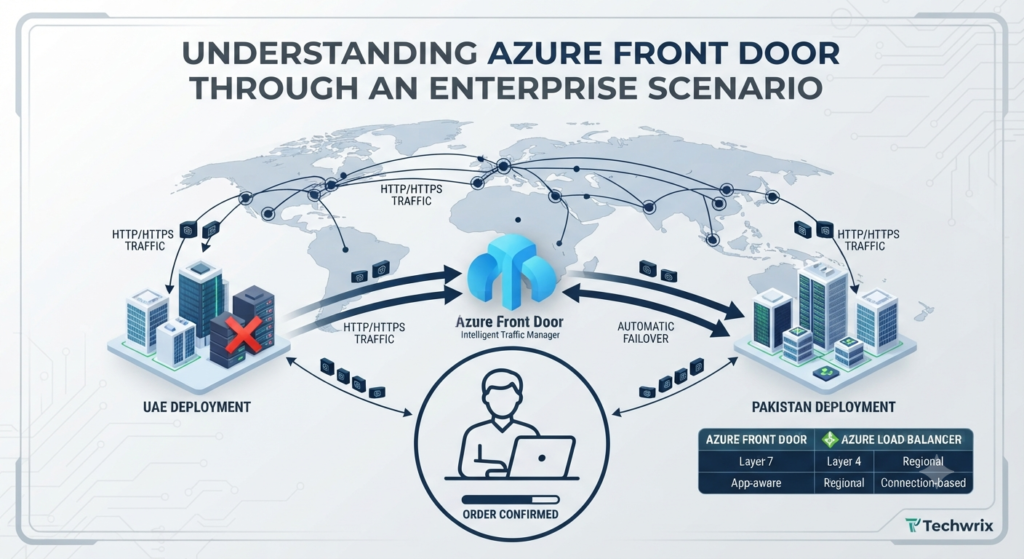
The role of Azure Front Door can be understood by examining a single customer order. Suppose a customer in Dubai makes an online purchase from LoopChocolates on Father’s Day. The request first reaches Microsoft’s global edge network before being forwarded towards the application’s backend. At the application’s global entry point, Azure Front Door is implemented. Suppose LoopChocolates has set up identical application instances in both the UAE and Pakistan. A customer browsing from Dubai may be directed to the UAE deployment because it can provide a faster response. However, what happens if the UAE deployment suddenly becomes unavailable? Azure Front Door’s health checks can detect the unavailable backend and remove it from the routing options. Future requests can then be sent to another available origin. The process happens automatically and within a very short period of time. Customers can continue browsing products, adding items to their carts, and placing orders without knowing that a backend failure occurred.
Also Read: Top 11 Cloud Cost Optimization Tools in 2026 (Buyer Guide)
More Than Just Traffic Distribution
Azure Front Door is often described as a global load-balancing service. However, its functionality is not restricted to simply distributing traffic.
It helps organizations maintain application availability during periods of high demand while improving performance for users in different geographical locations.
Some of the key benefits include:
- Improved response times: Requests can be routed towards an appropriate backend based on the application’s routing configuration.
- Health monitoring: Unavailable backends can be detected and excluded from routing.
- Automatic failover: Traffic can be directed towards another available origin when a backend becomes unavailable.
- Better availability: Applications can continue serving users even when one deployment encounters an issue.
- Traffic management: Large numbers of incoming requests can be distributed across available infrastructure.
From a business perspective, these technical features directly impact customer satisfaction. Faster page loads can reduce shopping cart abandonment. Strong infrastructure can reduce revenue loss during unexpected issues. Steady application availability builds customer trust in the platform.
In today’s cloud environments, smart traffic management is not just a way to improve performance. It is a necessary part of providing reliable digital experiences.
Azure Front Door vs Azure Load Balancer
The functionality of Azure Front Door and Azure Load Balancer is often confused because both services distribute incoming traffic. Their differences become clearer when we look at the architectural problems they are designed to solve.
| Feature | Azure Front Door | Azure Load Balancer |
| OSI Layer | Layer 7 | Layer 4 |
| Traffic | HTTP/HTTPS | TCP/UDP |
| Scope | Global | Regional |
| Main role | Global application traffic management | Network traffic distribution |
| Request awareness | Understands HTTP/HTTPS requests | Does not inspect application-level HTTP requests |
| Routing | Can use application-level routing rules | Distributes network connections |
| Typical use | Globally accessible web applications | Resources within a region |
Azure Load Balancer operates at Layer 4 of the OSI model. It distributes TCP and UDP traffic between resources within a region. It can balance network connections efficiently, but it lacks the same application-level understanding of an HTTP request.
On the other hand, Azure Front Door operates at Layer 7. This allows it to work with HTTP and HTTPS traffic and make routing decisions using application-level information.
Also Read: Cloud 3.0 Explained: Future of Enterprise Cloud Technology
Why the Difference Matters for LoopChocolates
For a globally accessible web application such as LoopChocolates, these capabilities make Azure Front Door an appropriate first point of entry. Azure Front Door does not necessarily replace Azure Load Balancer. Instead, the two services can complement each other.
Azure Front Door can handle global traffic management, while regional services can continue distributing requests within the application’s infrastructure. This distinction becomes especially important when an application has users across different geographical locations. The architecture can use global traffic management at the entry point while still relying on regional services to manage resources closer to the application backend.
Bringing It All Together
Finally, as the Father’s Day campaign comes to an end, thousands of customers have successfully browsed products, customized gift boxes, and completed their purchases without ever considering the infrastructure that supported their experience. They expected the website to remain available and responsive while they were using it. For cloud architects, however, that seamless experience is the result of deliberate architectural decisions.
Azure Front Door serves as an important point for traffic management, helping ensure that requests are forwarded towards an appropriate and available backend. By reducing latency, enabling automatic failover, and improving application availability, it transforms traffic management from a simple operational task into a well-designed architectural decision. Ultimately, the success of platforms like LoopChocolates is measured not by the complexity of their cloud infrastructure, but by its invisibility.
When thousands of customers arrive at once, and every interaction remains uninterrupted, the architecture has achieved exactly what it was designed to do.
[ad_2]
Source_link