[ad_1]
Summary
- Personalization backfires past clear thresholds: watch unsubscribe rates above 0.5% and recommendation click-through rates below 2% as early warning signs
- Zero-party data collected through preference centers, quizzes, and loyalty profiles is now the most reliable targeting input as third-party cookies disappear
- Cross-channel journeys should follow one behavioral trigger, not five disconnected campaigns competing for the same customer’s attention
- Loyalty programs work as engagement flywheels only when redemption is effortless and behavior data flows back into segmentation
- Retention rate, repeat purchase rate, and customer lifetime value (LTV) are the metrics that justify budget, not open rates alone
Our open rates look great and the dashboards are green, but repeat purchase rate hasn’t moved in over a year. That gap between “engagement metrics” and actual retention is the defining problem for B2C marketing leaders heading into 2026. B2C marketing solutions built around clicks and opens were never designed to answer whether a customer comes back.
This article is for lifecycle managers, customer relationship management (CRM) leads, and growth marketers at retail, ecommerce, travel, and fintech brands running multi-channel programs under real budget scrutiny.
We’ll walk through how to spot personalization that’s quietly frustrating customers, how to build a zero-party data foundation that resolves into unified profiles without third-party cookies, how to sequence channels so they read like one conversation instead of five competing ones, and which metrics actually convince finance to keep funding the program.
Why personalization fatigue is the new engagement killer
Personalization fatigue shows up as a measurable pattern, not a vague feeling: unsubscribe rates climbing past 0.5% or product recommendation click-through rates falling below 2% both signal that customers feel targeted rather than understood.
These thresholds are better used as directional guardrails because they can catch the problem before it shows up in quarterly retention numbers, when it’s much harder to reverse.
The gap is usually tactical. Name-merge emails, generic “we miss you” nudges, and recommendation blocks built from category-level browsing history all look like personalization but rely on surface data.
Real behavioral personalization uses purchase sequence, channel response history, and recency patterns, similar to how recency, frequency, monetary (RFM) segmentation separates a customer who is simply quiet from one who spent heavily and stopped.
That second group, often labeled “Cannot Lose Them” in RFM models, needs a different offer than someone browsing for the first time.
The distinction matters because customers can tell the difference between a brand that recognizes their behavior and one that recycles their first name.
In Insider One, personalization becomes more consistent when a unified customer profile, recommendations, dynamic content, and AI decisioning use the same behavioral context across retail, travel, and fintech programs, while those guardrail metrics stay directional rather than universal.
Building a zero-party data engine for a cookieless 2026
Zero-party data is information customers hand over deliberately, through preference centers, onboarding quizzes, and loyalty profile fields, and it’s now the most dependable targeting input available as third-party cookies phase out.
Unlike first-party data, which is inferred from behavior you observe, zero-party data states intent directly: a customer telling you they want travel deals to Southeast Asia is more actionable than a browsing session that merely suggests it.
Third-party data, sourced from external brokers and cross-site tracking, is losing reliability as browsers restrict tracking and regulations tighten.
First-party data, collected from your own site and app behavior, remains valuable but describes what customers did, not what they want next.
Zero-party data closes that gap when it is added to a unified customer profile that also pulls in web, app, CRM, loyalty, offline, catalog, and warehouse signals through identity resolution, and it works best when the ask feels useful rather than transactional.
Practical collection tactics that hold up across industries:
- Preference centers that let customers choose channel, frequency, and content category, framed as control rather than a settings chore
- Short onboarding quizzes that translate stated preferences into segment tags immediately, so the first message already reflects the answer
- Loyalty program profile fields tied to visible perks, like early access, so customers see a direct reason to fill them in
- Post-purchase surveys that ask about intent for the next purchase, not just satisfaction with the last one
A fintech brand asking about financial goals or a travel brand asking about trip type collects the same kind of signal a retailer gets from a style quiz. The mechanism transfers across sectors even when the product doesn’t.
Orchestrating cross-channel journeys that feel like one conversation
Cross-channel orchestration means every channel, email, push, SMS, WhatsApp, web and app personalization, in-app, on-site messaging, and retargeting ads responds to the same behavioural trigger instead of running as separate campaigns with separate logic.
When a customer abandons a cart, that single event should decide the next message across every channel, not spawn five uncoordinated ones from five different tools.
The failure mode is familiar: a customer gets a push notification about a browsed item, then an email about the same item an hour later, then a discount SMS the next day, none of which acknowledge the others.
Sequencing by intent and recency fixes this by ranking channels: the highest-intent, most recent behavior determines which channel fires next and suppresses the rest until the customer responds or the window closes.
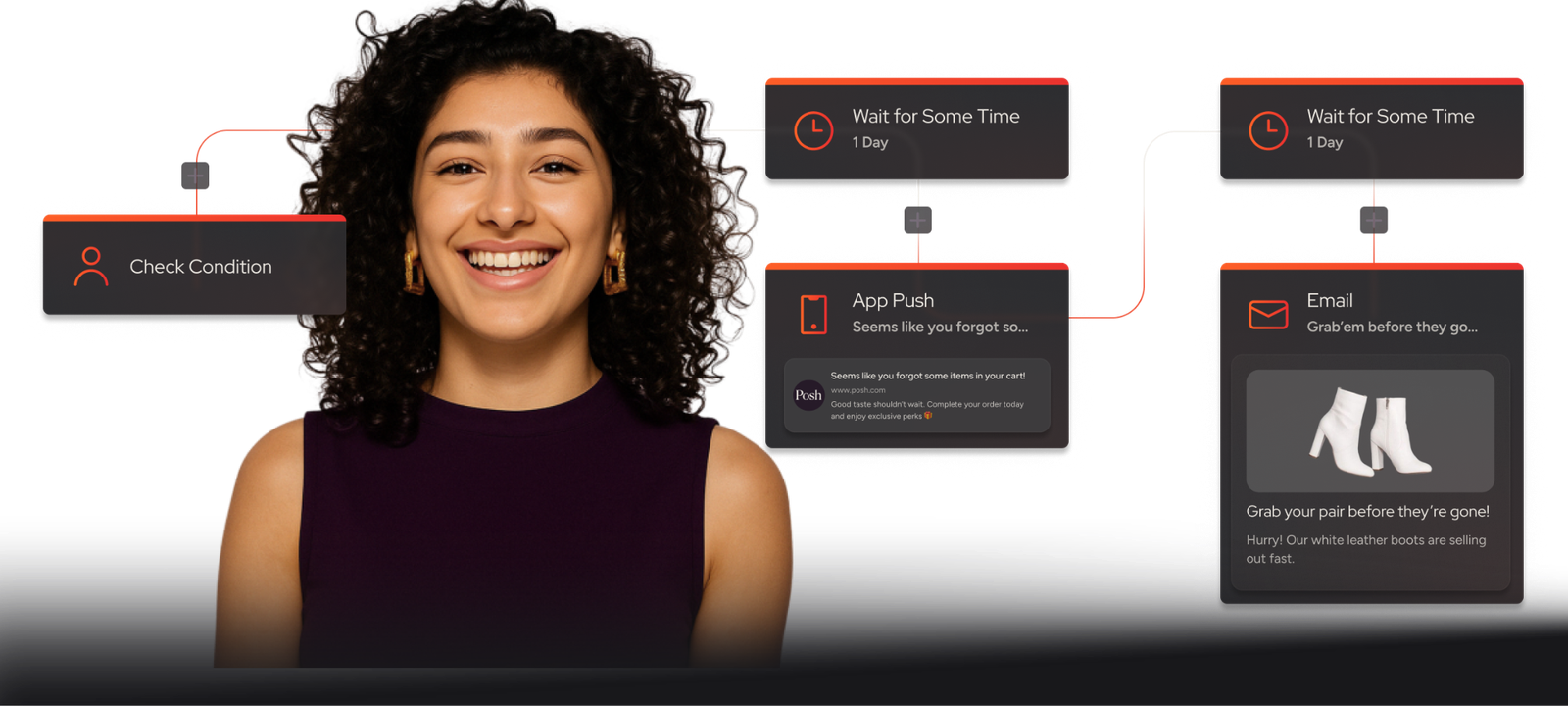
This is what Journey Orchestration is built to solve, coordinating channels around a unified customer profile and AI decision engine instead of siloed campaign logic in separate tools.
Our Architect journey builder lets teams design that single sequence once and apply it across channels, while audience sync keeps paid and owned targeting aligned instead of fragmenting logic across an email service provider (ESP), a push tool, and an SMS platform.
For example, Peugeot uplifted test drive applications by 120% using exit-intent overlays sequenced with follow-up messaging rather than firing every channel simultaneously.
The lesson transfers directly to travel and fintech funnels, where abandoned booking flows, onboarding drop-off, policy renewal, or an incomplete application each deserve one coordinated response, not a barrage.
Turning loyalty programs into engagement flywheels
A loyalty program becomes an engagement flywheel when personalized rewards and simple redemption convert enrollment into repeated, active participation rather than a dormant points balance.
Enrollment is the easy part; the harder problem is designing rewards specific enough to feel earned and redemption paths simple enough that customers actually use them before they churn.
The design principle is to treat the loyalty layer as a data source, not just a discount mechanism. Every redemption, tier upgrade, and reward choice tells you something about what a customer values next.
Feeding that behavior back into segmentation, for example, flagging high-frequency, high-spend customers who suddenly go quiet as “Promising” or “Cannot Lose Them” in RFM terms, sharpens the next offer instead of repeating a generic tier-based discount.
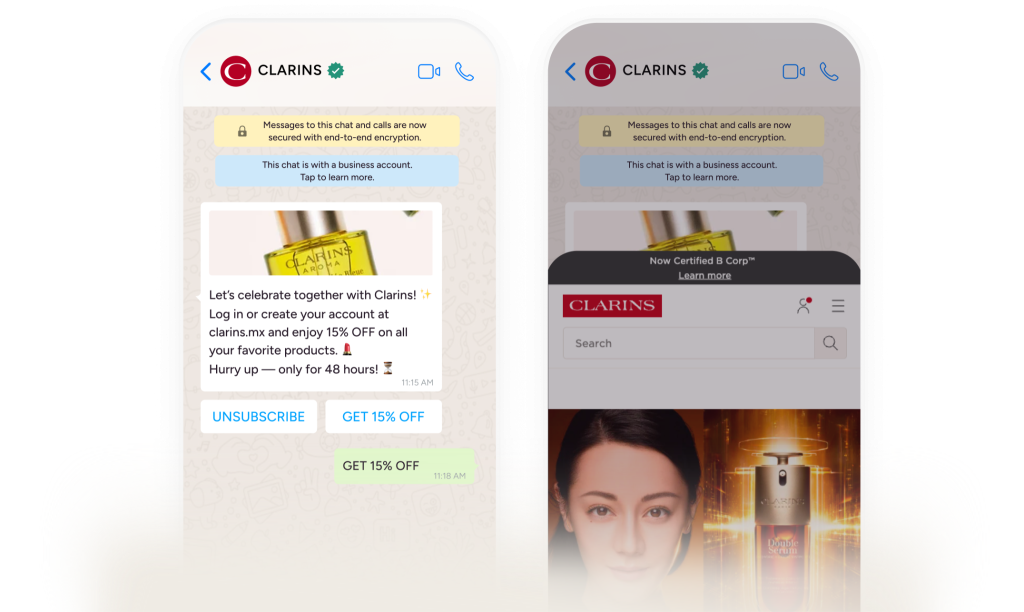
Similarly, Clarins grew WhatsApp sales 20x by using chatbot-driven, conversational engagement to make redemption and re-engagement feel personal rather than transactional. Both cases point to the same principle: loyalty mechanics only compound when the reward and the channel match how the customer already behaves.
Proving ROI: the key performance indicators that convince finance, not just marketing
The metrics that convince a finance team are retention rate, repeat purchase rate, and customer lifetime value, not click and open rates in isolation.
Click-through rate tells you a message got attention; it doesn’t tell you whether that attention turned into a second purchase six weeks later, which is the number finance actually cares about when approving next year’s budget.
The fix is treating engagement metrics as leading indicators, not the scoreboard. Track click and open rates as diagnostic signals for message quality, then report them alongside the downstream number they’re supposed to predict: repeat purchase rate for retail and ecommerce, policy renewal or account activation for fintech, rebooking rate for travel.
When a personalization program can show that a specific journey change moved retention, not just opens, the budget conversation changes entirely.
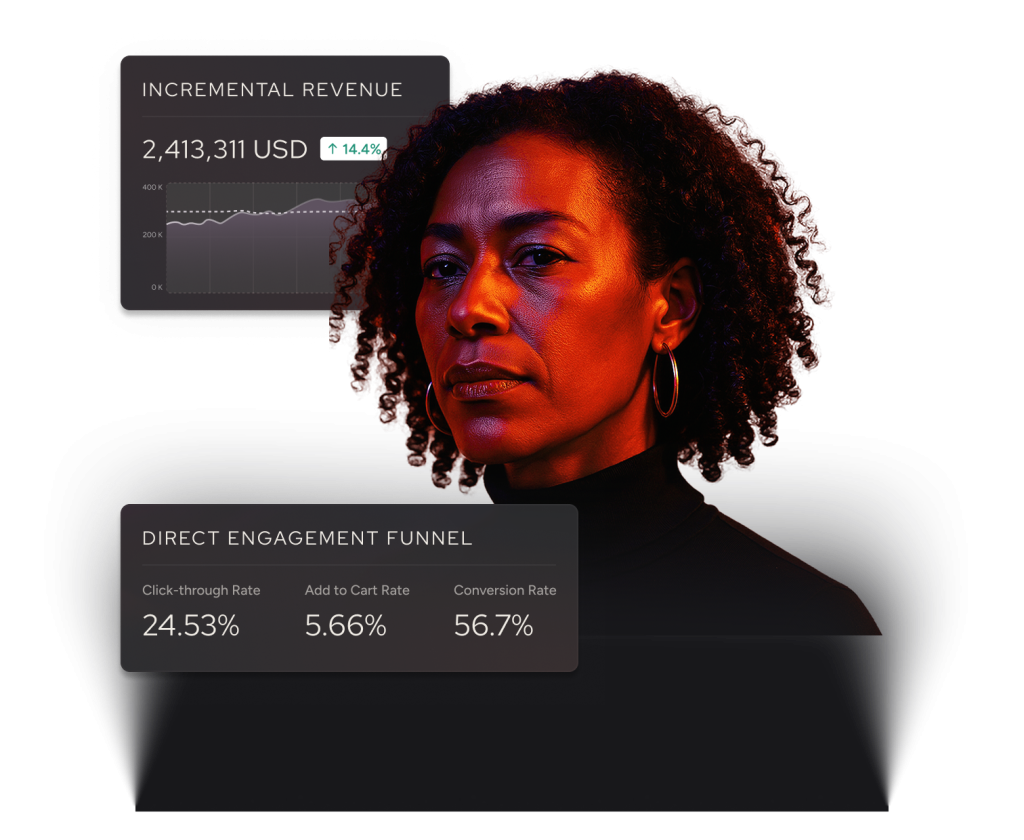
Our Reporting And Data tools are built to connect campaign and journey performance, behavior analytics, predictive analytics, revenue dashboards, and Snowflake-based data sharing to these downstream outcomes, so lifecycle teams can tie engagement signals to retention and LTV instead of presenting separate stories.
For a deeper breakdown of which retention levers move fastest, our guide on customer retention strategies walks through the sequencing in more detail.
Conclusion
Engagement metrics that stop at clicks and opens can’t tell you whether a customer is coming back.
The brands winning retention in 2026 build zero-party data into every interaction, sequence channels around one behavioral trigger, and report engagement in terms finance already understands: retention, repeat purchase, and lifetime value. That’s the shift from noise to a program that compounds.
To evaluate the fit of Insider One for your use case, book a personalized demo to review your goals, data requirements, channel mix, and implementation constraints with the Insider One team.
FAQs
Zero-party data is information a customer shares directly, through preference centers, quizzes, or loyalty profiles. It matters because third-party cookies are disappearing, and zero-party data states actual intent instead of inferring it, making it more reliable for targeting than inferred first-party behavior alone.
Watch two guardrail metrics: unsubscribe rate above 0.5% and recommendation click-through rate below 2%. Both signal that customers feel targeted rather than understood, usually because personalization relies on surface data like name-merge fields instead of actual behavioral signals.
Cross-channel messaging sends the same offer across multiple channels independently, often creating duplicate or conflicting messages. True orchestration sequences channels around one shared behavioral trigger, using a unified customer profile, AI decisioning, and audience sync so the most relevant channel fires next and paid and owned targeting stay aligned.
Report retention rate, repeat purchase rate, and customer lifetime value alongside click and open rates. Treat engagement metrics as diagnostic signals for message quality, and connect them explicitly to the downstream retention outcome they’re meant to predict.
[ad_2]
Source_link






![12 SEO Techniques to Boost Your Visibility and Traffic [2026]](https://mgrowtech.com/wp-content/uploads/2026/03/seo-techniques-120x86.png)