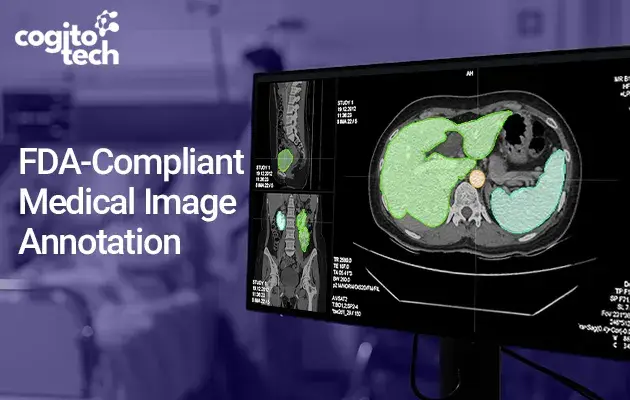
At the heart of every successful medical AI system lies one critical requirement: annotated training data. Medical AI models do not learn anatomy, pathology, or disease patterns on their own; they learn from examples created by expert-reviewed annotation. Whether identifying tumors on CT scans, segmenting organs in MRI, or detecting retinal abnormalities, annotation quality directly influences model performance.
This guide explores what FDA-ready medical image annotation means, why it matters for healthcare AI, the annotation techniques involved, imaging modalities covered, regulatory considerations, and best practices.
Why is the Importance of FDA-Compliant Annotation in Healthcare AI Growing?
Medical AI differs from conventional computer vision applications. For instance, an incorrectly labeled product image merely reduces recommendation accuracy in retail, while an inaccurately annotated lesion boundary on a CT scan can affect disease detection, treatment planning, and patient outcomes.
Medical AI models are increasingly used in high-risk clinical scenarios such as:
- Cancer detection
- Stroke diagnosis
- Cardiovascular assessment
- Ophthalmology screening
- Digital pathology
- Surgical navigation
- Clinical decision support
As these systems influence medical decisions, regulators expect AI developers to build models trained on high-quality datasets. Medical image annotation, therefore, becomes a foundational element of regulatory-grade AI development
What Does FDA-Compliant Medical Image Annotation Really Mean?
FDA-compliant medical annotation refers to annotation workflows designed to generate reliable, traceable, and clinically validated datasets that support AI systems developed under stringent FDA-regulated medical device frameworks.
An FDA-ready annotation workflow includes:
- Standardized annotation protocols
- Clinically validated ground truth
- Documented annotation guidelines
- Version-controlled datasets
- Multi-level quality assurance
- Expert adjudication
- Annotation audit trails
- Inter-observer agreement measurement
- Secure handling of protected health information (PHI)
Medical Imaging Modalities Requiring FDA-Ready Annotation
FDA-regulated healthcare AI relies on annotations across numerous imaging modalities, each presenting unique anatomical characteristics and diagnostic requirements.
X-ray datasets are commonly annotated for fractures, pneumonia, orthopedic abnormalities, and chest pathologies.
Computed Tomography (CT) requires volumetric annotation of organs, tumors, vascular structures, pulmonary nodules, and traumatic injuries.
Magnetic Resonance Imaging (MRI) focuses on soft-tissue structures, neurological disorders, musculoskeletal injuries, cardiac anatomy, and oncology applications.
Ultrasound annotation supports fetal assessment, echocardiography, abdominal imaging, vascular studies, and point-of-care ultrasound.
Mammography datasets require precise localization of masses, calcifications, architectural distortion, and breast density.
Fundus Photography and Optical Coherence Tomography (OCT) are extensively annotated for diabetic retinopathy, glaucoma, retinal vessel segmentation, and age-related macular degeneration.
Whole Slide Images (WSIs) used in digital pathology require detailed tissue- and cell-level annotations for cancer detection, biomarker identification, and histopathological analysis.
Why is Annotation Quality Crucial in FDA-Regulated Healthcare AI
High-quality annotation is the base for every successful healthcare AI model. Medical AI systems do not inherently understand pathology, anatomy, or disease patterns. Instead, they learn after discovering statistical relationships within expertly annotated datasets. Every segmentation mask, anatomical landmark, lesion boundary, classification label, or diagnostic annotation serves as ground truth. It teaches the model how to interpret normal and abnormal clinical findings.
Annotation quality also has a measurable impact on key performance metrics used to evaluate medical AI systems, including:
- Sensitivity (Recall) – The model’s ability to correctly identify patients with disease while minimizing missed cases (false negatives).
- Specificity – The ability to accurately identify healthy patients and reduce false-positive predictions.
- Precision and Predictive Value – Reliable annotations help improve confidence in positive predictions, reducing unnecessary follow-up procedures.
- Model Generalization – Consistent annotations across diverse patient populations, imaging devices, and clinical sites enable AI models to perform reliably beyond the original training dataset.
- Reproducibility – Standardized annotation protocols produce datasets that support repeatable model development, validation, and independent verification.
- Clinical Validation and Regulatory Readiness – Well-documented, traceable annotations strengthen the evidence required for clinical evaluation and help align dataset development with FDA Good Machine Learning Practice (GMLP) principles.
High-quality annotation therefore improves
- model accuracy
- robustness
- generalization
- reproducibility
- clinical validation
- regulatory compliance
Annotation quality is ultimately a patient safety issue, not simply a data quality issue.
Characteristics of an FDA-Ready Medical Annotation Workflow
It requires far more than accurate labels to build AI systems for healthcare. For AI models intended for Software as a Medical Device (SaMD) or other regulated healthcare applications, annotation workflows must be standardized, traceable, and clinically validated to produce reliable ground-truth datasets. Domain and subject matter experts are integral, but annotation quality also depends on the quality controls, processes, and documentation that administer the entire workflow.
Standardized Annotation Guidelines
Each project must begin with standard annotation protocols that define labeling rules, edge cases, inclusion and exclusion criteria, anatomical definitions, and disease-specific decision logic. These guidelines help ensure consistency across annotators and minimize subjective interpretation.
Annotation workflows should support internationally recognized healthcare standards whenever applicable, including:
- DICOM for storing, exchanging, and managing medical imaging data
- NIfTI for volumetric neuroimaging datasets
- HL7 FHIR for interoperable clinical information
- SNOMED CT, ICD-10-CM, LOINC, and RadLex for standardized medical terminology
Clinical Subject Matter Experts
Healthcare datasets often require input from radiologists, pathologists, cardiologists, ophthalmologists, and other specialists who are well-versed with disease presentation, imaging artifacts, and diagnostic criteria.
Multi-Level Quality Assurance
Rather than relying on a single annotator, FDA-ready workflows incorporate reviewer validation, consensus adjudication, expert verification, and continuous quality audits to maintain dataset integrity.
For example:
- Radiologists review lesion boundaries in CT, MRI, mammography, and X-ray studies.
- Pathologists verify tissue-level annotations in Whole Slide Images (WSIs).
- Ophthalmologists validate retinal abnormalities in fundus and OCT images.
- Cardiologists review annotations from ECG, echocardiography, and cardiac MRI.
Inter-Observer Agreement (IOA)
Different physicians may interpret the same medical image differently. Measuring IOA quantifies annotation consistency and highlights ambiguous cases requiring additional review.
Gold Standard Datasets
Verified benchmark datasets establish reference annotations used to train annotators, evaluate quality, and continuously monitor consistency throughout production.
Dataset Traceability
Every annotation should be traceable to:
- annotator
- reviewer
- annotation version
- guideline version
- timestamp
- revision history
Human-in-the-Loop Validation
AI-assisted annotation accelerates production, but clinicians must validate difficult cases before they become part of the final training dataset.
Human reviewers verify:
- anatomical boundaries
- lesion morphology
- disease classification
- segmentation accuracy
- annotation completeness
HIPAA-Compliant Data Handling and Security
The HIPAA Privacy Rule is a core regulation under the Health Insurance Portability and Accountability Act (HIPAA). It has been designed to safeguard the confidentiality of individuals’ medical information. It sets national standards for entities on how they handle protected health information (PHI) under health plans, healthcare providers, and healthcare clearinghouses. PHI includes data regarding patients’ identity, such as names, test results, billing information, medical records, or even demographic details when tied to health services.
Regulatory Standards Every Medical Annotation Company Should Understand
The FDA groups medical devices into three categories as per their risk level. The data labeling requirements are directly influenced by risk level.
Class I Medical Devices (Low Risk)
Class I are low-risk medical devices. These are not intended to sustain or support life. The devices falling under Class I are not of substantial importance in the prevention of health impairment, and usually pose low or minimal harm to patients (FDA). Around 47% of FDA-regulated devices are Class I devices, having minimal contact with patients, avoiding internal organs, the central nervous system, or the cardiovascular system.
Example – Examination gloves, tongue depressors, elastic bandages, and manual stethoscopes
Class II Medical Devices (Moderate Risk)
For Class II devices, general controls alone are insufficient to establish assurance of effectiveness and safety (require special controls to mitigate risks). Being in the middle tier of the FDA’s risk-based classification system, Class II devices introduce more risk than Class I devices. Class II devices are commonly used in clinics, hospitals, and outpatient settings for diagnosis, treatment, or patient monitoring.
Example – Infusion pumps, ultrasound imaging systems, powered wheelchairs, and automated diagnostic imaging software
Class III Medical Devices (Highest-Risk)
Class III medical devices represent the highest-risk category under FDA classification, are supposed to support or sustain human life. These devices play a crucial role in preventing serious health risks or present a significant potential risk of illness or injury. Due to their critical nature, Class III devices require stringent evaluation and must undergo the Premarket Approval (PMA) process before they can be commercially marketed.
Example – Heart valves, implantable pacemakers, and cochlear implants
Organizations developing Class III AI systems require:-
- board-certified reviewers
- multi-stage validation
- extensive documentation
- complete audit trails
- rigorous dataset governance
- comprehensive clinical evidence
| FDA Devices Class | Risk Level | Regulatory Controls | Premarket Requirements | Examples | Implications for AI/Medical Devices |
|---|---|---|---|---|---|
| Class I Devices | Minial Potential for harm | General controls, including proper labeling, manufacturing standards, quality practices, and FDA registration requirements. | Most Class I Devices are exempt from 510(k) premarket notification, ensuring faster market entry | Tongue depressors, bandages, examination gloves | Simple design, low-risk applications, limited regulatory burden, and minimal likelihood of causing patient harm |
| Class II Devices | Moderate potential for harm; may contact the body for longer or involve more complex interactions. | General controls plus special controls, including performance standards, post-market surveillance, clinical requirements, and specific labeling guidelines. | Most require 510(k) premarket notification to demonstrate substantial equivalence to an existing FDA-cleared device (predicate device) | Infusion pumps, surgical drapes, powered wheelchairs | Requires stronger documentation, validation testing, risk assessment, and quality controls compared with Class I devices. Many AI-enabled diagnostic tools fall under this category |
| Class III Devices | Highest potential for harm; often support or sustain life, are implanted, or are critical for diagnosis or treatment decisions; special controls, including performance standards, post-market surveillance, clinical requirements, and specific labeling guidelines | General control plus Premarket Approval (PMA), involving extensive scientific review to establish safety and effectiveness | Requires PMA approval unless the device qualifies under specific exemptions or established regulatory pathways | Heart valves, implantable pacemakers, cochlear implants | Requires extensive clinical evidence, rigorous validation, detailed documentation, longer development timelines, and the highest level of regulatory scrutiny. AI systems making critical diagnostic or therapeutic decisions may fall into this category |
FDA Approval Pathways for AI-Based Medical Devices
The FDA approval pathway for an AI-enabled medical device depends on its intended use, risk level, and device classification. Each pathway determines the level of clinical validation, documentation, and data quality required before the solution can be deployed.
510(k) Clearance
The 510(k) pathway is the most common route for Class II Software as a Medical Device (SaMD). Manufacturers must demonstrate that their AI solution is substantially equivalent to an existing FDA-cleared device (predicate). Although new clinical trials are not typically required, high-quality annotated datasets and robust validation are essential to showcase reliable model performance.
De Novo Classification
The De Novo pathway applies to novel, low- to moderate-risk AI devices with no existing predicate. AI developers have to establish the safety and device effectiveness through analytical and clinical validation.
Premarket Approval (PMA)
Premarket Approval (PMA) is the FDA’s most rigorous pathway for high-risk Class III AI devices. It requires extensive clinical evidence, technical documentation, and risk analysis. Since model performance depends on data quality, annotation workflows must be standardized, traceable, and validated by clinical experts to support regulatory approval.
FDA Frameworks and Guidance for AI/ML-Based Medical Software
As artificial intelligence becomes increasingly integrated into healthcare, the FDA has introduced regulatory frameworks and guidance to ensure AI-enabled medical devices are safe, effective, and clinically reliable. These frameworks help developers understand when AI software qualifies as a regulated medical device and the level of regulatory oversight required.
Software as a Medical Device (SaMD)
The FDA follows the definition established by the International Medical Device Regulators Forum (IMDRF) for Software as a Medical Device (SaMD). SaMD refers to software intended for medical purposes that performs these functions without being part of a physical medical device.
Not all healthcare software falls into this category. Applications that simply store, retrieve, or display patient information, such as electronic health record (EHR) systems, medical image viewers, or appointment scheduling platforms—generally pose lower risk and are subject to limited regulatory oversight. However, AI software that analyzes medical images, predicts disease risk, recommends diagnoses, or supports treatment decisions is more likely to be regulated as SaMD because it directly influences clinical care.
Clinical Decision Support (CDS) Guidance
The FDA also provides guidance on Clinical Decision Support (CDS) software, distinguishing between tools that assist healthcare professionals and those that independently drive clinical decisions. For instance, AI applications that summarize clinical guidelines or spot potential drug interactions while authorizing physicians to review the supporting evidence independently may not require FDA oversight. On the other hand, an AI system that automatically classifies a lung CT scan as malignant, recommends a treatment plan, or detects diabetic retinopathy from retinal images without providing transparent reasoning is more likely to be regulated as a medical device as clinicians cannot independently verify its recommendations.
FDA Good Machine Learning Practice (GMLP) and Annotation Quality
The FDA, Health Canada, and the UK’s MHRA jointly introduced Good Machine Learning Practice (GMLP) principles to encourage the development of safe, effective, and trustworthy medical AI systems. Although GMLP does not prescribe specific annotation methods, several principles directly depend on high-quality medical annotation.
Representative datasets ensure AI models learn from clinically diverse patient populations. Standardized annotation guidelines reduce variability between reviewers, while expert validation establishes reliable clinical ground truth. Comprehensive documentation, dataset versioning, audit trails, and continuous quality monitoring improve traceability and reproducibility throughout model development. Together, these practices strengthen regulatory compliance.
Conclusion
The importance of FDA-ready medical image annotation continues to grow as healthcare AI moves from research to clinical practice. High-quality annotations are beyond training inputs as they form the foundation for model accuracy and clinical validation. Organizations building AI-enabled medical devices must look beyond basic labeling capabilities and partner with annotation providers who understand clinical requirements, regulatory expectations, and the complexity of healthcare data. By combining medical expertise, secure annotation processes, and human-in-the-loop validation, developers can create reliable AI systems that support safer diagnosis, improved clinical workflows, and better patient outcomes.
Frequently Asked Questions (FAQ)
FDA-compliant medical image annotation refers to workflows designed to support the development of FDA-regulated AI-based medical devices. The goal is to build premium datasets that support accurate, safe, and clinically validated AI models.
Annotated datasets remain a learning channel for medical AI models. Every lesion boundary, segmentation mask, anatomical landmark, or disease label influences how an AI system interprets medical images. Erroneous annotations reduce model performance and affect metrics like specificity, sensitivity, and generalization. Well-annotated data ensures that AI models are trained on meaningful data.
FDA-ready annotation is critical across different imaging modalities used for healthcare AI applications such as MRI, X-rays, mammography, ultrasound, and more. Depending on the clinical objective, annotations may involve identifying lesions, segmenting organs, marking anatomical structures, classifying abnormalities, or labeling tissue-level features for pathology applications.
The FDA does not prescribe a fixed annotation team structure or require every annotation task to be performed by physicians. However, in some cases, it does specify that AI developers must demonstrate that their training and validation datasets are accurate, representative, and appropriate for the intended clinical use. In many medical AI applications, achieving this level of reliability requires involvement from qualified healthcare professionals, such as radiologists, pathologists, ophthalmologists, cardiologists, or other subject matter experts.
A regulatory-grade annotation workflow requires more than accurate labeling. It includes clearly defined annotation guidelines, multiple review stages, expert validation, inter-observer agreement assessment, gold-standard datasets, dataset version control, audit trails, and human-in-the-loop quality checks. These processes help maintain annotation consistency, improve model reliability, and support regulatory documentation.
For AI-enabled Class II medical devices, the FDA 510(k) pathway requires manufacturers to demonstrate that their solution is substantially equivalent to an existing cleared device. High-quality annotated datasets support this process by providing evidence of model performance, validation accuracy, and reliability across representative clinical data.
Healthcare AI leaders should assess annotation partners based on their medical expertise, experience with regulated healthcare datasets, security practices, compliance, and ability to maintain transparency in the entire annotation lifecycle.