Reading Time: 7 minutes
For the last decade, martech adoption followed a familiar shape. Buy the tool. Train everyone on it. Publish a rollout deck. Hope adoption sticks. Six months later, half the seats are unused, and the other half is running at 20% of what the tool can do.
AI does not work that way.
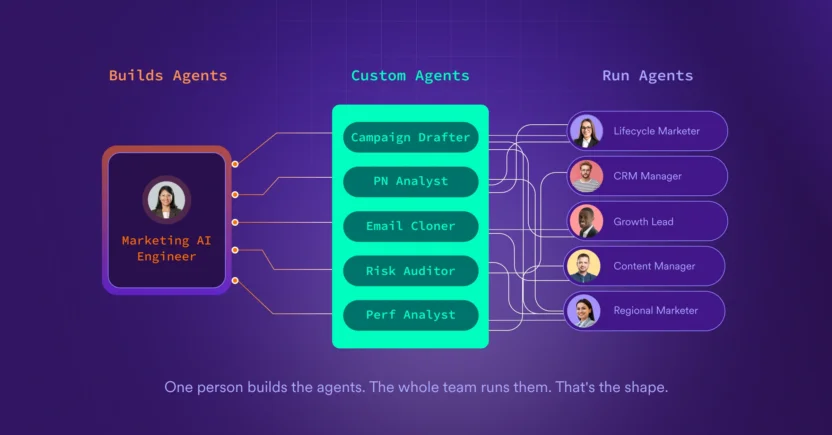
The best marketing teams we work with have quietly stopped trying to make every marketer an AI power user. Instead, they have reorganized around a much smaller idea: one or two people build, and everyone else runs. The person who builds is starting to have a name. They are the Marketing AI Engineers. And if you run a marketing or CRM org at a consumer brand, this is the most important role you don’t yet have on your org chart.
Why “AI for Everyone” Quietly Fails
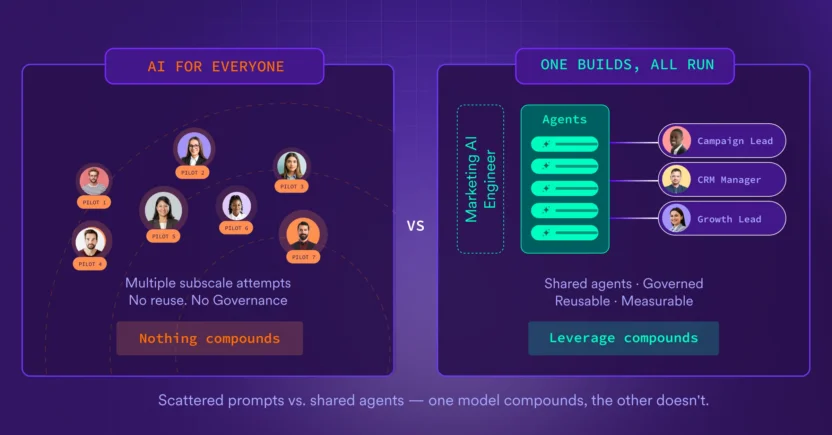
The default corporate response to AI is to buy licenses for the whole team and run a training session. We have watched this fail enough times to be blunt about why.
- Prompt engineering has a real learning curve. Most marketers will not spend the 40 to 100 hours it takes to become genuinely fluent, and no amount of internal enablement changes that. Proficiency with the tool — not the technology itself — is consistently the hardest part of AI adoption. The bottleneck is not the model. It is depth of focus.
- One-off automations do not compound.When every marketer builds their own private prompt library, you end up with 40 subscale attempts, no reuse, no governance, and no way to know which are actually working. Nothing accumulates.
- End-to-end value lives in workflows, not prompts. The real leverage is attaching agents to workflows that touch your data, your tools, your brand rules, and your audience segments. That is engineering work. It requires someone who thinks in systems, tests failure modes, and iterates on the agent the way an engineer iterates on a service — not someone squeezing a clever prompt into a spare afternoon.
The Pattern We See Emerging
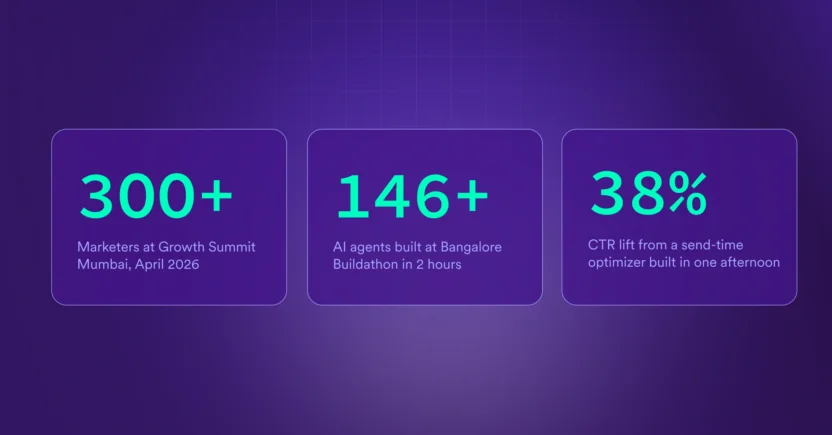
In April 2026, at MoEngage Growth Summit Mumbai, more than 300 marketers came into a room, and 60+ customers spent an afternoon building custom agents live on their own data. Over 30 of those agents went into production within weeks.
In June 2026, we ran the Bangalore Buildathon with 65 marketers from 36 brands. 146 AI marketing agents were built in a two-hour session. 225+ complex, real tasks completed live. One send-time optimizer agent, built that afternoon, delivered a 38% lift in click-through rate on the team’s next batch of campaigns.
None of these were toy demos. They were Merlin AI Custom Agents wired to live customer data, live campaigns, and live rules — built by the marketers who would run them, not by an outside dev team.
Agents in Production Today
- Push Campaign Drafter — A global consumer electronics brand ingests a CSV of offers and outputs 10 to 96 push drafts in a single execution, translated, localized, and ready for review.
- PN Campaign Analyst — One of India’s largest e-commerce players pulls yesterday’s push campaigns, benchmarks them against historical data, and reviews regional copy fit across 25–36 campaigns every morning.
- Weekly News Push Drafter — A leading streaming provider produces 7 drafts across 7 languages in a single run.
- Thursday BAU Email Cloner — A major North American retail group produces the week’s BAU draft with fresh partnership modules, without a marketer touching a builder.
- Uninstall Risk Auditor — A fashion & lifestyle retailer runs this across 90-day windows, prioritizing win-back drafts using five weighted risk signals.
- Daily Email Performance Analyst — A spirituality app produces the morning Slack summary and full report on its own.
Look closely at those teams and the pattern is almost boring in its simplicity: one person on the team built the agent. The whole team uses it. That is the shape of a modern marketing org.
And here evolves a new role in the martech organization —
|
What a Marketing AI Engineer Actually Is
A Marketing AI Engineer is a hybrid role that sits inside the marketing or CRM org and builds the agents, automations, and workflows the rest of the team runs. They are not a marketing ops person who configures tools someone else built. They are a builder who ships net-new systems on top of the marketing stack the org already has.
The demand signal is already loud. Open roles for this kind of hybrid, build-focused marketing role have more than doubled in the past year. This is not a fringe title anymore.
The Job-to-be-done
Identify the highest-leverage, highest-repetition workflows the team runs today. Build each one as a Custom Agent that lives on the marketing stack and respects the team’s guardrails. Observe how the agents run in production — improve them weekly. Teach the team to use them. Retire the manual version. Report leverage back to leadership as concrete numbers: campaigns per week, time-to-launch, error rate, incremental revenue.
Two Paths to Your First Marketing AI Engineer
Both paths lead to the same outcome. They differ in speed, risk, and where the trust comes from.
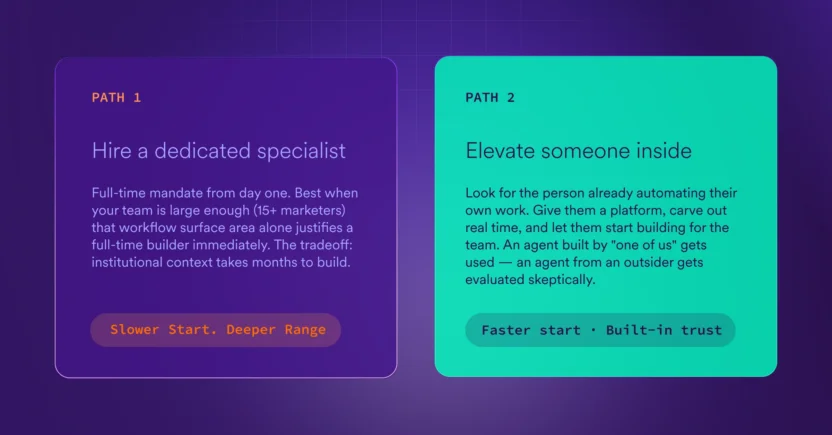
In practice, most of the production agents listed earlier in this post came from Path 2. The lifecycle marketer or CRM ops person who was already the “automation person” on the team, given a platform and a runway, turned into the marketing engineer almost by default. Path 1 is often what teams reach for after Path 2 proves the model and the workload outgrows one part-time builder.
Neither path is more legitimate than the other. What matters is that someone owns it, full-time, with the mandate to build agents that the wider team adopts — not evaluates, not pilots, adopts.
Job Description You Can Post — or Use to Formalize an Internal Move
RoleMarketing AI EngineerAlso called: Growth Engineer, Lifecycle Automation Lead Mission: Build and maintain the AI agents that give every marketer on the team 10x leverage over their day-to-day work. What You Will Do
What You Will Not Do
Experience
First-6-months Success Metrics
|
The Playbook for This Quarter
-
Pick your one person:
Before you open a req externally, look inside first. Somewhere in your team is a lifecycle marketer or CRM ops person who already automates their own work, ships their own scripts, or has been quietly using AI to move faster at their day job. That is your Marketing AI Engineer candidate. Do not overthink the search — and do not assume you have to hire your way into this.
-
Ramp them properly:
20% time in month one. 50% in month two. Full-time by month three. Do not part-time this indefinitely — the compounding only starts when the role is real. If you go the external-hire route instead, budget the same ramp for context, not skill.
-
Do the workflow audit:
Have them list every recurring workflow the marketing and CRM team runs. Rank each by frequency × time-per-run × pain. You will find your first three candidates in a week.
-
Build the top three, fast:
Ship in weeks, not quarters. The 65 marketers at the Bangalore Buildathon built 146 working agents in an afternoon using MoEngage Custom Agents. There is no reason your first three should take longer than a month.
-
Run your own buildathon:
Sit the whole marketing team down for a two-hour session where the Marketing AI Engineer walks them through running the agents on their own campaigns. Adoption becomes real when marketers see it working on their own data, in front of them — not when it’s announced in a rollout email.
This cadence works whether the builder is a new hire or a promoted teammate. We have watched it work across retail, fintech, media, travel, food-tech, and streaming, on teams from 8 marketers to 80.
In Summary
Reframe the ROI honestly. This is not “AI reduces cost per campaign.” It is: one Marketing AI Engineer plus a stack of custom agents equals the capacity of 5 to 8 marketers, at higher quality, without adding headcount.
The risk of not doing this is quieter but larger. In two years, marketing teams without a Marketing AI Engineer will be operating at half the throughput of teams that have one. The gap will look the same as the gap between teams that had a data analyst in 2015 and teams that did not by 2018. By the time it is obvious, it is late. McKinsey’s research on reinventing marketing workflows with agentic AI points the same direction.
The Title Is New. The Work Is Already Happening.Fewer people are running campaigns manually. A small number of builders inside marketing and CRM teams are shipping the agents that everyone else runs. Leadership measures the team on leverage, not on hours. The teams building on Merlin AI Custom Agents figured this out first. If you want to be ahead of the curve as well, let’s talk in detail! |
The post Why Your Marketing Team Needs a Marketing AI Engineer appeared first on MoEngage.