Continuous integration was supposed to make software delivery fast. For most teams it did, right up until the test stage. Builds compile in minutes, containers ship in seconds, but the test suite still reflects however many hours of manual scripting a team managed to invest, which is never enough. The result is a strange inversion: the pipeline is automated end to end, but the thing the pipeline exists to verify, correctness, depends on hand-written artifacts that age badly and grow slowly.
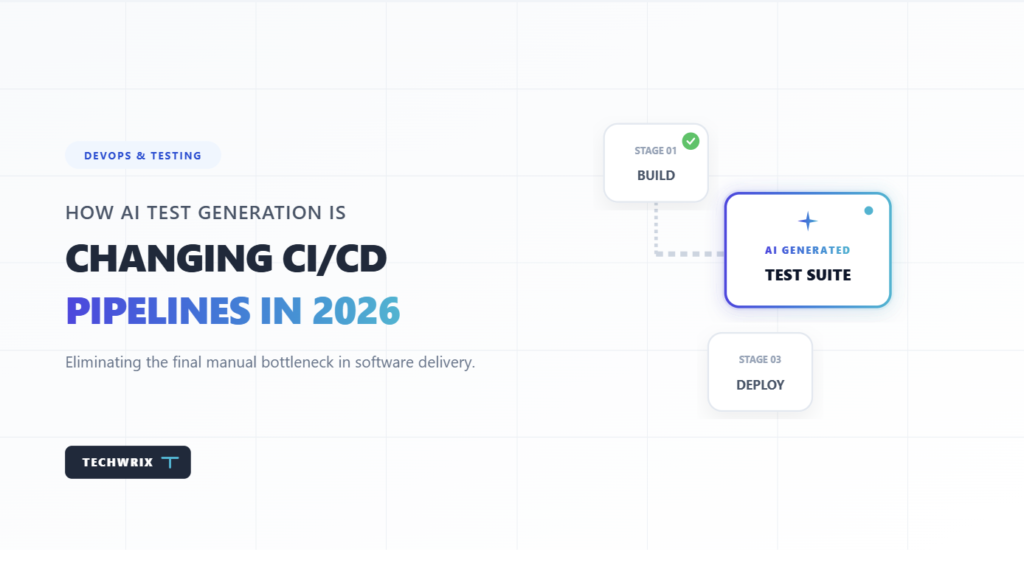
That is the gap AI test generation is closing, and it is changing how DevOps teams think about the test stage of their pipelines.
Also Read: How Regression Testing Helps Teams Move Fast Without Breaking What Already Works
The Real Bottleneck was Never Execution
When engineers complain that testing slows down their pipeline, they usually mean execution time, and they respond by parallelizing runners or trimming the suite. Both help, but they miss the actual constraint. The bottleneck in most organizations is test creation and maintenance, not test execution.
Consider what happens when a service changes. Someone has to update the affected tests, fix the mocks that drifted out of sync with downstream dependencies, and write new cases for the new behavior. In a monorepo with dozens of services deploying daily, this work never ends, and it competes directly with feature work for the same engineering hours. Teams respond rationally: they write fewer tests, they let coverage decay on older services, and they tolerate flaky suites because fixing them costs more than ignoring them. The pipeline stays green while its meaning quietly erodes.
Speeding up execution does nothing for any of this. The fix has to attack creation and maintenance, which is exactly where generative AI operates.
Where AI-Generated Tests Fit in the Pipeline
AI test generation is not one thing bolted onto one pipeline stage. In practice it shows up in three places.
At the pull request stage, schema-based generation produces test cases from API specifications. When a developer modifies an OpenAPI spec, tooling generates cases covering the new endpoints, including boundary values and invalid inputs that human authors reliably skip. These run as part of the PR checks, so coverage grows in lockstep with the API surface instead of lagging behind it.
At the pre-production stage, traffic-based generation does something more interesting. Platforms in this category record real API traffic from staging or production, then convert those interactions into deterministic test cases with automatically generated mocks for downstream services. The resulting suite reflects how the system is actually used, including the malformed payloads, retry storms, and odd header combinations that real clients produce and specification documents never mention.
At the maintenance layer, AI handles the noise problem that kills most regression suites. Timestamps, UUIDs, and session tokens change on every run, and traditional assertion-based tests either fail constantly or get written with such loose matching that they verify nothing. AI-driven noise detection learns which fields are legitimately dynamic and excludes them from comparison, which is the difference between a regression suite teams trust and one they override.

The tooling landscape has matured quickly. A detailed comparison of the current generative ai testing tools shows how differently vendors approach the problem, from AI assistants added to established products to open source platforms built entirely around traffic capture and replay. For pipeline architects, the architectural difference matters more than the feature lists, because it determines whether the tool works with your deployment model or against it.
Also Read: What DevOps Teams Get Wrong About Test Automation Tools
A Practical Adoption Pattern
Teams that adopt this successfully tend to follow the same sequence, and it is worth stealing.
They start with one service, usually a mature API with poor coverage, because that is where generated tests deliver the most value for the least risk. They record traffic in staging for a week, generate the initial suite, and then do the step that separates successful adoptions from failed ones: a human review pass. Engineers go through the generated cases, delete the ones that test nothing meaningful, and confirm the expected behaviors are actually correct. Skipping this step produces a large suite that verifies the system’s current bugs as intended behavior.
Once the reviewed suite is in place, it runs in CI on every pull request, exactly like hand-written tests. The difference appears at maintenance time. When the service changes legitimately, the team re-records traffic and regenerates rather than hand-editing dozens of assertions. Suite maintenance becomes an operational task measured in minutes, not an engineering task measured in days.
From there, expansion is service by service, prioritized by risk. Payment flows and authentication paths first, internal admin tools last.

What Changes in the Metrics
The measurable effects show up within a quarter. Coverage on previously neglected services jumps because generating a suite for a legacy API takes an afternoon rather than a sprint nobody will ever schedule. Flaky test rates drop where noise detection is in place, restoring the team’s trust that a red build actually means something. And mean time to detect regressions shrinks, because breaking changes surface in the PR that caused them rather than in production.
The second-order effect is cultural. When tests are cheap to create, engineers stop treating coverage as a scarce resource to be rationed. Edge cases get covered because covering them costs nothing, and the long tail of scenarios that produce most production incidents finally gets attention.
The Honest Limitations
None of this is magic, and pipelines that treat it as magic get burned. Generated tests inherit the quality of their source: traffic recorded from a buggy system generates tests that enforce the bugs. Review remains mandatory. Sensitive data in recorded traffic needs to be scrubbed before it lands in a test repository, which is a compliance requirement, not a nice-to-have. And AI generation does not replace the tests that encode business intent, the ones that say what the system should do rather than what it currently does. Those still need humans, and they always will.
The Bottom Line for Pipeline Owners
The test stage has been the least automated part of an otherwise automated delivery process for years, not because nobody noticed but because the automation technology did not exist. Now it does. The teams adopting AI test generation are not testing less, they are finally testing at the same speed they ship, and in a delivery culture where velocity is the metric everyone watches, that is not a marginal improvement. It is the removal of the last manual bottleneck in the pipeline.