[ad_1]
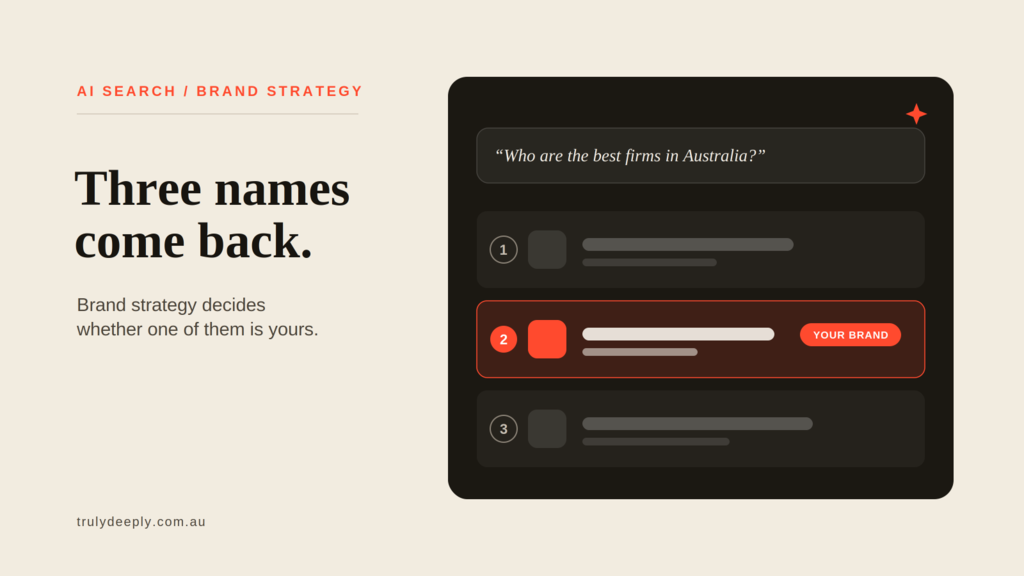
Your next client doesn’t search the way they used to. They ask Google or ChatGPT, “Who are the best firms for this in Australia?”
What comes back isn’t a page of blue links. It’s a confident, conversational recommendation that names three firms and says why each is worth considering.
If your brand is one of the three, you’ve just been handed an endorsement no paid ad could buy.
If it isn’t, you weren’t beaten on price, capability or pitch. You simply weren’t in the room, and you’ll likely never know the opportunity existed.
This is the new shortlist. And the uncomfortable truth for most brand owners is that the rules for getting onto it have very little to do with the tactics currently being sold to you.
The shift is already underway
The numbers are moving faster than most boards realise. ChatGPT is past 800 million weekly users. Google’s AI Overviews now appear on a meaningful and rising share of all searches.
Across the B2B world, the change is sharper still: research suggests the overwhelming majority of business buyers now use generative AI somewhere in their vendor research, and most say they trust the recommendations it gives them.
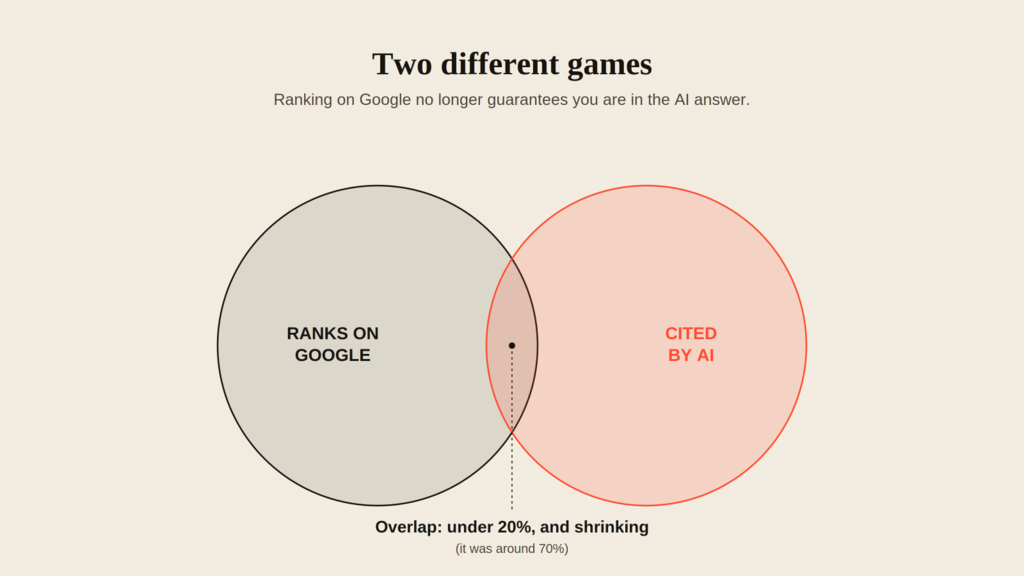
Here’s the part that should make you sit up. The overlap between the brands ranking on Google’s first page and the brands being cited inside AI answers has, by some estimates, collapsed from around 70% to under 20%. In other words, the work you’ve done to rank on Google does not automatically carry you into the AI answer. These are becoming two different games, and a lot of well-optimised firms are about to discover they’re invisible in the one that’s growing.
Why most of the advice you’re getting misses the point
A whole industry has sprung up overnight to sell you the fix.
It has a name, Generative Engine Optimisation, or GEO, and it usually arrives as a technical checklist: restructure your content, add schema, fix your robots.txt, write in extractable chunks, chase citations.
None of that is wrong. But almost all of it treats AI visibility as a plumbing problem. It isn’t. It’s a branding problem wearing a technical disguise.
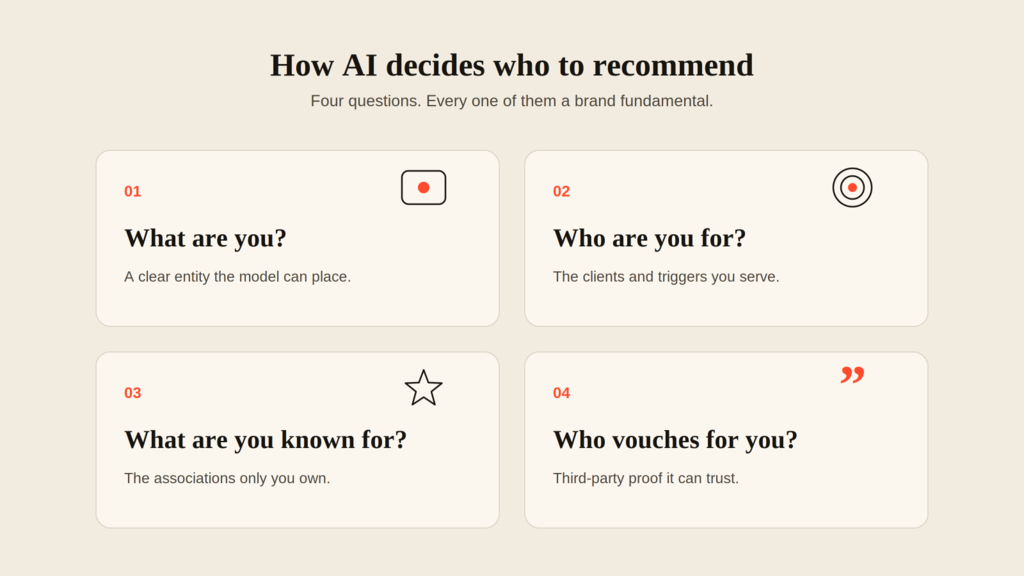
Strip away the jargon and ask what an AI engine is actually doing when it recommends a firm. It is trying to answer a human question with the most credible, relevant, well-understood options it can find. To do that, it has to be able to recognise what your brand is, who it’s for, what it’s known for, and whether anyone other than you says so. Those aren’t optimisation settings. They’re the four questions brand strategy has always existed to answer.
The brands that win in AI search are not the ones that gamed the format. They’re the ones the machine can understand clearly and corroborate confidently, because they were built that way.
How AI actually decides who to recommend
It helps to understand, in plain language, what’s happening under the bonnet.
When someone asks an AI a question, the model doesn’t simply paste it into a search box. It breaks the question into smaller sub-questions, gathers passages from across the web, and assembles an answer from sources it judges clear, relevant and trustworthy. Your brand can appear in that answer as a mention, a citation, or both.
Whether you make the cut comes down to a handful of things, and every one of them is a brand fundamental.
- Can it tell what you are?
AI models work with entities: distinct, recognisable “things” they understand. A firm with a sharp, consistently described proposition and identity is an entity the model can confidently place in a category and recommend. A firm that describes itself differently in every channel, hedges on what it does, or hides behind clever-but-vague language is a blur. Blurs don’t get recommended. - Are you connected to the right buying triggers?
Clients don’t enter a category in the abstract. They arrive with a specific need: we’re expanding into a new market, we’ve outgrown our name, our category is being disrupted. The firms that surface are the ones reliably associated with those moments. This is the science of category entry points, and it maps directly onto how AI assembles an answer: the more clearly you’re linked to the situations clients describe, the more often you’re the answer. - Does anyone else vouch for you?
This is where most firms come undone. A brand described only on its own website and a few low-authority blogs gives the model nothing to corroborate. AI engines lean heavily on third-party signals: earned media, reviews, expert commentary, conversations in places like LinkedIn and industry communities. Being talked about matters more than what you say about yourself. You cannot self-describe your way into an AI recommendation. - Are you distinctive, or are you wallpaper?
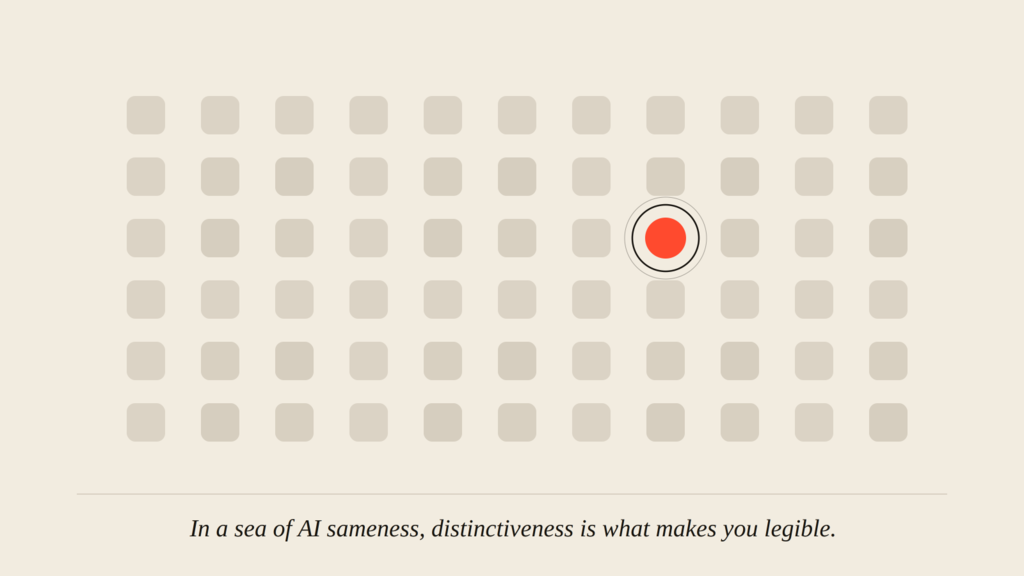
This is the quiet killer. Generative models are, by design, machines that produce the average. Feed them a category full of firms that all say “trusted,” “innovative,” “client-focused” and “end-to-end,” and they will blend you into an indistinguishable paste. The firms that get named are the ones with a genuinely different position and distinctive assets the model can latch onto. In a sea of AI sameness, distinctiveness isn’t a nice-to-have. It’s the thing that makes you legible.
The strategic payoff: AI rewards companies that invest in their brand
Notice what’s happened here. Entity clarity, strong category associations, third-party credibility, distinctiveness: these are not new demands invented by AI. They are the timeless markers of a well-built brand. AI search has simply turned them into a visibility mechanism with immediate commercial consequences.
There’s good evidence the market is already swinging back this way. McKinsey’s most recent research has CMOs naming brand as their number one priority, precisely because it creates distinctiveness and a clear value proposition. Kantar’s analysis of billions of data points found that brands seen as meaningfully different command several times the penetration of those that aren’t, and are far better placed to be surfaced, and chosen, in AI-mediated discovery. The machine, it turns out, has the same taste as the market. It rewards brands that are clear about who they are and meaningfully different from the pack.
Which means the firms most exposed by AI search are the vague ones, the “me-too” players who survived on being findable rather than being distinct. For them, this is a reckoning. For firms willing to do the strategic work, it’s the best argument in years for investing in brand properly.
How do you win in the AI world?
Resist the urge to hand this to your SEO team as a technical task. The highest-leverage moves are brand decisions.
Start by sharpening your entity. Be able to state, in one unambiguous sentence, what category you’re in, who you’re for and what you’re known for, then say it consistently everywhere your brand appears. Inconsistency is the enemy; a model that sees three different versions of you trusts none of them.
Get deliberate about the buying triggers you want to own. Map the real situations that bring clients into your category and make sure your brand is clearly and repeatedly connected to them, in your own content and, ideally, in others’. You’re building the associations the model will reach for when those situations come up in a prompt.
Then earn your way off your own website. Prioritise the third-party presence that gives AI something to corroborate: earned media, genuine reviews and case evidence, expert commentary, and a real voice in the communities and platforms your clients, and the models, pay attention to. A brand that others describe consistently is a brand AI can recommend with confidence.
And protect your distinctiveness fiercely. Keep your distinctive assets and your position consistent, and refuse the temptation to sand off the edges that make you recognisable. The pressure to optimise for the machine will quietly push you toward the category average. The firms that resist it will be the ones the machine can actually see.
Finally, measure it. The same way you’ve long tracked awareness and consideration, start tracking your presence in AI answers: your “share of model” across the prompts your prospective clients are actually using. You can’t manage a shortlist you never look at.
The key takeaway
It would be easy to read all this as a brand-new discipline demanding a brand-new playbook. It isn’t. AI search hasn’t changed what makes a brand strong. It has changed the stakes, and the speed, of getting it wrong.
The firms that get recommended by AI will be the ones that were already clear, already distinctive, already talked about for the right reasons. The technical work has its place, but it’s downstream. Upstream is the only question that’s ever really mattered: when someone in your category goes looking, whether they ask a colleague, a search engine, or a machine, is yours the firm worth naming?
Get that right, and AI becomes one more place your brand gets chosen. Get it wrong, and it becomes one more room you were never in.
Michael Hughes
Michael is Managing Partner and Strategy Director at Truly Deeply. Michael is passionate about helping businesses tell a compelling and authentic brand story so they can become distinctive enough to be chosen, by clients and by the machines they ask.
Want to find out more? Contact us.
[ad_2]
Source_link