3 ways to make media outreach more human.
As AI changes how people find information, one of the country’s oldest media brands is putting renewed focus on relationships.
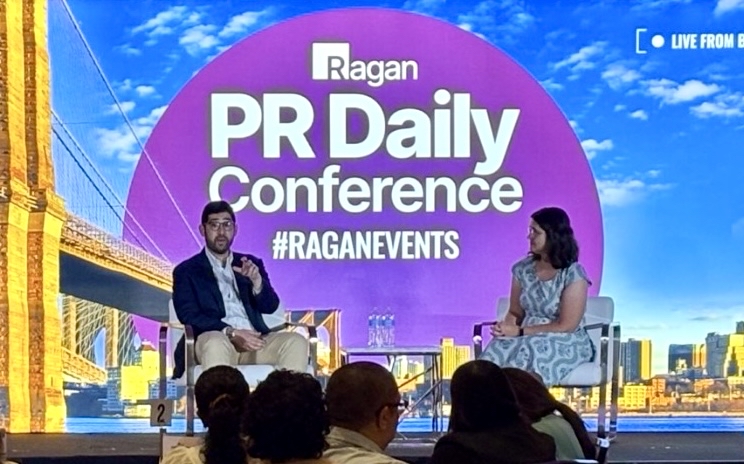
During Ragan’s PR Daily Conference, Time Editor-in-Chief Sam Jacobs said that AI is reshaping media distribution, but human connections remain one of journalism’s – and PR’s – most valuable assets.
“I think relationships need to be authentic,” Jacobs said, stressing that PR professionals should reach out with more than just a pitch. “I would like to hear from you when you don’t want something.”
Jacobs said brands need direct lines of trust with the people who shape perception. And while AI tools can be great for writing pitches, summarizing articles and generating content in seconds, the rise of automation is making genuine relationships stand out even more.
Pitch thoughtfully. Mass emails are noticed quickly.
When discussing outreach from PR pros, Jacobs said journalists can easily decipher a well-researched, tailored pitch from a mass distributed one.
“I can tell really quickly if this is an authentic, thoughtful human outreach,” he said. “And I can tell when maybe your client has said to you, ‘I need you to send 100 emails.’”
Personalization has become even more critical as newsrooms and coverage continue to shrink, Jacobs said.
“If your only outreach to Time or a Time journalist is to say, ‘Cover my company,’ and that is all we’re hearing from you, then it doesn’t really feel like an authentic relationship,” he said.
Instead, he appreciates hearing real feedback and seeing that someone has taken the time to read the publication.
“If I hear from someone to say, ‘Hey, I love that story,’ I feel, ‘Oh, this is a person, a reader. This is actually part of our audience.’”
Jacob’s advice:
- Build the relationship before the ask. React to coverage, share useful context and show you are paying attention when you are not pitching.
- Pitch fewer people and look at what they’re writing about. A thoughtful note will stand out more than a media blast.
- Make the story matter to the journalist’s audience. Lead with the person, tension or example that makes the story relevant to their coverage areas.
Trust matters most when coverage is complicated.
Trust is also built through repeated interactions, Jacobs said.
“Every time a reporter from Time calls you or you deal with someone from Time, that is an opportunity for us to build trust,” he said.
This is something that cuts both ways. Journalists build trust by being accurate, fair and transparent. Communicators build trust by being responsive, prepared and honest, especially when the story is difficult, he said.
Strong media relationships are tested when the story is complicated, sensitive or not entirely favorable.
Jacobs recalled advice from a former colleague when he was told it’s better for a journalist to call the subject of a story the night before and have them “choke on their steak” than let them “throw up their breakfast,” he said.
His point was not that sources should control coverage, Jacobs said. The point was that people should not be blindsided and tough stories are easier to navigate when there’s an established relationship.
“Sometimes we’re gonna be in moments with PR professionals where they’re really unhappy with me…But I want to be able to show up and say, you know, you’re gonna see me today in a way that you feel like maybe this isn’t a great feeling, but next year, we’re gonna be at another outing to work together, and I think that’s how you build that trust.”
AI makes relationships more critical.
The rise of AI adds more pressure to good relationships.
Jacobs said audiences are turning to AI tools for information over traditional search.
“The vast majorities of our audience now are moving away from Google and thinking about things simply through an AI interface,” he said.
This is a shift that has changed distribution, Jacobs said. It also increases the value of direct relationships. If audiences are getting information through AI summaries and social feeds, brands need stronger trust with the journalists and experts who help explain what’s true and why it matters.
Technology can make your work faster and more efficient, but it cannot make a journalist trust you or prove that you understand their audience, Jacobs said. It cannot replace the credibility that comes from showing up when there is no immediate ask.
“We’re all part of this thriving ecosystem that doesn’t work without each other,” he said.
Courtney Blackann is a communications reporter. Connect with her on LinkedIn or email her at courtneyb@ragan.com.
The post Time’s editor-in-chief on AI, relationships and what makes a good pitch appeared first on PR Daily.