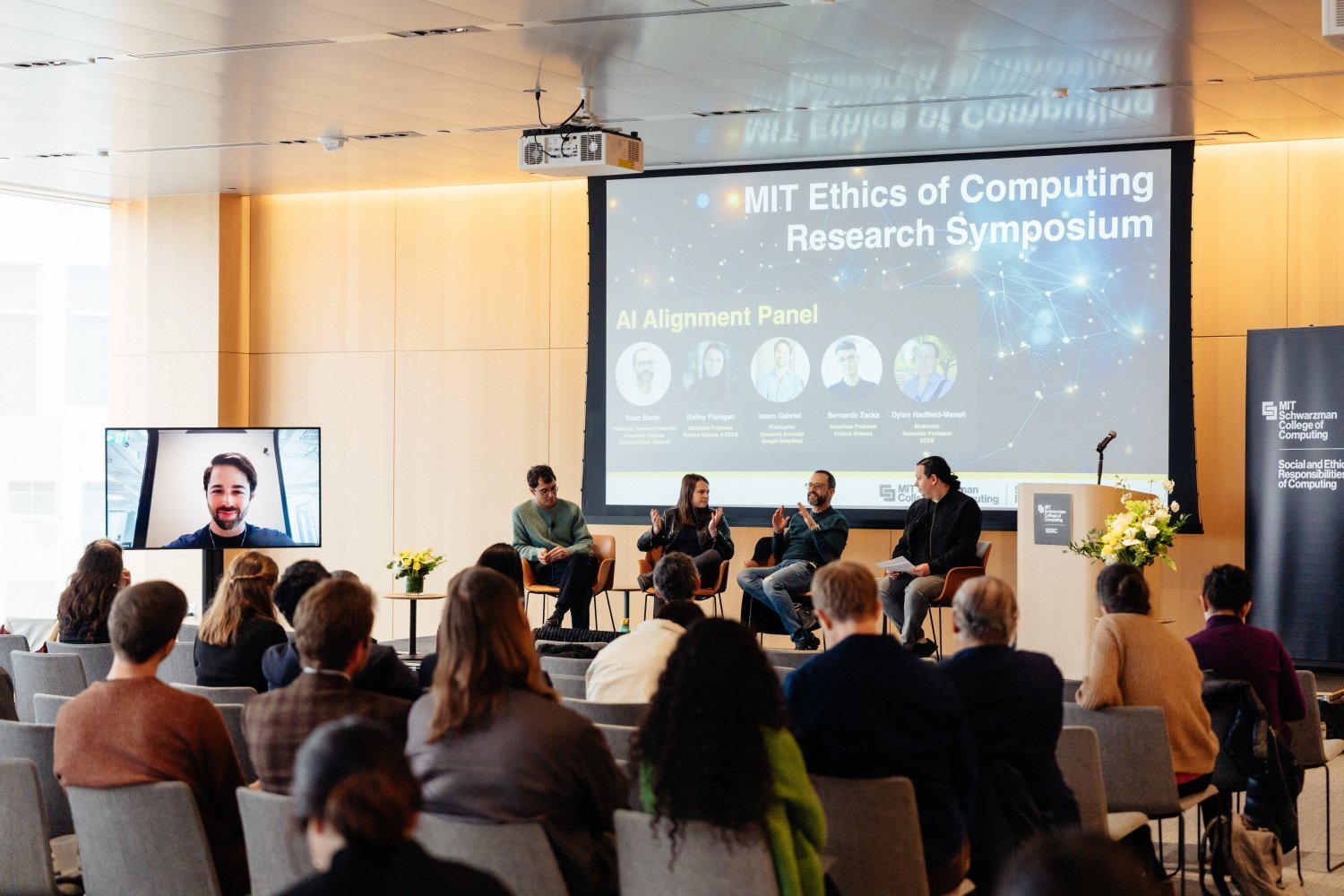

On April 30, the MIT Schwarzman College of Computing’s Social and Ethical Responsibilities of Computing (SERC) initiative hosted a full-day research symposium examining how artificial intelligence is shaping the world and its implications for society.
The symposium included research talks by SERC’s latest seed grant recipients on topics such as air pollution forecasting and responsible computer vision deployment, panels on AI alignment and AI in education, and a keynote address by Jon Kleinberg PhD ’96, the Tisch University Professor of Computer Science and Information Science at Cornell University. The event also featured a poster session, where student researchers showcased projects they worked on throughout the year as SERC Scholars.
“There is so much amazing research being done at MIT on how AI and computing can be forces for good that benefit humanity. It was inspiring to see so much community interest in all this cutting-edge work,” said Brian Hedden, co-associate dean of SERC and professor of philosophy, who holds an MIT Schwarzman College of Computing shared position with the Department of Electrical Engineering and Computer Science (EECS).
“As computing and AI become increasingly embedded in nearly every dimension of society, SERC’s mission is to help ensure that ethical reflection and technical progress advance together,” said Nikos Trichakis, co-associate dean of SERC and the J.C. Penney Professor of Management. “This year’s symposium highlights the extraordinary range of work underway across MIT, and creates a forum for our community to engage deeply with the responsibilities that come with shaping the future of computing.”
Aligning AI with human values — and what values those might be
The challenges with AI alignment and moral meshing lie in the ethical questions of how to instill “human values” onto a very powerful and rapidly changing technology. Who makes the decision on what values and rationalities are included in an ethical framework? How does one account for distortion when translating these values from user to machine?
These questions, among others, were posed by Dylan Hadfield-Menell, associate professor of EECS, during a panel he moderated that brought together an interdisciplinary group of speakers.
Iason Gabriel, a philosopher and research scientist at Google DeepMind, used the example of a judge to illustrate his point. “You want a judge to have good character, but to still interpret the rules. A reasonable person, though not necessarily the best person who ever lived. When it comes to AI, it’s not appropriate to model it as perfect. AI should be doing what we tell it to do, while using its character to interpret according to our moral values.”
Bailey Flanigan, assistant professor of political science in a shared appointment with the MIT Schwarzman College of Computing in EECS, took this a step further. To her, the most important problem to AI alignment is “resolving fundamental questions on who is entitled to govern different types of AI systems in the first place.”
Joining Flanigan on the panel was Bernado Zacka, associate professor of political science. Given the momentum of AI and complex institutional designs, Zacka expressed, “one of the most urgent problems is understanding the wisdom contained in the systems we are replacing, and why they function the way they do.”
As deployment pressure increases, it can often feel like people are building the plane as they fly it, although the panelists overall seemed optimistic about the trajectory of AI alignment, emphasizing how crucial human components are to shaping these systems.
Offloading versus uplifting
As students across all levels of education begin to use AI, questions arise on whether there’s a way to ethically incorporate AI tools while maintaining academic accuracy and rigor. At a panel on AI and education, MIT faculty and Marta McAlister, the director of Gemini for Education, explored how AI is already being used in their classrooms and discussed ways it can support learning while remaining aligned with instructional and curricular goals.
Professors Eric Klopfer and Samuel Madden, co-chairs of MIT’s Ad Hoc Committee on AI Use in Teaching, Learning, and Research Training, homed in on a central dilemma of whether AI is being used to offload work, rather than being used to help scaffold the concepts being taught.
Madden, faculty head of computer science in EECS and the MIT College of Computing Distinguished Professor, described the process of cognitive struggle, whereby learning is done through a series of trials and failures. He said, “students now, when they hit that wall, their first instinct is to ask AI. They don’t see this as excelling in this process, and they haven’t actually acquired the skill you’re assessing.” The question then becomes how instructors maintain the process of cognitive struggle so it provides just enough of a challenge to combat the urge to use AI.
Klopfer, who serves as director of the Scheller Teacher Education Program and the Education Arcade at MIT, echoed similar sentiments, in that critical thinking is no longer becoming a crucial step in the output of the work. Regarding where to start in keeping material just challenging enough, Klopfer suggested examining the curriculum as a whole. “Some core content has to go. We keep adding, instead of parsing or pruning,” he said.
Moderator Justin Reich, director of the Teaching Systems Lab and an associate professor in the Comparative Media Studies Program/Writing, noted that while teens know that AI is bad, it doesn’t necessarily stop their AI usage. However, by inviting them into the discussion on how AI is implemented and incorporating a more reflective exchange with instructors, students could be more equipped to choose how they use these tools and why.
Regardless, AI tools and their implementation should not be treated as a one-size-fits-all policy. Pat Pataranutaporn, the Asahi Broadcasting Corporation Career Development Professor of Media Arts and Sciences and head of the Cyborg Psychology research group at the MIT Media Lab, said, “AI is not just one thing. It can and should be designed differently to promote things like creativity and critical thinking. What we measure, and how, shouldn’t be about getting the answer right. We should think about it would really mean for a student to learn these days.”
Is mimicking human reasoning just as good as the real thing?
With a slide deck that included chess grandmasters and film references, Kleinberg’s keynote address, titled “AI’s Models of the World, and Ours,” evaluated instances where AI systems have inadvertently set us up to fail due to a mismatch between the system’s model of the world and ours.
To illustrate this point, Kleinberg used chess, where modern chess engines can compete at superhuman levels, but when paired with human partners, their strategies aren’t understandable or inferable to their human counterpart. These human handoffs would then lead to confusion. Kleinberg used the example of “The Fellowship of the Ring,” where Gandalf, a powerful wizard, entrusts a highly dangerous and important quest to a ragtag group of adventurers. For those familiar with the story, the group is unexpectedly left without Gandalf’s guidance, sending them into a temporary bout of very serious turmoil.
When the chess engine hands a turn over to its human partner, the human struggles to pick up on the predictive move pattern that the engine has been following up until this point. “The danger of human-algorithm teams is that when the human takes over, the algorithm knows what it wants to do next, but the human doesn’t,” explained Kleinberg.
These analogies showcase the differences in the ways AI understands a world — through predictive simulations, pattern recognition, and constraints — to mimic human reasoning versus the innate, embodied knowledge that comes with the human experience, and whether these systems truly understand the worlds in which they’re operating. But the question remains that if the game still results in a checkmate, does it matter?