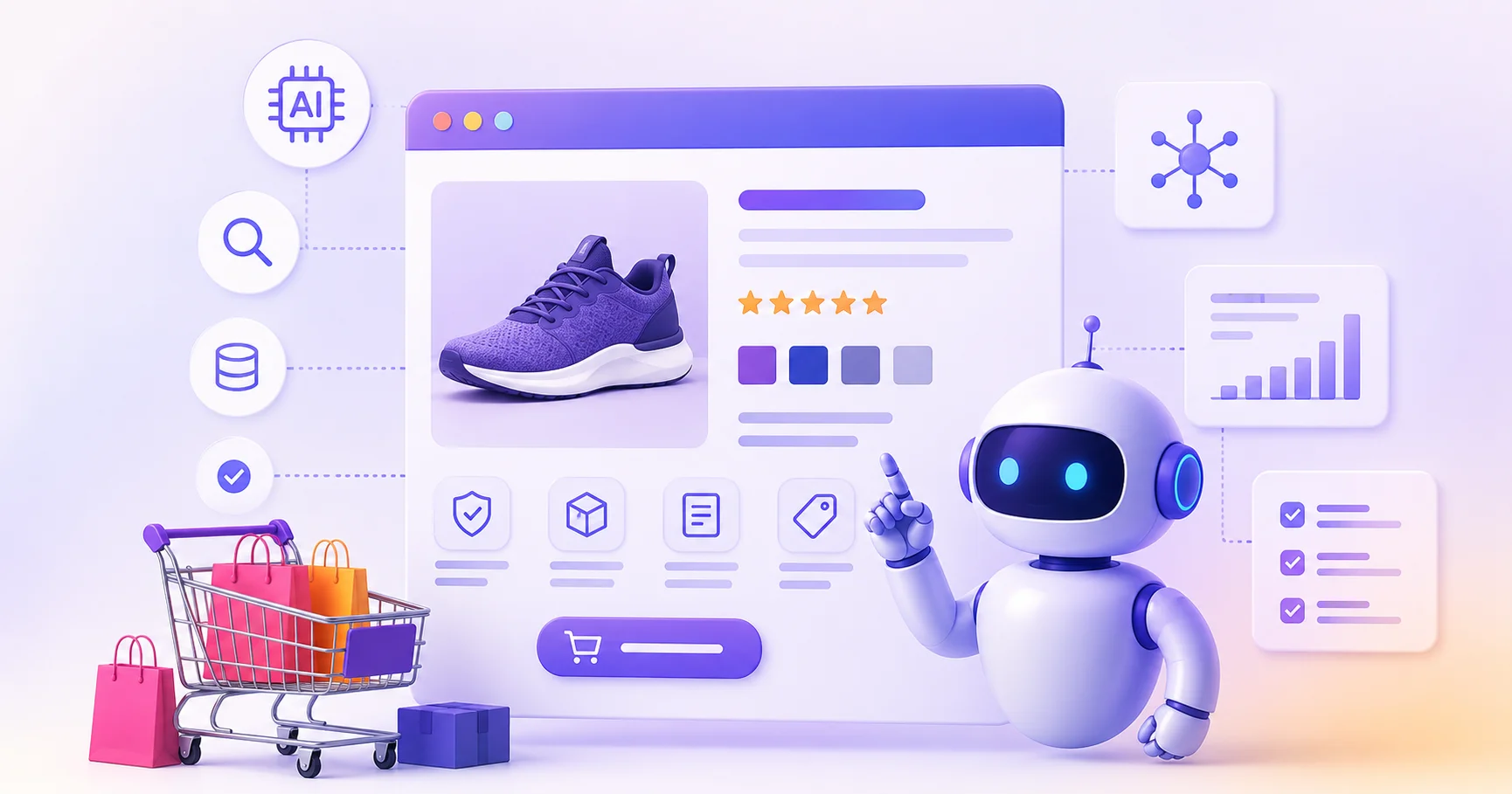
The way people shop online is changing fast. Instead of typing a query into Google and clicking through a list of links, more and more shoppers are asking AI agents like ChatGPT, Google Gemini, or Perplexity to do the legwork for them. These agents browse, compare, and recommend products on their own. And if your product pages aren’t built for them to read and understand, you’re simply not in the running.
McKinsey projects that agentic commerce will reach $1 trillion in the U.S. and $3 to $5 trillion globally by 2030. That’s a number too big to ignore.
So what does it actually take to get your product pages ready? Let’s break it down.
What Is Agentic AI?
“Agentic AI refers to AI systems that don’t just answer questions; they take action. A user tells the AI what they’re looking for, and the agent goes out, evaluates options, and returns a recommendation or even completes a purchase. The business that gets surfaced in that shortlist is not necessarily the one with the biggest ad budget or the most backlinks. It’s the one whose data the AI could actually read, interpret, and match against the user’s criteria.
That’s the key shift here. Traditional SEO was about getting humans to click. Agentic AI optimization is about getting machines to recommend.
How AI Agents Read Your Product Pages

AI agents don’t navigate the web like human shoppers. They don’t scroll through search results, compare tabs, or bookmark products for later. Instead, they evaluate products based on structured data, operational signals, and content quality, then surface the best matches directly in conversational responses.
If your product data doesn’t meet that threshold, your products simply don’t enter consideration.
Think about it this way: a human might overlook a missing spec or forgive vague copy. An AI agent won’t. It needs clean, complete, machine-readable information to confidently recommend your product.
Step 1: Add Structured Data (Schema Markup)
This is the single most important thing you can do. Structured data is a way of tagging your product information in a format that AI systems can read instantly, things like price, availability, brand, SKU, materials, and dimensions.
A page mentioning “margherita pizza $12” becomes, thanks to Product markup, a complete product sheet with price, availability, and technical characteristics. Search engines immediately understand that it’s a dish, its price, and its description. The same logic applies to any product you sell.
Use JSON-LD. Every AI engine prefers it because it’s cleanly separated from your HTML and easier to parse programmatically. Google’s official guidance explicitly recommends JSON-LD for AI-optimised content.
For e-commerce pages specifically, the must-have schema types in 2026 are:
-
Product schema, name, description, brand, SKU, GTIN, images, materials
-
Offer schema, price, currency, availability, item condition
-
Review schema, ratings and sentiment data
-
MerchantReturnPolicy, required field for Google Merchant Listings since 2025 Xictron
Pages with a complete Product schema see a +74.1% CTR lift when price, rating, and availability are displayed together. Alhena
Step 2: Write for Machines, Not Just Humans
Most product descriptions are written for humans, compelling, emotional, and keyword-heavy. That’s still useful, but it’s not enough.
A traditional SEO-optimised product page might include “comfortable running shoes” several times to rank for that keyword. An AI agent, however, needs structured attributes: heel-to-toe drop (8mm), cushioning type (gel-based), arch support (medium), weight (9.2 oz), materials (engineered mesh upper), intended use (long-distance running), and washing instructions.
Go through your product descriptions and ask: What would an AI agent need to know to confidently recommend this product? Add use cases, compatibility details, dimensions, and specifications.
Step 3: Keep Your Inventory Data Accurate in Real Time
AI agents rely on live, accurate data. If your page is showing “In Stock” but the item is sold out, the agent will skip your product and deliver a bad experience because this duality damages trust.
Inconsistent or outdated data causes AI agents to ignore or misrepresent your products. So be on the safe side and conduct a full audit of your inventory management system, implement real-time syncing between your warehouse and product pages, and test how quickly stock changes appear.
Step 4: Build Trust Signals Into Your Pages
AI agents don’t just look at product data; they assess whether you’re a trustworthy seller.
Key ways of improving trust: Customer reviews and ratings: AI systems use review schema to analyse sentiment and surface well-reviewed products. Consistent brand information, your brand name, logo, and contact details should be consistent across your site and schema. Clear return and shipping policies: these are now required fields in Google’s product schema, and AI agents use them to filter recommendations
Step 5: Think in Terms of AEO, Not Just SEO
You may have heard the term “Answer Engine Optimisation” (AEO). It’s worth understanding because it captures exactly what’s changing.
SEO prioritises pages. AEO prioritises answers and attributes. SEO rewards domain authority. AEO rewards data clarity and completeness. SEO results are links. AEO results are recommendations, sometimes without a click involved at all.
This doesn’t mean you abandon SEO. Traditional SEO still matters for Google traffic. But if you want to be visible to the growing wave of AI-assisted shoppers, your product pages need to be built for answers, not just rankings.
Step 6: Keep Your Schema Updated
Many brands skip this step, but this is one of the most important steps to follow. Schema.org implementation is not a one-time task. Every theme update, every new plugin, and every product range change can break structured data. Set up regular monitoring through Google Search Console.
In late 2026, AI systems are expected to cross-reference schema claims against live sources, penalising inaccurate schema rather than ignoring it. Getting ahead of this now is worth the effort.
Conclusion
Getting your product pages ready for agentic AI is not a future-proofing exercise. It’s an immediate competitive advantage. For brands not optimising their websites and content to be seen and cited by AI, this represents a significant missed opportunity. There are many ecommerce website development company in Bangalore that offer this service. When AI user agents search for information on behalf of users, slow-loading sites or poorly structured content means your brand simply doesn’t appear in the conversation.
The brands that win agentic commerce will be the ones whose product data is clean, complete, and machine-readable. You don’t need a massive budget to do this; you need the right structure. Bangalore becomes one of the best places to do find this service because there are many of the best ecommerce website development companies in bangalore and any one of them will surely match your needs and budget.
Start with your top 10 product pages. Add a JSON-LD Product schema. Fill in every attribute you have. Keep it accurate. Then scale.
The AI agents are already shopping. Make sure they can find you.