![How to do an SEO competitor analysis [+ template]](https://mgrowtech.com/wp-content/uploads/2026/05/seo-competitor-analysis.png)
Analyzing your competitors helps you develop your own SEO and AI optimization strategy. This process includes analyzing their traffic, content gaps, and AI visibility to help you understand what’s working for brands like yours.
In this guide, we’ll break down what a competitor analysis involves in more detail, and why you should conduct one for your business.
What is an SEO competitor analysis and why is it important?
An SEO competitor analysis is the process of analyzing the performance of websites you compete with in search engine results pages (SERPs).
But the analysis is no longer just limited to organic search listings. Many search queries return AI-generated answers through Google’s AI Overviews and AI Mode. And lots of people turn to other AI tools, like ChatGPT and Perplexity, in addition to traditional search engines. So it’s also important to factor in how your competitors perform on these platforms during your analysis.
Whether you’re a small business owner or an enterprise marketer, an SEO competitor analysis allows you to:
- Identify the keywords or AI prompts where you need to be more visible
- Find traffic channels you may be overlooking
- Uncover segments of your audience you may be missing based on the content they’re publishing
- Create a content calendar using the content gaps between you and your competitors
- Discover third-party websites that link to your competitors and could link to you
- Find online communities that talk about your competition but not you
The point of a competitor analysis isn’t to copy your rivals’ strategies. Instead, it’s to understand what works for them and to find ways to apply that to your own unique strategy.
Using Semrush’s My Reports, you can easily build a competitor analysis report with templates for AI visibility, organic search positions, domain comparisons, backlinks, and more.

But we’ll also show you how to do this analysis manually below.
How to do an SEO competitor analysis
An SEO competitor analysis has always been a detailed process. But AI search has expanded the number of surfaces your analysis needs to cover.
The sections below will show you how to do a competitive analysis using multiple sources. This ensures you cover all the surfaces your competitors are currently winning on.
Make a copy of this free template to follow along with the steps below.
Step 1. Identify your SEO competitors
Find your SEO competitors by looking at the websites that appear alongside yours in relevant search results. They might be direct business rivals or just organic competitors.
For example, a direct competitor of Men’s Health is Men’s Fitness because both are magazines in the same industry. Gymshark is one of Men’s Health’s organic competitors because it competes for the same keywords, even though Gymshark is in a different industry (clothing).
Compile a list of both direct and organic competitors. You can identify your organic competitors easily by looking up your most relevant keywords in search engines and AI platforms. Then, note the websites that appear the most often.
For example, if you were doing a competitive analysis for Men’s Health magazine, you might search for the following:
- “best magazines for men”
- “best fitness magazine for men”
- “fitness plan for men”
- “nutrition for men”
Use the same keywords to search on Google, YouTube, AI platforms, and Reddit. This way, you’re not limited to the data of just one platform.

But the fastest way to identify your organic competitors is to use Semrush’s Domain Overview tool.
Simply search for your domain and scroll down to “Main Organic Competitors.”
You’ll see a list of domains that rank for many of the same keywords as you. Click “View details” for an in-depth overview, including competition level and the total number of keywords they rank for.

Aim to analyze around three to five competitors to start with. This will give you enough data to work with for the competitive analysis, while keeping things relevant and manageable.
Step 2. Analyze your competitors’ traffic
Analyzing your competitor’s traffic helps you identify overall traffic trends, which pages are driving the most visitors to their website, and places they’re getting traffic from that you’ve been overlooking.
Analyze traffic trends
Analyze your competitors’ traffic trends and which of their pages drive the most traffic to find opportunities to drive more traffic to your own site.
Since you don’t have access to their actual traffic data, you can use Semrush’s Domain Overview to get estimates for organic and branded traffic.

Branded traffic trends can indicate whether your competitors are gaining or losing brand awareness. If branded traffic is increasing, it suggests more people are discovering them through other channels and looking them up directly. Rather than searching for related terms they happen to rank for.
You’ll also see your competitor’s keyword rankings over time, filterable by position. For Men’s Health, we see a downward trend in keyword rankings that correlates with a decrease in organic traffic.

When you spot a downward trend for a competitor, identify whether the decline comes from:
- An industry-wide drop: This usually points to a Google algorithm update or an increase in the number of queries being answered by AI Overviews (leading to a drop in clicks). If your own traffic moved similarly, competitor drops might not represent immediate opportunities.
- A drop isolated to one competitor: If this is the case, look at which pages lost rankings and whether those pages target keywords you’re actively going after. If they do, there could be traffic opportunities here.
If the trend is upward, identify when the growth started and whether it coincides with an algorithm update, a new content push, a spike in branded search, or something else. For example, if the growth is associated with new topic clusters, you may want to create similar content for your own site.
Analyze traffic sources
A modern SEO competitive analysis needs to look beyond just organic traffic from search engines. Looking at other traffic sources, like AI referrals, can uncover channels you aren’t yet leveraging that your competitors are.
For a deeper dive into multiple traffic sources at one time, use Semrush’s Traffic & Market Toolkit. It provides traffic insights from:
- AI sources
- Referrals
- Organic and paid search
- Organic and paid social
- Display ads
The tool also shows you trends for these over time.

You can dig into specific channels even further for more specific insights. Like which specific AI tools are sending your rivals referral traffic, how those sources have trended over time, and even the specific pages that are seeing the most growth from those traffic sources.

This is helpful for identifying new channels that could drive traffic to your own website. And by seeing which pages perform well for your rivals, you can gain insights into the types of content you may also want to create.
Step 3. Analyze your competitors’ keyword footprints
To analyze the keyword footprint of your competitors, identify all the search terms they rank for, the topic clusters they belong to, and how your own rankings compare.
Run a keyword gap analysis
A keyword gap analysis shows what your competitors rank for but you don’t.
You can do this quickly by using Semrush’s Keyword Gap tool. Add your domain and your competitor’s, then click “Compare.”

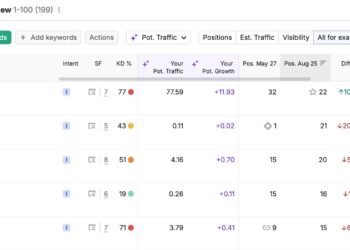
Scroll down to the “All keyword details for” section and select “Missing” to see all the keywords your domain doesn’t rank for, using the “Position” filter at the top to only show keywords your competitor ranks for in the top 10.
Use the other filters to narrow down your list further, for example using the “Intent” filter to only show keywords with commercial or transactional intent.

Look for keywords that are relevant to your own business offerings. Don’t just focus on search volume or keyword difficulty. These are useful metrics for rough prioritization. But an “easy” keyword with 2K monthly search volume isn’t worth targeting if there’s minimal chance of it leading to conversions.
Add relevant keywords to a spreadsheet, and when you’re finished, download it as a CSV file.
Segment the keywords into clusters
Now that you have a list of keywords your competitors rank for but you don’t, group them into thematic clusters to understand the topics they’re covering.
To do this, upload your CSV with the keywords to your favorite AI tool and add the prompt below:
“This CSV file contains a list of keywords my competitor [NAME] ranks for, but my website doesn’t. Each keyword contains its search intent, average monthly search volume, and keyword difficulty. Analyze the file and extract the main topic clusters the website targets.”
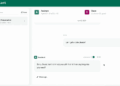
When the AI analysis is complete, you should get a result similar to this:

Use this information to decide on the topics where you need to strengthen your visibility.
Step 4. Check your competitors’ AI visibility
Check your rivals’ visibility in AI features like Google’s AI Overviews and AI Mode to understand what’s working for them beyond standard organic rankings.
Do this with the Semrush AI Visibility Toolkit to track your visibility compared to your competitors over time, and to see what specific prompts they appear for that you don’t.
Start with the Competitor Research report. Enter your domain and up to four competitors to see your visibility, audience size, and number of mentions over time. Use the platform selector to choose AI Overview or Google AI Mode specifically.

Scroll down to the “Topics & Prompts” section and click the “Missing” tab. This shows you all the prompts your competitors are appearing for that you’re not, sorted by topic. See the individual prompts you’re missing visibility for by clicking into a given topic, and click “View full response” to see the AI response to the prompt.

Look for prompts that are relevant to your business that you don’t currently appear for. These are prompts you can optimize for within existing content, or you can create new content around them.
Note: To go further with this part of the analysis, check out our guide to finding AI visibility gaps.
Step 5. Reverse engineer your rivals’ winning pages
Reverse engineering what’s working for your competitors helps you understand why their key pages are performing well in search and AI.
When choosing which pages to analyse, look for:
- Pages that rank in the top 10 for their target keywords and drive a lot of traffic
- Pages that are most cited by AI search platforms
Once you know which pages are driving your competitors’ traffic, look into your rivals’ editorial and structural decisions to understand why those pages perform well.
How they interpret the topic
Start with the angle. Is the competitor taking a strong position, or producing a neutral overview? Are they writing for a specific audience segment (a CFO, a first-time buyer, a developer) or keeping it generic?
If you’re creating or updating a similar page, this analysis can inform the audience you might want to speak to. It also helps you understand what’s already out there, and where you may need to differentiate your content to outrank your competitor.
How they structure the page
Next, map the H2s on your competitors’ top pages. This can show you subtopics the competitor is targeting within their content. You shouldn’t just blindly copy this, but if you see several high-ranking competitors structure a page in similar ways, that structure is likely what Google is rewarding.
Look at format choices too. Are they using comparison tables, step-by-step processes, original data, or proprietary frameworks? Original research can attract backlinks (which can help the page rank higher), while a strong, unique framework gives readers something to remember and AI tools something to cite.
How they write title tags
Next, check how competitors frame the page in search results. Does the title lead with the primary keyword? Do they use numbers, modifiers like “guide” or “checklist,” or audience-specific qualifiers? These choices reflect how they’re interpreting what the searcher wants, and this can help you understand how to write your own title tags to stand out in search results.
How they signal trust and authority
Finally, look at how competitors establish credibility on the page. Do authors have bios with credentials specific to the topic? Is the content citing original sources, proprietary data, or expert quotes?
Step 6. Analyze your competitors’ backlinks
Analyze your competitor’s backlinks to find opportunities to build links to your own site and boost your authority. First, look at trends to understand your rivals’ link building efforts, then run a backlink gap analysis.
Backlink acquisition trends
Look at backlink acquisition trends to determine if your rivals are investing in link building, or whether their content is attracting links organically.
To find these trends, use Semrush’s Backlinks tool to run an audit for a rival domain. Pay attention to the following graphs:
- Authority Score Trend: An estimate of how much a domain’s overall authority changed over the past year
- Referring Domains: Displays changes in the number of unique websites linking to your competitor over the last year
- Backlinks: Shows the number of links from other websites to your competitor over a 12-month period
If you see a rapid increase in any of the three graphs, it could indicate that your rival has been running a successful link building campaign.
Run a backlink gap analysis
A backlink gap analysis finds domains that link to your competitors but not you.
In Semrush’s Backlink Gap tool, you can compare yourself and up to three competitors at once.
Add your domain and your rivals’, click “Find prospects,” and the tool will return a list of sites linking to your rivals but not to you.

For each referring domain, you can click on the number of backlinks in your competitor’s column. This will pull up the list of referring pages and the competitor URLs they link to.

Select the domains you want to reach out to and click “+ Start Outreach” and then “Send prospects” to save them to your SEO project.

Step 7. Explore your rivals’ off-site presence
Analyzing your competitors’ off-site presence helps you find opportunities to build brand awareness and trust signals that search engines and AI platforms can use to learn more about your business. This can increase your chances of ranking higher and being mentioned or cited in AI-generated responses.
Social media
Dig into your competitors’ social media presence by analyzing their posting frequency, top platforms, user engagement levels, and promotional angles they use.
Social media presence isn’t a Google ranking factor. But social media posts can appear in search and AI results. So, if your rivals have a larger social media presence than you, they may be appearing in search results and AI responses that you’re not.
If your competitors post multiple times per week, it’s a sign social media may be driving meaningful engagement and results for them. Look at their top-performing posts to understand the kind of content they share that resonates with their audience.
Further reading: How to perform a social media competitor analysis in 6 steps
Community reach
Your audience likely uses multiple community platforms to research brands and talk about their issues, not just individual brand websites.
Competitors may be using these platforms to improve their visibility, so you need to analyze where they’re present, and where you should be present too.
Here’s an example using Reddit:
Go to Google, and enter “site:reddit.com” followed by the name of your competitor.

The search results will show Reddit threads that mention your rival. Note the sentiment and whether the competitor runs its own subreddit or participates in community discussions.
What do users highlight as the top benefits of your competitor? This provides insights into reasons potential customers might choose your rivals instead of you.
What do users highlight as pain points around your competitors’ products? These are areas you can focus on with your product/service, content, and messaging to present your brand as the better choice.
Step 8. Review your competitors’ local SEO (if applicable)
If you compete with other businesses in a specific geographical area, factor local SEO into your competitive analysis. Do this by reviewing their Google Business Profile (GBP), reviews, and visibility for local searches.
For each of your direct competitors, check if they have a GBP set up. Then, dig into the reviews to uncover:
- Frequent complaints
- How the business handles complaints
- What customers appreciate
This information helps you provide a better service by learning from competitors’ mistakes, and understanding what works for them so you can replicate it.
In addition to analyzing reviews, measure your competitors’ visibility in local searches. For example, if you have a dog grooming business in San Francisco, you might audit competitor visibility for queries like:
- Dog grooming in San Francisco
- Pet groomers in San Francisco
- Dog groomers near Pacific Heights, San Francisco
For these queries, log which competitors show up and where they rank in local search results compared to you.
Then, repeat this process in AI platforms, noting which competitors appear, who is listed first, and how the AI summarizes each business.
Turn your competitive SEO analysis insights into an action plan
The eight steps we’ve covered above should give you extensive insights into your competitors’ visibility across search and AI platforms. You should understand their strengths and weaknesses, and have a good idea of where to focus your content strategy to get and stay ahead.
Use the data to build an action plan that supports your goals, using the “Action Plan” section in the template as a jumping-off point.
To get continuous competitor insights, set up Semrush’s My Reports tool and start with one of the SEO competitive analysis templates. For example, the “Monthly Competitor Analysis” template breaks down competitor traffic performance, backlinks, paid search, and social media.

Get started with a free trial today.