In omni-channel marketing, we often treat online and offline experiences as two entirely separate worlds. We optimize for website clicks, cart additions, and digital conversions, while physical storefronts operate on traditional local advertising and bringing in traffic to the store. The real magic happens when marketers bridge the gap between digital exposure and physical foot traffic.
A prime example of this is a notable campaign illumin executed for the iconic sports equipment and lifestyle brand, Oakley. Facing the challenge of driving foot traffic across 172 stores in 41 states, Oakley designed a display advertising campaign that demonstrated how geo-targeting, real-time optimization, and data-driven agility when combined together turns into a masterclass paid campaign.
By looking into their six-week campaign, marketers can glean valuable insights on efficiently converting digital impressions into physical footsteps.
Here is an analysis of the strategy, the execution, and the core educational takeaways from Oakley’s omni-channel success.
The challenge: scaled localization
Driving traffic to a single flagship store is a manageable data exercise. Driving traffic to 172 distinct locations spread across 41 unique state markets is an entirely different scale of complexity.
Oakley had two main objectives:
- Increase physical store visits using a highly cost-efficient programmatic framework.
- Maintain a healthy, robust click-through rate (CTR) online to ensure that the ad creative was actively building brand equity and engagement, not just serving as passive background noise.
To achieve this, the team at Oakley needed a framework that provided deep visibility into the consumer journey alongside real-time attribution data. Without immediate feedback on whether an ad actually resulted in a store visit, optimizing the campaign would be impossible.
Too often, local advertising relies purely on radius targeting (e.g., “show this ad to anyone within 5 miles of the store”). While location matters, intent and behavior matter more.
Oakley partnered with the journey advertising platform illumin, alongside location intelligence partner Cuebiq, to build a more sophisticated targeting matrix. The strategy was built on three core phases:
1. Multi-Layered audience testing
Instead of guessing which audience would respond best, Oakley initiated the six-week campaign by casting a strategic net across three distinct buckets:
- Open audiences (a broad reach approach to capture top-of-funnel awareness)
- Third-party audiences (demographic and interest-based segments related to sports and lifestyle).
- Verified location-based segments (consumers whose real-world historical foot traffic data showed they frequented similar retail environments or fit the exact profile of an ideal Oakley shopper)
2. Identifying and leaning into the “winner”
Within the opening days of the campaign, the data revealed a clear narrative. While broad third-party audiences were generating impressions, the verified location-based segments were driving actual, measurable store visits at a significantly higher rate.
Rather than letting the campaign run its course on autopilot (a common practice in programmatic advertising) the team immediately shifted budget away from underperforming segments and poured it directly into the high-impact location audiences.
3. Aggressive micro-optimizations
With the target audience locked in, the final layer of the strategy focused on efficiency. Since illumin’s platform allows for tracking cost-per-visit metrics in real-time, the team optimized geo-targeting parameters and ad placements. If a specific geographic cluster or ad creative was bringing down efficiency, it was adjusted or paused immediately.
The results of Oakley’s omni-channel campaign highlighted the profound difference between unoptimized programmatic buying and active, data-driven management:
- From $332.35 to $5.35 Per Visit: On day one of the campaign, before any data had been collected or optimizations made, the initial cost per in-store visit was a staggering $332.35. By continuously removing underperforming segments and refining the geo-targeting based on real-time foot traffic data, that number plummeted to $5.35 by the final day of the campaign, a cost reduction of over 98%.
- Sustained Digital Engagement: Despite shifting the primary focus toward offline visits, the digital health of the campaign remained entirely intact. The campaign maintained a consistent 0.18% CTR, proving that the creative was highly relevant to the audiences receiving it.
3 Key takeaways for omni-channel marketers
Oakley’s campaign offers three vital lessons for any marketer tasked with driving offline actions through digital channels:
1. Set up mid-campaign pivots before launching
If Oakley had waited until a post-campaign wrap-up to evaluate performance, the campaign would have been an expensive lesson for the marketing teams.
When launching an omni-channel campaign, build standard operating procedures (SOPs) that require optimization checks at day 3, day 7, and day 14. Look for the outliers, both positive and negative, and reallocate the budget dynamically.
2. Prioritize real-world behavior over online interactivity
Someone clicking on an ad or reading an article about sports doesn’t necessarily mean they are ready to get in their car and drive to a mall. However, someone who regularly visits athletic facilities, outdoor retailers, or specialty sports shops has already demonstrated a physical habit. When the goal is an offline action, leverage location intelligence and behavioral data that reflect real-world habits rather than online browsing history alone.
3. Maintain balanced metrics
When optimizing heavily for a downstream metric (like physical store visits), it’s easy to lose sight of upstream metrics (like CTR or viewability). If your CTR drops to near-zero, it usually indicates your creative is exhausting the audience or your ads are being served in low-quality environments, which ultimately affect the brand long-term. It’s imperative to always measure secondary metrics to ensure your primary optimization isn’t hurting your overall brand health.
How illumin facilitates modern omni-channel success
The massive pivot executed during Oakley’s campaign highlights a broader reality in digital marketing: strategies are only as good as the tools used to implement them. The 98% drop in cost per visit wasn’t achieved by luck; it was made possible by having the right technology infrastructure in place.
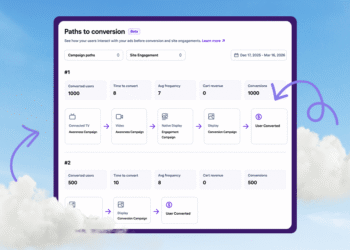
- Canvas visibility: Traditional programmatic platforms often obscure the specific paths a user takes. By using illumin’s canvas, marketers can visually map and track how audiences interact across the entire funnel, providing immediate clarity on which touchpoints actually move the needle.
- Agile budget reallocation: The ability to instantly shift capital away from broad third-party data and into highly efficient verified location segments is where illumin shines. Instead of dealing with rigid, siloed campaign structures, the platform allows brands to seamlessly adjust course mid-flight based on real-time performance.
- Proving real-world performance: By bridging the gap between digital ad execution and offline measurement partners, illumin puts control back into the hands of marketers. This ensures that ad spend is directly tied to business outcomes.
Ultimately, Oakley’s campaign serves as a blueprint. When brands pair highly relevant, real-world behavioral data with an agile, transparent platform like illumin, driving scaled omni-channel growth becomes a repeatable science.
About illumin
illumin is a strategic advertising platform focused on improving how programmatic campaigns are planned, executed, and managed. By reducing fragmentation across workflows, illumin supports in-market decision-making across the open web. Headquartered in Toronto, Canada, illumin serves brands and agencies across North America, Latin America, and Europe.
For more information, visit illumin.com
See More. Achieve More.