• About Us
  • Disclaimer
  • Contact Us
  • Privacy Policy
Wednesday, May 27, 2026
mGrowTech
No Result
View All Result
  • Technology And Software
    • Account Based Marketing
    • Channel Marketing
    • Marketing Automation
      • Al, Analytics and Automation
      • Ad Management
  • Digital Marketing
    • Social Media Management
    • Google Marketing
  • Direct Marketing
    • Brand Management
    • Marketing Attribution and Consulting
  • Mobile Marketing
  • Event Management
  • PR Solutions
  • Technology And Software
    • Account Based Marketing
    • Channel Marketing
    • Marketing Automation
      • Al, Analytics and Automation
      • Ad Management
  • Digital Marketing
    • Social Media Management
    • Google Marketing
  • Direct Marketing
    • Brand Management
    • Marketing Attribution and Consulting
  • Mobile Marketing
  • Event Management
  • PR Solutions
No Result
View All Result
mGrowTech
No Result
View All Result
Home Al, Analytics and Automation

Meet EAGLE 3.1: The Speculative Decoding Algorithm That Fixes Attention Drift in LLM Inference

Josh by Josh
May 27, 2026
in Al, Analytics and Automation
0
Meet EAGLE 3.1: The Speculative Decoding Algorithm That Fixes Attention Drift in LLM Inference


Speculative decoding is a technique for speeding up large language model inference. A small, fast draft model proposes several tokens. The large target model verifies them in parallel. If accepted, inference is faster. If rejected, the system falls back gracefully.

EAGLE Team, vLLM Team, and TorchSpec Team has launched the EAGLE series including EAGLE 1, EAGLE 2, and EAGLE 3 has become one of the most widely adopted and practically deployed families of speculative decoding algorithms across both research and production systems. Today, that family gets a targeted reliability upgrade with introduction of EAGLE 3.1.

What was Going Wrong

While speculative decoding performs well in controlled settings, performance often degrades under different chat templates, long-context inputs, or out-of-distribution system prompts.

The EAGLE team traced this fragility to a phenomenon called attention drift as speculation depth increases, the drafter gradually shifts attention away from sink tokens and toward its own generated tokens.

In simpler terms: the drafter is a small model that predicts future tokens. As speculation gets deeper, it starts attending to its own prior outputs instead of the original context. This degrades acceptance length and output stability.

Two underlying issues were identified. First, the fused input representation becomes increasingly imbalanced as higher-layer hidden states dominate the drafter input. Second, hidden-state magnitude grows across speculation steps due to the unnormalized residual path. Together, these effects make the drafter progressively less stable at deeper speculation depths.

Two Architectural Fixes in EAGLE 3.1

To address attention drift, EAGLE 3.1 comes with two key architectural improvements: FC normalization after each target hidden state and before the FC layer, and feeding post-norm hidden states into the next decoding step.

FC normalization stabilizes the hidden states that the drafter receives from the target model. Without it, hidden-state magnitude grows across steps, making the drafter increasingly unreliable. Applying normalization at each step keeps the inputs bounded.

The post-norm design makes the method behave more like recursively invoking the drafter across decoding steps, rather than simply appending additional layers to the target model.
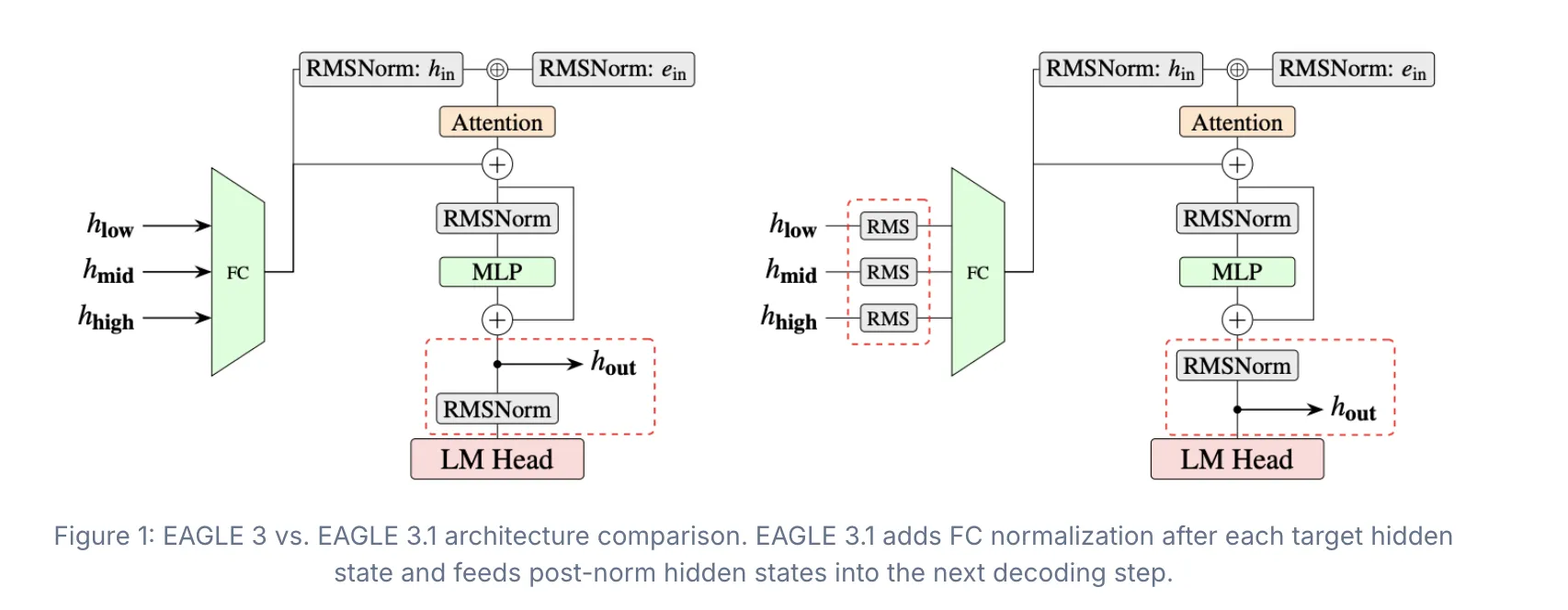
https://vllm.ai/blog/2026-05-26-eagle-3-1

What These Fixes Deliver

Compared with EAGLE 3, EAGLE 3.1 demonstrates: better training-time to inference-time extrapolation, stronger long-context robustness, higher resilience to chat template and system prompt variation, and more stable acceptance length across diverse serving environments.

In long-context workloads, EAGLE 3.1 achieves up to 2Ă— longer acceptance length compared with EAGLE 3.

Training Infrastructure: TorchSpec

TorchSpec now provides efficient training support for EAGLE 3.1 and future speculative decoding algorithms. By lowering training overhead and simplifying experimentation workflows, TorchSpec helps accelerate iteration and exploration for next-generation speculative decoding research and deployment.

Based on TorchSpec and vLLM, the research team also trained and open-sourced an EAGLE 3.1 draft model for Kimi K2.6, available on HuggingFace. The model serves as an example of deploying EAGLE 3.1 with TorchSpec training and vLLM serving support on a real-world serving model

vLLM Integration: Config-Driven and Backward-Compatible

EAGLE 3.1 lands in vLLM as a config-driven extension of the existing EAGLE 3 implementation. The integration includes FC normalization support, post-norm hidden-state feedback, and removal of hardcoded assumptions around target hidden states.

Backward compatibility with existing EAGLE 3 checkpoints is fully preserved. EAGLE 3.1 draft models can be plugged directly through the same speculative-decoding code path.

vllm serve nvidia/Kimi-K2.6-NVFP4 \
  --trust-remote-code \
  --tensor-parallel-size 4 \
  --tool-call-parser kimi_k2 \
  --enable-auto-tool-choice \
  --reasoning-parser kimi_k2 \
  --attention-backend tokenspeed_mla \
  --speculative-config '{"model":"lightseekorg/kimi-k2.6-eagle3.1-mla","method":"eagle3","num_speculative_tokens":3}' \
  --language-model-only

Benchmark Results on Kimi K2.6

The research team benchmarked the Kimi K2.6 EAGLE 3.1 draft model on Kimi-K2.6-NVFP4 with vLLM (TP=4, GB200, non-disagg) on the SPEED-Bench coding dataset. EAGLE 3.1 delivers 2.03Ă— higher per-user output throughput at concurrency 1. The speedup stays meaningful as concurrency scales: 1.71Ă— at C=4 and 1.66Ă— at C=16.

Marktechpost’s Visual Explainer

01 / 07

vLLM · May 26, 2026


The EAGLE team, vLLM team, and TorchSpec team jointly released EAGLE 3.1 — a targeted fix for speculative decoding instability in production LLM serving.

#speculative-decoding
#vLLM
#LLM inference
#performance

02 / 07

Background

What is Speculative Decoding?


A technique for speeding up LLM inference using two models working together.

  • A small, fast draft model proposes several tokens ahead
  • The large target model verifies all proposed tokens in one pass
  • Accepted tokens are kept — rejected tokens fall back gracefully
  • Result: higher output throughput with no change in output quality

03 / 07

The Problem

Attention Drift in EAGLE 3


EAGLE 3 performance degraded in real-world deployments under three conditions:

  • Different chat templates
  • Long-context inputs
  • Out-of-distribution system prompts

Root cause: attention drift — as speculation depth increases, the drafter shifts attention away from sink tokens toward its own generated tokens.

04 / 07

Root Cause

Two Underlying Issues

  • The fused input representation becomes increasingly imbalanced — higher-layer hidden states dominate the drafter input
  • Hidden-state magnitude grows across speculation steps due to the unnormalized residual path
  • Together, these make the drafter progressively less stable at deeper speculation depths

READ ALSO

Design a High-Precision Retrieve-and-Rerank Pipeline with ZeroEntropy Zerank-2 Reranker

Meet OmniVoice Studio: A Local, Open-Source Alternative to ElevenLabs

05 / 07

Architecture

Two Architectural Fixes

Fix 1
FC normalization applied after each target hidden state and before the FC layer. Keeps hidden-state magnitude bounded across decoding steps.

Fix 2
Post-norm hidden-state feedback — normalized hidden states fed into the next decoding step, making the drafter behave like recursive invocation rather than appended layers.

06 / 07

Benchmarks · SPEED-Bench Coding · GB200 TP=4

Per-User Throughput vs. No-Spec Baseline

2.03Ă—Concurrency 1

1.71Ă—Concurrency 4

1.66Ă—Concurrency 16

In long-context workloads, EAGLE 3.1 achieves up to 2Ă— longer acceptance length compared with EAGLE 3. Tested on Kimi-K2.6-NVFP4 with vLLM.

07 / 07

Deployment · vLLM v0.22.0

How to Deploy EAGLE 3.1


Backward-compatible with EAGLE 3 checkpoints. Already merged in vLLM main. Stable release: v0.22.0.

vllm serve nvidia/Kimi-K2.6-NVFP4 \
  --trust-remote-code \
  --tensor-parallel-size 4 \
  --tool-call-parser kimi_k2 \
  --enable-auto-tool-choice \
  --reasoning-parser kimi_k2 \
  --attention-backend tokenspeed_mla \
  --speculative-config \
    '{"model":"lightseekorg/kimi-k2.6-eagle3.1-mla",
      "method":"eagle3",
      "num_speculative_tokens":3}' \
  --language-model-only

Key Takeaways

  • EAGLE 3.1 fixes attention drift — a newly identified instability where the drafter loses focus on sink tokens at deeper speculation depths.
  • Two architectural changes — FC normalization and post-norm hidden-state feedback — stabilize the drafter across speculation steps.
  • In long-context workloads, EAGLE 3.1 delivers up to 2Ă— longer acceptance length compared with EAGLE 3.
  • Benchmarks on Kimi-K2.6-NVFP4 show 2.03Ă— per-user output throughput at concurrency 1, dropping to 1.66Ă— at C=16.
  • EAGLE 3.1 is backward-compatible with EAGLE 3 checkpoints and is already merged into vLLM main, shipping in v0.22.0.

Check out the Technical details. Also, feel free to follow us on Twitter and don’t forget to join our 150k+ ML SubReddit and Subscribe to our Newsletter. Wait! are you on telegram? now you can join us on telegram as well.

Need to partner with us for promoting your GitHub Repo OR Hugging Face Page OR Product Release OR Webinar etc.? Connect with us


Michal Sutter is a data science professional with a Master of Science in Data Science from the University of Padova. With a solid foundation in statistical analysis, machine learning, and data engineering, Michal excels at transforming complex datasets into actionable insights.



Source_link

Related Posts

Design a High-Precision Retrieve-and-Rerank Pipeline with ZeroEntropy Zerank-2 Reranker
Al, Analytics and Automation

Design a High-Precision Retrieve-and-Rerank Pipeline with ZeroEntropy Zerank-2 Reranker

May 27, 2026
Meet OmniVoice Studio: A Local, Open-Source Alternative to ElevenLabs
Al, Analytics and Automation

Meet OmniVoice Studio: A Local, Open-Source Alternative to ElevenLabs

May 26, 2026
Together AI Open-Sources OSCAR: An Attention-Aware 2-Bit KV Cache Quantization System for Long-Context LLM Serving
Al, Analytics and Automation

Together AI Open-Sources OSCAR: An Attention-Aware 2-Bit KV Cache Quantization System for Long-Context LLM Serving

May 26, 2026
Best Authentication Platforms for AI Agents and MCP Servers in 2026
Al, Analytics and Automation

Best Authentication Platforms for AI Agents and MCP Servers in 2026

May 25, 2026
Build a Complete Langfuse Observability and Evaluation Pipeline for Tracing, Prompt Management, Scoring, and Experiments
Al, Analytics and Automation

Build a Complete Langfuse Observability and Evaluation Pipeline for Tracing, Prompt Management, Scoring, and Experiments

May 25, 2026
Microsoft Research Releases Webwright: A Terminal-Native Web Agent Framework That Scores 60.1% on Odysseys, Up from Base GPT-5.4’s 33.5%
Al, Analytics and Automation

Microsoft Research Releases Webwright: A Terminal-Native Web Agent Framework That Scores 60.1% on Odysseys, Up from Base GPT-5.4’s 33.5%

May 24, 2026
Next Post
What It Is and Why It’s Important

What It Is and Why It’s Important

POPULAR NEWS

Trump ends trade talks with Canada over a digital services tax

Trump ends trade talks with Canada over a digital services tax

June 28, 2025
15 Trending Songs on TikTok in 2025 (+ How to Use Them)

15 Trending Songs on TikTok in 2025 (+ How to Use Them)

June 18, 2025
Communication Effectiveness Skills For Business Leaders

Communication Effectiveness Skills For Business Leaders

June 10, 2025
App Development Cost in Singapore: Pricing Breakdown & Insights

App Development Cost in Singapore: Pricing Breakdown & Insights

June 22, 2025
Comparing the Top 7 Large Language Models LLMs/Systems for Coding in 2025

Comparing the Top 7 Large Language Models LLMs/Systems for Coding in 2025

November 4, 2025

EDITOR'S PICK

Best Walking Pads for Working From Home (2026)

Best Walking Pads for Working From Home (2026)

April 29, 2026
GEO and the Future of PR Measurement: Why Generative Visibility Is Becoming the New Standard

GEO and the Future of PR Measurement: Why Generative Visibility Is Becoming the New Standard

January 31, 2026
11 Best Chromebooks of 2025, Tested and Reviewed

11 Best Chromebooks of 2025, Tested and Reviewed

August 5, 2025
A sounding board for strengthening the student experience | MIT News

A sounding board for strengthening the student experience | MIT News

June 19, 2025

About

We bring you the best Premium WordPress Themes that perfect for news, magazine, personal blog, etc. Check our landing page for details.

Follow us

Categories

  • Account Based Marketing
  • Ad Management
  • Al, Analytics and Automation
  • Brand Management
  • Channel Marketing
  • Digital Marketing
  • Direct Marketing
  • Event Management
  • Google Marketing
  • Marketing Attribution and Consulting
  • Marketing Automation
  • Mobile Marketing
  • PR Solutions
  • Social Media Management
  • Technology And Software
  • Uncategorized

Recent Posts

  • The Blueprint for Your Success: A Note on The New MoEngage Academy
  • From Contract Backlogs to Real-Time Risk Intelligence: Re-architecting Compliance Review Systems
  • What It Is and Why It’s Important
  • Meet EAGLE 3.1: The Speculative Decoding Algorithm That Fixes Attention Drift in LLM Inference
  • About Us
  • Disclaimer
  • Contact Us
  • Privacy Policy
No Result
View All Result
  • Technology And Software
    • Account Based Marketing
    • Channel Marketing
    • Marketing Automation
      • Al, Analytics and Automation
      • Ad Management
  • Digital Marketing
    • Social Media Management
    • Google Marketing
  • Direct Marketing
    • Brand Management
    • Marketing Attribution and Consulting
  • Mobile Marketing
  • Event Management
  • PR Solutions