If you’re a small business that wants visibility without spending marketing dollars you don’t have, you’ll want to use a guerrilla marketing strategy. Jay Conrad Levinson built the whole framework in 1984 around one insight: observation beats ad spend every time. The business owners who get this right build real customer momentum on budgets that would disappear in a single week of Google Ads.
Every article about guerrilla marketing shows you the famous campaigns. You see them, admire the creativity, and think — I should do something like that.
That doesn’t work.
Copying a guerrilla campaign without understanding the thinking behind it produces forgettable results. The campaigns that worked were successful not because of the format. They worked because the person behind them saw the world differently. They understood what guerrilla marketing is before they ever executed a single tactic.
The secret behind every guerrilla campaign is observation. A guerrilla marketer notices friction, habits, patterns, boredom, waste, ego, fear, pride, inconvenience, timing, and attention leaks. Then they turn those things into marketing.
That’s the job.
Stop Thinking Like a Marketer
Traditional marketers ask the wrong questions.
“What should we post?” “What platform should we use?” “How do we get more reach?”
Guerrilla marketers ask different ones:
- Where is attention already happening?
- Where is frustration already happening?
- Where are people emotionally vulnerable?
- Where are people waiting?
- Where are people stuck?
- What feels broken, annoying, expensive, confusing, or slow?
That’s where marketing lives. Marketing strategy starts with questions, not platforms. Get the questions right and the tactics become obvious.
The Guerrilla Marketing Strategy Framework — Three Lenses to See Opportunities
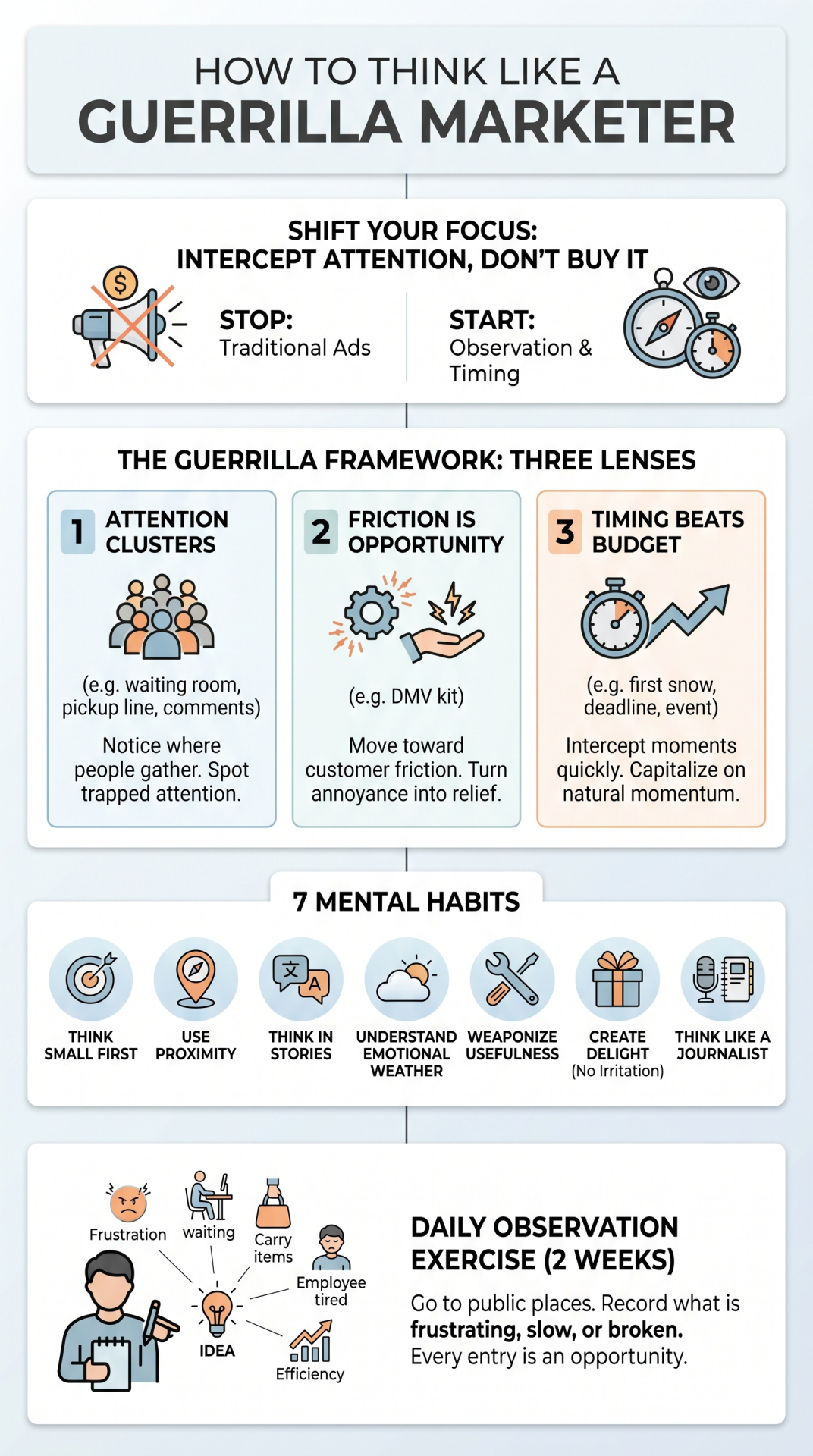
Every solid guerrilla marketing strategy starts with training yourself to see the world differently. Here are the three filters that change how you read every room you walk into.
1. Attention Clusters
People gather in predictable places. Your job is to notice where attention naturally pools.
Waiting rooms. School pickup lines. Trade show coffee stations. LinkedIn comment sections. Community Facebook groups. Networking event registration tables. Airport charging stations. HOA meetings. Local business expos. Slack groups. Reddit threads. Youth sports tournaments.
The average marketer sees locations. The guerrilla marketer sees:
- Trapped attention
- Emotional state
- Idle time
- Buying intent
- Conversation openings
That changes everything.
2. Friction Is a Marketing Opportunity
Most businesses run away from friction. Guerrilla marketers move toward it.
Long restaurant wait times. Confusing invoices. Trade show exhaustion. Terrible onboarding. Boring networking events. Parents sitting in cars for 45 minutes.
If something annoys people repeatedly, there is marketing potential hiding there.
A coffee shop near a DMV gives away “survival kits” — coffee coupons and aspirin packets to people waiting in line. That’s guerrilla marketing. It works because it matches the exact emotional state of the audience at that specific moment. Matching your marketing to the moment your customer is in is one of the highest-leverage, lowest-cost moves in small business marketing.
3. Timing Beats Budget
Big brands buy reach. Guerrilla marketers intercept moments.
First day of snow. Tax deadline week. Local layoffs. School graduation season. New neighbors moving in. Festival weekends. Power outages. Construction detours. Economic uncertainty.
The best guerrilla marketers think like traders — they watch momentum and react quickly. Google Ads costs have risen sharply across most industries, which means showing up in the right moment, at near-zero cost, is a real competitive edge for small businesses.
💡 STRATEGY ALERT
Start a Friction Journal. Spend one week writing down every moment of frustration, boredom, inconvenience, or wasted time you observe — in waiting rooms, at local businesses, at networking events, anywhere your customers go. Each entry is a potential marketing opportunity. At the end of the week you’ll have more usable guerrilla ideas than any brainstorming session could produce.
Guerrilla Marketing Is Pattern Recognition

This is the part most people miss.
Guerrilla marketing is pattern recognition applied to marketing. Start noticing: repeated complaints. Repeated jokes. Repeated delays. Repeated behaviors. Repeated conversations.
That repetition is market data.
When every small business owner in your network says “I don’t know where my leads are coming from anymore” — that’s not conversation. That’s a positioning opportunity. When every parent at soccer practice mentions they’re killing 90 minutes in a parking lot — that’s not small talk. That’s an attention cluster with zero competition and a captive audience.
The guerrilla marketer’s job is to spot the pattern before anyone else does, then show up with something useful, relevant, and memorable before the window closes.
The 7 Mental Habits Behind a Strong Guerrilla Marketing Strategy
These habits separate guerrilla marketers from everyone else. None require a budget. All require a different way of thinking.
1. They Think Small First
Most marketing fails because it starts too big. Guerrilla marketers ask smaller questions first.
Can I dominate one room? Can I become unforgettable to 25 people? Can I own one local conversation?
Trust spreads socially. Own the room before you try to own the market.
2. They Use Proximity
Physical closeness matters more than most marketers realize.
Sponsoring benches near soccer fields. Free charging stations at events. Branded umbrellas during rain. Snacks outside conferences. Cheat sheets at trade shows. Branded water in long lines.
People remember who helped them physically — in the moment they needed it most.
3. They Think in Stories
Nobody retells “great targeting.”
People retell things that were weird. Useful. Funny. Surprising. Emotional. Generous. Before planning any campaign, ask whether a customer would tell a friend about this. That’s the filter. If the answer is no, the campaign isn’t ready.
4. They Understand Emotional Weather
Every environment has emotional conditions.
A hospital feels different from a concert. A tax seminar feels different from a craft fair. The best guerrilla marketers match the emotional weather of every room they enter.
Calm during chaos. Humor during boredom. Relief during stress. Optimism during uncertainty. The right emotion in the right moment creates a memory that advertising cannot buy.
5. They Weaponize Usefulness
The most effective guerrilla marketing often looks like help.
Checklists. Wipes. Chargers. Snacks. Cheat sheets. Maps. Templates. Emergency kits.
Useful beats clever almost every time. Customers who remember you for helping them become your most loyal advocates — and they refer people without being asked.
6. They Create Interruption Without Irritation
This distinction matters enormously.
Good guerrilla marketing creates curiosity, delight, relief, amusement, and surprise. Bad guerrilla marketing creates inconvenience, embarrassment, confusion, and hostility.
If people feel trapped or manipulated, you lose — and word travels fast in small communities. The goal is to be the best thing that happened to someone in an otherwise forgettable moment.
7. They Think Like Journalists
This is the hidden superpower.
A guerrilla marketer constantly asks: What’s the real story here? What are people secretly worried about? What are people pretending isn’t happening? What changed recently? What contradiction exists in this market?
That’s where breakthrough ideas come from — the gap between what people say and what they actually feel.
⚠️ REALITY CHECK
The Exercise That Sharpens Your Guerrilla Marketing Strategy
This is the fastest way to develop the observation muscle. Do it every day for two weeks.
Go somewhere public — a coffee shop, a waiting room, a networking event, a hardware store. Answer these questions before you leave:
- What are people frustrated about?
- What are people waiting for?
- What feels inefficient or slow?
- What are people carrying?
- What do people keep asking?
- What are employees tired of hearing?
- What could make this easier, faster, funnier, calmer, or more human?
Do this consistently and something shifts. You stop seeing places. You start seeing marketing openings.
The best guerrilla marketing ideas feel obvious after you see them. That’s the signal you’re getting closer.
The Biggest Mistake Small Businesses Make With Guerrilla Marketing
They think it means flashy stunts, viral videos, and big creative productions.
It usually means empathy. Timing. Observation. Relevance. Usefulness. Courage.
🛑 DON’T COPY BLINDLY
The final mindset shift is the simplest one. Stop asking: “How do I advertise?” Start asking: “How do I become memorable inside a real human moment?”
That question changes your marketing forever.
Frequently Asked Questions About Guerrilla Marketing Strategy
What is a guerrilla marketing strategy?
A guerrilla marketing strategy is an approach to generating visibility and customers by using observation, timing, and usefulness instead of paid advertising. Guerrilla marketers find where frustration, boredom, and emotion already exist — then show up there with something relevant. Jay Conrad Levinson formalized it in 1984 specifically for businesses without large ad budgets. The entire framework assumes resource constraint and compensates with creativity, observation, and consistency.
How is guerrilla marketing different from traditional marketing?
Traditional marketing asks how to reach the most people. A guerrilla marketing strategy asks where people are already gathered, what they’re frustrated about, and what moment they’re in. Traditional marketing buys attention. Guerrilla marketing earns it through observation, timing, and usefulness — which means it works even when your budget is near zero.
Can small businesses with almost no budget build a guerrilla marketing strategy?
Yes — and that’s exactly what the approach was built for. Levinson created guerrilla marketing after a student asked him to recommend a book about marketing on limited budgets. No such book existed, so he wrote one. The entire framework assumes resource constraint and compensates with creativity, observation, and consistency. More than half of Levinson’s 200-plus guerrilla marketing weapons cost nothing at all.
What makes a guerrilla marketing idea different from a guerrilla marketing stunt?
A stunt is attention-seeking without strategic purpose. A real guerrilla marketing strategy connects your brand’s meaning to an emotional moment your audience is already experiencing. The coffee shop handing survival kits to DMV customers is meeting a specific emotional state with a relevant, branded gesture. That’s the difference between memorable and merely noticeable.
How do I start building a guerrilla marketing strategy for my specific business?
Start with the observation exercise: go somewhere your customers go and spend 20 minutes writing down everything that feels frustrating, slow, inefficient, or boring. Every answer is a potential marketing opportunity. Then filter your ideas through three questions — Is it unexpected in this context? Does it connect back to what my business offers? Would a customer share it or tell a friend? The ideas that pass all three are your best starting points.