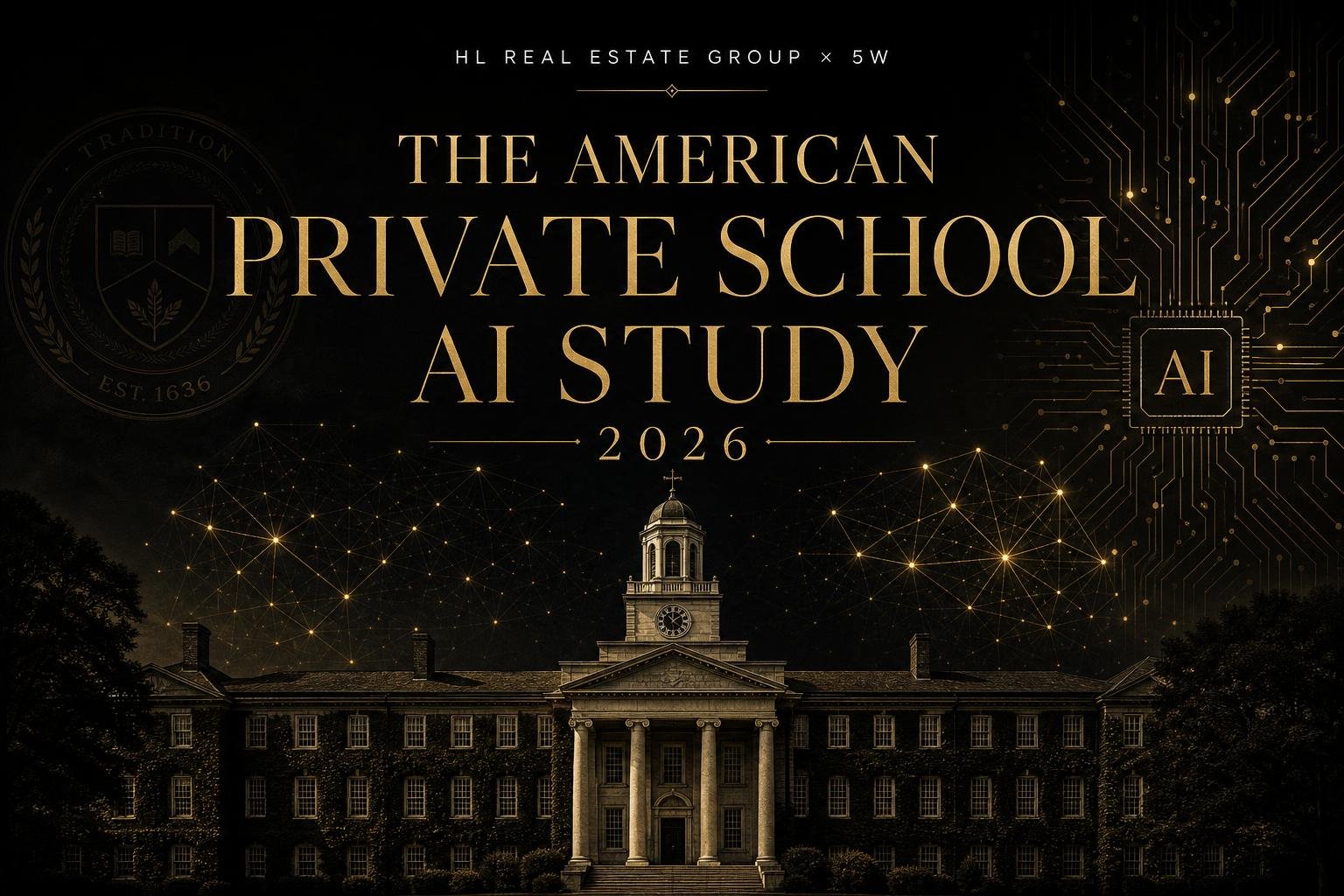
The Florida Private School AI Study 2026 — our latest installment in the AI Visibility research series, in partnership with HL Real Estate Group by Haute Living — turned out to be the cleanest applied case we have published. Here is what we found, and what it means for any brand operating in any category.
When we set out to audit Florida’s top private K-12 schools earlier this year, we expected to find what we have found in every other category we have measured. Brands and institutions that have done meaningful work on artificial intelligence are not surfacing in the AI engines now mediating consumer discovery. That gap is the central finding of every installment of our AI Visibility research series, from luxury hospitality to financial services to consumer health.
The Florida private schools study, released this month in partnership with HL Real Estate Group by Haute Living, confirmed the pattern. What surprised us is how concentrated the answer was. Of the twelve top Florida private K-12 schools we audited on six published criteria for institutional AI commitment, only three made our top tier. All three are in South Florida. All three sit along a single 70-mile coastal corridor that runs from West Palm Beach south through Boca Raton and Fort Lauderdale to Coconut Grove and Coral Gables.
That concentration turned a category audit into a relocation story — which is what made HL Real Estate Group, the South Florida luxury brokerage founded by Haute Living, the right co-publisher. Their clientele asks the school question first now. Ours wants to know which institutions show up when those families open ChatGPT.
The Three Tier A Schools
Pine Crest School FORT LAUDERDALE & BOCA RATON
Pine Crest’s 2024-29 Strategic Plan defines its graduate of the future as competitive in an AI-driven economy. AP and Post-AP Computer Science Artificial Intelligence courses sit in the catalog. The school employs an Educational Data, AI & Computer Science Specialist as a named position. Its Pine Crest neXt Innovation Institute trains other independent schools’ faculty on AI integration — making Pine Crest the only Florida school in our study that exports AI pedagogy to peer institutions.
Ransom Everglades School COCONUT GROVE · MIAMI
The AIRE (Artificial Intelligence at Ransom Everglades) Task Force convenes weekly across humanities, STEM, world languages, and technology. The upper-school catalog includes a master’s-level Advanced Machine Learning course and an AI-based digital humanities research seminar. The school’s seven-year integrated AI curriculum is the most structurally developed of any Florida school we audited.
Oxbridge Academy WEST PALM BEACH
Oxbridge has named Artificial Intelligence as a formal Signature Program — peer in the catalog to its Free Enterprise Institute, Aviation, and Cambridge Scholars programs. Founded in 2011 by William I. Koch on a 54-acre West Palm Beach campus. The clearest “AI is on the marquee” institutional positioning of any school we studied.
The Visibility Gap
Our visibility audit ran a parallel set of consumer-intent prompts through ChatGPT, Claude, Perplexity, and Google AI Overviews. “Best Florida private school for AI.” “Best Miami private school for an AI-curious student.” “AI curriculum private school Florida.” The kind of question a parent relocating from out of state would actually type.
None of the three Tier A schools surfaced consistently as primary answers. What surfaced instead — and this is the same pattern we have documented across every prior category in this research series — was a mix of universities with established AI programs (irrelevant to a K-12 family), summer enrichment providers (auxiliary to the school decision), and a small number of AI-native newcomer schools that have been built specifically for AI search discovery rather than for residential admissions.
The Tier A Florida schools have done the work. They have not yet done the publishing of the work in the form the AI engines can cite. The work and the publishing of the work are now the same job.
Why this matters beyond Florida private K-12
The Florida finding is a Florida finding only because that is the audit we ran. The pattern generalizes. Across luxury hospitality, financial services, healthcare, consumer beauty, and now education, the brands and institutions winning AI search in 2026 are the ones that have been deliberately structured for AI citation. Those that have not — regardless of the underlying quality of the offering — are absent from the answer boxes that increasingly mediate first-stage consumer discovery.
For our clients in any category, the operating implications are the same as they have been throughout this research series:
Name a public owner of the AI program. One human, identifiable on the institutional website, in a faculty bio or executive bio that surfaces in third-party search.
Publish a framework, not just a policy. Citable, structured, indexable, written in the language a customer or prospect would type into ChatGPT.
Build a single canonical landing page at /ai or the domain-appropriate equivalent, with structured schema markup and frequent updates.
Place external authority citations in third-party press, peer-reviewed venues, or institutional partnerships that the AI engines weight more heavily than self-published claims.
Audit AI engine coverage quarterly with a thirty-day response cycle on identified gaps.
None of this requires capital expenditure. All of it requires a decision and an owner.
The window
Across every category we have measured, the same temporal dynamic holds. The AI engines reweight their training data and citation patterns continuously. The brands that establish AI-engine authority in 2026 lock in the citation graph for the cycle that follows. Brands that wait until 2028 are competing against a graph that has already crystallized around someone else.
For Florida’s three Tier A private schools, the work is the easy part — the work is done. What remains is the publishing of it. For the Tier B schools we studied, there is a credible twelve-month path to Tier A. For the Tier C schools, the climb is longer, but the field is still more open than it will be eighteen months from now.
The same reasoning applies to every category 5W serves. The Florida private school study is the latest applied case. It will not be the last.