Summary
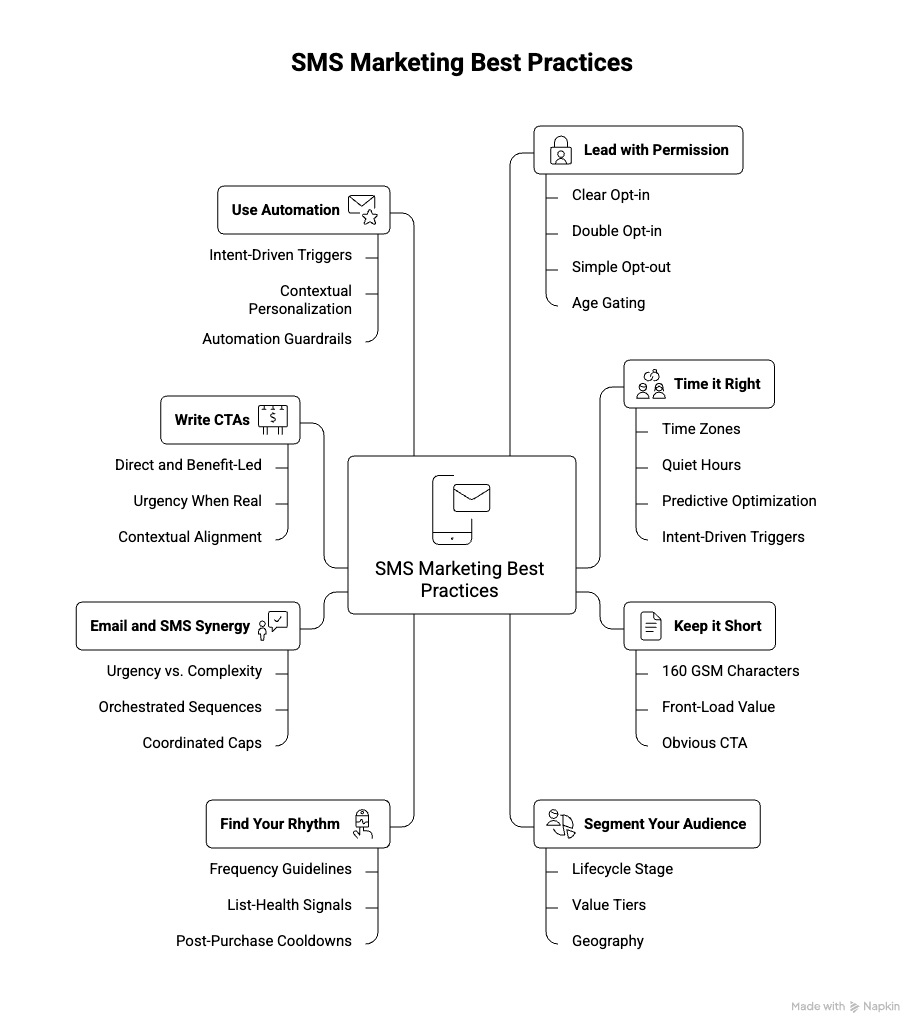
1. Secure explicit, informed consent and store audit-ready proof to protect deliverability, comply with regulations like TCPA and TRAI, and reduce long-term opt-outs.
2. Optimize send time using local time zones, quiet-hour guardrails, predictive models, and real-time triggers to capture intent within SMS’s compressed engagement window.
3. Keep messages within a single segment, lead with value, and use one clear CTA to maximize clarity, control costs, and improve completion rates.
4. Segment audiences by lifecycle stage, customer value, and geography so every message aligns with intent and avoids the churn risks of batch-and-blast campaigns.
5. Set frequency guardrails, monitor fatigue signals, and enforce post-purchase cooldowns to protect list health as volume scales.
6. Orchestrate email and SMS within one lifecycle strategy, so each channel plays a distinct role and drives incremental lift instead of overlap.
7. Write direct, benefit-led CTAs with real urgency and clear next steps to convert fast-moving attention into action.
8. Automate high-intent triggers and personalize with behavioral data so scale strengthens relevance instead of diluting it.
9. Measure revenue per message, conversions, opt-outs, and incremental lift to tie SMS performance to real business outcomes.
10. Test timing, tone, CTAs, and link formats systematically and use control groups to prove incrementality before scaling winners.
SMS marketing today is a frontline revenue driver for high-growth B2C brands. In 2025, 66% of businesses used SMS marketing tools to reach customers, and 67% increased their budgets. The reason is simple: 82% of consumers check text messages within five minutes, and nearly a third check text notifications within 60 seconds. When attention is this immediate, SMS marketing best practices are the difference between revenue and churn.
Immediacy amplifies both gains and mistakes. Regulatory pressure under TCPA, GDPR, and TRAI is rising, and consumer tolerance for irrelevant texts is shrinking. Weak consent, poor timing, and generic targeting drive opt-outs and damage lifetime value in a channel where nearly every message is seen.
If that challenge sounds familiar, this guide outlines ten SMS marketing best practices that high-performing B2C teams consistently rely on.
10 proven SMS marketing best practices to earn attention (and action)
1. Lead with permission and clear expectations
Permission underpins deliverability, compliance, and retention. High-performing SMS marketing programs secure explicit consent, store audit-ready proof, and set clear expectations, especially in regions with strict rules like TCPA quiet hours in the U.S. and TRAI promotional windows in India. Here’s what you can do.
- Make the opt-in contract crystal clear at signup. Clearly state what messages subscribers will receive, the expected frequency, and the core value they gain. Also, include visible terms and privacy links in the sign-up flow so consent is informed and defensible.
- Use double opt-in to confirm intent and maintain lower-risk lists. Store audit-ready proof of consent, including timestamp, phone number, source, and consent language shown. Keep records of opt-outs as well to maintain a defensible compliance trail.
- Make opt-out simple and frictionless. Include clear instructions and honor unsubscribe requests immediately. Recognize common variants of opt-out keywords and never message users again after confirmation.
- Implement age gating for regulated categories like alcohol, tobacco, or gambling. Capture appropriate verification where required and avoid marketing to minors by default.
Opt-outs drop when subscribers know exactly what to expect. Follow clean consent practices to strengthen carrier trust and safeguard deliverability. Over time, disciplined transparency compounds into higher retention and stronger lifetime value.

2. Time it right because every second matters
SMS engagement follows a compressed response curve. Most clicks and conversions happen within minutes of delivery, which means send-time directly shapes revenue efficiency and opt-out risk. Here’s how to time it right.
- Treat time zones and quiet hours as hard guardrails. In the U.S., TCPA norms generally restrict marketing texts to 8 a.m. to 9 p.m. in the recipient’s local time zone. India’s TRAI ecosystem also applies defined windows for promotional messaging (9 a.m. to 9 p.m.), making region-based scheduling mandatory.
- Use predictive send-time optimization to individualize delivery windows. Leading platforms like Insider One let you model each subscriber’s likely engagement time using historical interaction data. Then you can spread delivery across the day instead of blasting everyone at once.
- Prioritize real-time, intent-driven triggers. Cart abandonment, browse abandonment, price-drop, back-in-stock, and appointment reminder triggers outperform scheduled campaigns because they align with high-intent behavioral events. Even then, keep guardrails: quiet-hour enforcement, throttling during high-volume events, and extra caution for sensitive categories.
3. Keep your message short, sharp, and conversational
A standard GSM-7 message supports 160 characters. That character count comes down to 70 characters and triggers multi-segment sends when you add a single emoji or special character. You experience lower click-through and completion rates with split messages. Here’s how to avoid it.
- Keep messages within 160 GSM characters to avoid segmentation. If you use emojis or special characters, assume the effective limit drops to 70 and plan accordingly.
- Front-load value because the preview does the selling. Treat the first few words like a subject line because that’s what appears in the inbox preview. Lead with the benefit or offer, then add only the minimum context needed.
- Make the CTA obvious. Keep one clear action and tell recipients what happens after the tap (where the link goes). Use emojis sparingly and only if they clarify tone or intent.
4. Segment your audience so every message feels personal
SMS is a high-attention channel, meaning relevance is non-negotiable. The more your program scales, the more ‘one message for everyone” turns into higher opt-outs and lower ROI. That’s exactly why modern SMS marketing playbooks push segmentation and personalization as core mechanics.
- Segment by lifecycle stage to match intent. Use lifecycle buckets like new, active, and lapsed to change both the offer and the urgency. You can send welcome/value education for new, replenishment/loyalty nudges for active, and win-back incentives for lapsed.
- Add value tiers like VIP/high-LTV vs. deal-seekers to protect margin and improve conversion. This tiering helps you reserve early access, exclusives, and concierge-style perks for customers who justify it. Add geography as well to map messages with local store events, delivery windows, weather-driven needs, and region-specific promos.
5. Find your sending rhythm before your audience tunes out
You’ll see unsubscribes and complaints rising fast as frequency climbs. That’s why high-performing SMS marketing programs set a baseline cadence by message type, then use caps, cooldowns, and fatigue signals to protect list health.
- Set frequency guidelines by program type. Many recommend a starting point of 1-2 SMS per week and adjusting based on opt-outs and revenue per message. Transactional and reminder messages should be ‘only when needed’.
- Use list-health signals, like rising opt-outs, complaints, falling clicks, or repeated non-engagement, to suppress sends for that subscriber segment. Pair this with per-user frequency caps and cross-channel messaging coordination so a customer doesn’t get multiple messages on the same day.
- Add post-purchase cooldowns (no promos for a set period) to reduce noise when customers are already getting transactional updates.
6. Make email and SMS marketing work together, not against each other
Email supports depth, storytelling, and rich detail, while SMS wins on immediacy and action. Winning teams orchestrate both within one lifecycle strategy to eliminate overlap, control marketing pressure, and unlock incremental revenue.
- Design roles by urgency vs. complexity to prevent channel cannibalization. Use SMS marketing for time-sensitive nudges and high-intent moments, and use email marketing for context, education, and long-form updates that don’t fit in 160 characters. Treat this as a sequencing rule so subscribers never receive two versions of the same message.
- Orchestrate sequences that create lift. Use the best email marketing tools to deliver the full promotion, product story, or detailed announcement. Then deploy SMS closer to the deadline as a short, high-urgency reminder to capture last-mile conversions. In time-sensitive situations, send urgent alerts via SMS for immediate visibility, while email follows with detailed explanations, FAQs, or policy updates.
- Coordinate caps and suppression across both channels so a customer who already converted from email does not receive the SMS reminder, and vice versa. This layer helps teams protect deliverability and reduce opt-outs while scaling multi-campaign calendars.
7. Write CTAs that are impossible to ignore
In SMS, you have limited characters, a fast-scan inbox preview, and a short intent window, meaning vague CTAs waste the moment. Try using a single, clear CTA with a destination that matches the promise. Then test CTA language to find what converts for your audience.
- Make the CTA direct and benefit-led. Use action verbs tied to a specific outcome (for example, claim VIP access or unlock 20% off). Also, keep one action per message, and make sure the click lands exactly where the CTA implies it will land.
- Add urgency only when it is real. Time-bounded language (like, ends tonight, last chance, or back in stock) works when it reflects an actual deadline or scarcity. Continue A/B testing CTA urgency language to quantify lift and avoid overusing urgency cues.
- Tailor CTAs to the context and the job-to-be-done. Align the CTA with the customer’s immediate context. For example, you can use ‘reply RSVP to confirm your spot’ for local events or ‘claim your code before midnight’ for flash sales. Context-fit CTAs reduce friction because the next step is obvious and the value is immediate.
8. Use automation, but personalize wherever you can
Triggered SMS campaigns consistently outperform batch campaigns because it aligns with real-time user behavior. The performance gap widens when personalization is based on behavioral and transactional data rather than static templates.
- Automate the triggers that map to intent and utility. Prioritize flows like cart recovery, browse abandonment, back-in-stock, price drop, and shipping updates because they are tied to a clear user action or need. These triggers work best when they fire quickly, while intent is still fresh.
- Personalize with context. While first name is table stakes, better signals include cart contents, last purchase, preferred category, location/store, and loyalty status. Contextual personalization, based on real-time behavior, reads more natural and drives stronger engagement than static templates.
- Build guardrails so automation does not become spam. Use suppression rules, frequency caps, and opt-out monitoring to protect list health at scale. For certain flows, some platforms may also enforce tighter compliance constraints (for example, limits and timing rules around abandoned-cart SMS), so your automation logic needs to account for those boundaries.
9. Look at the full picture (track more than clicks and opens)
SMS opens are a weak signal because visibility is structurally high and inconsistently measurable across devices and apps. Ideally, you should judge SMS marketing performance by revenue efficiency, churn signals, and provable incremental lift, and here’s how.
- Replace vanity with revenue efficiency. Track revenue per recipient/message and conversions to understand which campaigns and flows actually pay back. Most mature SMS reporting stacks define revenue per message explicitly as revenue divided by delivered messages, which makes it comparable across sends and periods.
- Treat opt-outs and complaints as first-class KPIs. Monitor opt-out rate and complaint indicators at the message and segment level, as they predict future deliverability and list decay.
10. Test small and build on what works
SMS programs scale safely when they are run like an experiment pipeline. Consider testing one variable at a time (timing, copy, CTA, channel) so you can attribute lift cleanly and avoid false winners.
- Test the levers that move revenue. Prioritize A/B tests on send time, tone, voice, CTA phrasing, and message length, and change only one element per test to isolate causality.
- Treat link format as a deliverability and trust variable. Carriers and industry bodies discourage public URL shorteners. Consider using branded or dedicated short domains so the sender identity stays clear and filtering risk drops.
- Prove incrementality and operationalize continuous optimization. Use holdouts/control groups to measure true lift, and then graduate winners into ongoing optimization.
Turn SMS marketing best practices into measurable revenue with Insider One
Best practices create the framework. Insider One powers the execution.
Insider One unifies SMS, email, mobile app, push, and web into one real-time orchestration engine. Journeys trigger from live behavioral signals, turning SMS from a batch channel into a precision lifecycle action.
With Insider One, you can trigger SMS based on high-intent events like cart activity, product views, price drops, and restock alerts. Its unified customer profile consolidates transactional, behavioral, and channel data, enabling precise personalization, send-time logic, suppression rules, and cross-channel frequency control. Plus, you can run A/B tests, measure incremental lift, and attribute revenue across orchestrated journeys instead of evaluating SMS in isolation.
Wayne notes in his G2 review, “The mobile app and email/SMS channels make it easy to re-engage high-intent browsers with timely nudges, promotions, and back-in-stock alerts that bring them back to complete purchases.” That is the difference between applying best practices in theory and operationalizing them at an enterprise scale.
Want to see Insider One in action? Request a demo today and see the difference for yourself.
FAQs
Most SMS campaigns see open rates between 90% and 98% because text messages are typically read within minutes. However, open rate is not the best success metric for SMS marketing. Focus instead on click-through rate, revenue per message, conversions, and opt-out rate to measure true performance.
4 to 8 messages per month is a common starting range for promotional SMS. Transactional messages like order updates and shipping alerts should only be event-driven and typically range from 2 to 6 per order cycle. Triggered lifecycle flows like cart recovery or browse abandonment usually perform best at 1 to 3 messages per trigger sequence. If opt-outs exceed 1-2% per campaign or engagement drops consistently, your frequency is likely too high for that segment.
Offer a clear, specific incentive at opt-in, and place SMS sign-up forms at high-intent touchpoints like checkout, product pages, and post-purchase confirmation pages. Also, promote SMS across email, social, and in-store with QR codes, and message new subscribers within minutes of signup to deliver the promised value immediately.
Make opt-out simple by honoring keywords like STOP immediately and confirming the unsubscribe clearly. Monitor opt-out rates at the campaign and segment level to identify messaging or frequency issues early. Also, reduce irrelevant sends and tighten segmentation to protect long-term list health and deliverability.