

You’ve read the studies about the best time to post on social media: Tuesday at 10am ; Wednesday at 11am; Sunday never. You’ve adjusted your schedule. You’ve set the reminders. And still, your best-performing post this year went live on a Thursday evening, almost by accident.
Sound familiar?
Here’s what’s actually happening. According to our 2026 Agorapulse survey, 82% of social media teams rely on past performance data to decide what to post and when. They look at what worked before and reproduce it: same social media content ideas, same format and time slot. The problem isn’t the data. They’re optimizing for a pattern, when the only thing that actually matters is the person behind it.
Picture this. A content team notices their LinkedIn posts perform better on Tuesday mornings. They lock it in. Tuesday 10am becomes the rule. Six months later, engagement is flat. Nothing changed, except the audience did. New followers, different roles, different daily rhythms. The Tuesday rule was never about their audience. It was about a moment in time that no longer exists.
Why the “best time to post on social media” studies are answering the wrong question
Every year, the same studies come out. They analyze millions of posts across thousands of accounts. They crunch engagement rates by day and hour. They build neat little heatmaps. And they conclude: post on Tuesday morning, avoid weekends, Friday afternoons are dead.
These studies may be right. These studies are useless for your situation.
Here’s why. Those numbers are averages. An average across industries, company sizes, audience types, content formats, and posting intents. The B2B SaaS brand targeting procurement managers is in the same dataset as the lifestyle influencer targeting Gen Z. The educational thread is averaged with the promotional campaign. The brand with 200 followers is weighted alongside the brand with 2 million.
What you get is a number that doesn’t belong to anyone.
49% of social media teams struggle to measure what truly works. When you optimize for generic benchmarks, you lose the ability to understand your own signal. You’re reading someone else’s audience. And calling it strategy.
There’s a deeper problem too. Most studies measure reach and impressions at different time slots. Those are visibility metrics. A post that gets seen is not the same as a post that gets processed. A scroll-past doesn’t mean engagement. And optimizing your sche@dule for maximum eyeballs, rather than maximum attention, is a category error that no heatmap will ever fix.
The variable nobody talks about: mental availability
“The social media web is a very noisy one indeed and making sure that you are heard requires you to shout more effectively, rather than louder.” – David Amerland
Here’s the real issue with every “best time to post on social media” guide.
They all assume the goal is to reach your audience when they’re online. The actual goal is to reach them when they’re in reception mode for this specific content, in this context.
Those are two completely different things.
Being online means your audience is scrolling. If they are in reception mode, it means they’re ready to stop, read, think, and act. Scroll availability is passive. Mental availability is active. And the gap between the two is where most content disappears.
Think about it concretely. A procurement manager is technically “online” at 7am: they check LinkedIn before the day starts. But they’re triaging, in inbox mode. Learning mode kicks in later. Post a 6-minute read at that moment, and watch it vanish. Post the same piece at 12:30pm, when they’ve cleared their morning backlog and have 15 minutes to think: different results. Same audience, same content, completely different context.
This is a pattern observed across millions of posts and thousands of brands. The time slot is almost never the real variable. The audience’s mental state is.
Why most teams never get here
Only 32% of social media teams have clearly defined personas guiding their content. 37% say they have “a rough idea” of their audience.
A rough idea of your audience means a rough idea of their daily rhythm. A rough idea of their peak attention. A rough idea of when they’re ready for what you have to say.
You can’t find the right moment for someone you don’t actually know.
This is the structural problem underneath the posting times question. Teams ask “when should we post?” before they’ve answered “who are we posting for?” and “what state of mind do we want to reach them in?” The schedule becomes the strategy. And it isn’t.
41% of social media professionals say that better understanding of what works and why would make the biggest difference in improving their content. Understanding. That’s the gap. And no universal time slot closes it.
How to find your right moment (not everyone else’s)
Stop looking at industry benchmarks first. Start with your own data and read it differently.
Most teams look at when their high-performing posts went live and copy that time slot. That’s the wrong layer of analysis. Look instead at how your best posts performed. Not just reach or impressions. Look at saves, shares, and substantive comments. Those are the signals of real reception: someone stopped, processed and did something intentional with your content. That’s mental availability showing up in the data.
Then ask: what do those posts have in common beyond the timestamp? The topic, the format, the context. Was it a week where your industry had a trigger moment? Was it a content type that invites reflection rather than reaction? Was it a piece that required three minutes to consume, not three seconds?
The right moment isn’t just a slot. It’s the intersection of three variables.
Best time to post on social media: 3 questions that matter more than any time slot
Your audience’s daily rhythm
When do they have mental space vs screen time? This varies by job title, seniority, industry, and platform. A marketing director on LinkedIn doesn’t behave the same way at 9am as at 1pm. By midday, they’ve cleared the urgency backlog. They have 20 minutes that are genuinely theirs. That’s the window. Map their day by interviewing your best customers about their workday rhythms. Look at when your most engaged comments, your most thoughtful responses. That’s your signal.
The platform changes the equation entirely. Peak engagement periods are not the same on every social media. The best time to post on LinkedIn sits around mid-morning or lunch on weekdays, when professionals have cleared their urgent backlog. The best time to post on Instagram or TikTok follows a completely different logic: evenings, weekends, the idle minutes between tasks. Same content goal, different platform, different headspace.
Treat them as a starting point, not a rule.
Your content’s cognitive weight
Every piece of content demands something from its reader. Light content can land in high-distraction moments because it requires no sustained attention. Heavy content – a detailed how-to, a case study, a manifesto – needs a low-distraction window or it simply won’t be absorbed. Posting a 2,000-word guide on a Monday morning? It’s a mismatch between cognitive demand and available attention. The same guide posted on a Wednesday afternoon, when your audience has cleared the week’s main blocks? It’s a different story.
Your content’s intent
What is this specific post supposed to do? Spark a conversation, shift a belief, or drive an action? Each intent corresponds to a different receptivity state. The patterns are consistent across industries. Here’s how intent maps to receptivity:
- Conversation-sparking content (a polarizing take, an open question…) works in the morning scroll, when people are in social mode and looking for something to react to.
- Belief-shifting content (a reframe, a counter-intuitive insight) works when people have time to sit with discomfort and think it through. That’s rarely 8am.
- Action-driving content (a download, a tool, a template) works when people are already in decision or planning mode. For B2B, that often means Tuesday to Thursday, mid-morning or early afternoon. For B2C, the logic is different. Know your audience’s decision windows, which is different from their screen time.
When those three align, you stop posting at the best time according to someone else’s study. You’re posting at the right time for your audience, your content, and your goal. That’s a completely different exercise.
What this looks like in practice
A SaaS company targeting HR managers had been posting educational content every Tuesday at 10am. Social Media Managers have been following a benchmark study from a well-known tool. Solid reach. Low saves, low shares, almost no comments of substance.
They ran a simple audit. They pulled every post with a save or a share in the past six months and mapped the actual publish times. Pattern: their highest-quality engagement clustered around Thursday 12:30pm and Friday 9am. The algorithm had nothing to do with it. HR managers in their audience used Thursday lunch and Friday morning as “catch up and learn” windows before the weekend.
They shifted their heavy content to those windows. Light content (quick stats, short takes) stayed in Tuesday morning slots. Substantive comments went up. Saves increased. The content didn’t change. The audience didn’t change. The understanding of when that audience was ready did.
That’s the work. Unglamorous? Maybe, but it’s what separates a content schedule from a social media strategy.
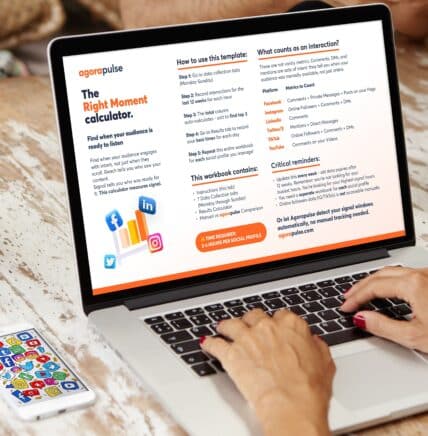
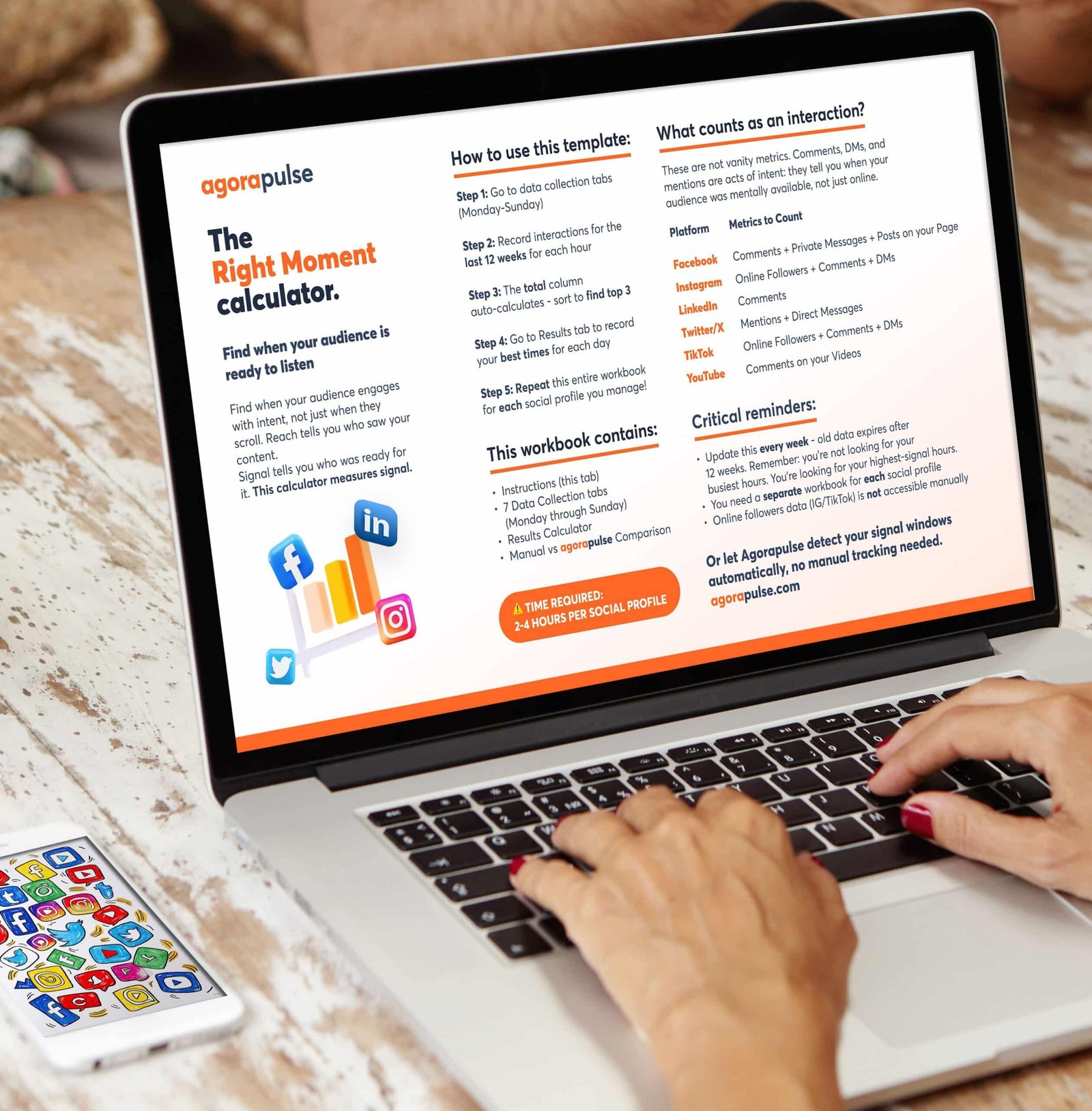
This is exactly what the Right Moment Calculator was built for.
Its purpose isn’t to hand you a universal time slot or tell you Tuesday 10am works for everyone. It helps you map your specific audience, your content type, and your publication goal – and identify the window where those three converge.
It’s an editorial decision tool. The opposite of a reach hack.
Because here’s what we’ve learned from over a decade of processing social content across thousands of brands and every industry: the teams with the most consistent, meaningful engagement aren’t the ones who found the magic hour.
They’re the ones who stopped chasing it and started understanding who they were talking to, and when that person was actually ready to listen.
Here is the only question worth asking before you schedule.
You can keep reading studies, copying the heatmaps, testing Tuesday versus Wednesday.
Or you can ask a different question before you hit schedule.
Stop asking “when should I post?” Start asking “when will my audience be ready for what I’m about to say?”
That’s an editorial question dressed up as a timing one. And it changes everything.












![Pixel 11 Pro XL leak is the most boring one yet, very little changes [Gallery]](https://mgrowtech.com/wp-content/uploads/2026/04/Pixel-11-Pro-XL-leak-1-120x86.jpg)
